Have you wondered exactly what to do with Amaryllis bulbs after they are done blooming? Confused about how to properly care for amaryllis? Well keep reading because I have grown amaryllis plants to mammoth proportions in the past, and they have produced clusters of bulbs and several flowering stalks all in one pot!
I will teach you everything I know so that you can easily do this too if you follow my tips and instructions.
Enter your email, and I will send this link straight to you!
There are many things that are crucial to have your amaryllis bloom and thrive for years to come:
Proper light
Correct dormant period
Attention to the foliage
Fertilization to help keep the bulbs strong for the future
Table of Contents
Planting Your Amaryllis
Quick side note...Amaryllis is just the common name for this plant. Not to be confused with the "belladonna" lily which is Amaryllis belladonna.
What most people know as Amaryllis are actually in the Hippeastrum genus. Common names can be so confusing!
I will refer to these plants as Amaryllis though because that's what everyone calls them.
When you first get your amaryllis bulb, it is important that you plant the bulb at the correct depth. More on this topic shortly.
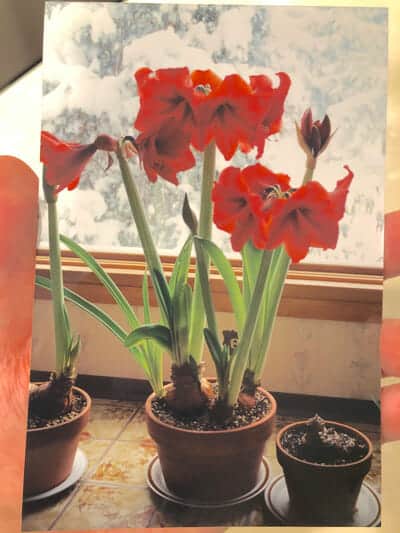
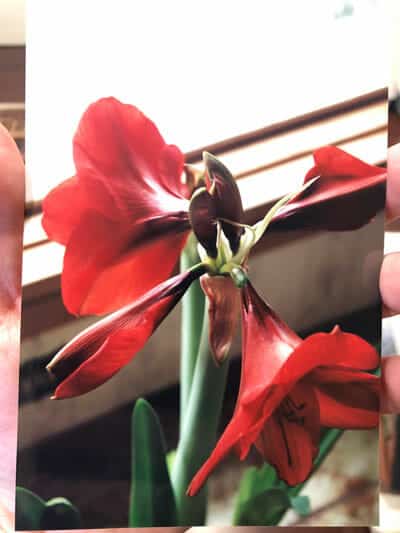
Check out this amaryllis below that I grew years ago. Look at all the blooms! It grew into a cluster of bulbs, and each bulb produced multiple flower stalks, each with 4-6 flowers.
I had this plant for over a decade before I bought my own home and left my parents' house and sadly didn't take it with me...what a mistake that was!
Purchasing an Amaryllis Bulb
I would recommend purchasing the biggest bulb that you can afford.
If you see skimpy little tiny bulbs, they honestly are not worth even the few dollars that you spend on them, unless you want to force them to bloom and throw away right after.
For best results, avoid purchasing the pre-boxed kits where you can't see the bulb.
I like to either go to a garden center and hand select big, loose bulbs, or you can purchase some online. Regardless, only get the biggest one that you can afford. I promise you won't regret it.
These plants can become glorious specimens, as you can see from my photo above of the 'Orange King' amaryllis that I cared for over a dozen years or so.
Planting Your Amaryllis Bulb
Select a Pot
Next, select an appropriate pot size for your amaryllis. You don't want to pick too small of a pot, but you also don't want a gigantic pot.
Place the bulb in the middle of the pot that you think you'll use, and you'll want about 2-3 inches, roughly, from the edge of the bulb to the perimeter of the pot.
I prefer either terracotta pots or ceramic pots. They give you extra weight because these plants can become too top heavy if you plant them in lightweight pots.
My preferred pots of choice are terracotta pots. Although you will be watering more frequently due to the porous nature of the pots, it will result in a healthier root system.
Regardless what pot you choose, it MUST have a drainage hole. Don't even think of planting in a pot with no drainage hole.
The potted bulb should be about half exposed and half under the potting soil.
I like to place a broken pot shard over the drainage hole, and use a general all-purpose potting soil (I really love Espoma's potting soil or use any good, well-drained indoor potting mix) to which I mix a good bulb food. You can even add in 1 part perlite or ¼" pumice (link to Amazon) into 3 parts of your favorite potting mix to improve drainage.
I have gotten fantastic results with using Bulb-Tone and mixing it right into the soil.
Stick with this fertilizer and you will not be disappointed. You should not use any fertilizers that are high in Nitrogen for bulbs.
A very important step in planting the bulb is to make sure you don't bury the whole bulb under the soil. Keep about the top half above the surface of the soil.
Lastly, be sure to gently firm the fresh potting soil down with your hands.
Place Your Amaryllis in its Growing Location
Once you have planted it, give it a light watering and place it in a bright location. These plants prefer a lot of direct sun, and you have read many sites that say to place in bright indirect light.
This is not the case and I have achieved my results in part because I kept my plant in a very sunny Southern exposure window.
These are sun loving plants! So place your plant in the sunniest spot that you have. More on this topic later.
Now it's a waiting game! Be careful not to overwater your amaryllis at this stage because it won't be able to use much water yet. Wait until the top couple inches of potting soil are dry before watering again.
Within a few days to a couple weeks or so, you should be able to see some new growth with the flower stalk(s) emerging from the top of the bulb.
Sometimes when you purchase your bulb, the flower stalk has already started in growth.
Turn Your Pot
As your amaryllis flower stalk(s) start to grow, you'll need to rotate your pot so that the stalk(s) grow straight. They will continually lean toward the light, so rotate them every few days, or as needed.
For a healthy, well-grown plant, each bulb will produce at least one flower stalk, and each stalk should have at least 4 flower buds.
In my plant that I described earlier, I had several flower stalks in one pot and each stalk had 4-6 flowers!
This is a photo of the same plant where you can see the stalk has 6 flowers.
What to Do With Amaryllis After Flowering
This is the trick, right? What exactly should you do with your amaryllis after it is done blooming? The key is to understand the growth cycle.
Cut the Flower Stalks Off
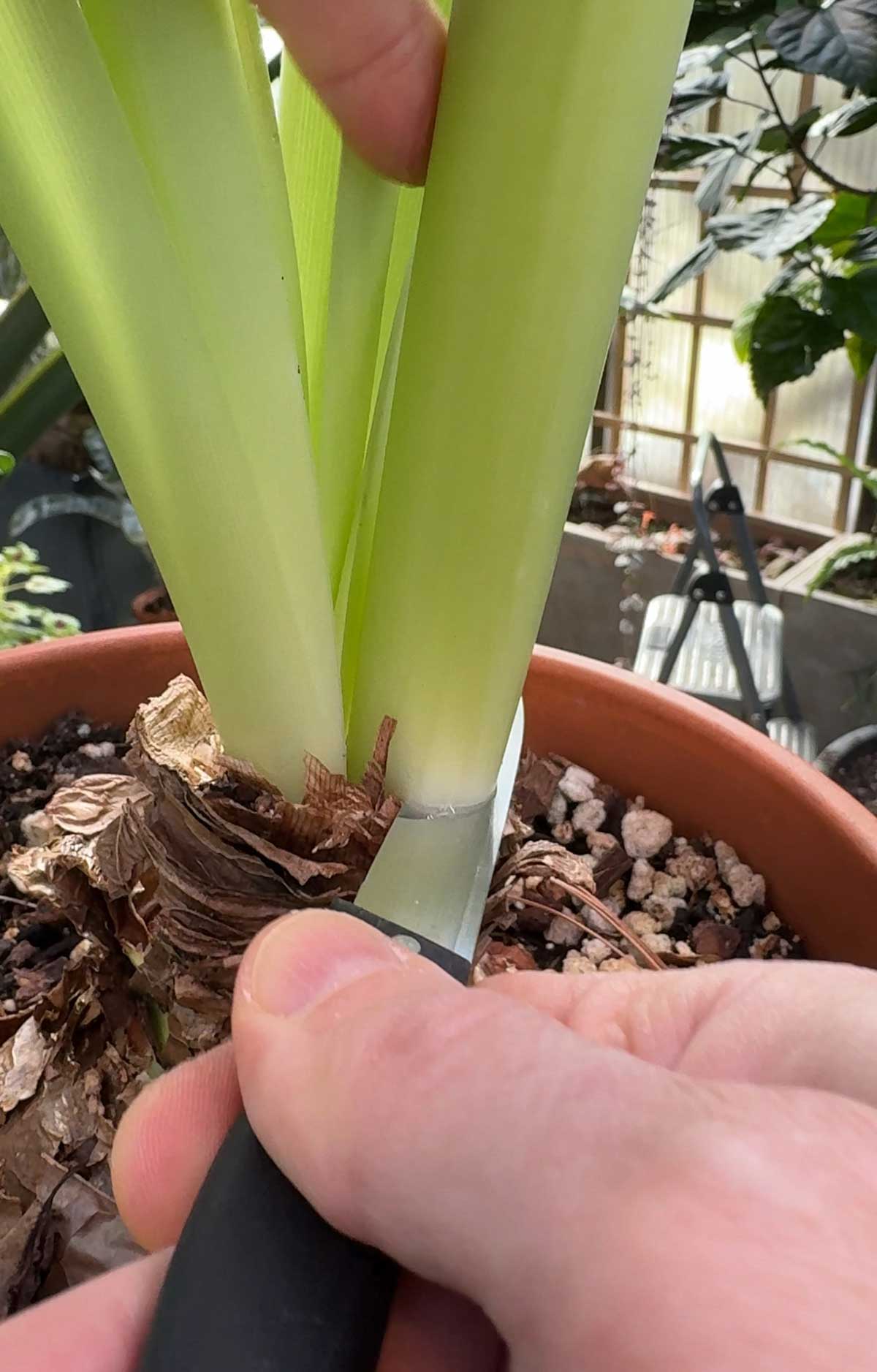
After the plant has bloomed its heart out for you, carefully cut the flower stalks off as close to the bulb as you can. Be careful not to cut into any leaves. You can also wait until the flower stalk dries up on its own before cutting it off. Either option is fine.
Here is exactly where to cut your flower stalk when it is done flowering.
This is the crucial time for your amaryllis where you will be nurturing it until it reblooms again for you the following year.
And if you follow my advice, it will be very easy to keep your amaryllis blooming every year for years to come! I have repeated this process for many, many years and it works.
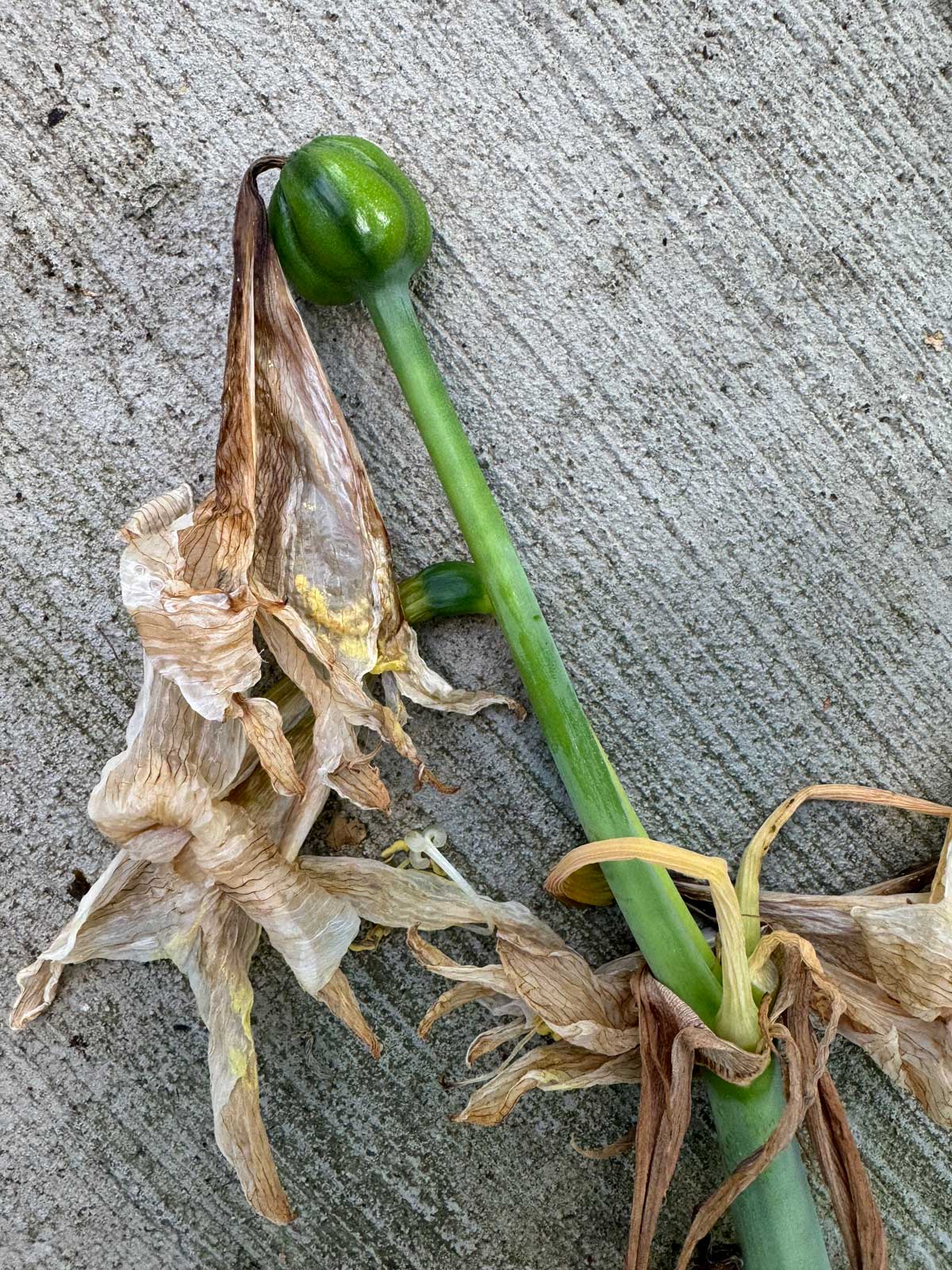
Amaryllis seed pod
Sometimes, the flowers will pollinate and you will get a bulbous growth at the top of the flower stalk, like I show in the photo above. This is a seed pod.
You can leave the seed pod on the stalk until it turns dry and brown, and then harvest the seeds inside and plant them. Keep in mind that if you grow amaryllis from seeds, the resulting seedlings may produce flowers that are not like the parent plant, but it is fun to find out!
If you don't plan on sowing seeds, cut off the seed pods so the plant doesn't waste energy producing seed.
HOW TO CARE FOR AMARYLLIS PLANTS
Allow the Leaves to Grow and Provide Routine Care
After you cut off the spent flowers and flower stalks, this will be the growing phase for your plant. Do NOT cut off any leaves at this time. You need to allow them to grow and ripen for several months until the next dormancy period.
Sometimes amaryllis will grow leaves at the same time as the flower stalks, and sometimes they will appear a bit later. After all, plants are all individuals like people!
Light
Keep your growing amaryllis in the sunniest window you have. If you don't, you will risk not getting any flowers, or a poor show at best.
The plant I documented in this post was kept in a large, Southern exposure window that was very sunny.
If you keep your amaryllis is lower light, you can tell because the leaves will become weak and floppy. Amaryllis need to be in direct sun for best results.
When temperatures are warm enough, I like to put my plants outside (see details below in a separate section).
Watering
Allow the surface of the soil to dry out, maybe an inch or so. Then water thoroughly. Do not let your plant sit in water at any time or it will rot.
Fertilizing
You want to avoid fertilizers that are high in nitrogen. Bulbs like to have have fertilizers that lean more heavily on the Phosphorus and Potassium.
I've had really great success with using both Bulb-Tone and Neptune's Harvest Fish Emulsion. Always use fertilizers as recommended according to the label. I only use fish emulsion if I have my plants outdoors because the odor is quite strong.
Stick with these fertilizers, and I will summarize those again at the end of the post for your convenience. I highly recommend these fertilizers to enhance the size and quantity of your blooms!
When Warm Weather Arrives Outside
If you live in a cold climate like me, when the weather is warm enough to place houseplants outside, the best thing you can do is to place this plant outside in full sun.
Don't put it directly into full sun immediately though! When transitioning a plant from indoors to outdoors, you need your plant to go through a hardening off period.
This is CRITICAL otherwise you will scorch the leaves very quickly.
Although your plant may have been growing in full sun indoors, you still need to harden off your plant when you move it outdoors.
When the weather is warm enough, start out by placing the amaryllis in full shade for a few days. It will get accustomed to the higher light outdoors.
Then move it to an area where it maybe gets an hour or two of morning sun. Do this for a few days. And gradually increase it from there.
You can't go too slow with this process, but if you go too fast you will burn the leaves!
Preparing Your Amaryllis to Rebloom
Stop All Watering
This is the secret sauce right here! Leave your amaryllis outside until about late September or early October.
At that point, place it in a sheltered spot outside where it would get NO rain and you want to completely cut off all water.
If it is too cold outside, depending on where you live, bring the plant back indoors. As long as the minimum temperature outside is around 55F or so, you should be just fine.
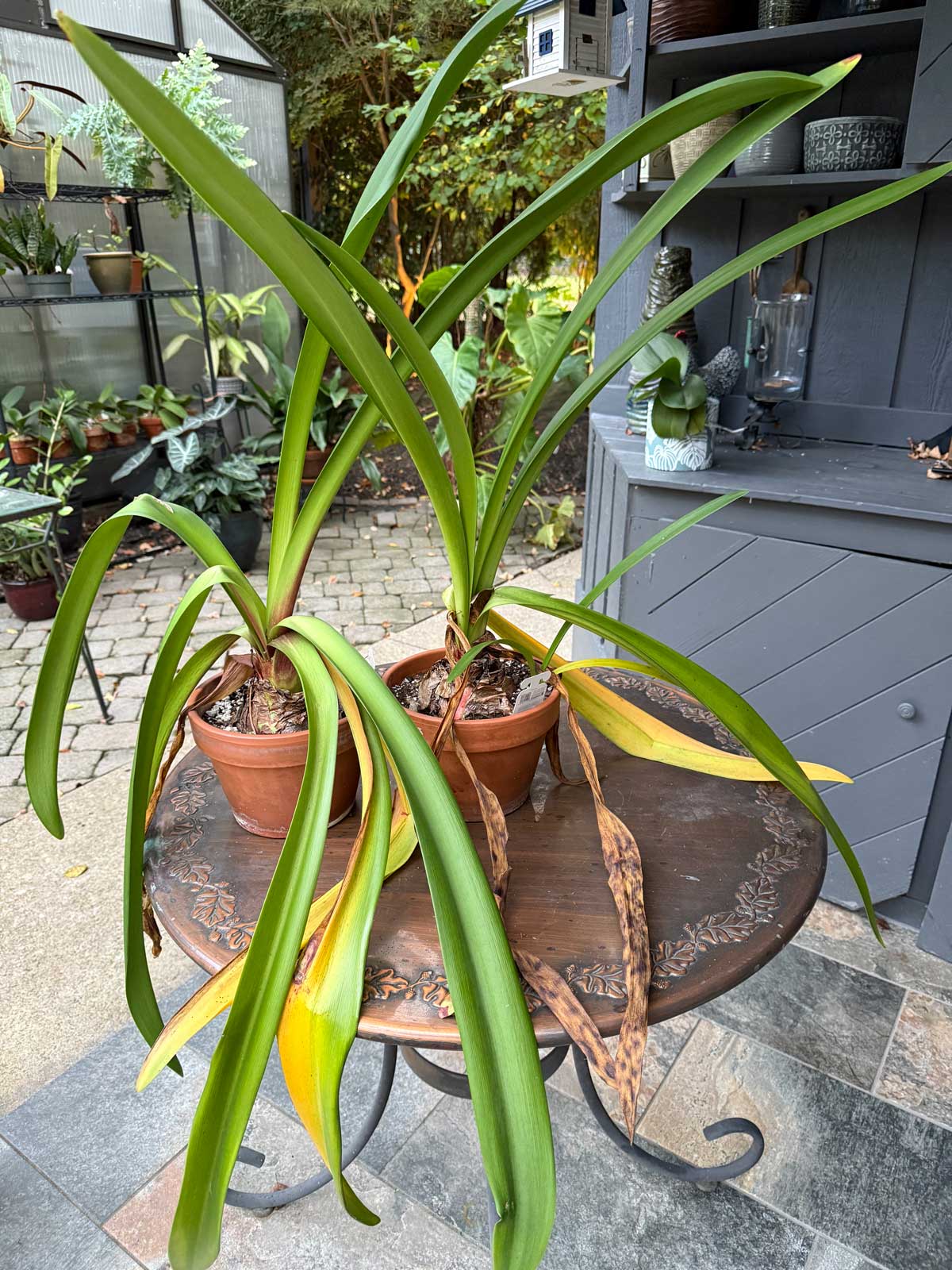
Again, cut off ALL water. The foliage will start to yellow and wilt. In the photo below, I've withheld water for about 2 weeks, and you can see the plants are starting to go dormant.
When all the foliage is yellowed and dried up, take a sharp, sterilized knife or scissors and cut all the leaves off down to the neck of the bulb. The foliage won't all do this at once so you can remove any brown leaves as they happen.
Let all of the foliage ripen and don't cut any foliage off until this is done!
Dormancy Period
Next, you'll want a period of dormancy for your plant.
Then place the pot in a cool, dark place for a full 4-6 weeks. A cool place like a basement works well. You'll want your bulb to rest for at least a month.
If you want to delay forcing the amaryllis to bloom a little later, you can keep it a couple more weeks.
One thing to note is that most amaryllis that are on the market need this dormancy period.
This is one variety that is evergreen and that you should NOT give it a dormancy period. The variety is Hippeastrum papilio (or the butterfly amaryllis).
Return Your Amaryllis to Your Window
After the 4-6 week rest period for your amaryllis, it is time to return your amaryllis to your sunny window.
At this time, it is also important to replenish the nutrients in the soil. I like to add a special bulb fertilizer blend to the soil, and also use liquid fertilizer throughout the whole growing season.
I have achieved wonderful results with using Bulb-Tone for my amaryllis throughout the years. Again, for bulbs, you don't want to use any fertilizer that has a high nitrogen content. Bulb-Tone has been absolutely fantastic.
Simply use the recommended amount per the label, and mix it into the top part of the soil, and water it in.
Give your plant a nice watering at this time, but go easy on the watering until the growth really starts to take off. After the plant is done flowering, I like to fertilize periodically with a fish emulsion fertilizer.
Using the Bulb-Tone and fish emulsion fertilizers (both organic and not synthetic), it really results in beautifully healthy plants that flower abundantly!
You should soon get flower spikes forming, and then new leaves. The flower spike typically comes first, but not always.
Take note when your amaryllis blooms. If you want to tweak the bloom period for the next year, you can adjust the timing of when you take the bulb out of dormancy in the following year so that you can have it bloom during the holiday period.
Amaryllis Toxicity
Amaryllis is toxic to cats and dogs according to the ASPCA.
CAN I PLANT A WAXED AMARYLLIS?
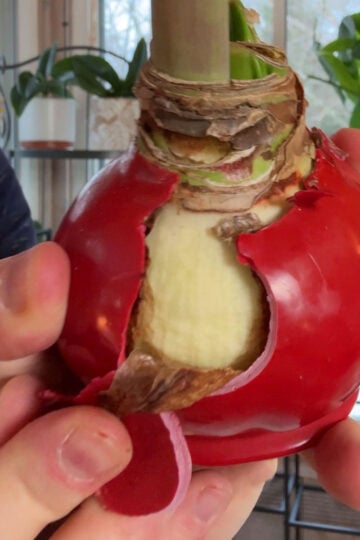
Lastly, I wanted to address the trend of waxed Amaryllis bulbs. Waxed Amaryllis were developed in Europe and have now become very widespread. The bulbs are encased in wax to conserve moisture.
You simply purchase the waxed bulb, place it anywhere in your home (preferably right in front of a window) and it will bloom in a few weeks. No soil, no pot, no water. Simply place it down!
If you want to just enjoy the blooms and throw it away, this is a great option for you.
However, if you want to keep the plant long-term, resulting in a beautiful specimen like I've shown earlier in this post, buy an unwaxed bulb and follow my instructions earlier in this post.
If the waxed bulb was a gift, or if you didn't know, and you want to keep growing it year to year, I'd recommend the following (and check out my blog post on saving a waxed amaryllis bulb for a guide with photos). The basic steps though are:
Try and remove the wax off the bulb as soon as possible. If you wait too long, you'll decrease the chances of success.
At the base of the bulb, there will be a coil of wire which is meant to keep the plant from tipping over. Remove the wire.
Depending on how long the bulb has been in wax, you may find that the outer part of the bulb may be moldy or mushy. Gently clean away this areas to expose the firmer bulb underneath.
I would then let the bulb sit to air dry for about 2-3 days.
Finally, go ahead and plant it in a pot like I described earlier in this post. You may want to refrain from watering for a few days after you plant the bulb.
Place in a sunny window and hope for the best!
Like I mentioned, these waxed bulbs are NOT designed to be kept long-term, but if you remove the wax early on, you may be able to save it and keep it growing year over year.
If you intend to keep it long-term, it is wise to just purchase an unwaxed bulb if at all possible.
COMMONLY ASKED AMARYLLIS QUESTIONS
Should I cut off dead amaryllis flowers?
Yes, after all blooms have wilted, cut off any flower stems as close to the base as you can with a sterilized, sharp knife. Do NOT cut off any leaves. Place your plant in a sunny spot and allow the leaves to keep growing for several months until the dormancy period the following year.
Why amaryllis will not bloom?
The most common reason in most cases is not enough light. These plants need to be in a sunny location in order for the plant to be strong enough to bloom for the holiday season.
What do you do with amaryllis bulbs after they bloom?
The most critical part is that you MUST keep the leaves growing and in a sunny spot. Simply remove any spent flowers, as well as the flower stalk, and allow the leaves to keep growing until you induce a dormancy period right before the holiday seasons. With proper care, your amaryllis will bloom for years to come.
So this concludes the blog post on how to care for amaryllisf and how to get amaryllis to bloom for you year after year. With a little effort, you will end up with a beautiful specimen plant! And if you love flowering plants indoors, check out my blog post on the best flowering plants to grow indoors.
It's a shame you did not mention actually planting your amaryllis in the garden in the warmer regions. I have about 12 bulbs blooming in my garden which were indoor holiday gifts at some point. I am in North Carolina in 7b and they do great in the garden here.
Yes, those are seed pods! I allowed them to ripen once, and once the pods were dry, I sowed the seeds and grew new plants from them. I will have to say that your seeds probably will not result in the same variety as your original plant though, but it might be fun to see what the resulting plants' flowers look like.
I may add to the post later. Thanks for the comment! The easiest way to propagate is when your plant will produce a new bulb. They will grow in clusters over time, so when your plant is dormant, you can separate them out and pot them up separately.
I am concerned about the pot I have my amaryllis in. Barely an inch of soil on the sides and no drainage hole. Don’t know why I did that. When is the best time to repot it? Now?
Thank you for all of the great tips! I am anxious to see if my plant will bloom this fall.
I have followed your steps this far. One question I do have is my plant has grown the
leaves and now the leaves are turning yellow at the top which seems like the process that
should happen in fall and not now? I live in wisconsin and I have cut the flower stalks
down to the bulb and have kept watering it and it remains in a very sunny window.
It grew tall leaves but now they seem to be yellowing. I am doing something wrong? Please
help....
Kindly,
Anna
Jan. 28, 2022--This is my first plant. I just love it, it was a gift I want to keep it. I googled at it's beauty and photographed it's stages. Now the last blooms have gone, this month of January and two big bulbs are growing out of one stalk with the dead petals in tack. I'm thinking that I should wait for weakness at the bottom of them and cut them to repot. I talk to all my house plants, I don't want to make it nervous. I did carefully cut the other stalk, it withered and died . I am so scared that it will die. Another small stalk is growing, it was next to the stalk that died. HELP ME PLEASE!
Hello, Great information. I kept a potted amaryllis from Christmas 2020 and did every thing that you suggested to have blooms this year 2021, except that I did not use any fertilizers. The plant thrived through the year. The bulb began to grow two nice leaves after dormancy, but it never grew a flower stalk. Should I repeat the cycle and fertilize this time. Will it grow a flower next year 2022 even if it did not grow one this year? Just to be clear do you use fish emulsion through the year before dormancy and Bulb Tone after you bring the bulb out if dormancy? Thank you in advance.
Hi Vicki! Make sure that your plant is getting plenty of direct sunshine, and fertilize throughout the growing season. If it's not getting enough light, it will not have enough strength to bloom for you. You can use both those fertilizers I recommended. If your plant is getting the proper care, it will bloom for you next year.
I purchased an amaryllis bulb in a large clay bowl in November 2021 and have been amazed at the growth and beauty of this flower! The bulb has produced two large stalks with three flowers each, Imagine my dismay upon awakening this morning to see the amaryllis stalk lying on its side. Help, What should I do? Do I need to tie the stalk, repot, or what? Any suggestions would be appreciated!
Hi Glenda! Sorry to hear this! I'm guessing the stalks were probably weak from not enough light. You can try to prop them back up and support them with a stake. It's really all you can do at this point if the flower stalks aren't too damaged.
You are correct Marcia. The bulb needs to grow leaves and do its thing for several months in order to prepare for next year's blooming. You can try removing the wax like I mentioned in my previous comment and plant it and see what happened. If you really love these plants and want to keep them year over year, I'd highly recommend just purchasing a bulb that is not waxed. The waxed bulbs are more of a one-and-done type thing.
I was gifted a beautiful creamy white amaryllis in “silver wax” the instructions were CLEAR do not water & I didn’t! It had 2 stalks as the last of the 8 (total) blooms are about to die - what now?
I used to have a beautiful garden in UK, when I moved to US had a just as beautiful garden in NJ,NOW we’re in
G-d’s waiting room Florida: my question as we’re on a saltwater inter coastal in
N Palm Beach, FL how much of a difference to help our Amaryllis bloom again?
The amaryllis started blooming 10 days before 🎄 & 2nd stalk started blooming 2 days B4 🎄
Hi Marcia, unfortunately the bulbs that are wrapped in wax are meant to bloom and then throw out (so that you have to keep buying them yearly). If you want your plant to continue to live, you'd have to peel off the wax and plant it like I describe in this post. Hopefully, it will start growing leaves and then just follow my care instructions. If you like these plants and want to keep them year over year, I'd recommend buying one that is not waxed and following everything I've discussed in my post. You can easily find them online if you don't find any locally. Good luck!
Hi Raffaele !
I’m visiting my sister in North Carolina. I found her dormant amaryllis bulbs in a paper bag from 1 1/2 year ago. I decided to plant them following your great instructions in clay pots, using your recommended fertilizers. After just a couple of days, they have begun to sprout. I just potted them May 24 th and it is plenty warm here already.
My question : Her back patio is shady with some filtered sunlight due to her trees. Can I place these on her patio now as they are just beginning to sprout ? Any concerns with leaf burning ? Is this ok to do ? Can we slowly transition them to a brighter location later on in her back yard ?
Thank you so much ! Patricia
Ps. My amaryllis plants back in Ohio this spring were fantastic ! I will try to send you pictures to share if you would like to post ! What is the best contact info to you to send pictures to you ?
Hi Patricia! I would gradually acclimate your sister's amaryllis, and the patio sounds safe for now. I'd leave it there for a week or so and then move it to a location with a little more sun. Just move gradually over the period of maybe 2-3 weeks and you should be ok :-). Eventually, I'd give it as much sun as possible. I'm happy your plants back in Ohio did well for you! You can share your photos on Instagram if you use it (my account is @ohiotropics) or email me using the contact form on my website. When I reply, you can attach photo. Thanks for sharing your story!
I was given an Amaryllis bulb in a box by a neighbor 2 years ago. I knew that I had seen them blooming at Christmas, but I figured it was a bulb, so I planted it in a clay pot and brought it into the house. Christmas came and went with just leaves. I figured ok, it’s alive, so I took care of it and it spent a summer outside in its pot. I brought it in, and this time I thought it was doomed as the leaves died. Christmas and darkness meant that the bulb wound up being forgotten in a dark spot in a corner. Interestingly, just when I was ready to pitch it, a couple of spikes leaves appeared next to it, so I left it alone, but started to water it again. I know nothing about this flower, but I can’t throw anything that lives away out of hand ( including orchids which usually die.) when the days began to lengthen, my basil plant in my Ortho water planter decided it was plantzilla, so I took and planted it in the pot that held the Amaryllis as there was room enough for it. Because it is a sun lover, I placed it next to our south facing kitchen window next to the table. Of course, the basil grew Iike topsy, but imagine how I felt when over night this stalk appeared from under it and seemed to double in size every day...er, night, cause each morning it was taller. In a matter of days, it formed a rounded top and we watched as it started to open. Today we have two delicate pale apricot huge flowers with one more still to come. I found your site and realized that if I was going to see this through, I had better find out about it. BTW, the orchid my third daughter gave me for Mother’s Day last year is keeping company and blooming again and keeping company with its giant neighbor. I intend that they should both beat the odds again! Thanks for the clear information.
Hi Rosemary! Thanks for sharing your story! Your apricot flowers sound lovely. There is always a surprise or two in any plant journey, so I'm glad your amaryllis is blooming for you now 🙂 They're such amazing plants! If you follow the tips in this post, you'll be able to keep your plant a very long time.
Thank you for your very helpful blog. Your instructions say to cut off all the foliage after they have gone yellow and dried out. Do you mean that I will do this with all the foliage at the same time or as each leaf yellows and dries up to cut it off?
You're welcome Peggy! Each leaf should be allowed to yellow completely. So you can cut off one at a time as each one completely yellow/dries up. Or you can just wait until all of the foliage is yellowed and at that point you can cut all of the leaves off at the same time. Whatever you prefer!
Hi Raffaele,
I enjoyed reading your Amaryllis growing tips. I always admired and wished I could have an Amaryllis plant. I've heard from people that it's a waste of money having to throw them out after it has bloomed. This year I did not care and bravely bought a dozen bulbs from a local department store. I followed the directions carefully and to my surprise all 12 bulbs grew and gave me beautiful flowers all through the holiday season. I have three with flower buds and ready to open up right now. My question is I would like to plant them outdoors. Can I do that too? We moved here in Sunset Beach, NC. I have better luck growing outdoor plants here than where I used to live which is NJ. Do you have tips for growing these bulbs outdoors after they bloomed indoors nicely for me?
Thanks,
Carmelita
Hi Carmelita! I don't have experience growing them in the ground outdoors since I live in northern Ohio (ha!), but yes they can absolutely be grown outdoors if your climate is warm enough. I've seen various sources that say they're hardy to zone 7b. Some say even zone 6 but somehow I'm skeptical. I did a quick search on sunset beach NC and it looks like you're about zone 8a so I'd say it is possible! I'm not sure if you would need any protection there in the colder months (mulch) or not. How cold to winters typically get there? I would definitely try and experiment. Keep me posted on your progress!
@Raffaele, I grow most of mine outside in the pots,i live in S.Calif so they do well here outside.I also grow a couple inside in my north east bay window.I have quite a few of them,the plain reds,the stripes,pink & white stripe,kind of an off white with almost peach colores stripes.My favorites are my blood red and my double whites. The ones in the bay window dh planted last year and they just finished blooming,the ones outside should start blooming soon,as i usually get blooms in march/april,and then again late in the year sept/oct.
I moved to my mom's house in Tampa FL. She has multiple Amarillus plants planted in the ground. They bloom in spring and are beautiful. But I noticed less flowers in the last bloom. Should the bulbs be replanted so that they are not all on top of each other?





It's a shame you did not mention actually planting your amaryllis in the garden in the warmer regions. I have about 12 bulbs blooming in my garden which were indoor holiday gifts at some point. I am in North Carolina in 7b and they do great in the garden here.
That's great that you can grow them in the ground where you are!
what are the bulbuous that are on the stocks after the flower blooms, are these seed pods andif so what should i do with them.
Yes, those are seed pods! I allowed them to ripen once, and once the pods were dry, I sowed the seeds and grew new plants from them. I will have to say that your seeds probably will not result in the same variety as your original plant though, but it might be fun to see what the resulting plants' flowers look like.
Would have been to also have info on propagation.
I may add to the post later. Thanks for the comment! The easiest way to propagate is when your plant will produce a new bulb. They will grow in clusters over time, so when your plant is dormant, you can separate them out and pot them up separately.
I am concerned about the pot I have my amaryllis in. Barely an inch of soil on the sides and no drainage hole. Don’t know why I did that. When is the best time to repot it? Now?
Yes, I would do it now. 🙂 It'll set your plant up for a good growing season and make it strong and healthy for next year's flowers.
Thank you for all of the great tips! I am anxious to see if my plant will bloom this fall.
I have followed your steps this far. One question I do have is my plant has grown the
leaves and now the leaves are turning yellow at the top which seems like the process that
should happen in fall and not now? I live in wisconsin and I have cut the flower stalks
down to the bulb and have kept watering it and it remains in a very sunny window.
It grew tall leaves but now they seem to be yellowing. I am doing something wrong? Please
help....
Kindly,
Anna
Hi Anna! It would help if I could see a photo. I'll send you a quick email so that you can attach a photo.
Jan. 28, 2022--This is my first plant. I just love it, it was a gift I want to keep it. I googled at it's beauty and photographed it's stages. Now the last blooms have gone, this month of January and two big bulbs are growing out of one stalk with the dead petals in tack. I'm thinking that I should wait for weakness at the bottom of them and cut them to repot. I talk to all my house plants, I don't want to make it nervous. I did carefully cut the other stalk, it withered and died . I am so scared that it will die. Another small stalk is growing, it was next to the stalk that died. HELP ME PLEASE!
I just sent you an email Martha.
Hello, Great information. I kept a potted amaryllis from Christmas 2020 and did every thing that you suggested to have blooms this year 2021, except that I did not use any fertilizers. The plant thrived through the year. The bulb began to grow two nice leaves after dormancy, but it never grew a flower stalk. Should I repeat the cycle and fertilize this time. Will it grow a flower next year 2022 even if it did not grow one this year? Just to be clear do you use fish emulsion through the year before dormancy and Bulb Tone after you bring the bulb out if dormancy? Thank you in advance.
Hi Vicki! Make sure that your plant is getting plenty of direct sunshine, and fertilize throughout the growing season. If it's not getting enough light, it will not have enough strength to bloom for you. You can use both those fertilizers I recommended. If your plant is getting the proper care, it will bloom for you next year.
I purchased an amaryllis bulb in a large clay bowl in November 2021 and have been amazed at the growth and beauty of this flower! The bulb has produced two large stalks with three flowers each, Imagine my dismay upon awakening this morning to see the amaryllis stalk lying on its side. Help, What should I do? Do I need to tie the stalk, repot, or what? Any suggestions would be appreciated!
Hi Glenda! Sorry to hear this! I'm guessing the stalks were probably weak from not enough light. You can try to prop them back up and support them with a stake. It's really all you can do at this point if the flower stalks aren't too damaged.
Oops - Q #2: my amaryllis didn’t have any leaves I’m guessing that will have an effect on the bulb.
You are correct Marcia. The bulb needs to grow leaves and do its thing for several months in order to prepare for next year's blooming. You can try removing the wax like I mentioned in my previous comment and plant it and see what happened. If you really love these plants and want to keep them year over year, I'd highly recommend just purchasing a bulb that is not waxed. The waxed bulbs are more of a one-and-done type thing.
I was gifted a beautiful creamy white amaryllis in “silver wax” the instructions were CLEAR do not water & I didn’t! It had 2 stalks as the last of the 8 (total) blooms are about to die - what now?
I used to have a beautiful garden in UK, when I moved to US had a just as beautiful garden in NJ,NOW we’re in
G-d’s waiting room Florida: my question as we’re on a saltwater inter coastal in
N Palm Beach, FL how much of a difference to help our Amaryllis bloom again?
The amaryllis started blooming 10 days before 🎄 & 2nd stalk started blooming 2 days B4 🎄
Thanks & a blooming wonderful 2022 ☺️
Hi Marcia, unfortunately the bulbs that are wrapped in wax are meant to bloom and then throw out (so that you have to keep buying them yearly). If you want your plant to continue to live, you'd have to peel off the wax and plant it like I describe in this post. Hopefully, it will start growing leaves and then just follow my care instructions. If you like these plants and want to keep them year over year, I'd recommend buying one that is not waxed and following everything I've discussed in my post. You can easily find them online if you don't find any locally. Good luck!
Your post was so easy to understand. It provided ,just what I needed to know & understand. Great information! Thanks
Glad you enjoyed it Jane! Thanks for commenting.
Hi Raffaele !
I’m visiting my sister in North Carolina. I found her dormant amaryllis bulbs in a paper bag from 1 1/2 year ago. I decided to plant them following your great instructions in clay pots, using your recommended fertilizers. After just a couple of days, they have begun to sprout. I just potted them May 24 th and it is plenty warm here already.
My question : Her back patio is shady with some filtered sunlight due to her trees. Can I place these on her patio now as they are just beginning to sprout ? Any concerns with leaf burning ? Is this ok to do ? Can we slowly transition them to a brighter location later on in her back yard ?
Thank you so much ! Patricia
Ps. My amaryllis plants back in Ohio this spring were fantastic ! I will try to send you pictures to share if you would like to post ! What is the best contact info to you to send pictures to you ?
Hi Patricia! I would gradually acclimate your sister's amaryllis, and the patio sounds safe for now. I'd leave it there for a week or so and then move it to a location with a little more sun. Just move gradually over the period of maybe 2-3 weeks and you should be ok :-). Eventually, I'd give it as much sun as possible. I'm happy your plants back in Ohio did well for you! You can share your photos on Instagram if you use it (my account is @ohiotropics) or email me using the contact form on my website. When I reply, you can attach photo. Thanks for sharing your story!
I was given an Amaryllis bulb in a box by a neighbor 2 years ago. I knew that I had seen them blooming at Christmas, but I figured it was a bulb, so I planted it in a clay pot and brought it into the house. Christmas came and went with just leaves. I figured ok, it’s alive, so I took care of it and it spent a summer outside in its pot. I brought it in, and this time I thought it was doomed as the leaves died. Christmas and darkness meant that the bulb wound up being forgotten in a dark spot in a corner. Interestingly, just when I was ready to pitch it, a couple of spikes leaves appeared next to it, so I left it alone, but started to water it again. I know nothing about this flower, but I can’t throw anything that lives away out of hand ( including orchids which usually die.) when the days began to lengthen, my basil plant in my Ortho water planter decided it was plantzilla, so I took and planted it in the pot that held the Amaryllis as there was room enough for it. Because it is a sun lover, I placed it next to our south facing kitchen window next to the table. Of course, the basil grew Iike topsy, but imagine how I felt when over night this stalk appeared from under it and seemed to double in size every day...er, night, cause each morning it was taller. In a matter of days, it formed a rounded top and we watched as it started to open. Today we have two delicate pale apricot huge flowers with one more still to come. I found your site and realized that if I was going to see this through, I had better find out about it. BTW, the orchid my third daughter gave me for Mother’s Day last year is keeping company and blooming again and keeping company with its giant neighbor. I intend that they should both beat the odds again! Thanks for the clear information.
Hi Rosemary! Thanks for sharing your story! Your apricot flowers sound lovely. There is always a surprise or two in any plant journey, so I'm glad your amaryllis is blooming for you now 🙂 They're such amazing plants! If you follow the tips in this post, you'll be able to keep your plant a very long time.
Thank you for your very helpful blog. Your instructions say to cut off all the foliage after they have gone yellow and dried out. Do you mean that I will do this with all the foliage at the same time or as each leaf yellows and dries up to cut it off?
You're welcome Peggy! Each leaf should be allowed to yellow completely. So you can cut off one at a time as each one completely yellow/dries up. Or you can just wait until all of the foliage is yellowed and at that point you can cut all of the leaves off at the same time. Whatever you prefer!
@Raffaele, great, thanks. Just wanted to be clear.
Hi Raffaele,
I enjoyed reading your Amaryllis growing tips. I always admired and wished I could have an Amaryllis plant. I've heard from people that it's a waste of money having to throw them out after it has bloomed. This year I did not care and bravely bought a dozen bulbs from a local department store. I followed the directions carefully and to my surprise all 12 bulbs grew and gave me beautiful flowers all through the holiday season. I have three with flower buds and ready to open up right now. My question is I would like to plant them outdoors. Can I do that too? We moved here in Sunset Beach, NC. I have better luck growing outdoor plants here than where I used to live which is NJ. Do you have tips for growing these bulbs outdoors after they bloomed indoors nicely for me?
Thanks,
Carmelita
Hi Carmelita! I don't have experience growing them in the ground outdoors since I live in northern Ohio (ha!), but yes they can absolutely be grown outdoors if your climate is warm enough. I've seen various sources that say they're hardy to zone 7b. Some say even zone 6 but somehow I'm skeptical. I did a quick search on sunset beach NC and it looks like you're about zone 8a so I'd say it is possible! I'm not sure if you would need any protection there in the colder months (mulch) or not. How cold to winters typically get there? I would definitely try and experiment. Keep me posted on your progress!
@Raffaele, I grow most of mine outside in the pots,i live in S.Calif so they do well here outside.I also grow a couple inside in my north east bay window.I have quite a few of them,the plain reds,the stripes,pink & white stripe,kind of an off white with almost peach colores stripes.My favorites are my blood red and my double whites. The ones in the bay window dh planted last year and they just finished blooming,the ones outside should start blooming soon,as i usually get blooms in march/april,and then again late in the year sept/oct.
Sounds lovely!
I moved to my mom's house in Tampa FL. She has multiple Amarillus plants planted in the ground. They bloom in spring and are beautiful. But I noticed less flowers in the last bloom. Should the bulbs be replanted so that they are not all on top of each other?
You can certainly try that. Has your mother been fertilizing them?