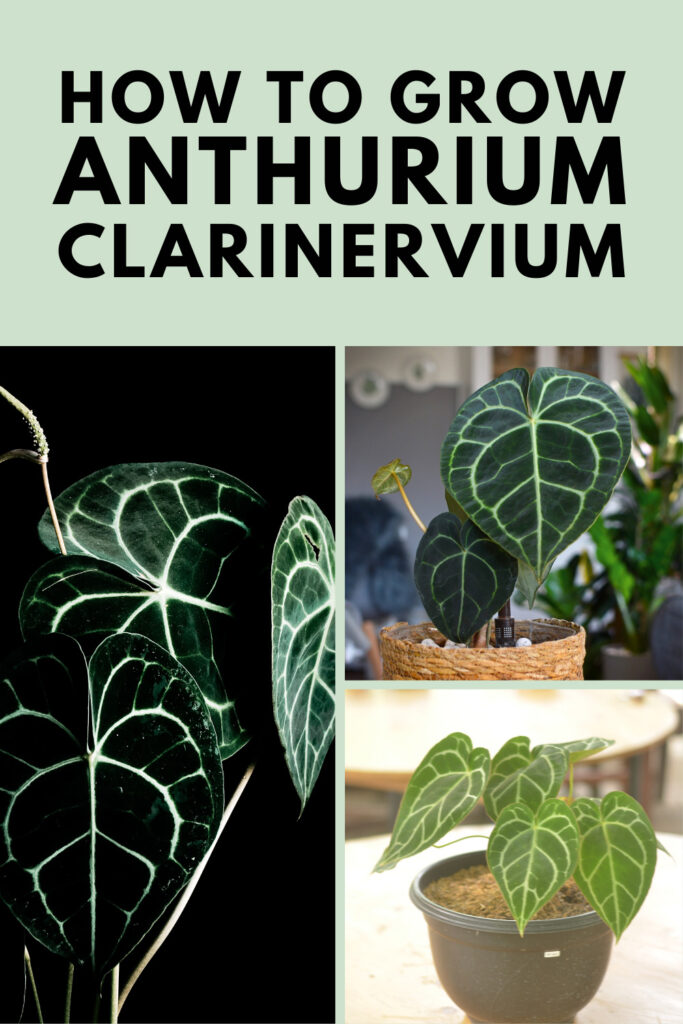
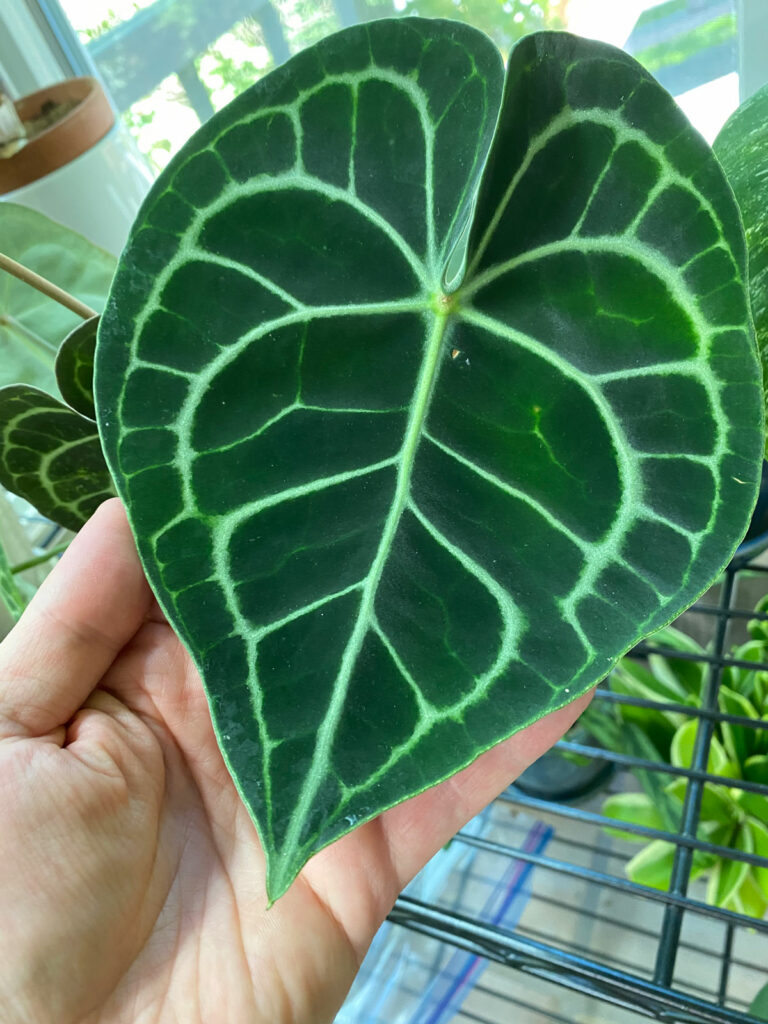
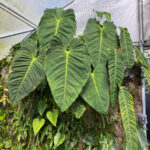
Anthurium clarinervium is a stunning foliage houseplant in the Aroid family and is sure to stop you in your tracks with its dark green, deeply lobed heart shaped leaves and contrasting white veins.
Would you like to save this post?
Enter your email, and I will send this link straight to you!
I'll tell you how I care for mine and also discuss Anthurium care in general. It's a fascinating genus and one that is growing in popularity among houseplant collectors (if you can find one, that is!)
Anthurium clarinervium is native to Mexico and grows as an epiphyte. Since it is an epiphyte, it has special potting soil needs which I'll discuss soon!
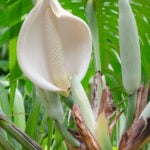
They do flower, and will look similar to many aroid family flowers in that they have both a spadix and a spathe, but they are insignificant on Anthurium clarinervium.
These plants clearly are grown for their striking, leathery, thick foliage.
Table of Contents
Anthurium Clarinervium: Care Guide
Many species in the Anthurium genus can get prohibitively large inside the home. The clarinervium is a smaller growing species that is perfect to grow in the home! Indoors, the leaves will grow to about 6" or a little larger.
LIGHT
These plants enjoy mostly bright indirect light or filtered sunlight. Keep these plants away from too much direct sun. A little bit is fine.
An exception is in the winter time if you live in areas with much shorter and cloudier days like I do. During those months, some direct sun will greatly benefit these plants.
My own plant sits in an Eastern facing window so it get some morning sun. In the summer, I place the plant outside in complete shade.
TEMPERATURE
Anthuriums love and thrive in warm temperatures. Aim to keep them at 70-90F (21-32C) if you can. I keep mine in my sunroom and it does get into the 60s (F) in the winter but I wouldn't go much lower than that.
HUMIDITY
Anthuriums love high humidity and are really best grown in a greenhouse, but you can grow them successfully indoors with some attention.
If your indoor winter air is dry as a result of forced air heat inside your home, I would highly recommend getting a humidifier. I experimented with different humidifiers and found one that I LOVE.
I run it from about October (or whenever we turn our heat on in the house) until April or May so (when we normally shut off the heat).
Try and maintain humidity of at least 40% relative humidity, if not more. 50-60% indoors would be better.
Do you need a good humidifier? I'm thrilled with mine, so if you need one, read my blog post where I talk about humidity and houseplants, and my absolute favorite humidifier.
I've tested tons of humidifiers and I talk about the best one I've come across. I use it on-stop during the winter!
WATERING
Anthuriums, like many orchids, are epiphytes so they grow on trees and tree branches. They are often drenched in nature from frequent rains, but they will dry out quickly because their roots are much more exposed because of the way they grow.
This is what you must reproduce in the home in order to be successful.
Don't let these plants sit in water or it will spell death and they will rot. After you water thoroughly, make sure you discard excess water. Let it ALL drain away. Don't let any sit in the saucer underneath.
Don't water again until the top inch or two of the potting mix is dry. Just use your finger to determine that.
You'll want to try to keep most of the potting mix lightly moist, with the top couple inches being dry and the rest of it being barely moist. If it is still wet underneath, don't water. Wait longer and check your plants regularly!
You can't just have good watering techniques though. Epiphytes like Anthurium demand an appropriate potting soil as well in order to thrive.
SOIL
Since these plants are epiphytes, they require fantastic drainage. To accomplish this, I like to add orchid bark to my potting mix. This is the "secret" to growing these plants.
You can start with 1 part of orchid bark to 2-3 parts of whatever all-purpose peat-based houseplant potting soil that you like to use. This will provide the amazing amazing drainage that they need to thrive.
You can also throw a handful of perlite in the mix for good measure.
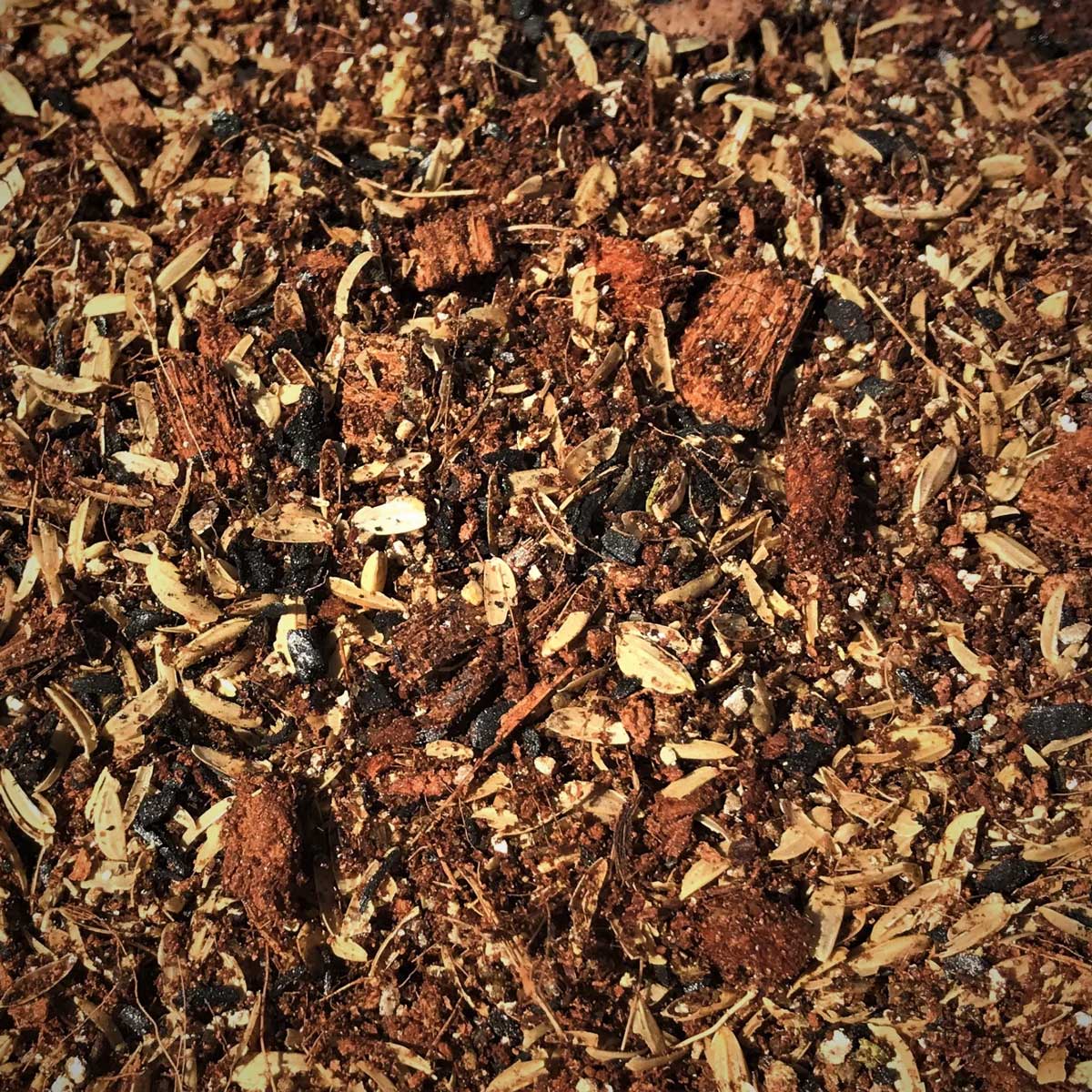
Equal parts potting mix, perlite and orchid bark results in a nice, chunky mix that these plants love. This is the mix that I am currently using for this plant.
FERTILIZING
Fertilize throughout active growth in the Spring and Summer time. I like to fertilize dilutely with every watering (or almost every watering).
My favorite houseplant fertilizer is Dyna-Gro Grow and I purchase on Amazon. I add ¼" teaspoon per gallon of water and use it on all my leafy tropicals.
It is an amazing, COMPLETE fertilizer and is urea-free so it won't burn your plants. I highly recommend this fertilizer and I've had great results from using it.
AIR CIRCULATION
Since these are epiphytes, they love air circulation. Think about it. In nature they're growing on the side of cliffs, rocks, and on trees, so they're exposed to a good amount of air circulation.
Air circulation will benefit all plants, but especially epiphytes like Anthuriums. I'm not talking about cold drafts though 🙂 You'll want to avoid those.
I like to gently circulate the air in my sunroom with my ceiling fan. I'll turn it on low and it will provide circulation for my Anthuriums, orchids, and all the other plants.
If it is warm outside, open a window for air circulation. Or better yet, let it sit outside for the summer in the shade to get the benefit of rainwater, natural air circulation, and higher humidity levels.
PROPAGATION
Propagation is best done by division when you repot, if your Anthurium has more than one stem. Gently loosen the roots and tease apart any new section of growth.
Make sure each division has roots and at least 1 or 2 leaves of its own and pot it up separately.
Where to Buy Anthurium Clarinervium
This is the real challenge! This is a very hot plant that is both expensive and difficult to find. Most websites that you find will have the dreaded "out of stock" phrase next to Anthurium clarinervium.
Regardless, here are a couple other sources to keep your eye on and you can even get on the waiting list for some of them. They are both fantastic companies and I've had great experiences with both of them.
NSE Tropicals in Florida, run by Enid Offolter, has an amazing array of tropical plants and I highly recommend them.
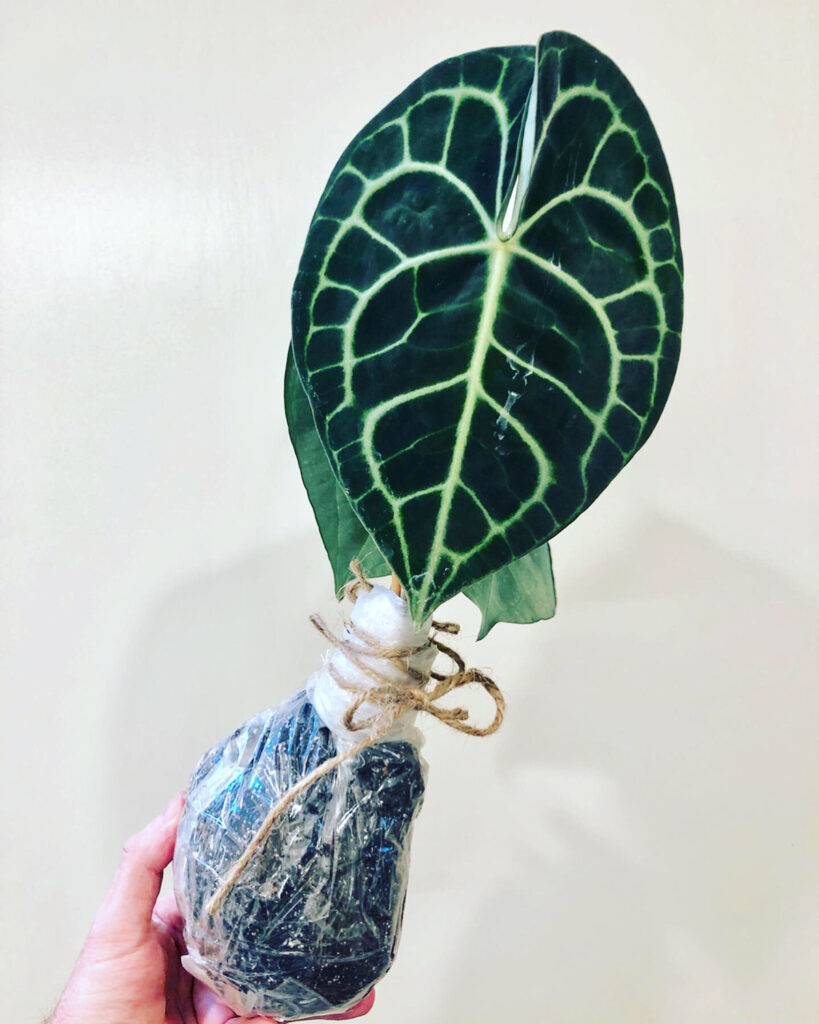
PA Orchid Exchange is where I purchased mine, but it is not a regularly stocked item (but then again, it probably isn't a regularly stocked item anywhere!). Mine was beautifully packed when I received it.
ANTHURIUM CLARINERVIUM FLOWER
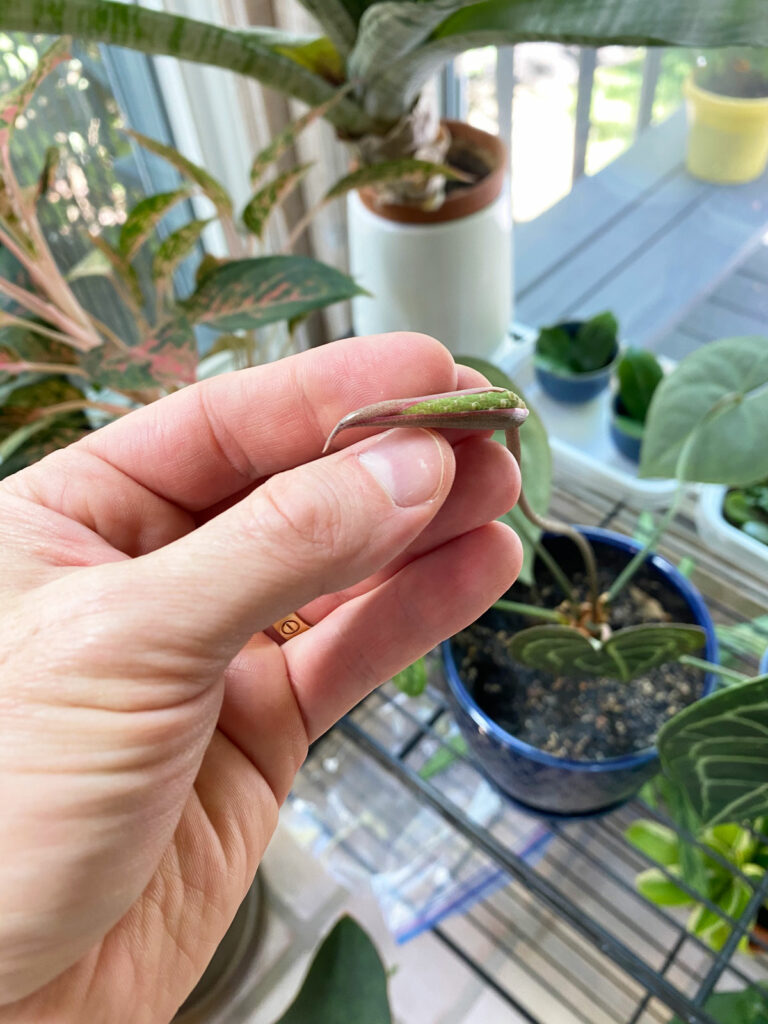
No one grows this plant for its flowers, but I've found that they do appear pretty often.
A partially opened flower on my Anthurium clarinervium
Since the flowers are insignificant, I usually just cut them off so that my plant can focus its energy on growing new leaves.
ANTHURIUM CLARINERVIUM PROBLEMS
ROOT ROT
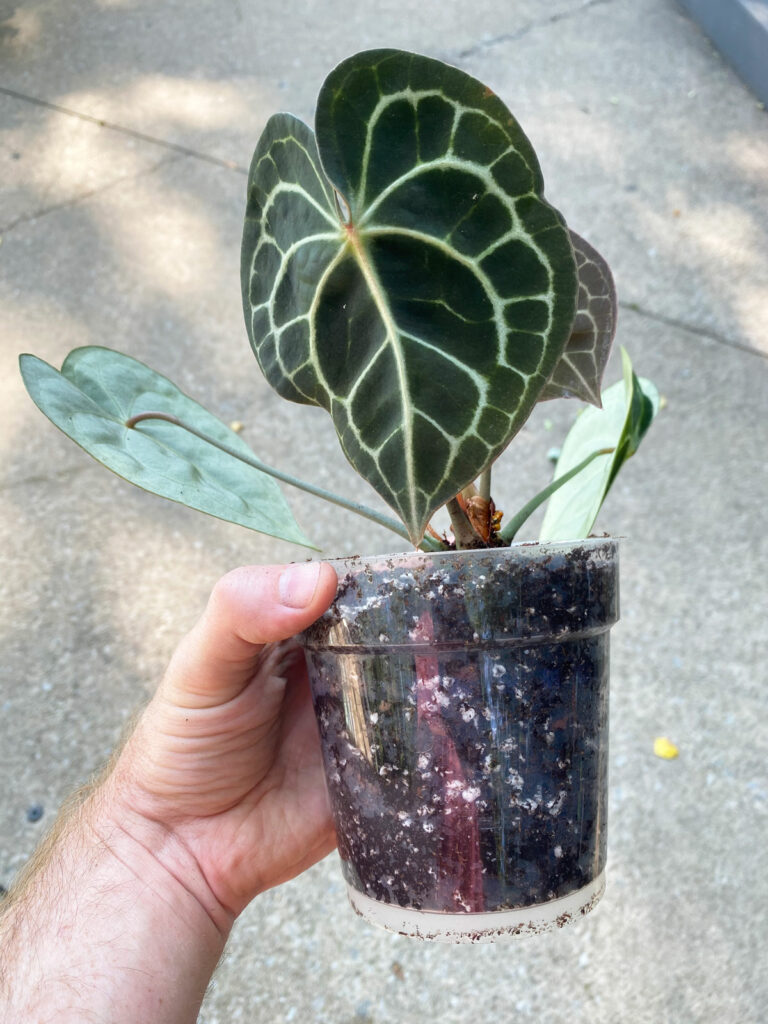
I have learned not to always trust the potting mix that plant comes in. The potting mix that mine came in was not sufficient. Even though I knew better, I didn't change it out for a while.
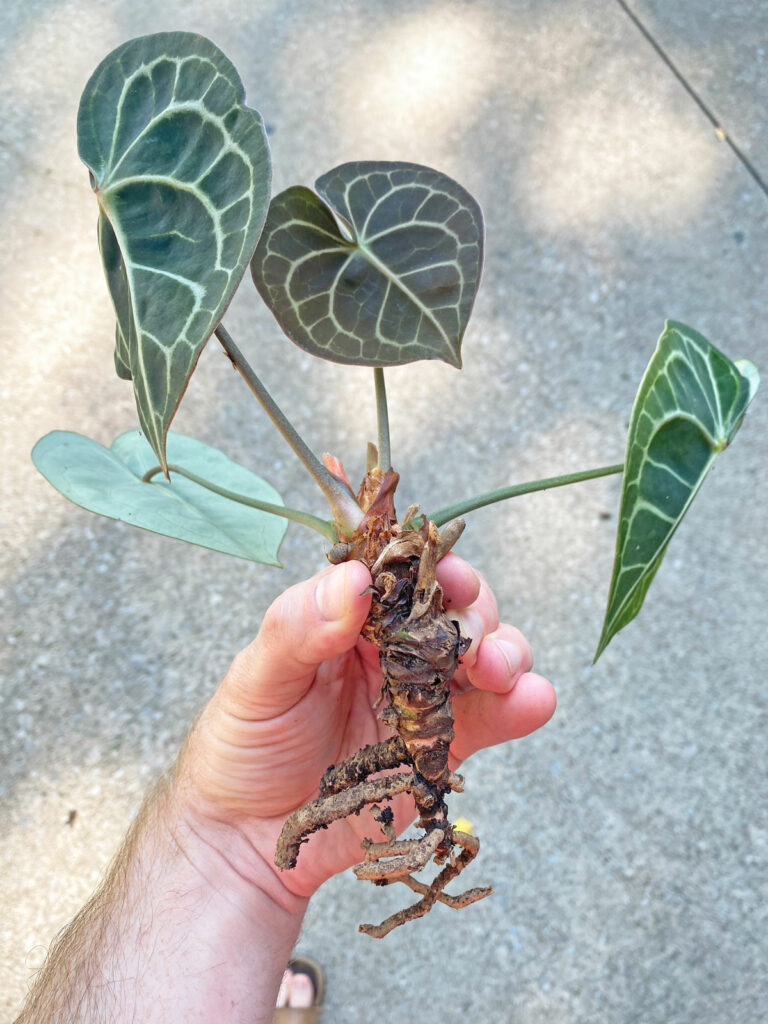
Anthuriums need a chunky, airy potting mix. Mine stayed too long in a mix that wasn't chunky porous enough and it suffered from root rot.
I was a little surprised once I took my plant out of the pot and saw that the root system above.
After this point, I placed it in a pot with equal parts all-purpose potting mix, orchid bark and perlite and the plant is thriving.
YELLOW LEAVES
Yellow leaves can be caused by a number of things, and because of this, it is up to you to troubleshoot. Yellowing leaves can be caused by:
Potting mix that has gone completely dry for too long.
Potting mix that has stayed too wet for too long. Many things can contribute to this: not enough light, a poor potting mix, pots with no drainage, and pots that are much too big for the plant's root system.
CURLING LEAVES
Normally, when leaves curl, it can be caused by the following:
Potting mix that is too dry
Potting mix that has stayed too wet
Low humidity is often an issue with these plants. Try and provide at least 40-60% relative humidity indoors.
Temperatures that are too cold or too hot.
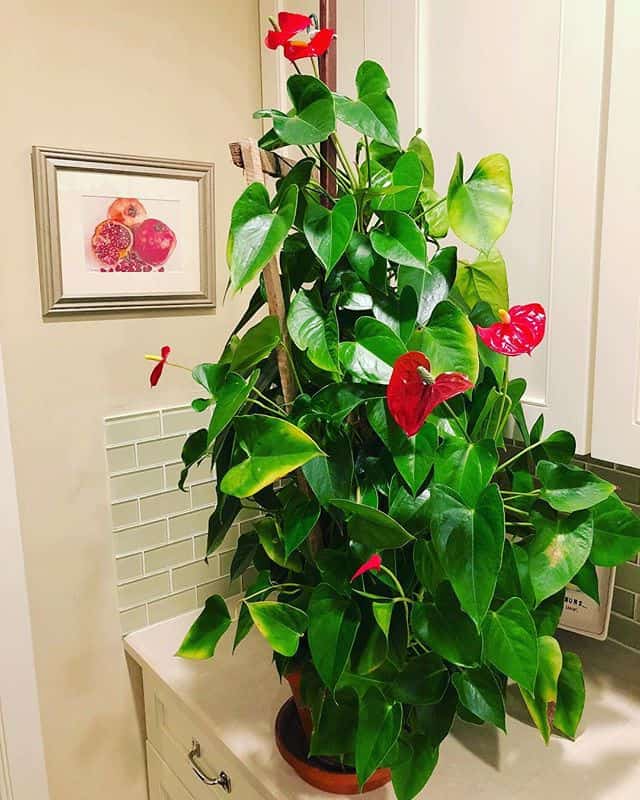
If you'd like to know how I grow the "common" Anthurium that you see everywhere, check out my Anthurium Care: Growing Flamingo Flower blog post. I've had this plant below for over 15 years and is one of my oldest and most prized plants.
Do you have any Anthuriums? Be sure not to miss my Anthurium varieties blog post containing many unusual and rare species that you can grow in your home. Comment below with any questions!
I just want to take a moment to thank you for your genuine articles, I have been a plant parent for about five years now 🙂 and I have killed many plants due to incorrect articles and youtube videos. However, your advice is always on point, but more importantly I trust your articles and youtube videos. I just purchased a plant plug from Green Escapes on Etsy and I was just reviewing my care and found this article! I can take peace in knowing that your advice is genuine. I do think I have this plant in the wrong soil as i been keeping an eye on it and it seems to be staying wet too long, so as soon as I get home I will be repotting it 🙂 It is a beautiful plant and I am anxious to watch it grow.
Again, I just want to thank you because I don't think any of your articles or youtube videos has stirred me wrong. 🙂 Thank you for your love of plants and your genuine advice for them.
I've had this little 4 inch guy for a couple of months now and his leaves keep turning yellow and falling off. Now he's down to one leaf. The roots are plump and healthy, but there's been no sign of new growth. Decided to transfer him into leca with 1/4 strength seaweed-based plant food, but he doesn't seem to like that either. My space is warm and ~60% humidity. I also leave a fan on low-medium to circulate air in my living room where my plant sits on a shelf near a west-facing window with no direct light. None of my other plants are freaking out like this one. What am I doing wrong?! Should I leave him in leca? Will he grow back from just roots? D: Help!
How far exactly is your plant from the window? And is it off to the side of the window? Everything you've described sounds ok, but I'm wondering about the light. Have you let your potting mix dry out completely at all?
Hi, I just received a single leaf antherium clarinervia ..
I was about to transplant it the next day when I see the back of the leaf has what looks like a white film on about 50 percent of the back. The seller has yet to respond, I am concerned.
Thank you
I'd have to see a photo to try and help, but maybe wait and see what the seller says and hopefully things will be ok! If you'd like to send me a photo, use the contact form on my site to email me, and when I respond, you can attach the photo.
Hi Raffael, thank you so much for this very helpful article! I just got a tiny Clarineverium two days ago, and I am so afraid to kill it!
I was told to use orchid moss on top of the soil and keep it wet so my plant would thrive. Is that truly helpful?
I’m also debating buying growing light a humidifier (?) I don’t get much natural light in my appartement, which is why.
Thank you so much for your help!
Best,
Marie
Hi Marie! Glad you found the post helpful! As far as the moss on top...it's not necessary. What is underneath though? Is it a super-chunky mix? Or does it look like plain potting soil? Depending on what is underneath, some sphagnum moss on top might help, but I wanted to ask. A grow light and humidifier sounds like a great idea if you don't have much natural light and your air is dry.
Hello Raffaele, this post was very informative!! Thank you so much for this. My clarinervium leaves are not sitting flat and are starting to curl a little and ruffle on the edges a bit. I wasn’t sure if it’s a humidity or the leaves telling me they’re thirsty.
I just potted it in my aroid mix (coco coir, orchid bark, perlite, horticultural charcoal) 2 days ago in a terracotta pot. I run a humidifier so it’s about 50-60% but it’s gotten colder her in CA so temp in the house is 68-70 degrees.
Hi Nicole! The key is to feel your potting mix whenever you notice something wrong. Did you feel your soil when you noticed the issue? My hunch is that it was probably dry? I know you said that you just started using the aroid mix a couple days ago, but keep the following things in mind. Your mix sounds like the drainage should be amazing, but is it retaining enough moisture? It's all a balancing act. How do you water? Do you thoroughly soak your potting mix? With really chunky, airy mixes like you described, it becomes even more important to soak it well since it drains so sharply. In addition, since you have it in a terra cotta pot, it would dry out even faster. You may need to water more often than you think, so use your finger to feel the mix. I don't know if you use moisture meters, but I would recommend not using one. Use your finger. When the potting mix is dry in the top inch or two, it's time to water again. Take it to your sink and give it a nice thorough watering at that point :-). I hope this helps!
Hi Raffaele,
Very informative article and by far the best I have come across on the beautiful Anthurium Clarinervium. I brought mine with one 6inch leaf and a Spink growing out. To give it good amount of humidity I had it in a propagation box and tiny spike just unfurled today, but it is one inch in size.
Does the size remain same or does it grow bigger like the other leaf? Can you please share what I could be doing wrong to have a stunt growth?
Thank you
Shilpa
Thank you for your post! I have found it challenging to find articles on care that are comprehensive and user-friendly. Yours was the best of both!
I was wondering if you knew anything about Antherium Compacta? I bought one and I cannot seem to find care/troubleshooting information. Can you help with that?
Hi Ramona! I'm so happy you enjoyed the article! I've never grown compacta before, so I can't speak from personal experience with that one...but standard Anthurium care would apply! What are your issues?
Thanks so much for sharing! I have one of these beauties at home but have gotten some brown spots with a yellow rim on many of the leaves and can’t figure out what could be the wrong. I desperately want to save it though! Is this something you’ve seen or know how to treat?
Hello there !
Thank you for the article it’s really helpful!
I bought mine one week ago and it’s pretty big, it has around 8 big leaves, but it came in a pot with perlite only. No soil, nothing else, just perlite! This got me wondering if I should repot it... I’m not sure it’s is a good idea to leave it on perlite and I get the feeling the tip of their leaves is getting pretty dry ... any idea what I should do?
Thank you so much! ??
Hi Laura, I would definitely pot it up in soil! Maybe it was just shipped that way to make it lighter and less expensive for shipping? I assume you got it in the mail?
Thank You for your answer @Raffaele !
I potted it up in soil today the way you explained. I really hope it’s going to adapt fast! Leaves we’re getting pretty dry and losing their velvety texture 🙁
I found a single stem of this beautiful plant (no roots) in a gutter on a walk. It must have come out of a floral arrangement! Can I propagate this so it will grow roots at all? I love it so much ?
If by the stem you mean the petiole (the part attached to the leaf), and that's all that it has (which is what I suspect), it will not grow into a new plant.
@Raffaele,
Yes there’s no roots or anything, just the leaf and the stem. I’m so sad! But I feel lucky that I found it at all. Do you have any suggestions for me to help it last as long as possible?
I recently had an infestation of mites in my China Doll plant, I an now noticing for the first time my Anthurium Clarinervium has splits on the epidermis of the stems and a few brown spots on some of the leaves. Is this cause for concern? I have inspected the leaves and do not find any mites, I added a small amount of a systemic insect control to be proactive. Is it possible this is a fungal disease? I do have to replant it into a larger pot; any recommendations for this issue at the time of replanting.
First of all thank you very much for that exhaustive article ?
I’ve purchased a clarinervium in march and after a bit the leaves started facing down (I had a really hard time getting it to dry after I watered it the first time, so that may be a clue as to why). It’s now hanging on a ramp close to a window and never gets direct sunlight, manages to dry way faster and is about to produce a second new leaf in as many weeks, but the leaves are still facing down, which is a bit of a shame... Any tips would be greatly appreciated ?
Hi Maxime! You're very welcome! I found that when I received my plant, it took a few months to stabilize and get used to my environment. I lost a leaf or two, but then everything was fine. I would just say to give it some time to adjust, and try and follow all the care advice I have in my post. It will come around! What size pot do you have your plant in? It's not too large of a pot for the plant is it?
Hi Raffael. Thanks much for sharing this article. I recently purchased a very small anthurium clarinervium. In a 4 inch pot. The leaves are developing quite nicely but the white veins are very faint. Do the veins get more pronounced as the plant ages?




I just want to take a moment to thank you for your genuine articles, I have been a plant parent for about five years now 🙂 and I have killed many plants due to incorrect articles and youtube videos. However, your advice is always on point, but more importantly I trust your articles and youtube videos. I just purchased a plant plug from Green Escapes on Etsy and I was just reviewing my care and found this article! I can take peace in knowing that your advice is genuine. I do think I have this plant in the wrong soil as i been keeping an eye on it and it seems to be staying wet too long, so as soon as I get home I will be repotting it 🙂 It is a beautiful plant and I am anxious to watch it grow.
Again, I just want to thank you because I don't think any of your articles or youtube videos has stirred me wrong. 🙂 Thank you for your love of plants and your genuine advice for them.
I've had this little 4 inch guy for a couple of months now and his leaves keep turning yellow and falling off. Now he's down to one leaf. The roots are plump and healthy, but there's been no sign of new growth. Decided to transfer him into leca with 1/4 strength seaweed-based plant food, but he doesn't seem to like that either. My space is warm and ~60% humidity. I also leave a fan on low-medium to circulate air in my living room where my plant sits on a shelf near a west-facing window with no direct light. None of my other plants are freaking out like this one. What am I doing wrong?! Should I leave him in leca? Will he grow back from just roots? D: Help!
How far exactly is your plant from the window? And is it off to the side of the window? Everything you've described sounds ok, but I'm wondering about the light. Have you let your potting mix dry out completely at all?
a complete and useful article, thanks for the information.
Glad you enjoyed it!
Do you use any pole/support for your Anthuriums?
Hi Hannah! My clarinervium isn't very big yet so I don't have any support right now, but it will need one in the future!
Hi, I just received a single leaf antherium clarinervia ..
I was about to transplant it the next day when I see the back of the leaf has what looks like a white film on about 50 percent of the back. The seller has yet to respond, I am concerned.
Thank you
I'd have to see a photo to try and help, but maybe wait and see what the seller says and hopefully things will be ok! If you'd like to send me a photo, use the contact form on my site to email me, and when I respond, you can attach the photo.
Hi Raffael, thank you so much for this very helpful article! I just got a tiny Clarineverium two days ago, and I am so afraid to kill it!
I was told to use orchid moss on top of the soil and keep it wet so my plant would thrive. Is that truly helpful?
I’m also debating buying growing light a humidifier (?) I don’t get much natural light in my appartement, which is why.
Thank you so much for your help!
Best,
Marie
Hi Marie! Glad you found the post helpful! As far as the moss on top...it's not necessary. What is underneath though? Is it a super-chunky mix? Or does it look like plain potting soil? Depending on what is underneath, some sphagnum moss on top might help, but I wanted to ask. A grow light and humidifier sounds like a great idea if you don't have much natural light and your air is dry.
Thank you for posting this. I have one with a new leaf growing but it looks wrinkly and as it's slowly unfurling, I see a couple of holes in the leaf
Wish I could share a photo but if you send me an email address I will send one to you. Hopefully by then it will have recovered.
Hello Raffaele, this post was very informative!! Thank you so much for this. My clarinervium leaves are not sitting flat and are starting to curl a little and ruffle on the edges a bit. I wasn’t sure if it’s a humidity or the leaves telling me they’re thirsty.
I just potted it in my aroid mix (coco coir, orchid bark, perlite, horticultural charcoal) 2 days ago in a terracotta pot. I run a humidifier so it’s about 50-60% but it’s gotten colder her in CA so temp in the house is 68-70 degrees.
Thank you in advance!
Hi Nicole! The key is to feel your potting mix whenever you notice something wrong. Did you feel your soil when you noticed the issue? My hunch is that it was probably dry? I know you said that you just started using the aroid mix a couple days ago, but keep the following things in mind. Your mix sounds like the drainage should be amazing, but is it retaining enough moisture? It's all a balancing act. How do you water? Do you thoroughly soak your potting mix? With really chunky, airy mixes like you described, it becomes even more important to soak it well since it drains so sharply. In addition, since you have it in a terra cotta pot, it would dry out even faster. You may need to water more often than you think, so use your finger to feel the mix. I don't know if you use moisture meters, but I would recommend not using one. Use your finger. When the potting mix is dry in the top inch or two, it's time to water again. Take it to your sink and give it a nice thorough watering at that point :-). I hope this helps!
Hi Raffaele,
Very informative article and by far the best I have come across on the beautiful Anthurium Clarinervium. I brought mine with one 6inch leaf and a Spink growing out. To give it good amount of humidity I had it in a propagation box and tiny spike just unfurled today, but it is one inch in size.
Does the size remain same or does it grow bigger like the other leaf? Can you please share what I could be doing wrong to have a stunt growth?
Thank you
Shilpa
I'm glad you enjoyed the post! Are you sure it's a leaf and not a flower that you have? 🙂
Hi Raffaele,
Thank you for your post! I have found it challenging to find articles on care that are comprehensive and user-friendly. Yours was the best of both!
I was wondering if you knew anything about Antherium Compacta? I bought one and I cannot seem to find care/troubleshooting information. Can you help with that?
Thank you in advance,
Ramona
Hi Ramona! I'm so happy you enjoyed the article! I've never grown compacta before, so I can't speak from personal experience with that one...but standard Anthurium care would apply! What are your issues?
Hi Raffaele,
Thanks so much for sharing! I have one of these beauties at home but have gotten some brown spots with a yellow rim on many of the leaves and can’t figure out what could be the wrong. I desperately want to save it though! Is this something you’ve seen or know how to treat?
Thanks a lot!
Best,
Anna
Hi Anna! Sorry to hear that you're having problems with your plant. It could potentially be either a bacterial or fungal issue.
Hello there !
Thank you for the article it’s really helpful!
I bought mine one week ago and it’s pretty big, it has around 8 big leaves, but it came in a pot with perlite only. No soil, nothing else, just perlite! This got me wondering if I should repot it... I’m not sure it’s is a good idea to leave it on perlite and I get the feeling the tip of their leaves is getting pretty dry ... any idea what I should do?
Thank you so much! ??
Hi Laura, I would definitely pot it up in soil! Maybe it was just shipped that way to make it lighter and less expensive for shipping? I assume you got it in the mail?
Thank You for your answer @Raffaele !
I potted it up in soil today the way you explained. I really hope it’s going to adapt fast! Leaves we’re getting pretty dry and losing their velvety texture 🙁
I found a single stem of this beautiful plant (no roots) in a gutter on a walk. It must have come out of a floral arrangement! Can I propagate this so it will grow roots at all? I love it so much ?
If by the stem you mean the petiole (the part attached to the leaf), and that's all that it has (which is what I suspect), it will not grow into a new plant.
@Raffaele,
Yes there’s no roots or anything, just the leaf and the stem. I’m so sad! But I feel lucky that I found it at all. Do you have any suggestions for me to help it last as long as possible?
I recently had an infestation of mites in my China Doll plant, I an now noticing for the first time my Anthurium Clarinervium has splits on the epidermis of the stems and a few brown spots on some of the leaves. Is this cause for concern? I have inspected the leaves and do not find any mites, I added a small amount of a systemic insect control to be proactive. Is it possible this is a fungal disease? I do have to replant it into a larger pot; any recommendations for this issue at the time of replanting.
Hi Berenice, I'd have to see a photo to try and help.
@Raffaele,
I will upload and email to you.
thank you for getting back to me.
@Berenice Diehl,
Hi Raffaele,
Can you please send me your email address directly because it keeps bouncing my email back when i try to send it.
Thanks!
Hi !
First of all thank you very much for that exhaustive article ?
I’ve purchased a clarinervium in march and after a bit the leaves started facing down (I had a really hard time getting it to dry after I watered it the first time, so that may be a clue as to why). It’s now hanging on a ramp close to a window and never gets direct sunlight, manages to dry way faster and is about to produce a second new leaf in as many weeks, but the leaves are still facing down, which is a bit of a shame... Any tips would be greatly appreciated ?
Thanks in advance !
Hi Maxime! You're very welcome! I found that when I received my plant, it took a few months to stabilize and get used to my environment. I lost a leaf or two, but then everything was fine. I would just say to give it some time to adjust, and try and follow all the care advice I have in my post. It will come around! What size pot do you have your plant in? It's not too large of a pot for the plant is it?
Hi Raffael. Thanks much for sharing this article. I recently purchased a very small anthurium clarinervium. In a 4 inch pot. The leaves are developing quite nicely but the white veins are very faint. Do the veins get more pronounced as the plant ages?
Hi Debbie! That I'm not sure of, but I would imagine yes!