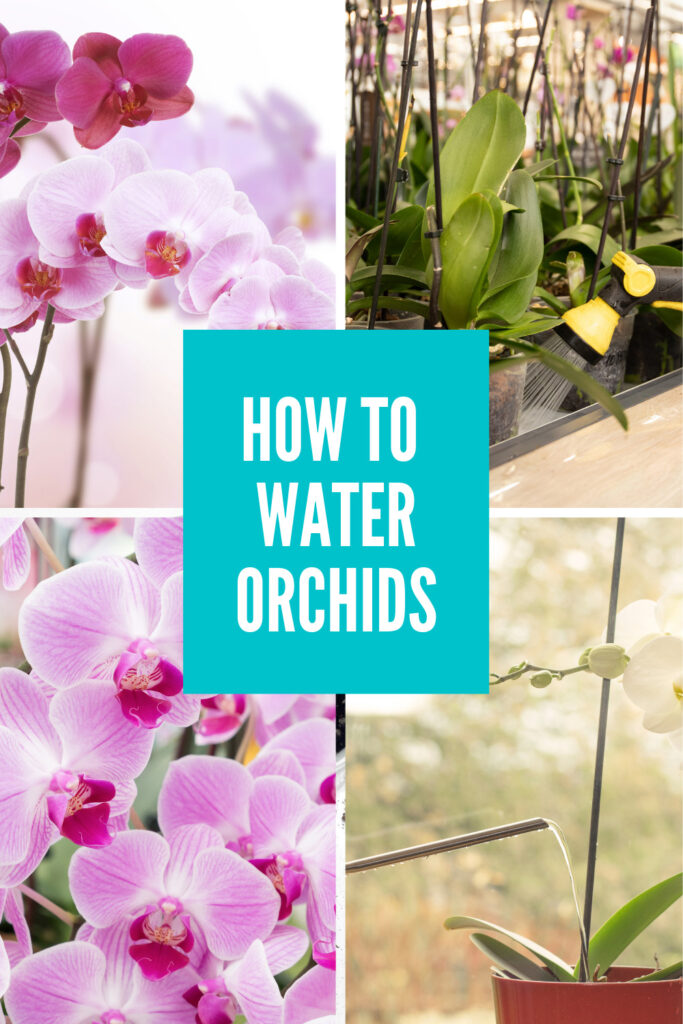
The topic of how to water orchids has caused much confusion for many people. Throughout the years, I've helped many clients be successful with orchid care. Keep reading to let me show you three methods that I use, and that you can be successful with, when it comes to watering your Phalaenopsis or Moth Orchid.
Would you like to save this post?
Enter your email, and I will send this link straight to you!
Table of Contents
What is the best way to water an orchid?
In this post, I will go through in detail 3 ways to water your orchid and some important information that you need to know about each one:
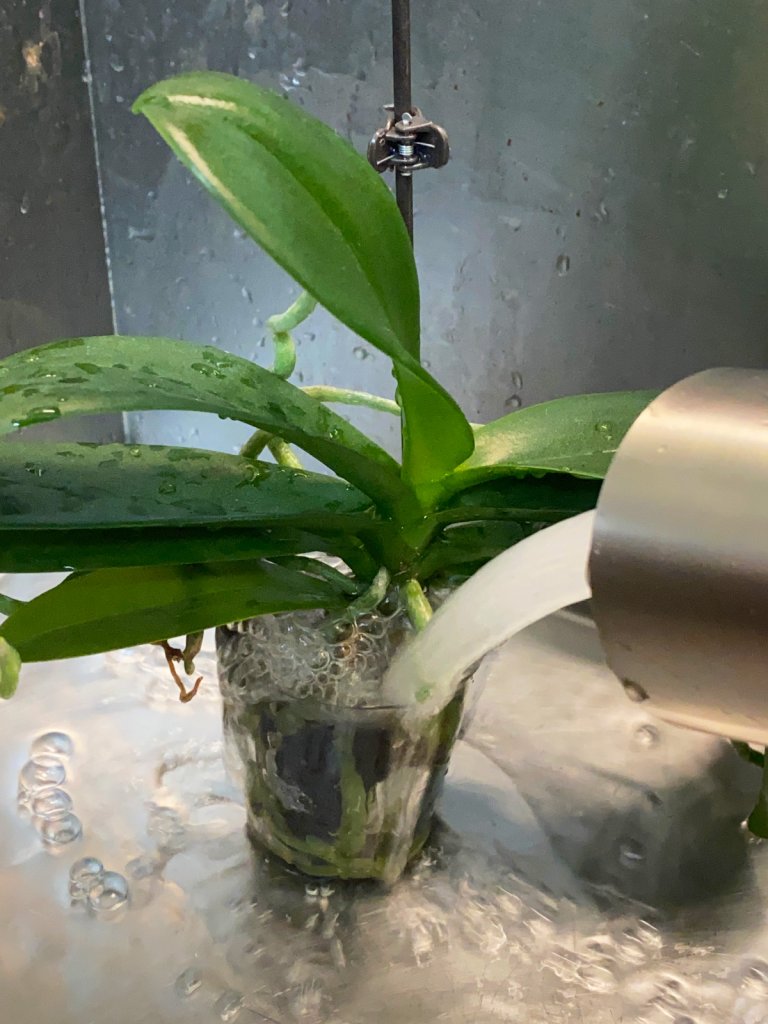
Stream water through the pot until the potting medium is thoroughly soaked.
Give your plant a good soak in a cachepot or bucket for a period of time (this is best for very dehydrated plants).
Place your plants outdoors during warm weather, or during periods of rain.
Notice I did not include ice cubes as a method to water your orchids. I'll explain why later.
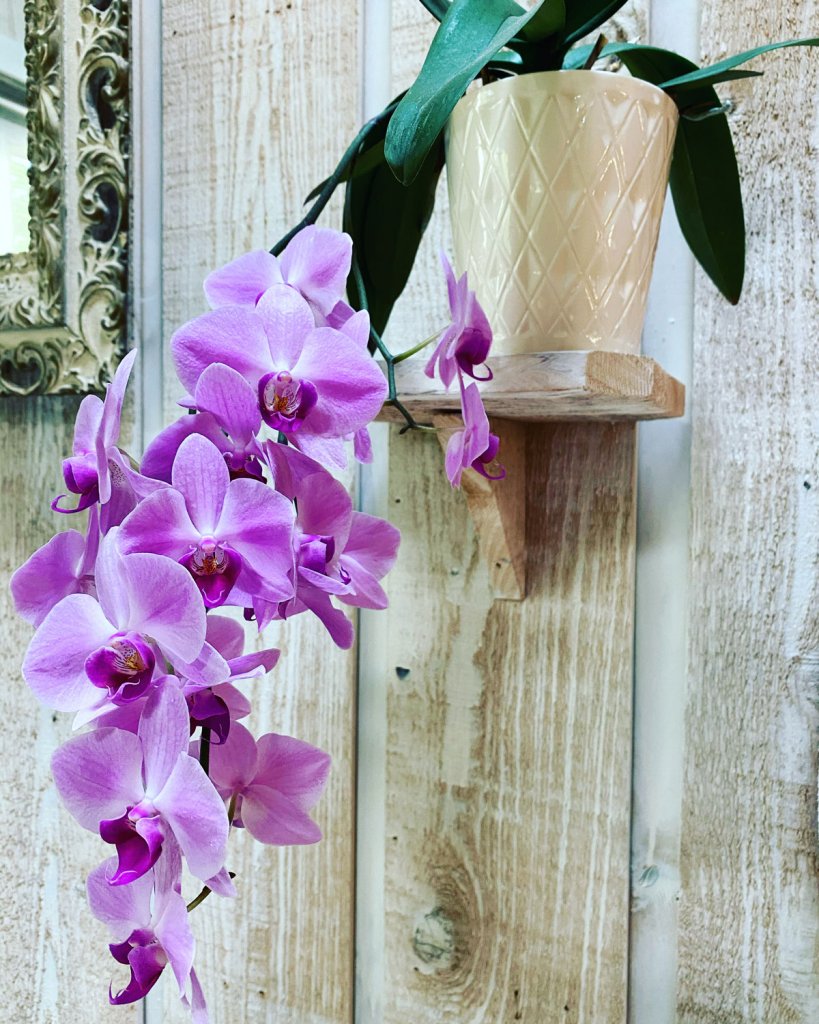
An exceptional flower spike on one of my Phalaenopsis orchids
Whatever method you use, water quality is an important consideration, and if you have treated water from a water softening unit, do not use this to water your orchids.
Most of these units exchange calcium and magnesium with sodium, and sodium is toxic to plants.
If you are using RO water or distilled water, you'll need to add fertilizer to replace necessary nutrients. Many orchid enthusiasts have great success using the MSU Orchid Fertilizer (link to Amazon) that is specially formulated for these cases.
I personally have been using tap water for years without any issues and I live in a hard water region (though rain water would be superior if you can collect it) and I supplement with Dyna-Gro Grow fertilizer with almost every watering (¼-/12 teaspoon per gallon), though I am experimenting with different fertilizers. For more details, check out my post on how to fertilize orchids.
Now let's talk about the actual watering methods:
1. Stream Water Through in Your Sink
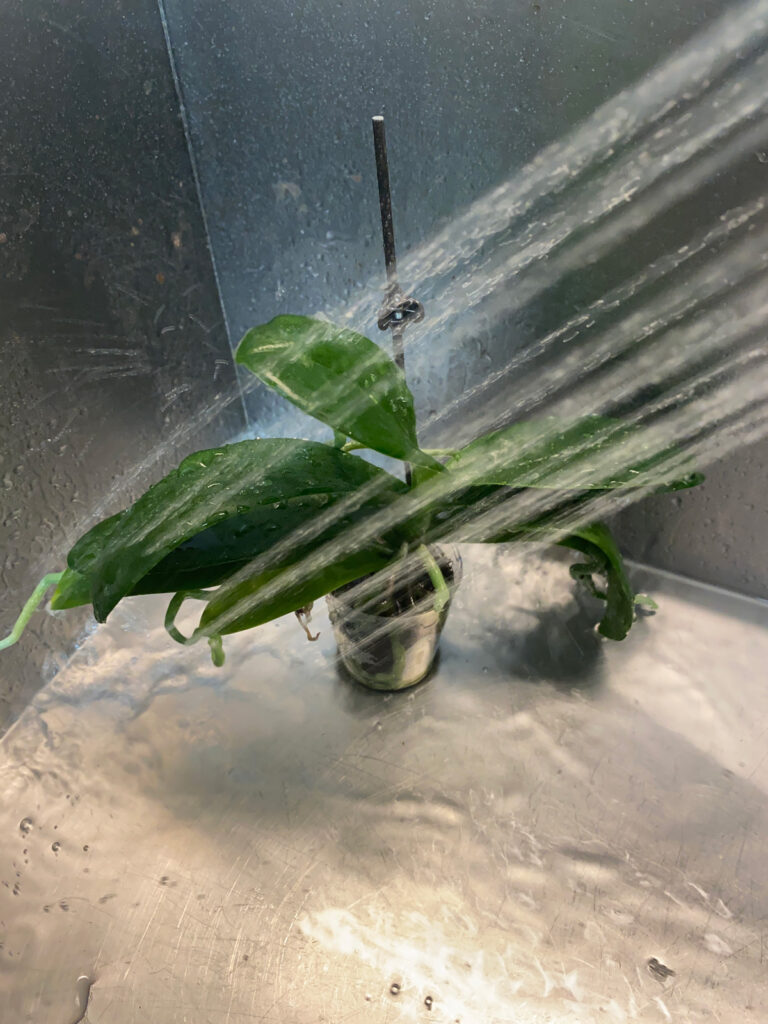
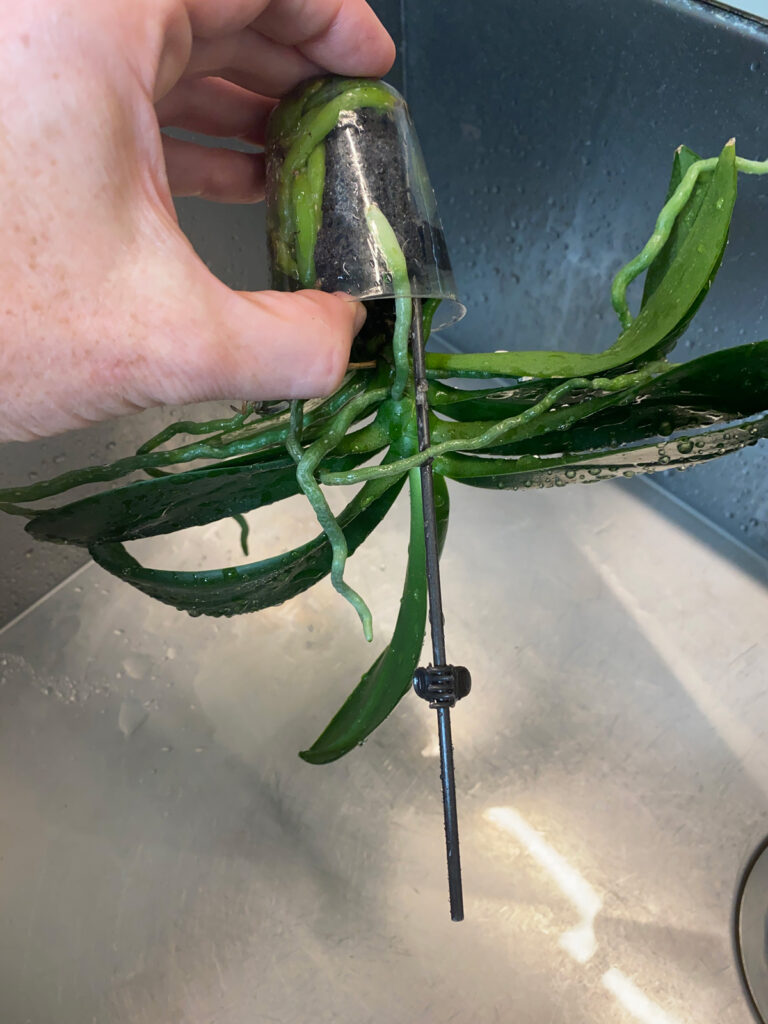
This is the simplest method that you can use for routine watering of your plant. Take your plant to the sink and stream lukewarm water through the pot so that you thoroughly soak the potting medium (whether you're using orchid bark or sphagnum moss).
Be sure to moisten everything well!
Water temperature is important, so avoid using water that is too cold because this can shock your plant.
Remember, these are tropical plants and are used to warm conditions, so make sure you use tepid water and not cold water.
Allow all water to drain away through the drainage holes, and you're done.
This method is great if your plant is in good condition and not terribly dehydrated. It is also my preferred method for orchids growing in sphagnum moss.
If you've neglected your plant and your orchid bark has gone terribly dry, you can use this method, but I especially recommend using method #2 in the next section.
(If you leave your plant too dry for too long, it will first start to droop and then you will get wrinkled orchid leaves.)
I also like to wet the entire plant in order to rinse dust off the leaves and moisten any aerial roots that otherwise would not get any attention. This will also help deter and help to wash away any pests.
Once I'm done, I turn the plant upside down and gently shake it in order to dislodge any water that may have collected in the crown of the plant (where the leaves join together in the center of your plant).
If you have stagnant air with poor air circulation combined with water lodged in the crown of the plant, this could encourage crown rot.
If it's impractical to turn your plant upside down, I sometimes just take a deep breath and blow out any water that has accumulated in the middle of the plant! Whatever works for you.
If you want to learn all about how to get your orchid to rebloom reliably and have healthy, thriving moth orchid plants, don't miss my signature, online orchid care course, Become an Orchid Master. It also includes bonuses with support from me, personally, to guide you in your orchid journey!
2. Soak Your Orchid for More Intensive Watering
You can use this method for routine watering as well, and is especially beneficial if your bark mix has gone really dry and you need to be able to increase the water retention to previous levels.
When bark or even sphagnum moss (whatever your orchid happens to be growing in) goes completely dry, it is sometimes difficult to "re-wet" and this method will help accomplish that.
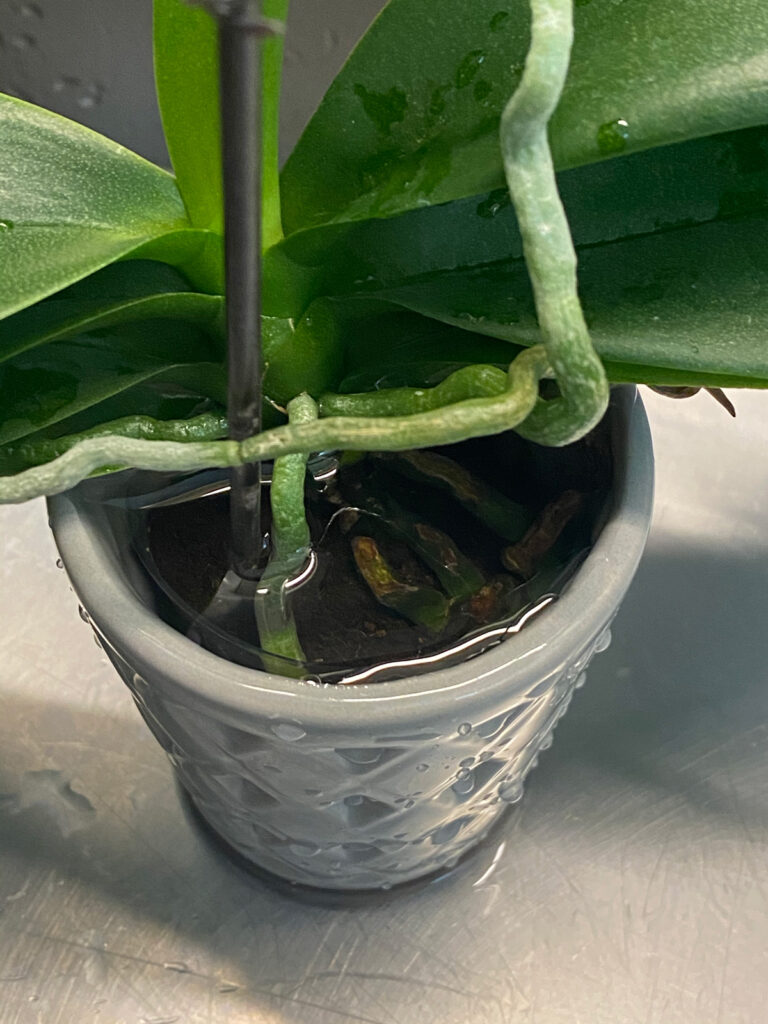
Depending on how dry your plant is, simply slip your plant into a decorative pot or bowl of water, and let it soak for at least 15-30 minutes.
This will not rot out your plant. I've seen some sources saying that soaking your plant longer than 5 minutes will cause your plant to rot and it's simply not true! You're not leaving your orchid in water for days.
In fact, if you have a severely dehydrated plant with shriveled roots, you can use this method to soak your plant even overnight and do this at least weekly until it starts to revive.
Once your soak is done, take your plant out of the exterior pot, let the water drain out, take the exterior pot and empty the water in the bottom of the pot, slip your plant back in and you're done.
I've used this method many times and have never had root rot before, as long as you have a dry period in between watering.
I don't typically recommend this soaking method for sphagnum moss, unless it has gone so dry that you need to rehydrate it...so after you do that, drain excess water away and then from that point forward, use the top watering method. Sphagnum moss holds a lot of water, so I prefer using method 1 on a regular basis.
3. Let Mother Nature Water Your Orchids
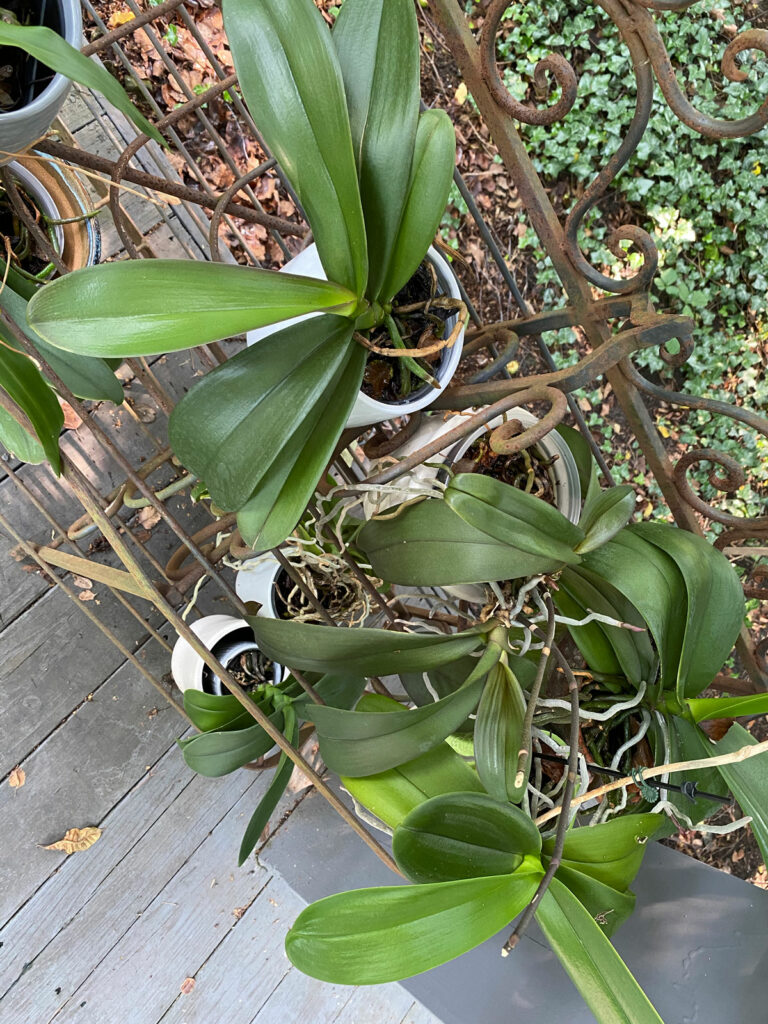
I often take my orchids outdoors for the summer and place them in the shade for a few months. There are many benefits to placing your orchids outdoors:
Rainwater is a superior form of water for your orchids or any houseplants. And besides this...
The air circulation is very beneficial for plant growth.
The natural temperature drop in the evening often triggers more blooming. Don't allow your plants to be outside if there are extended periods below 55°F (13°C). They do not like cold temperatures.
Some of my orchids placed in a shady spot outdoors
Most of my orchids are growing in clear plastic pots with drainage holes that are slipped into ceramic, decorative containers with no drainage hole.
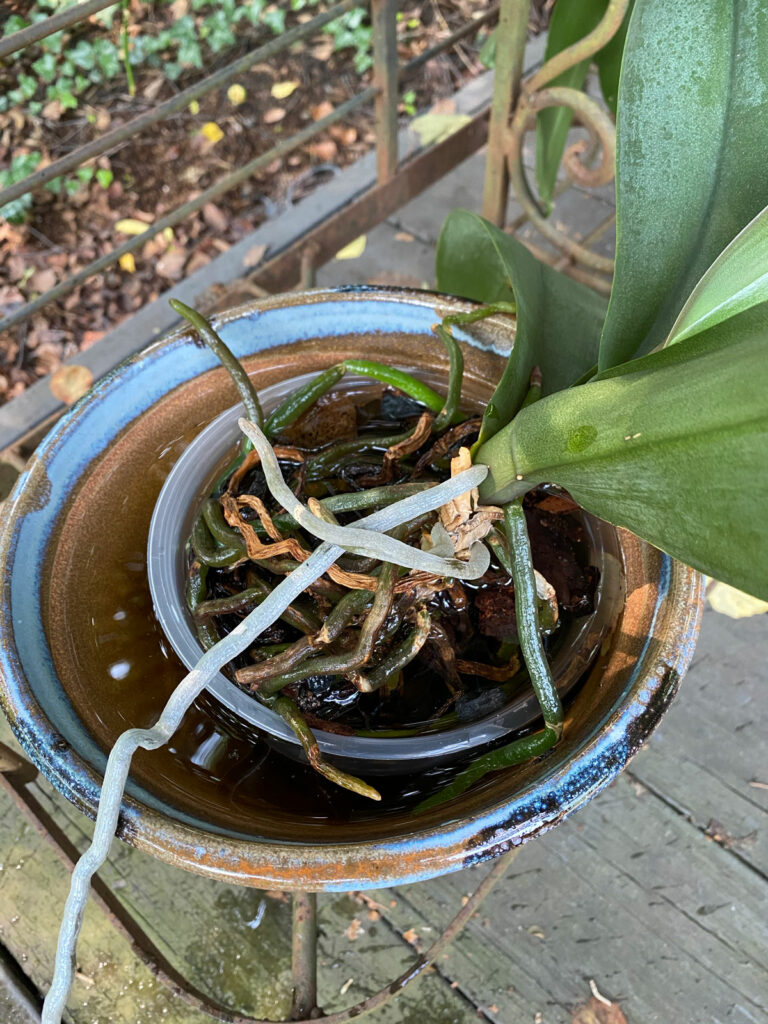
After a good rain, if your decorative pots have no drainage holes, water will accumulate and you'll have to empty it out.
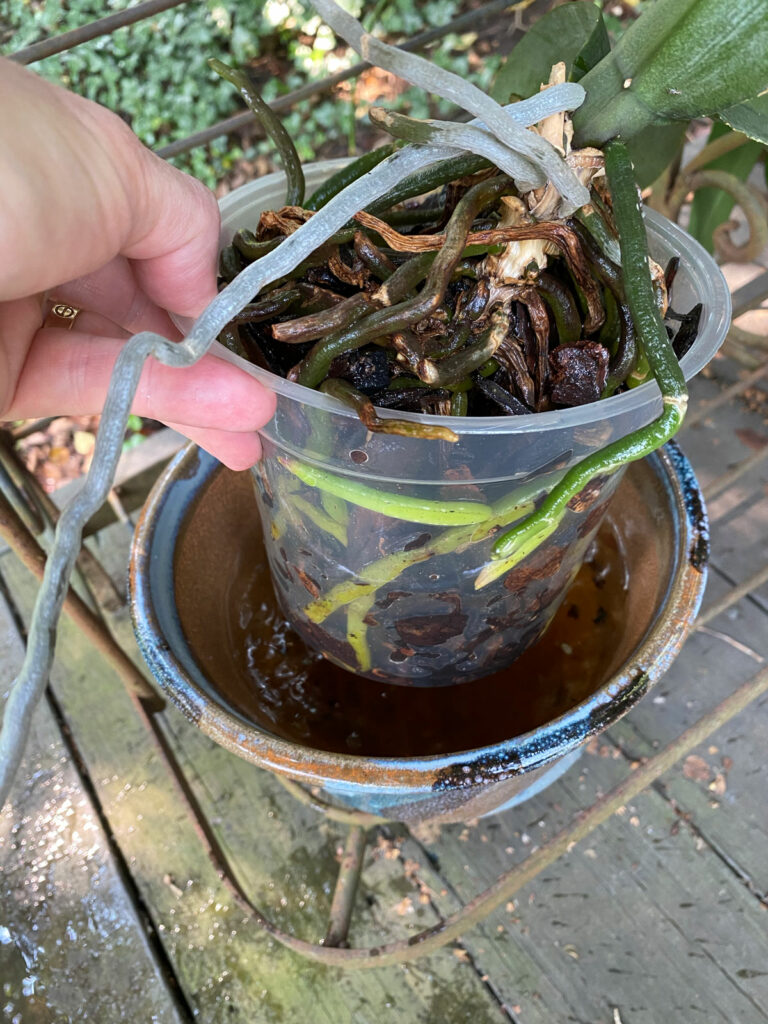
In the photo below, I lifted my clear plastic pot (with drainage holes) and allowed excess water to drain away, and then I dumped the excess water out of the exterior ceramic pot and placed the plant back in.
Clear plastic pots make it easy to tell if your orchid needs water. Hydrated roots will be green, and dry roots will be a silvery white color, usually.
How do you know when to water your orchid?
Moth orchids do not like to go completely dry. If your potting media has gone completely dry, go ahead and water immediately otherwise your plant will start to suffer.
The downside of moth orchids that is that they only grow one or two new leaves per year in many cases, so if you are not attentive with watering, you can get droopy orchid leaves and yellow leaves rather quickly.
Here are some additional watering tips:
Stick your finger in the bark mix or sphagnum moss. If it feels wet, don't water. If it is just barely damp, you can probably wait another day or two. This is my personal, preferred method.
If you don't want to use the finger test, you can either employ the pencil trick. Stick the sharpened end of a pencil deep into the potting medium. Leave it in for a few minutes, and if it has darkened, there is enough moisture. If it appears the same color, go ahead and water. You can even use a bamboo chopstick or wooden skewer as an alternative.
If your home has very low humidity, your potting media (as well as the aerial orchid roots) will dry out more quickly so keep an eye on things! In a more humid environment, your potting media will take longer to dry out.
If your orchid is growing a bark mix, I think it's OK to use a watering schedule. I never use a strict watering schedule for other plants growing in soil/potting mix, but you would be safe to do a once a week watering schedule for orchids growing in a bark mix. The key is to observe adjust when you need to.
Now, if you want a fun project, have you ever tried growing orchids in water culture? This method uses no medium at all (no bark or moss). And it's super fun to do!
Why you should not use ice to water your orchids
The natural habitat of most Phalaenopsis orchids is warm and tropical so ice makes no sense.
In fact, if ice that comes in contact with an orchid's roots they'll quickly become damaged. There are several reasons why this can be dangerous, and I've written a detailed blog post that described why you shouldn't water orchids with ice.
Lastly...are you having a hard time getting your orchid to rebloom? Check out my post to help you out:
So glad I found your blog. I have an orchid that inherited from my mother after she passed.
I assumed it was dead and beyond help. Recently a new leaf sprouted. I just finished repotting thanks to your video. I was afraid about cutting near the roots.
Question is the esty link your store? I want to buy the 5 pack of baby orchids to start. My plan is to do an orchid wall in my living room to soften the area around the dogs space. And, as a memory wall to mom who passed from Alzheimer’s.
My question is I’m in the California desert area of Palm Springs. Should I also order a heat pack?
As long as there is enough light where you are putting them, it should be fine. Sorry for the delay in my response. I would monitor temperatures for shipping. As long as the temps stay above 50-55F or so throughout shipping, they'll be fine.
This is called a keiki (hawaiian for "baby"). Once the keiki's leaves are maybe 3-4 inches long and have their own roots, you can cut it off the stalk and pot it up!
Wow. I repotted and revived 2 orchids using ice cube method and orchid food. They bloomed well, then started wilting. The roots look almost completely dead! Do I cut away the dead parts? When repotting, how much of the aereal root needs to be above ground? Still confused but will try method of weekly submersing. I also will put them back in their little teeny pots.
Hi Linda! I would ditch the ice method for sure. It is very harmful for the roots. I actually have a YouTube video on repotting orchids. You'd benefit from watching it! Here is my blog post on repotting orchids, and inside the post, I include the YouTube video that you can watch. I hope it helps! https://www.ohiotropics.com/2019/05/08/repotting-you-moth-orchid/
Do you fertilize every time you water...once a week?
I have Schultz 15-5-5 liquid Orchid Fertilizer and have new 5-6 months old moth orchids.
I have had the experience of not fertilizing correctly resulting in all 5 dying.
Having bought new plants which are all at different stages of flowering, as each is finished flowering, I change the pot to another slightly bigger plastic pot with many holes in sides and bottom with fresh orchid bark. I do not have a decorative pot for them but have all on a terracotta saucer filled with small stones so plants will not sit in water.
I do water from a plastic watering container weekly but fill the container with tap water awaiting watering the following week so the chemicals in the water dissapate...I have not fertilizer the new orchids for fear of killing them.
When watering I take each plant to the sink, water with last weeks tap water until it runs out the bottom, and then place on the saucer with stones.
Yes, usually every time I water but I get lazy sometimes. Your watering sounds OK. But, it concerns me when you said you've killed your orchids by fertilizing. If you do it at every watering, you have to do it very dilutely and not at full strength, unless the label specifically says that concentration is for every watering. Did you measure the fertilizer accurately, and also measure the water? If you eyeball, it can be dangerous.
Question. When I got my orchids it came in a plastic pot but I do not know what the roots were in. So when I replanted it to a bigger pot and used the wood bark I didn't check out the roots and just put the whole thing in the pot with the wood chips. I have new leaves growing so I am wondering should I take it out and clean the old potting medium off and the check the roots and maybe trim them. She seems to be growing ok and the new leaves are getting big fast. What do you suggest? Leave it for now or get rid of the old stuff and replant?
I water mine in the sink about every three or four days. I live in phoenix and it is to dry and hot for them to be outside even in the shade. I have it (Ophelia) yes I name my plants, in bark. I also have an oscillating fan on for air circulation. The fan helps me and my orchid. I use your tip and put pebbles in the tray with a little water for humidity.
I grow quite a few Phal orchids indoors. I have discovered when the blooms are beginning to wilt, I cut the spike and put it in a small vase with clean water changed daily. The orchid blooms last about two weeks. I also snip the stem of the orchid spike to give it a clean opening.
Thank you for your informative read Rafael. I wouldn’t say i’m a plant specialist by any means. However, I have been an (ok) plant mommy for years now – not with orchids though. I love orchids, and have multiple beautiful silk ones (I know, I’m bad!) but I’m always hesitant now to buy any real ones because they always die so quickly on me. Now, I SEEM to be doing what you are recommending, but I’m obviously doing something wrong, right? The reason why I’m asking is my husband surprised this past Valentine’s Day with guess what? Yup. A lovely new orchid! Now at first, the orchid was of course blooming with 12 gorgeous (but small) flowers on it. So I thought, ok, let’s try this again Nicole! The moss felt moist enough, but not incredibly moist, but definitely not dry. So since, what I thought was my problem in the past with orchids were that I was watering them too much. So I didn’t water this new one until the following week when I watered the rear of my other plants babies. Then after watering this guy, of course one by one my once blooming flowers started to die on me, leaving me with one sad looking orchid. So what am I doing wrong? Present day, I still have 4 flowers left alive on my poor little orchid, and around 3 hanging on for their lives. I feel horrible. Then today, when I was giving my little guy a deep soak and watering him. I took him out of his ceramic pot afterwards to drain, and noticed 2 of his top roots on had about 2 inches where they were dried out on the top. Which unfortunately, I hadn’t noticed the last time I watered him, but that could of been because I still had one of those clear drainage pots (which now, after reading your post, I probably shouldn’t have ever removed) still on. When my husband originally bought the orchid, knowing how I haven’t had the best luck with my past orchids, but that I did still really love the plants in general. My husband asked the women at the store for some tips on taking of them SO THEY DON’T ON HIS MURDEROUS WIFE! And one of those lovely tips was to remove that clear plastic pot that holds the plant together when we got home, and to only keep the orchid in the other ceramic pot instead. So me thinking that maybe THAT clear plastic pot had been my problem all these years. Considering that the women told my husband that the only thing that those plastic pots do is make so orchids “can’t breathe”. I cut that clear drainage pot off my poor little guy right away when I watered him! Now I’m completely lost though Do I try to find another one if those plastic pots? As for the dead parts of the roots. I already cut out those two little parts on the roots. So I'm hoping that will at least help that issue, but what else can I do from keeping my poor little orchid from living a short sad life like his past brothers? Please help me Rafael. Please! Any suggestions on keeping my little orchid alive?
Hi Nicole, I'll make a couple comments that hopefully will help you. First off, the flowers will not last forever. You don't know how long your flowers were open when you received it, so they may have been close to the end of their lifespan. I like to purchase orchids that are just starting to open, if I can, because I know that I'll have a longer lasting bloom period. You can successfully use clear plastic pots as well as any other type of pot. I do find that sometimes growers will pack the sphagnum moss too much and it will stay wet for too long. I personally prefer growing them in a bark mix. As far as the roots that dried out, you can mist any aerial roots. They will dry out very quickly (especially if you run forced air heat in the winter time and the air is really dry). It won't kill your orchid if some of them dry out though! I hope this helps a little. I talk about orchid care in my very short book Moth Orchid Mastery, and I also have a section on them in my new book, Houseplant Warrior.
If you want to keep the plant long term, I would repot it into a pot with a drainage hole. Orchid roots will quickly rot if they're sitting in water. In the meantime though, I would recommend this. Fill the pot with water, let it sit for a few minutes, at least, and then gently tip the plant over and let all the water drain away that way.
Great information, Raffaele. I am a novice at plants, and I can't seem to keep the alive. However, my son gave me an orchid plant on Mother's Day in 2017 and I have managed to keep it alive and growing. It gets soaked in ice water for 5 minutes every 10 days or so. It worried me that the leaves were getting soaked also, since they hang over the side of the pot. My plant is in a ceramic pot with holes, so I don't take it out of the pot for watering. It's been doing well, however, it doesn't bloom very often...maybe twice a year. I haven't been using fertilizer on a regular basis...it's very confusing to me...until the last couple of months. Now I'm trying to remember to fertilize every other watering. I guess I will stop the ice water soak...been shocking my poor orchid for almost 5 years. Presently, I have 8 buds growing...I'm sooo happy!!
I have just acquired several moth orchids and all look great except one. A lower leaf looks wrinkly and the exposed roots look shriveled and pretty bad. I don't know if it's too much water or not enough. Planted in bark and is outside with two others which are doing fabulous. I have to say that I used ice cubes once on them but it made no sense to me so I went searching and found your blog. I really appreciate your help.
You're welcome Maureen! I do have a blog post that talks about droopy/wrinkly leaves. It can be caused by both dehydration and also staying too wet. Here is my post and hopefully it will help clarify things for you! https://www.ohiotropics.com/2019/11/30/droopy-wrinkled-orchid-leaves/
We live in cenral Utah, which is high desert. Availablity of rainwater is not a practial way to capture water for our moth orchids. Also, water in this area is hard, so our water is artificially softened, making it unsafe to use for watering orchids. Are there other options not mentined in this article that can work - perhaps bottle spring water; or adding dilute fertilizer to distilled water? We love our orchids and want to take good care of them, so we need help finding a good watering option!
Hi Stephen! Thank you for this comment! I just updated my post to include this information so you can go back and look. If you use RO water or distilled water, many people use a fertilizer that is specifically for these types of waters to replace nutrients. Many people have success with the MSU Orchid Fertilizer which I linked to in the post.
Once a week, in the sink, in the perforated plastic pot. I water several times over a day, letting the plant drain between each watering. Then I let the plant sit over night to make sure it has drained before putting it back into the ceramic 'over-pot'.




Thank you very much for this!
You're very welcome Ray!
So glad I found your blog. I have an orchid that inherited from my mother after she passed.
I assumed it was dead and beyond help. Recently a new leaf sprouted. I just finished repotting thanks to your video. I was afraid about cutting near the roots.
Question is the esty link your store? I want to buy the 5 pack of baby orchids to start. My plan is to do an orchid wall in my living room to soften the area around the dogs space. And, as a memory wall to mom who passed from Alzheimer’s.
My question is I’m in the California desert area of Palm Springs. Should I also order a heat pack?
As long as there is enough light where you are putting them, it should be fine. Sorry for the delay in my response. I would monitor temperatures for shipping. As long as the temps stay above 50-55F or so throughout shipping, they'll be fine.
My orchid is growing what looks like two new plants with leaves and roots high up on the original stem. Any thoughts on what to do or not do?
This is called a keiki (hawaiian for "baby"). Once the keiki's leaves are maybe 3-4 inches long and have their own roots, you can cut it off the stalk and pot it up!
Wow. I repotted and revived 2 orchids using ice cube method and orchid food. They bloomed well, then started wilting. The roots look almost completely dead! Do I cut away the dead parts? When repotting, how much of the aereal root needs to be above ground? Still confused but will try method of weekly submersing. I also will put them back in their little teeny pots.
Hi Linda! I would ditch the ice method for sure. It is very harmful for the roots. I actually have a YouTube video on repotting orchids. You'd benefit from watching it! Here is my blog post on repotting orchids, and inside the post, I include the YouTube video that you can watch. I hope it helps! https://www.ohiotropics.com/2019/05/08/repotting-you-moth-orchid/
Do you fertilize every time you water...once a week?
I have Schultz 15-5-5 liquid Orchid Fertilizer and have new 5-6 months old moth orchids.
I have had the experience of not fertilizing correctly resulting in all 5 dying.
Having bought new plants which are all at different stages of flowering, as each is finished flowering, I change the pot to another slightly bigger plastic pot with many holes in sides and bottom with fresh orchid bark. I do not have a decorative pot for them but have all on a terracotta saucer filled with small stones so plants will not sit in water.
I do water from a plastic watering container weekly but fill the container with tap water awaiting watering the following week so the chemicals in the water dissapate...I have not fertilizer the new orchids for fear of killing them.
When watering I take each plant to the sink, water with last weeks tap water until it runs out the bottom, and then place on the saucer with stones.
Yes, usually every time I water but I get lazy sometimes. Your watering sounds OK. But, it concerns me when you said you've killed your orchids by fertilizing. If you do it at every watering, you have to do it very dilutely and not at full strength, unless the label specifically says that concentration is for every watering. Did you measure the fertilizer accurately, and also measure the water? If you eyeball, it can be dangerous.
Question. When I got my orchids it came in a plastic pot but I do not know what the roots were in. So when I replanted it to a bigger pot and used the wood bark I didn't check out the roots and just put the whole thing in the pot with the wood chips. I have new leaves growing so I am wondering should I take it out and clean the old potting medium off and the check the roots and maybe trim them. She seems to be growing ok and the new leaves are getting big fast. What do you suggest? Leave it for now or get rid of the old stuff and replant?
I water mine in the sink about every three or four days. I live in phoenix and it is to dry and hot for them to be outside even in the shade. I have it (Ophelia) yes I name my plants, in bark. I also have an oscillating fan on for air circulation. The fan helps me and my orchid. I use your tip and put pebbles in the tray with a little water for humidity.
All good things Naomi! Enjoy Ophelia 🙂
I grow quite a few Phal orchids indoors. I have discovered when the blooms are beginning to wilt, I cut the spike and put it in a small vase with clean water changed daily. The orchid blooms last about two weeks. I also snip the stem of the orchid spike to give it a clean opening.
Thanks for sharing Gail :-).
Thank you for your informative read Rafael. I wouldn’t say i’m a plant specialist by any means. However, I have been an (ok) plant mommy for years now – not with orchids though. I love orchids, and have multiple beautiful silk ones (I know, I’m bad!) but I’m always hesitant now to buy any real ones because they always die so quickly on me. Now, I SEEM to be doing what you are recommending, but I’m obviously doing something wrong, right? The reason why I’m asking is my husband surprised this past Valentine’s Day with guess what? Yup. A lovely new orchid! Now at first, the orchid was of course blooming with 12 gorgeous (but small) flowers on it. So I thought, ok, let’s try this again Nicole! The moss felt moist enough, but not incredibly moist, but definitely not dry. So since, what I thought was my problem in the past with orchids were that I was watering them too much. So I didn’t water this new one until the following week when I watered the rear of my other plants babies. Then after watering this guy, of course one by one my once blooming flowers started to die on me, leaving me with one sad looking orchid. So what am I doing wrong? Present day, I still have 4 flowers left alive on my poor little orchid, and around 3 hanging on for their lives. I feel horrible. Then today, when I was giving my little guy a deep soak and watering him. I took him out of his ceramic pot afterwards to drain, and noticed 2 of his top roots on had about 2 inches where they were dried out on the top. Which unfortunately, I hadn’t noticed the last time I watered him, but that could of been because I still had one of those clear drainage pots (which now, after reading your post, I probably shouldn’t have ever removed) still on. When my husband originally bought the orchid, knowing how I haven’t had the best luck with my past orchids, but that I did still really love the plants in general. My husband asked the women at the store for some tips on taking of them SO THEY DON’T ON HIS MURDEROUS WIFE! And one of those lovely tips was to remove that clear plastic pot that holds the plant together when we got home, and to only keep the orchid in the other ceramic pot instead. So me thinking that maybe THAT clear plastic pot had been my problem all these years. Considering that the women told my husband that the only thing that those plastic pots do is make so orchids “can’t breathe”. I cut that clear drainage pot off my poor little guy right away when I watered him! Now I’m completely lost though Do I try to find another one if those plastic pots? As for the dead parts of the roots. I already cut out those two little parts on the roots. So I'm hoping that will at least help that issue, but what else can I do from keeping my poor little orchid from living a short sad life like his past brothers? Please help me Rafael. Please! Any suggestions on keeping my little orchid alive?
Hi Nicole, I'll make a couple comments that hopefully will help you. First off, the flowers will not last forever. You don't know how long your flowers were open when you received it, so they may have been close to the end of their lifespan. I like to purchase orchids that are just starting to open, if I can, because I know that I'll have a longer lasting bloom period. You can successfully use clear plastic pots as well as any other type of pot. I do find that sometimes growers will pack the sphagnum moss too much and it will stay wet for too long. I personally prefer growing them in a bark mix. As far as the roots that dried out, you can mist any aerial roots. They will dry out very quickly (especially if you run forced air heat in the winter time and the air is really dry). It won't kill your orchid if some of them dry out though! I hope this helps a little. I talk about orchid care in my very short book Moth Orchid Mastery, and I also have a section on them in my new book, Houseplant Warrior.
Y orchid didn't come with a drainage so how much should I water it?
If you want to keep the plant long term, I would repot it into a pot with a drainage hole. Orchid roots will quickly rot if they're sitting in water. In the meantime though, I would recommend this. Fill the pot with water, let it sit for a few minutes, at least, and then gently tip the plant over and let all the water drain away that way.
Great information, Raffaele. I am a novice at plants, and I can't seem to keep the alive. However, my son gave me an orchid plant on Mother's Day in 2017 and I have managed to keep it alive and growing. It gets soaked in ice water for 5 minutes every 10 days or so. It worried me that the leaves were getting soaked also, since they hang over the side of the pot. My plant is in a ceramic pot with holes, so I don't take it out of the pot for watering. It's been doing well, however, it doesn't bloom very often...maybe twice a year. I haven't been using fertilizer on a regular basis...it's very confusing to me...until the last couple of months. Now I'm trying to remember to fertilize every other watering. I guess I will stop the ice water soak...been shocking my poor orchid for almost 5 years. Presently, I have 8 buds growing...I'm sooo happy!!
Hi RoseMarie! Glad your plant is doing well now! 🙂
I have just acquired several moth orchids and all look great except one. A lower leaf looks wrinkly and the exposed roots look shriveled and pretty bad. I don't know if it's too much water or not enough. Planted in bark and is outside with two others which are doing fabulous. I have to say that I used ice cubes once on them but it made no sense to me so I went searching and found your blog. I really appreciate your help.
You're welcome Maureen! I do have a blog post that talks about droopy/wrinkly leaves. It can be caused by both dehydration and also staying too wet. Here is my post and hopefully it will help clarify things for you! https://www.ohiotropics.com/2019/11/30/droopy-wrinkled-orchid-leaves/
Awesome, thanks for sharing
You're very welcome Eleonora!
We live in cenral Utah, which is high desert. Availablity of rainwater is not a practial way to capture water for our moth orchids. Also, water in this area is hard, so our water is artificially softened, making it unsafe to use for watering orchids. Are there other options not mentined in this article that can work - perhaps bottle spring water; or adding dilute fertilizer to distilled water? We love our orchids and want to take good care of them, so we need help finding a good watering option!
Hi Stephen! Thank you for this comment! I just updated my post to include this information so you can go back and look. If you use RO water or distilled water, many people use a fertilizer that is specifically for these types of waters to replace nutrients. Many people have success with the MSU Orchid Fertilizer which I linked to in the post.
Great orchid watering care info thank you!!!
You're very welcome Lisa!
Once a week, in the sink, in the perforated plastic pot. I water several times over a day, letting the plant drain between each watering. Then I let the plant sit over night to make sure it has drained before putting it back into the ceramic 'over-pot'.
Sounds like you have it down pat! 🙂