Is your hibiscus dying, or maybe you have one that is struggling to bloom? Are you interested in turning your plant around so that it becomes a lush, blooming machine? I've been growing hibiscus for many years, and I wanted to share the most common problems and solutions with you so that you too can have a thriving plant!
I will first go over some common problems with hibiscus, but then keep reading to the end where I also go over general care tips on how to keep your plant growing well and thriving.
Would you like to save this post?
Enter your email, and I will send this link straight to you!
Table of Contents
COMMON HIBISCUS QUESTIONS WITH SOLUTIONS
Note that this post is about tropical hibiscus, and not to be confused with Rose of Sharon or even hardy hibiscus, both of which are hardy in many cold-winter regions. Tropical hibiscus are very tender and will perish in cold weather.
1. Why are my hibiscus flowers dying quickly?
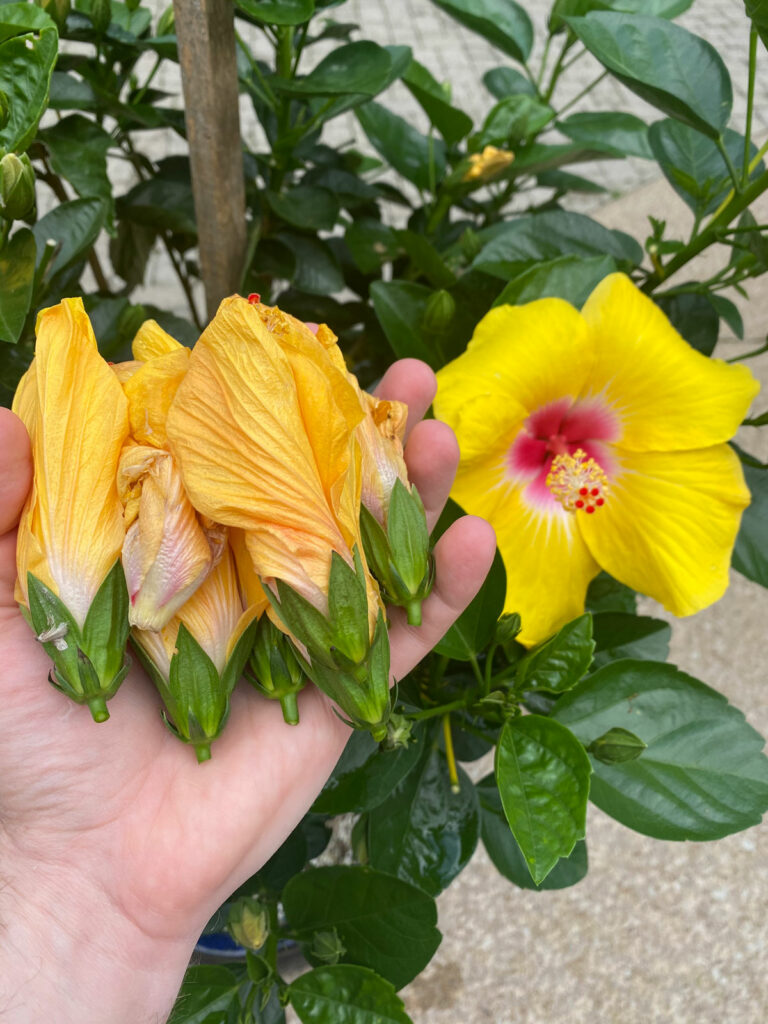
This is just the nature of the flowers. Flowers only last one full day, and then it's time to deadhead! Some newer varieties sometimes last a bit longer, but plan on short-lived flowers.
This is the way nature designed these plants so it is nothing that you are doing wrong.
Be sure to deadhead the flowers daily to keep the plant tidier since spent flowers can quickly make a mess.
I grow a lot of hibiscus outside in the summer, and deadheading the spent blossoms is a daily task to keep plants tidy.
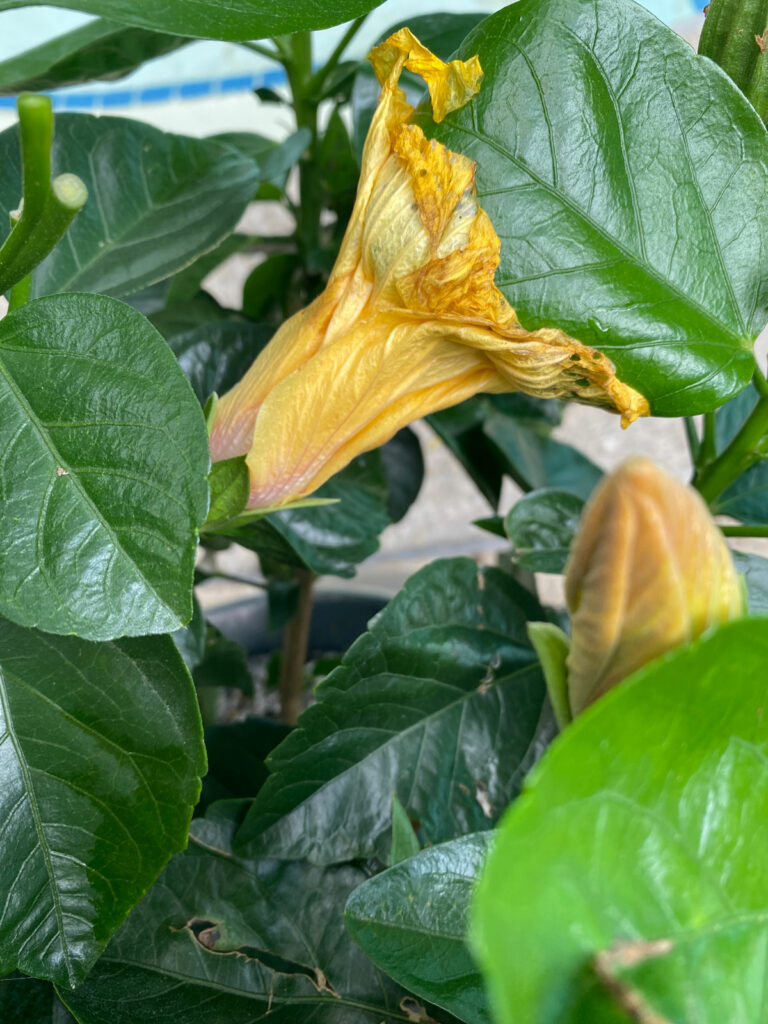
When your hibiscus flowers are done, be sure to deadhead promptly since the spent blossoms can smother the some of the foliage and encourage pests and diseases.
A spent hibiscus flower starting to decay on a leaf. For the best health and appearance, be sure to deadhead promptly!
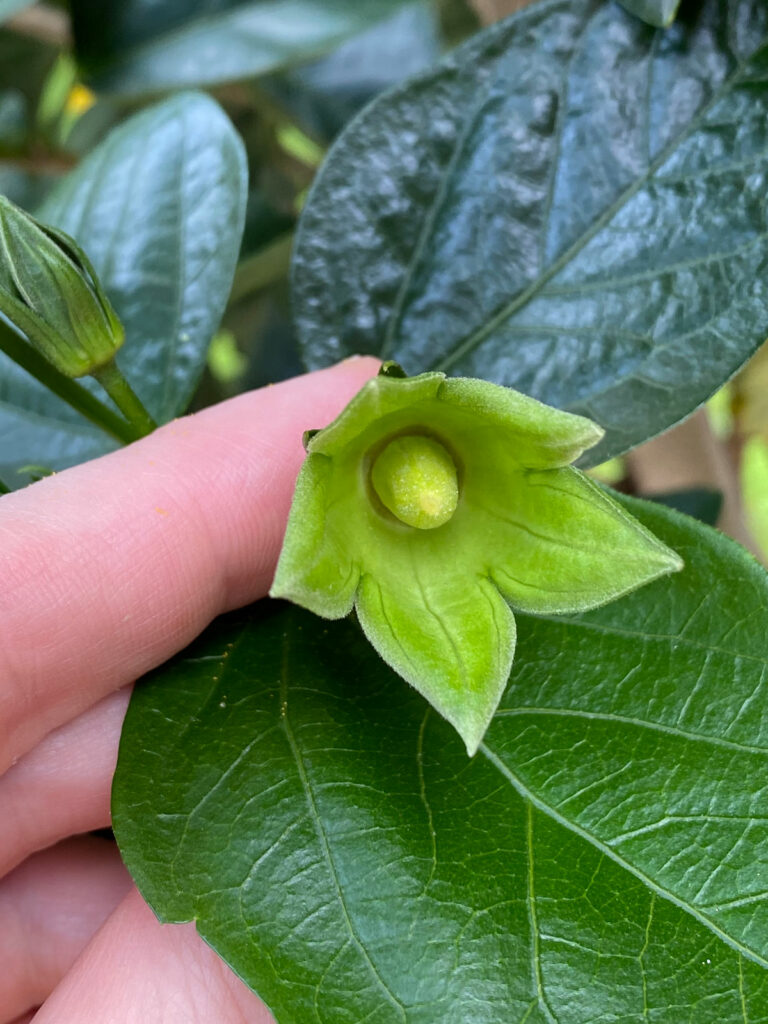
Be sure to also remove the base of the flower itself when you deadhead so that you don't have seed pods developing and taking energy away from your plant.
Make sure to also remove the base of the flower where the seed pod will form.
2. Why are my hibiscus flowers dying and falling off before opening?
Sometimes flower buds will fall off well before they open. Why does this happen?
There are quite a few reasons why this can happen. These can include:
1. Allowing your potting mix to go completely dry. If you let your plant get to the point of the foliage wilting, you will often see some flower buds fall off before opening.
2. Potting mix staying too wet. Never let your plant sit in water and stay sopping wet for extended periods.
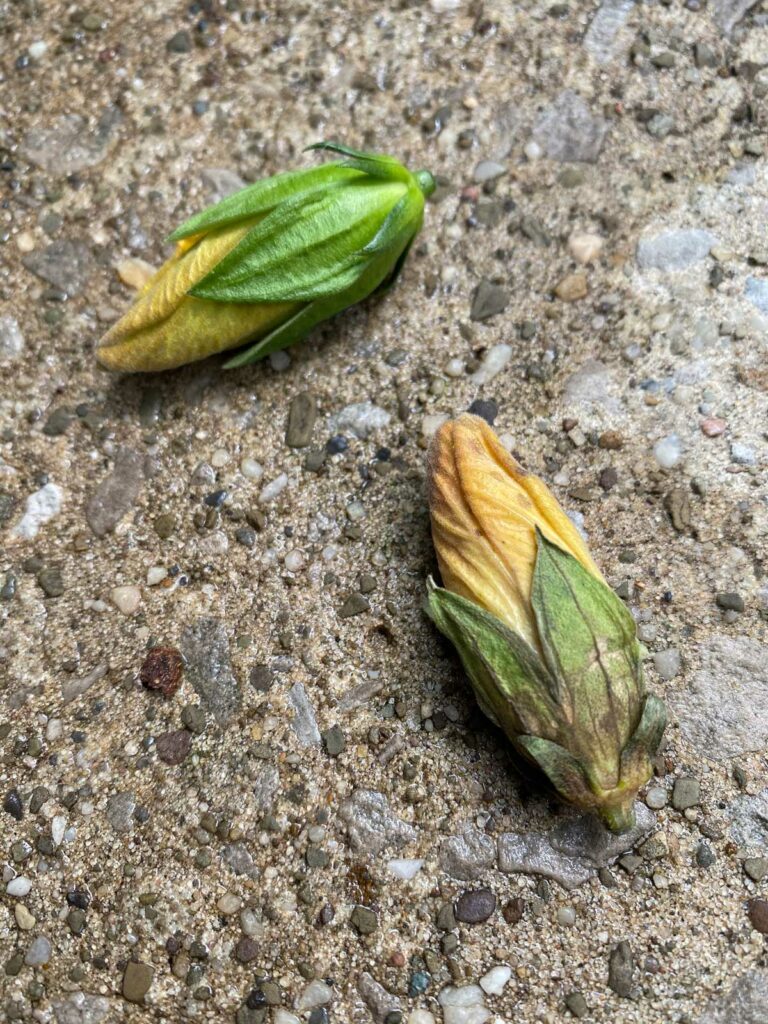
Two unopened buds that fell off after a period of excessive rain.
3. Reportedly, double-flowered hibiscus are more prone to buds dropping, but I commonly see it in any variety.
4. Extremes in temperature, either too cold (below 50F) or too hot (above 90F) can also cause bud drop.
If your plant appears healthy and green and isn't producing any flowers, it is very likely that your plant is not receiving enough direct sun. Whether you grow hibiscus indoors or outdoors, they need at least a few hours of direct sun in order to bloom .
Hibiscus are also heavy feeders and you must be sure that you're fertilizing enough.
Both sunlight AND fertilizing are vital for a blooming hibiscus.
A healthy hibiscus in prime shape will have a virtually continual supply of flower buds growing.
I grow my hibiscus outdoors in warm weather and treat them as annuals. When I purchase them in late Spring, I'll promptly move them into a larger pot (I typically go about 1-2 sizes larger than the container it was previously growing in.
Next, I like to use an application of Osmocote Plus (link to Amazon) when I repot it. After about 1 to 1 ½ months, I'll make another application of Osmocote Plus.
Osmocote is a time-release fertilizer that will gradually and continuously supply your plants with nutrients every time you water.
In addition to this application, I will also water my plants with Fish Emulsion & Kelp every 1-2 weeks.
Given the right conditions, including following this fertilization regiment (along with plenty of sunshine outdoors), my hibiscus plants bloom continually all summer-long!
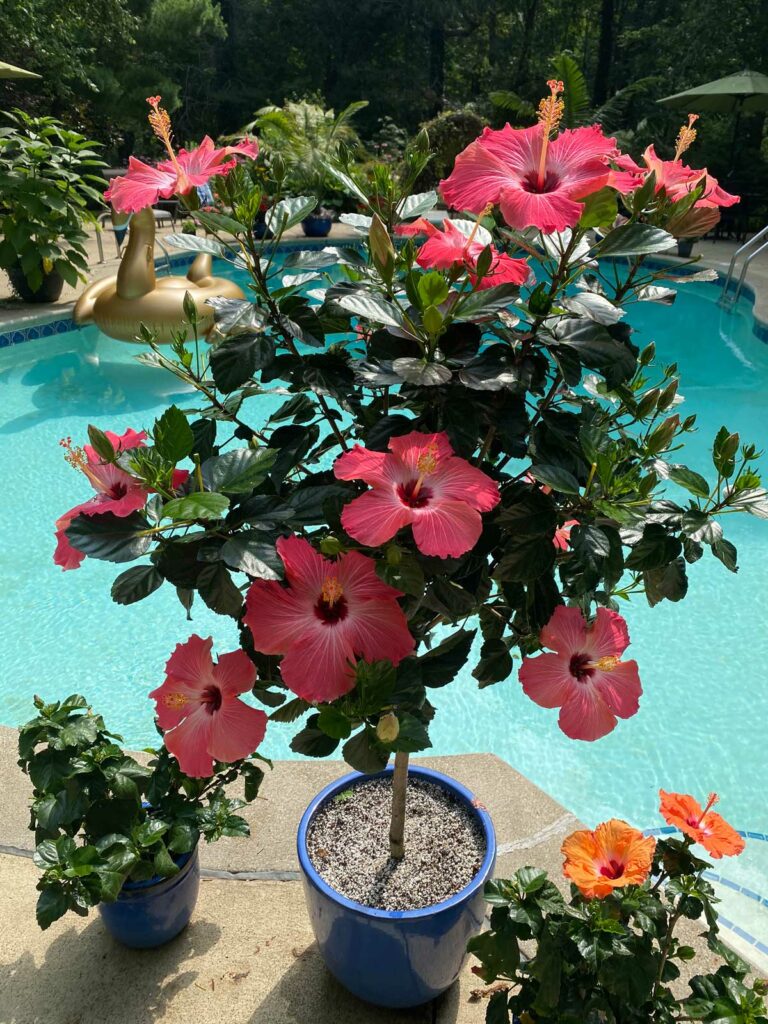
A particularly good day on my pink hibiscus!
For more detailed information how getting your hibiscus to flower abundantly, check out my post: How to Get Hibiscus to Bloom.
4. Why is my hibiscus getting yellow leaves?
A yellow leaf or two is normal, but if you start to see quite a bit of them, and quickly, it's time to evaluate the cause. Like any plant problem, there are several different causes:
Extremes in soil moisture (too dry or too wet) is a common cause of yellow leaves. Feel your potting mix. If it has gone bone dry, go ahead and promptly soak your plant thoroughly. On the opposite end, NEVER let your plant sit in water for extended periods of time. Always grow in a pot with a drainage hole and empty out any accumulated water that could have collected in the saucer.
Extremes in temperature. Tropical hibiscus love it WARM and typically do best in the 65-85F temperature range. Temperatures that are too cold or too hot can result in yellow leaves. Cold, drafty windows indoors, or when temperatures start to get cold outside if you're growing them outdoors, can cause this.
If you're moving a plant that has been growing lush and beautifully outdoors and move it indoors, hibiscus will often respond in protest with quite a few yellow leaves. There is much less light indoors and the plant can not support all of the foliage that it developed while it was growing outdoors.
Spider mites can also cause yellow leaves. Leaves will typically appear a mottled yellow and will continually turn more yellow over time. Looks closely to find the characteristic fine webbing of the spider mites (including on the underside of leaves). Spider mites thrive in hot, dry conditions, especially when there are low levels of humidity. Check out my blog post on how to treat spider mites.
5. Why does my hibiscus have yellow leaves with green veins?
This is likely a symptom of chlorosis, and a classic sign would be where the leaf veins remain green, but the rest of the leaf turns yellow.
There are many causes of chlorosis, including an iron or magnesium deficiency, soil that is too acidic or alkaline, waterlogged soil, and any pests/diseases affecting the roots.
6. What is eating my hibiscus flowers?
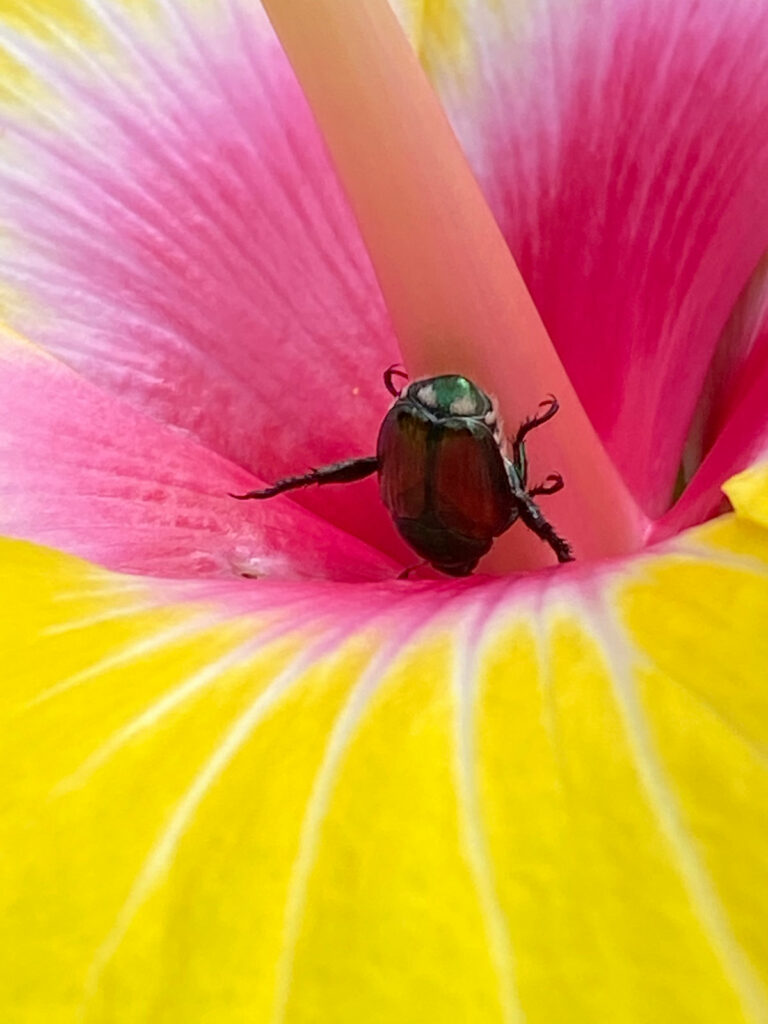
There are a number of pests can you affect hibiscus, but the one that typically affects mine outdoors are Japanese beetles.
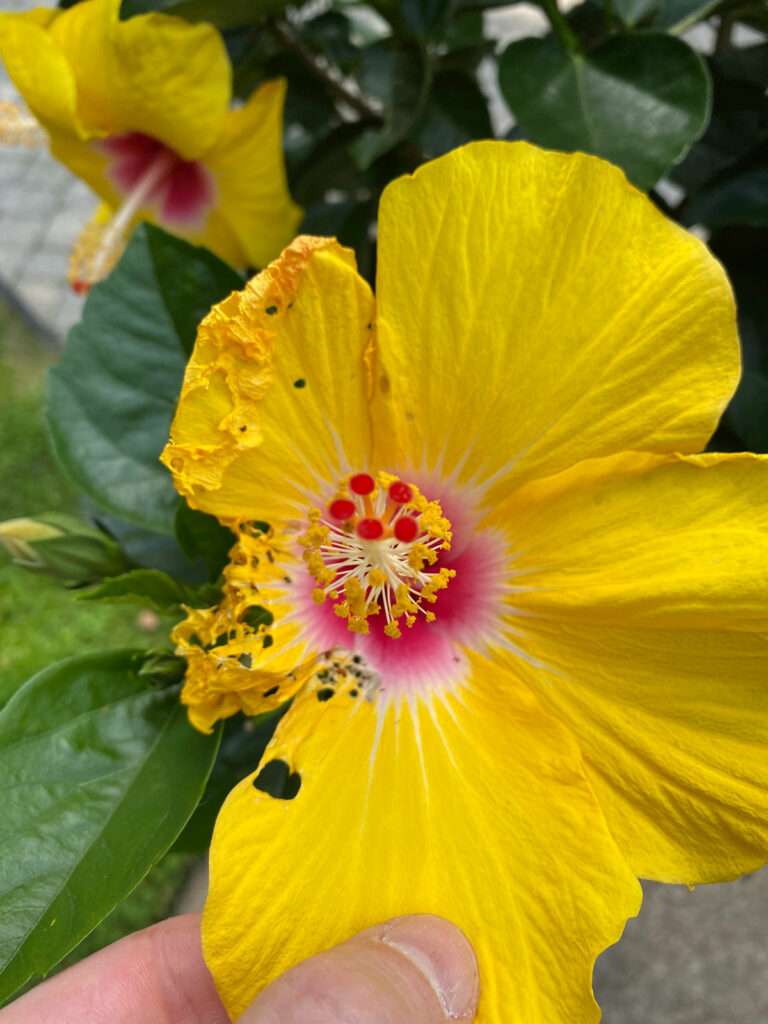
Without fail, for me, they start to appear around the beginning of July and persist for about a month. I often see them eating right through new flower buds, well before they open, and they will also attack fully opened flowers as well.
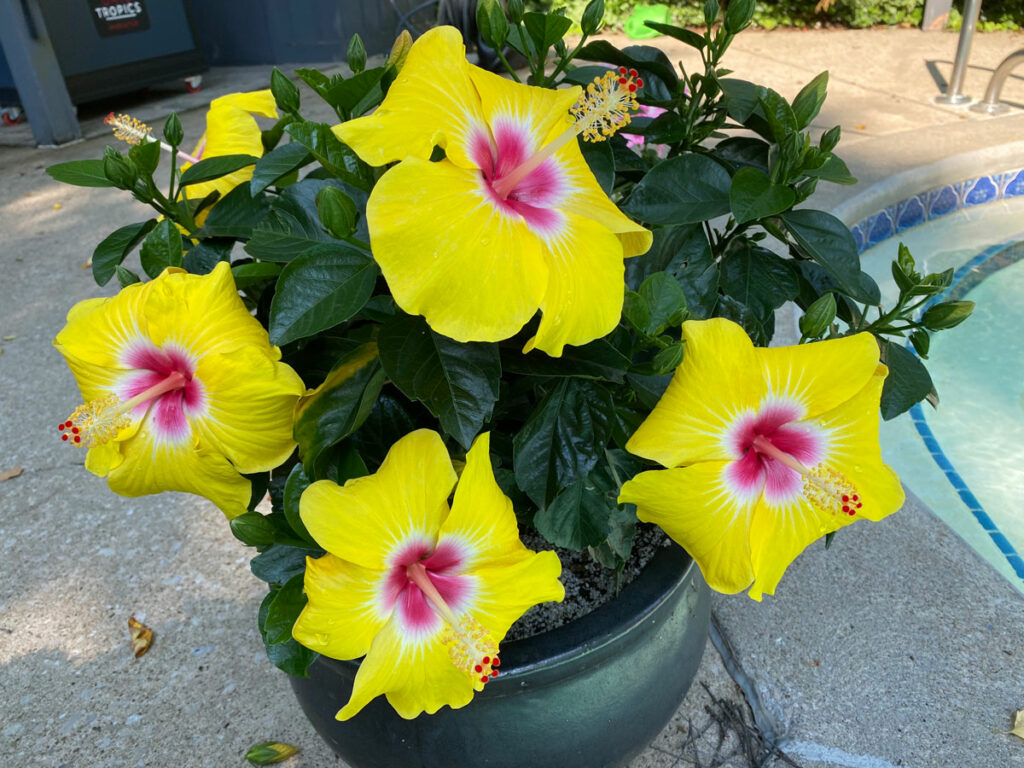
A Japanese beetle on one of my yellow hibiscus plants
Here is what Japanese beetle damage looks like on hibiscus flowers.
You'll want to look on the undersides of the flowers too to find the Japanese beetles.
Did you know that grubs in your grass actually grow up to be Japanese beetles? Be sure not to miss my blog post that talks about how to deal with Japanese beetles.
If I notice them on my hibiscus flowers, I'll either pick them off and throw them on the ground and step on them, or flick them into a cup of soapy water. You'll want to be consistent and do this daily if you notice Japanese beetles on your plants.
Some other major pests of hibiscus include white flies, aphids, and mealybugs, all of which are easily treated with an insecticidal soap. You can also try neem oil, though I'm not a fan of the smell and I find insecticidal soaps are more effective.
7. Why is my hibiscus wilting?
The most common reason for a wilting hibiscus is soil that has gone too dry. Hibiscus truly despise when their soil goes completely dry, and the entire plant will wilt. If you feel your soil and it is bone dry, promptly soak it.
A dehydrated hibiscus can die pretty quickly if you leave it dry for too long.
Plants can also wilt when under stress from temperature extremes (too cold or too hot).
If you are growing your plants outdoors in pots like I do, when it gets too cold, you can move them indoors if you are planning on saving your plant over the winter time.
On any hot day, make sure that you keep your plants watered enough if you keep your plants outdoors. They will usually need watering daily in hot, sunny weather.
TROPICAL HIBISCUS PLANT CARE
LIGHT
For best results, give your hibiscus full sun to partial shade for good growth and flower production. Without enough sun, your plant will give you few, if any blooms and no one purchases these as foliage plants! These are full-sun plants so give your plant the brightest location that you can.
Just be careful when you do increase light for your plant so that you're not burning the foliage. If you have a hibiscus indoors that you'd like to move outdoors, always place it in full-shade first outdoors for several days and then gradually increase the sun exposure.
If you fail to acclimate your plant slowly enough, you may see white splotches on your leaves that resulted from sun scorch.
To elaborate a bit more on light, if you're growing these plants indoors, give them the sunniest window possible.
I live in Ohio, where I normally grow mine only outdoors in pots, and I give them the sunniest position possible.
If you live in any areas that have very strong sun, in addition to very hot conditions, you may want to give them only a half day of sun outdoors.
WATERING
During hot and dry weather, regular watering is a must, and if you grow hibiscus outdoors in pots like I do, they will usually require watering daily so be sure to provide them with enough water.
If you let your potting mix dry out completely, the lower leaves will often turn yellow. Do this repeatedly, and you will lose a lot of leaves.
It is best to try and maintain a fairy moist potting mix for your plant and avoid extremes in soil moisture. I would recommend aiming for a pretty evenly moist soil and only allow the top inch or two to dry out before watering again.
Good drainage is essential so always grow hibiscus in pots with drainage holes. Root rot can quickly set in if you allow your plant to sit in excessive moisture.
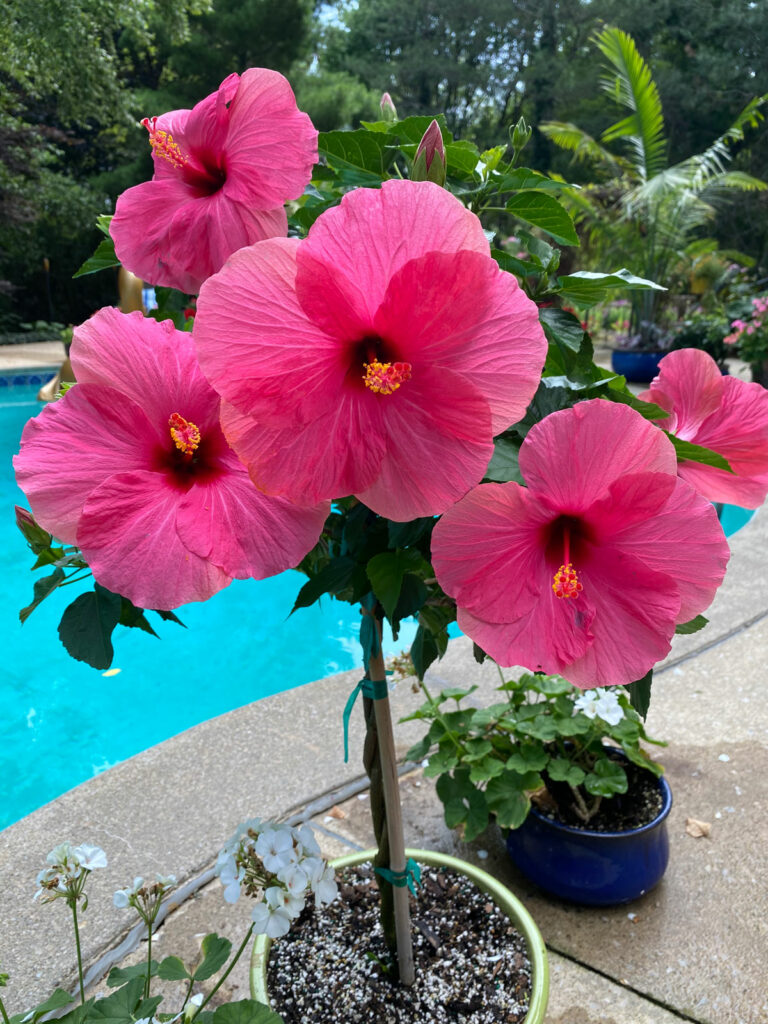
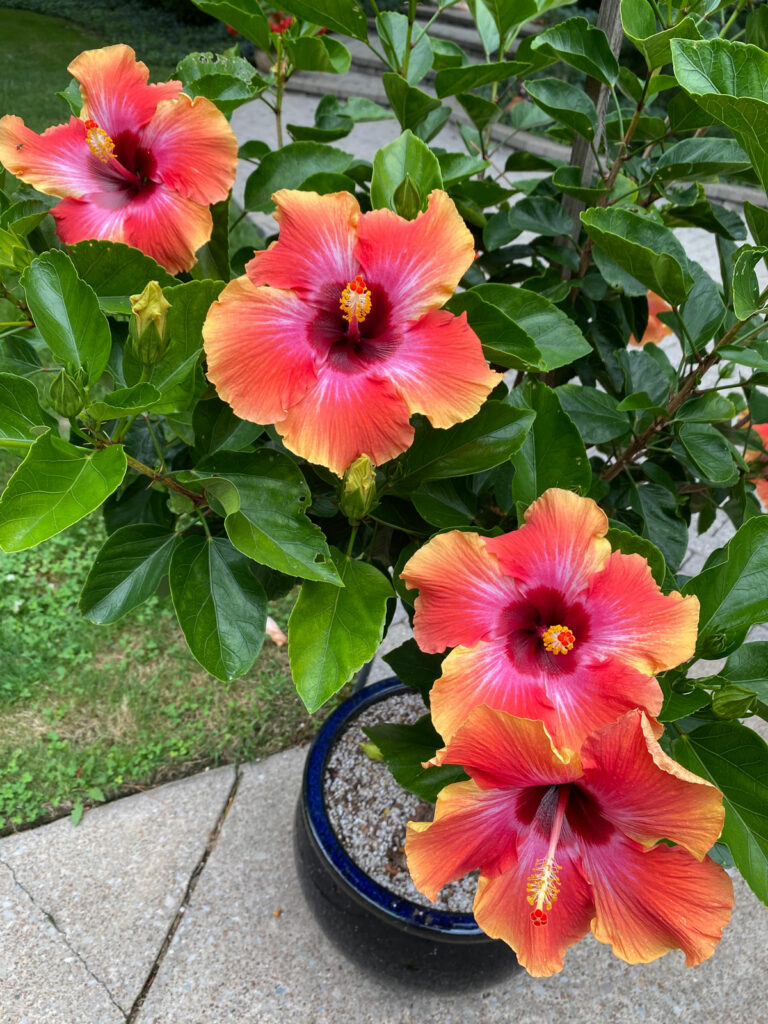
One of my very favorite hibiscus, this one is part of the Hollywood Hibiscus line.
TEMPERATURE
Being tropical plants, hibiscus are freeze babies and love warm weather. These are NOT hardy plants and will freeze and die in temperatures at or below freezing.
Even temperatures in the 40-50F range will cause your plant to start shutting down and suffer. An ideal temperatures range is 65-85F.
FERTILIZING
Fertilizing is a MUST in order to have a healthy, blooming plant.
Hibiscus are heavy feeders so be sure to regularly fertilize for best results.
A well fertilized plant will produce an abundance of flowers.
REPOTTING
When you purchase a hibiscus from the garden center, most of the time they're going to be pretty root bound and will dry out very quickly in the nursery pots that they're growing in.
In my experience, it is very important to not keep them in these containers and transplant them into a pot that is 1-2 sizes bigger than their old pot.
If you don't do this, it may be too difficult to keep your plant properly hydrated, thus causing a host of different issues.
You can use a variety of different potting mixes, but what I usually do is mix about 3 parts of Miracle Gro potting mix with 1 part of perlite to fluff things up a bit and improve drainage.
If you'd like to keep your hibiscus plants over the winter, check out my blog post on a 5 step process that you can use for overwintering hibiscus.
FREQUENTLY ASKED QUESTIONS
Can you grow hibiscus from seed?
Yes you can, but the resulting plants can vary and may not look like the parent plant. It's always a gamble, but fun to try if you have the patience. Check out this informative article from Hidden Valley Hibiscus for more details if you are interested.
How can you tell the difference between a hibiscus seed pod and a flower bud?
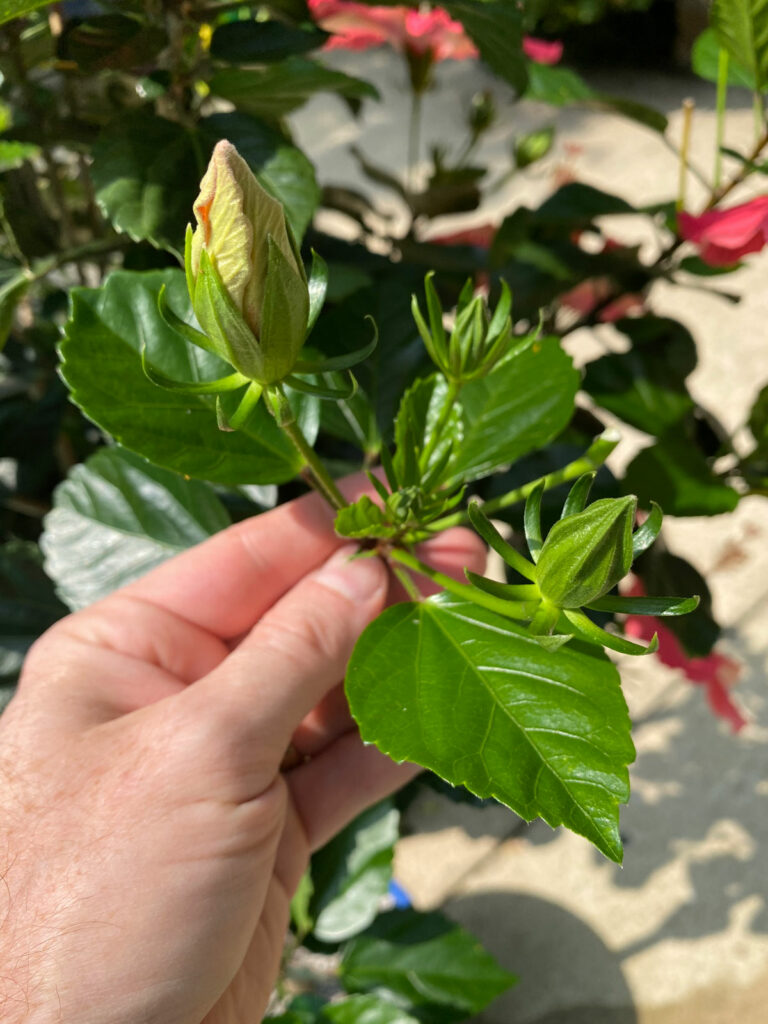
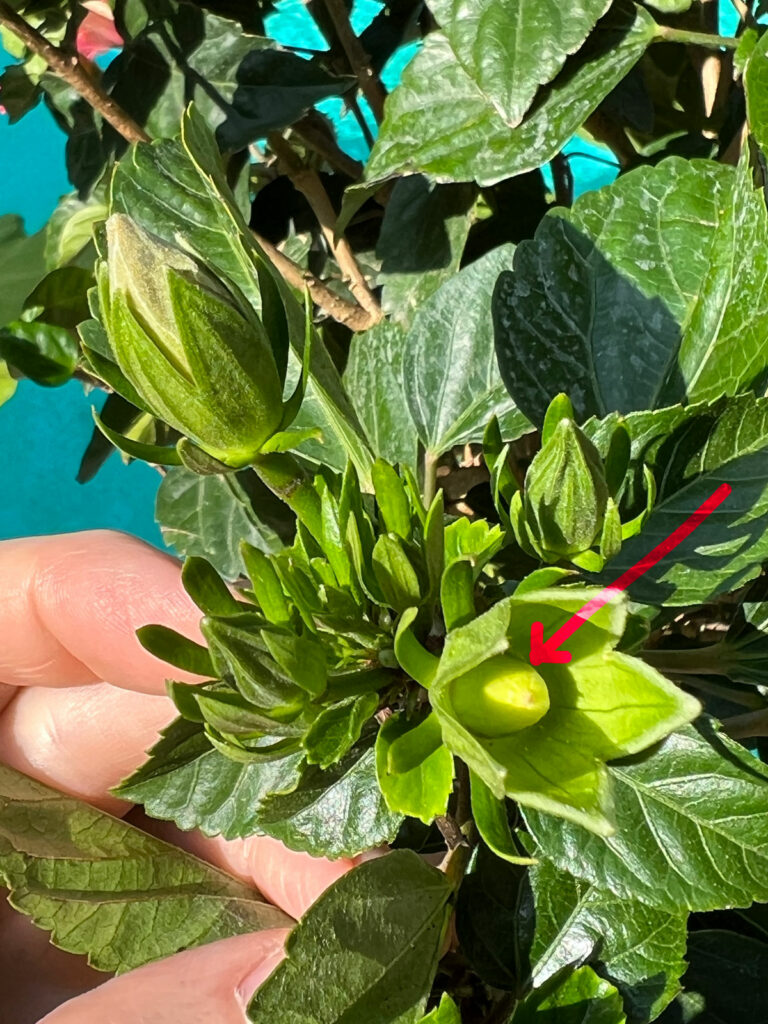
If you look closely, you can easily tell the difference. Take a look at the photos below.
In the picture above, I placed a red arrow pointing to the hibiscus seed pod. The rest of that cluster contains all flower buds in different stages of development.
You can see that the seed pod is round, while the flower buds are pointy at the tips and have edges on them.
Should I remove hibiscus seed pods?
Yes, although the spent flowers themselves usually fall off, you should also remove the seed pods so that that your plant can continue to focus its energy on flower production instead of setting seed.
Are hibiscus plants annuals or perennials?
The long answer is they are perennials, but sometimes they act as annuals. There are more varieties than just tropical hibiscus. Check out my post on are hibiscus plants annuals or perennials to learn the answer, and to learn more about the common types that are grown in gardens.
My hibiscus got a fungus and I got it thru that but I over watered it. I repotted it so that it could dry out. There is nothing left but stems. I clipped the stems and they are still showing green inside. I have been completely misting it every day and carefully watering it when it needs it. Should I give up on it or keep up the misting?
I have been waiting to hear if I should give up on my hibiscus or not, but I never got an answer.
It is just sticks for limbs. I am determined to save it if I can because my daughter gave it to my birthday and I just love it. It was so beautiful and I was so proud to show it off especially when it bloomed. Then it got the fungus. Please help me. It will break my heart to throw it away but it is pretty silly to mist a dead plant. Thank you so much Suzy
@Suzy, So sorry I didn't see your answer I am 80 years old and have cataracts so I don't see really well. My sincere apology. Now to answer your question. The last trauma for the poor thing was I over watered it. I took it out of the pot it was in and put it in another one a little larger. I hoped it would help dry it out and give it more growing room. It came back a little
and has just turned into a twig tree. I swear I can see it trying to sprout here and there but it just might be wishful thinking. Thank you again for help.
My hibiscus has done well for several years. This year it had only a few blossoms and the leaves would wilt, but when I watered it they would perk up. I checked the soil around the plant and it was moist but not sopping wet. The only thing I did differently was I usually take a lawn bag full of leaves and place it over the top of the whole plant for the winter which I did not do this past winter. It is an outdoor plant and is on the west side of our house. Any ideas what might have happened?
Greetings!
I started with one dinner plate hibiscus plant in 2003. I live in Minneapolis, MN. It gets really cold here. I thought it was an annual, but we had a mild winter and it came back in year two! But the next winter was too cold.
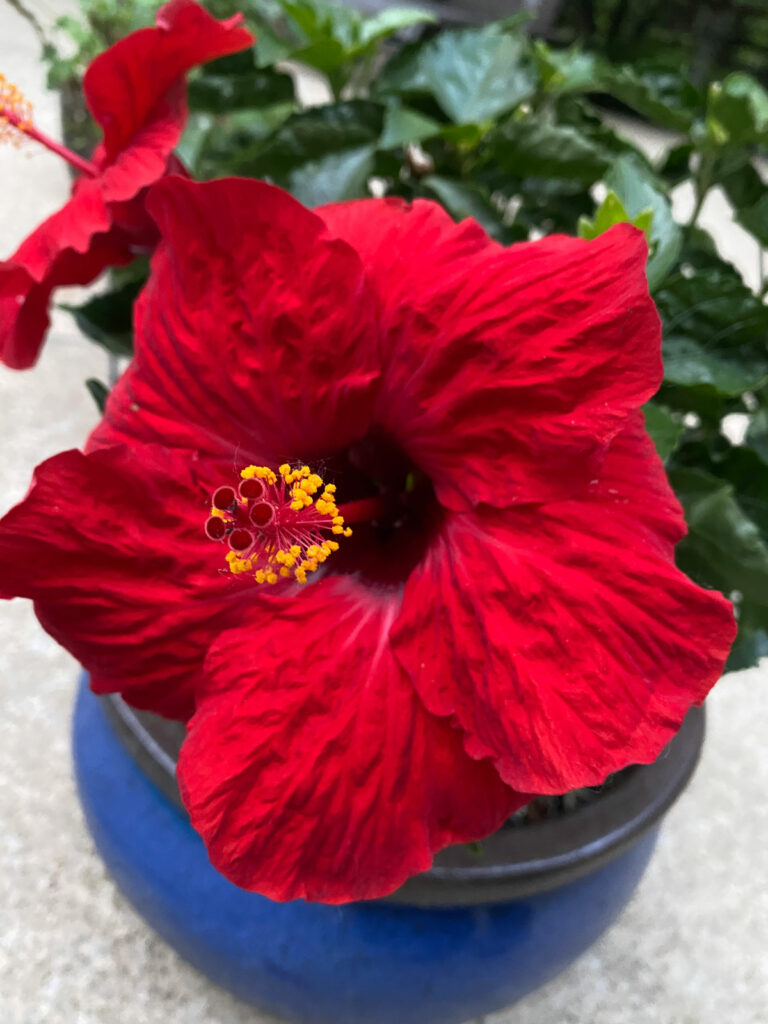
So I got a different type of hibiscus. It’s the red one with the yellow stamen in your photos above. I’ve had her since 2005. She is very special to me. She summers in the garden and winters in our south facing windows. She traditionally blooms all winter long. One bloom a day. She has been our Hanukkah bush/Christmas tree since 2005.
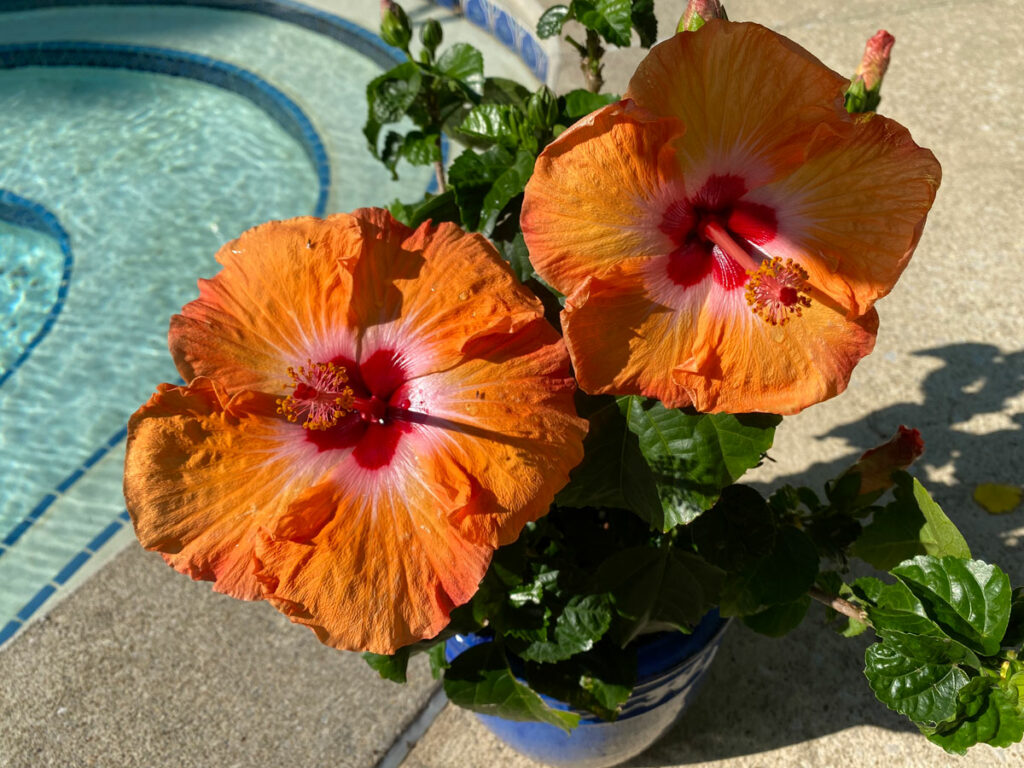
Last year we got another hibiscus, sort of golden orange! Spectacular.
I’m not much of a plant person, but I’ve fallen in love with Hibiscus. I winter in Mexico and they call it Jamaica (pronounced Ha-Mike-Ah). I now order the organic whole from Amazon and drink it every day. The rehydrated flowers can be used for dishes such as Hibiscus barbacoa. They are a very meaty flower bud! They are perfect of the inside of a taco! But I digress!
I’m desperate. The original hibiscus, dropped all of her leaves but two overnight in May right as the weather got hot here. Only the branch that the two living leaves survived is now producing leaves. I tried to cut the other stalks back to see if they would produce. So now I don’t know what to do. The one branch has basically sprouted a healthy plant from it but the rest of the plant is dormant or not producing. I don’t know what to do. I want to keep the plant alive. Is there a way to replant that one branch so that it will sprout roots and become the main stalk?
I love this hibiscus so much. I don’t want to lose it. Any recommendations would be welcome!
Do you know why your plant dropped all its leaves? You mentioned it got hot. I'm assuming that you didn't keep up with the watering and it probably dried out a lot and proceeded to drop its leaves. Does this seem to be the case? As long as the branches are not completely dried out and are still flexible, it should come back with the appropriate attention to light, watering, etc. You can prune it back a bit to help encourage new growth and bushiness. You can also propagate with tip cuttings if you're like. I would recommend placing tip cuttings in a small pot and keep the humidity high as its trying to root. Perhaps with a plastic bag on top. Hope this helps a bit!
Leaves on one of my five tropical hibiscus are an unhealthy looking dark green and many yellow ones. Flowers are now smaller and less robust. I’ve sprayed frequently with seven for little tiny bugs, and all five receive regular watering and deadheading. Only one seems to be unhealthy.
I have “ dinner plate” hibiscus, I’ve had them approximately 23 years. The plants were well established when we purchased the home. It’s super hot here 90-100 but I’ve never had a problem. They get afternoon sun and are watered twice a day for about 5 minutes. I currently have tons of brown dried blooms that never bloomed. Can you provide any guidance?
Hi Denise! I assume you're talking about the hardy hibiscus that come back every year? I assume you have yours in the ground?
Are you thoroughly soaking the soil? I'm wondering if you need to leave the hose on for longer, especially in those temperatures.
Hi Paula! It's hard to say without more details since it can be caused by a lot of things. Are you doing anything differently than what I describe in the post when it comes to light, watering, fertilizing?
My hibiscus froze twice in the last two yrs the first yr in the spring it grew back real good the second yr it froze again this time it came back but it only grew a few inches and hasn’t grown since then what may cause that it use to be a very healthy plant I water it every two or three day but to no avail what may be the solution thanks
It's hard to say without seeing a photo, but have you had any strong winds lately maybe? That's the only thing I can think of if you haven't seen any pests.
Hi,
My hibiscus has lots of buds but they don’t open. Some of the brunches have 5-6 buds each! It’s brunches have become very tall too. I put neem oil on it, fertilized it, I don’t know what else to do. Now I’m thinking of cutting off the brunches and buds to see if that helps the plant, give it strength. Now it has some yellow leaves too. I wish I could attach some pictures to this. Please let me know what may be wrong. Thanks
Hi Monica! Use the contact form on my website to send me an email. Please include all the care details, and when I reply back, you can attach some photos. I can try and help!
I also live in Ohio. Mine are doing quite well in my patio in pots. I'd love to move them indoors during the winter. What else can I do to care for them over the winter?
Hi Summer! Do you have any really sunny windows? I'd recommend placing them directly in front of the sunniest window you have. If you don't have any particularly sunny windows, you can supplement with grow lights. Don't be surprised though when they shed some leaves during the transition indoors. It's a perfectly normal response to adjusting to less light.
Thanks for the advice I has a purple herbiscus I had to move it due to garden works at the start of summer. I transplanted it in another flower bed with compost and fed it plant food but it is wilting I'm dead heading the leaves that are dieing but the plant is still most and serving is there anything else I need to do
Hi Lisa! It's hard to say without more details. It sounds like it may have suffered some transplant shock when you dug it up? Maybe find a way to provide it with some temporary shade if you can, while it recovers.
I have lost two Luna hibiscus. They were thriving after I planted them. In the autumn, I trimmed the plant down to about two inches from ground as I have read is proper care. Yet, neither Luna has emerged. There is no growth. I added kemp and emulsified fish to soil. But they failed to give me any growth. I am so disappointed. It is early July here in Florida so In all likelihood they are dead. I just don’t know what I did wrong.-Nancy
Hi Nancy! I'm sorry to hear about your hibiscus. I would never recommend trimming your hibiscus down that far. Whatever source you used was not correct...unless they were talking about the hardy hibiscus and you mistakenly took that advice for tropical hibiscus. They are completely different plants. Some pruning can be beneficial for tropical hibiscus, but there really should be no reason to trim it down that drastically, especially where you live. If you haven't seen any growth by now, the plant probably did not make it. Next time, if you need to trim your plant, I'd recommend not taking off more than 1/3 or so of the plant.
hi! my hibiscus trunk is completely blacked when i checked to see if it was alive. at one point it was pot bound and i fixed it but it’s been weeks and hasn’t come back
Sorry to hear that! I'd need more details to help. If you want to send me an email through the contact form on my website, when I reply, you can send a photo and I can try and help more. I'd need to know details of the conditions that you've had your plant growing in, in order for me to best help you.
My hibiscus has gotten to much water during a flash flood watch , it is wilting & my bloods are drooping, how do I get it to dry out, do I need to change pots? It was so beautiful but not so much now.It is extremely hot also right now.
My hibiscus are struggling with excessive heat (they are planted in the ground). Can I prune back in order to "reset" them during the summer or will that cause them even more stress?
Hi Heather, I would compensate by watering it more if you can. Has it gotten really dry as well? Pruning will not cause them more stress, but if your plants are not getting enough water during the heat, I would make hydration the primary concern.
Hi, I just planted 2 trees in the ground, I live in concord California, one seems to be doing ok, the other one has very limp leaves. Not doing to good. It’s hot here, I water them every day. I fertilized them when I planted them. Don’t know what else I should do.
Hi Sue, I would need more information to help as there can be many factors. If it's really hot and sunny and the plant suffered from transplant shock, it could be causing stress on the plant. Give it some more time, be diligent with watering, and maybe provide some shade for the plant that looks wilted. Maybe place an umbrella over it while it recovers a bit?

My hibiscus got a fungus and I got it thru that but I over watered it. I repotted it so that it could dry out. There is nothing left but stems. I clipped the stems and they are still showing green inside. I have been completely misting it every day and carefully watering it when it needs it. Should I give up on it or keep up the misting?
I have been waiting to hear if I should give up on my hibiscus or not, but I never got an answer.
It is just sticks for limbs. I am determined to save it if I can because my daughter gave it to my birthday and I just love it. It was so beautiful and I was so proud to show it off especially when it bloomed. Then it got the fungus. Please help me. It will break my heart to throw it away but it is pretty silly to mist a dead plant. Thank you so much Suzy
@Suzy, So sorry I didn't see your answer I am 80 years old and have cataracts so I don't see really well. My sincere apology. Now to answer your question. The last trauma for the poor thing was I over watered it. I took it out of the pot it was in and put it in another one a little larger. I hoped it would help dry it out and give it more growing room. It came back a little
and has just turned into a twig tree. I swear I can see it trying to sprout here and there but it just might be wishful thinking. Thank you again for help.
My hibiscus has done well for several years. This year it had only a few blossoms and the leaves would wilt, but when I watered it they would perk up. I checked the soil around the plant and it was moist but not sopping wet. The only thing I did differently was I usually take a lawn bag full of leaves and place it over the top of the whole plant for the winter which I did not do this past winter. It is an outdoor plant and is on the west side of our house. Any ideas what might have happened?
Has it been in the same pot for all those years? Maybe it's really root bound.
Greetings!
I started with one dinner plate hibiscus plant in 2003. I live in Minneapolis, MN. It gets really cold here. I thought it was an annual, but we had a mild winter and it came back in year two! But the next winter was too cold.
So I got a different type of hibiscus. It’s the red one with the yellow stamen in your photos above. I’ve had her since 2005. She is very special to me. She summers in the garden and winters in our south facing windows. She traditionally blooms all winter long. One bloom a day. She has been our Hanukkah bush/Christmas tree since 2005.
Last year we got another hibiscus, sort of golden orange! Spectacular.
I’m not much of a plant person, but I’ve fallen in love with Hibiscus. I winter in Mexico and they call it Jamaica (pronounced Ha-Mike-Ah). I now order the organic whole from Amazon and drink it every day. The rehydrated flowers can be used for dishes such as Hibiscus barbacoa. They are a very meaty flower bud! They are perfect of the inside of a taco! But I digress!
I’m desperate. The original hibiscus, dropped all of her leaves but two overnight in May right as the weather got hot here. Only the branch that the two living leaves survived is now producing leaves. I tried to cut the other stalks back to see if they would produce. So now I don’t know what to do. The one branch has basically sprouted a healthy plant from it but the rest of the plant is dormant or not producing. I don’t know what to do. I want to keep the plant alive. Is there a way to replant that one branch so that it will sprout roots and become the main stalk?
I love this hibiscus so much. I don’t want to lose it. Any recommendations would be welcome!
Thanks!
Do you know why your plant dropped all its leaves? You mentioned it got hot. I'm assuming that you didn't keep up with the watering and it probably dried out a lot and proceeded to drop its leaves. Does this seem to be the case? As long as the branches are not completely dried out and are still flexible, it should come back with the appropriate attention to light, watering, etc. You can prune it back a bit to help encourage new growth and bushiness. You can also propagate with tip cuttings if you're like. I would recommend placing tip cuttings in a small pot and keep the humidity high as its trying to root. Perhaps with a plastic bag on top. Hope this helps a bit!
Leaves on one of my five tropical hibiscus are an unhealthy looking dark green and many yellow ones. Flowers are now smaller and less robust. I’ve sprayed frequently with seven for little tiny bugs, and all five receive regular watering and deadheading. Only one seems to be unhealthy.
I have “ dinner plate” hibiscus, I’ve had them approximately 23 years. The plants were well established when we purchased the home. It’s super hot here 90-100 but I’ve never had a problem. They get afternoon sun and are watered twice a day for about 5 minutes. I currently have tons of brown dried blooms that never bloomed. Can you provide any guidance?
Hi Denise! I assume you're talking about the hardy hibiscus that come back every year? I assume you have yours in the ground?
Are you thoroughly soaking the soil? I'm wondering if you need to leave the hose on for longer, especially in those temperatures.
I love my hibiscus. I'm in Florida & the leaves are curling & it's not flowering. Help please 🙂
Hi Paula! It's hard to say without more details since it can be caused by a lot of things. Are you doing anything differently than what I describe in the post when it comes to light, watering, fertilizing?
My hibiscus froze twice in the last two yrs the first yr in the spring it grew back real good the second yr it froze again this time it came back but it only grew a few inches and hasn’t grown since then what may cause that it use to be a very healthy plant I water it every two or three day but to no avail what may be the solution thanks
Other than giving it plenty of sun, water and fertilizer, that's all I would recommend. If it's not in a sunny spot, you might consider moving it.
I have a hibiscus that some of the flowers are splitting. They don't seem to be eaten or diseased. Any ideas?
It's hard to say without seeing a photo, but have you had any strong winds lately maybe? That's the only thing I can think of if you haven't seen any pests.
Hi,
My hibiscus has lots of buds but they don’t open. Some of the brunches have 5-6 buds each! It’s brunches have become very tall too. I put neem oil on it, fertilized it, I don’t know what else to do. Now I’m thinking of cutting off the brunches and buds to see if that helps the plant, give it strength. Now it has some yellow leaves too. I wish I could attach some pictures to this. Please let me know what may be wrong. Thanks
Hi Monica! Use the contact form on my website to send me an email. Please include all the care details, and when I reply back, you can attach some photos. I can try and help!
I also live in Ohio. Mine are doing quite well in my patio in pots. I'd love to move them indoors during the winter. What else can I do to care for them over the winter?
Hi Summer! Do you have any really sunny windows? I'd recommend placing them directly in front of the sunniest window you have. If you don't have any particularly sunny windows, you can supplement with grow lights. Don't be surprised though when they shed some leaves during the transition indoors. It's a perfectly normal response to adjusting to less light.
Thanks for the advice I has a purple herbiscus I had to move it due to garden works at the start of summer. I transplanted it in another flower bed with compost and fed it plant food but it is wilting I'm dead heading the leaves that are dieing but the plant is still most and serving is there anything else I need to do
Hi Lisa! It's hard to say without more details. It sounds like it may have suffered some transplant shock when you dug it up? Maybe find a way to provide it with some temporary shade if you can, while it recovers.
I have lost two Luna hibiscus. They were thriving after I planted them. In the autumn, I trimmed the plant down to about two inches from ground as I have read is proper care. Yet, neither Luna has emerged. There is no growth. I added kemp and emulsified fish to soil. But they failed to give me any growth. I am so disappointed. It is early July here in Florida so In all likelihood they are dead. I just don’t know what I did wrong.-Nancy
Hi Nancy! I'm sorry to hear about your hibiscus. I would never recommend trimming your hibiscus down that far. Whatever source you used was not correct...unless they were talking about the hardy hibiscus and you mistakenly took that advice for tropical hibiscus. They are completely different plants. Some pruning can be beneficial for tropical hibiscus, but there really should be no reason to trim it down that drastically, especially where you live. If you haven't seen any growth by now, the plant probably did not make it. Next time, if you need to trim your plant, I'd recommend not taking off more than 1/3 or so of the plant.
hi! my hibiscus trunk is completely blacked when i checked to see if it was alive. at one point it was pot bound and i fixed it but it’s been weeks and hasn’t come back
Sorry to hear that! I'd need more details to help. If you want to send me an email through the contact form on my website, when I reply, you can send a photo and I can try and help more. I'd need to know details of the conditions that you've had your plant growing in, in order for me to best help you.
My hibiscus has gotten to much water during a flash flood watch , it is wilting & my bloods are drooping, how do I get it to dry out, do I need to change pots? It was so beautiful but not so much now.It is extremely hot also right now.
It should dry out on its own, especially if it's hot. You may stress it further if you try anything else right now.
My hibiscus are struggling with excessive heat (they are planted in the ground). Can I prune back in order to "reset" them during the summer or will that cause them even more stress?
Hi Heather, I would compensate by watering it more if you can. Has it gotten really dry as well? Pruning will not cause them more stress, but if your plants are not getting enough water during the heat, I would make hydration the primary concern.
Hi, I just planted 2 trees in the ground, I live in concord California, one seems to be doing ok, the other one has very limp leaves. Not doing to good. It’s hot here, I water them every day. I fertilized them when I planted them. Don’t know what else I should do.
Hi Sue, I would need more information to help as there can be many factors. If it's really hot and sunny and the plant suffered from transplant shock, it could be causing stress on the plant. Give it some more time, be diligent with watering, and maybe provide some shade for the plant that looks wilted. Maybe place an umbrella over it while it recovers a bit?