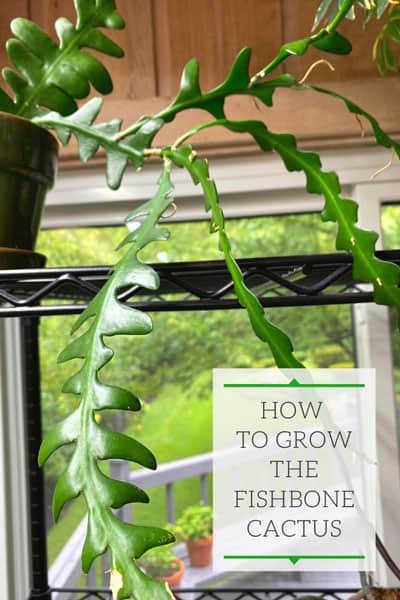
If you're looking for an unusual houseplant, look no further than the Fishbone Cactus (also known as Ric Rac Cactus or Zig Zag Cactus)! It is a striking houseplant visually, and easy to care for as well!
In this post, I will go into details on how to propagate fishbone cactus, how to care for the plant, as well as discuss flowering and other intriguing details!
Would you like to save this post?
Enter your email, and I will send this link straight to you!
Before I go into the propagation and care, I'd like to go over a bit about the natural habitat and also talk about a couple different species that are out there.
There is a lot of confusion on the topic. They're both considered fishbone cactus and the care is the same, but they are in fact different species!
Table of Contents
EPIPHYLLUM ANGULIGER VS. SELENICEREUS ANTHONYANUS
I know, those botanical names are a handful! Both of these species are considered Fishbone Cactus even though they are slightly different plants.
The main way to tell the difference is by looking at the flowers (if we are lucky enough for our plants to bloom!)
Take a look at the photos below. The flowers are gorgeous and only last a day, but the main way to tell the difference is in the color of the flowers.
Selenicereus anthonyanus (also classified at different points in time as Disocactus anthonyanus and Cryptocereus anthonyanus) have beautiful reddish/pink flowers.
The flowers make it super easy to tell the difference. Just by looking at the foliage, it may be a little trickier.
I found a resource that visually shows photos of the foliage of both species. You can visually see a difference in the foliage, and the Selenicereus anthonyanus foliage has more distinct and thinner "fishbones."
Based on that, I can't quite tell which one my plant is, because I have leaves on the same plant that look a little different. Hopefully one day my plant will flower and I will finally be able to know!
I have a hunch that it is Epiphyllum anguliger. Fortunately, the care is identical and that's all that matters.
Both of these plants are native to Mexico and are epiphytic cacti.
FISHBONE CACTUS PROPAGATION AND CARE
HOW TO PROPAGATE
My own plant that I grow was started from cuttings that a friend sent me. I'll briefly describe how I propagated my plant, and then talk about the care of Fishbone Cactus.
I water propagated my own plant, but you can easily place them in soil as well.
You can make several cuttings from a single leaf (it might technically be considered a modified stem) and root each one.
Just be careful though that you don't turn the cuttings upside down as they will not root! The part of the cutting that was closest to the pot will be the end that roots.
Aim to make each cutting about 3-4 inches long or so. There is no need to make them longer. The more cuttings you have, the fuller your resulting plant will be!
Once you make your cuttings, like any succulent or cactus, you need to allow your cuttings to dry and callous over before propagating. This is to ensure that your cuttings don't rot.
Simply let your cuttings air dry for a few days first.
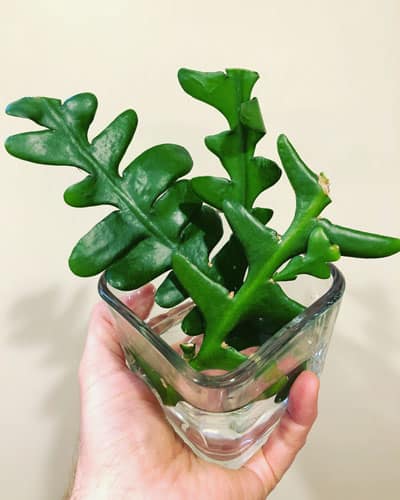
After a few days, you can place them in a vase with water to root, or directly into a pot of soil. I placed mine in water as shown below.
After a few weeks, or less, my cuttings rooted.
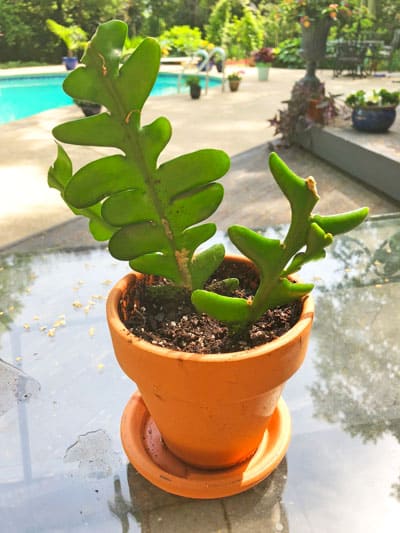
Once your roots about about an inch long or so, go ahead and plant them up into your potting mix (I'll describe that shortly).
After callousing over, you could have inserted the cuttings directly into soil, instead of in water, and the cutting would root this way too. Keep the soil barely moist to encourage rooting.
Keep in mind that it is always better to propagate in Spring or Summer during the growing season. Try and avoid propagation during the winter time when plants typically aren't doing much in the growing department.
My own plant grows in front of an Eastern facing window. These plants grow very well indoors with a few hours of sun, but don't overdo it. I'd recommend placing your fishbone cactus right in front of an Eastern window or Western window.
Avoid strong, mid-day sun.
These plants need warm temperatures to thrive, so keep your indoor temperatures comfortable. Never allow temperatures to fall below 50F (10C) so keep this in mind if you summer your houseplant outdoors.
WATERING
Always water thoroughly and allow all excess water to escape the drainage hole. Remember, these are epiphytes so they should never sit in water.
During the growing season, allow the top inch of the potting soil to dry out before watering again.
During the winter time when temperatures may be cooler indoors and there is less light, you can allow your soil to dry out a bit more (even completely) before watering again.
POTTING MIX
You can use a variety of potting mixes as long as your potting mix is extremely well drained.
For my own plant, I used a succulent mix to which I added some ¼" pumice (links to Amazon) to increase the drainage.
You can use whatever you have on hand though.
If you mix together 2 to 3 parts succulent mix with 1 part of either perlite or pumice, this will work beautifully. You can even use 1 part orchid bark instead of the perlite or pumice. Or a combination of all of these.
The goal is to have a very quickly draining potting mix and there isn't one magic potting mix. Many types will work!
If you're looking for an amazing potting mix that you can use straight out of the bag for your Ric Rac Cactus, check out the Tropical Succulent Soil Blend from Oh Happy Plants. This is an amazing mix and you will get 10% off at checkout automatically if you use my link.
FERTILIZER
I use my favorite all-purpose fertilizer called Dyna-Gro Grow. It is an AMAZING, premium fertilizer that contains all the micro and macro nutrients needed for plant growth.
I simply add ¼ teaspoon per gallon of water and use this every time I water.
AERIAL ROOTS
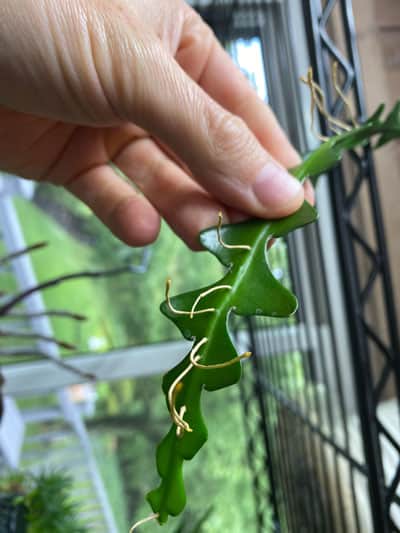
You may be wondering why you're seeing aerial roots on your plant.
Plants grow aerial roots for different reasons, and it is very normal for epiphytes to grow aerial roots.
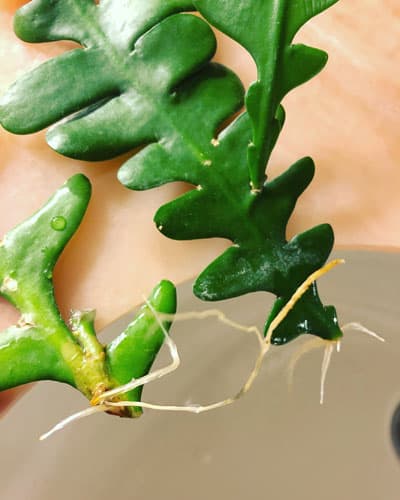
Take a look at the aerial roots on my plant.
Epiphytes are plants that grow on other plants (such as on trees) for support. They use their aerial roots to attach onto their host tree, but also to gather nutrients and water from the surrounding area, and from organic debris that may be laying around.
So when you do see aerial roots on your fishbone cactus, it is perfectly normal. The worse case is that maybe it is signaling that your plant is dry and needs to be watered. Be sure to check the potting medium and give it a good water if the soil just happens to be bone dry.
And don't forget that you should be fertilizing as a part of your care routine. I highly recommend Dyna-Gro Grow!
Do you have a fishbone cactus? Comment below. I'd love to hear!
My fishbone cactus is healthy! Two straight stems are growing from the top of two leaves. There are small arial roots coming out where it is straight. Do I cut off the straight stems or leave them?
Thank you!
I made a few cuttings of my fishbone cactus but they became limp and shrivelled after a day whilst waiting for it to callous, so I planted them in cactus soil but they're still limp. I only sprayed the top with water to keep the cuttings in place. Some even became discoloured. Will those cuttings survive? How long does it take for them to grow roots?
It's hard to say, but at this point, I would recommend keeping humidity high. Place it in a clear plastic bag, or prop one over the plant. The soil needs to be kept pretty moist so don't be afraid to water. With some pampering, you may be able to save it. Hope this helps!
bought 5 cuttings about 6 months ago put them in small pots one for each they still look them same followed directions but no luck any help would b appreciated thanks
Thanks for your teaching, very helpful, had them before but they died...now I know what to do...prob. like the orchids, people give them too much water.Is there a root powder you recommend for the cuttings?I love the flowers & the smell is devine, even one flower can perfume the whole room!
Thanks for your time, Cornelius in England,soon France...from the Netherlands
I don't have a particular brand of rooting hormone that I recommend. I haven't really tested many or kept track of it. This plant will readily root without any rooting hormone. It may cause it to root more quickly, but it is not necessary :-).
Hello. Thank you for the info. I first read this article when I saw my fishbone cactus growing the aerial roots. It was also growing long thin stems, which I learned it was etiolated. But it now has more sun and the leaves are looking healthy.
I reread this again to learn how to propagate this plant. It is one of my favorites!
@Lydia, Mine is doing the same. It is not overwatered, the roots look healthy, but some of the stems start with a brown spot halfway up and start turning mushy. Im going to try to propagate from some of the healthy leaves but was wondering if you were able to save yours and what you did...
Hello! I purchased a huge ric rac cactus a few months ago (about 3 feet long and taking up about half a 10 in pot) and just gave it a thorough watering today. I will admit I have not watered it probably as much as I should, so your article was really informative. Thank you! 🙂
Thank you for sharing, I find your website very helpful 🙂 I'm wondering, have you ever tried to make the cactus climb? I see that it climbs trees in nature but typically indoors it seems people leave them to drape.
Give it some time. It will eventually start to fill out! You can also take more cuttings and plant them back in the original pot as well. This will be a quicker method.
Hello! Thank you for this helpful info! One question: what is the brown scaly gworth? I think I see a bit in some of your pictures, and I've got it on my little fishbone, mostly at the base of the stem/leaf. Anything I should be concerned about? Thank you!








My fishbone cactus is healthy! Two straight stems are growing from the top of two leaves. There are small arial roots coming out where it is straight. Do I cut off the straight stems or leave them?
Thank you!
It would help to see a photo, but I would probably just leave what you have! 🙂
My zigzag has thin soft spines appendages growing. What are those??
Hm, I'd have to see a photo, but it sounds like they're just aerial roots.
@Danielle Pusey, I have the same issue, in fact I can no longer touch it because if the spines touch any part of my skin, it itches for days!
I made a few cuttings of my fishbone cactus but they became limp and shrivelled after a day whilst waiting for it to callous, so I planted them in cactus soil but they're still limp. I only sprayed the top with water to keep the cuttings in place. Some even became discoloured. Will those cuttings survive? How long does it take for them to grow roots?
It's hard to say, but at this point, I would recommend keeping humidity high. Place it in a clear plastic bag, or prop one over the plant. The soil needs to be kept pretty moist so don't be afraid to water. With some pampering, you may be able to save it. Hope this helps!
Do you know if the aerial roots if planted will root for propagation purposes? Thanks so much!
Yes, they should definitely help things along! 🙂
I have 2 cuttings i am currently propagating..
Good luck! 🙂
Should I take off my Arial roots or can I plant them into the same pot for a fuller plant
Hi Noreen! The aerial roots by themselves will not grow a plant for you. You need a portion of the leaf in order to grow a new plant.
bought 5 cuttings about 6 months ago put them in small pots one for each they still look them same followed directions but no luck any help would b appreciated thanks
Have you taken them out to see if they've rooted? Are you giving them enough light? Have you watered thoroughly?
@lee, have you got them in upside-down?
Thanks for your teaching, very helpful, had them before but they died...now I know what to do...prob. like the orchids, people give them too much water.Is there a root powder you recommend for the cuttings?I love the flowers & the smell is devine, even one flower can perfume the whole room!
Thanks for your time, Cornelius in England,soon France...from the Netherlands
I don't have a particular brand of rooting hormone that I recommend. I haven't really tested many or kept track of it. This plant will readily root without any rooting hormone. It may cause it to root more quickly, but it is not necessary :-).
Hello. Thank you for the info. I first read this article when I saw my fishbone cactus growing the aerial roots. It was also growing long thin stems, which I learned it was etiolated. But it now has more sun and the leaves are looking healthy.
I reread this again to learn how to propagate this plant. It is one of my favorites!
You're very welcome Erin! They are pretty unique plants!
Hi! A few of the tips on the branches of my plant are turning soft/mushy and brown. Any idea what that means?
Hi Lydia! Did you feel your potting mix? Is it wet? Do you have drainage holes in the pot?
@Raffaele, no, it’s not wet, I let it dry out, then water it. It does have drainage holes
My pot is a glazed pot, could that be an issue?
@Lydia, Mine is doing the same. It is not overwatered, the roots look healthy, but some of the stems start with a brown spot halfway up and start turning mushy. Im going to try to propagate from some of the healthy leaves but was wondering if you were able to save yours and what you did...
This is great! Thank you for all the info. Is it okay to cut the aerial roots off?
Hi Chelsie! I suppose you can if they really bother you!
what does it mean if your fishbone cactus is looking shriveled? It isn't pump anymore and looks deflated?
Have you let the soil dry out excessively?
Hello! I purchased a huge ric rac cactus a few months ago (about 3 feet long and taking up about half a 10 in pot) and just gave it a thorough watering today. I will admit I have not watered it probably as much as I should, so your article was really informative. Thank you! 🙂
Hi Donelle! Wow, that sounds like quite a beautiful specimen! I'm glad you found the article helpful 🙂
Thank you for sharing, I find your website very helpful 🙂 I'm wondering, have you ever tried to make the cactus climb? I see that it climbs trees in nature but typically indoors it seems people leave them to drape.
I have not tried this myself in the home, but it would be something fun and different to try! 🙂
Hi. Is there any way or tips to make the propagated fishbone plant to have branches as its parent has? cheers!
Give it some time. It will eventually start to fill out! You can also take more cuttings and plant them back in the original pot as well. This will be a quicker method.
Hello! Thank you for this helpful info! One question: what is the brown scaly gworth? I think I see a bit in some of your pictures, and I've got it on my little fishbone, mostly at the base of the stem/leaf. Anything I should be concerned about? Thank you!
Hi Daisy! As the new growth ages over time, it's just what happens. There is nothing to be concerned about :-).
Phew, great to hear! Thank you!