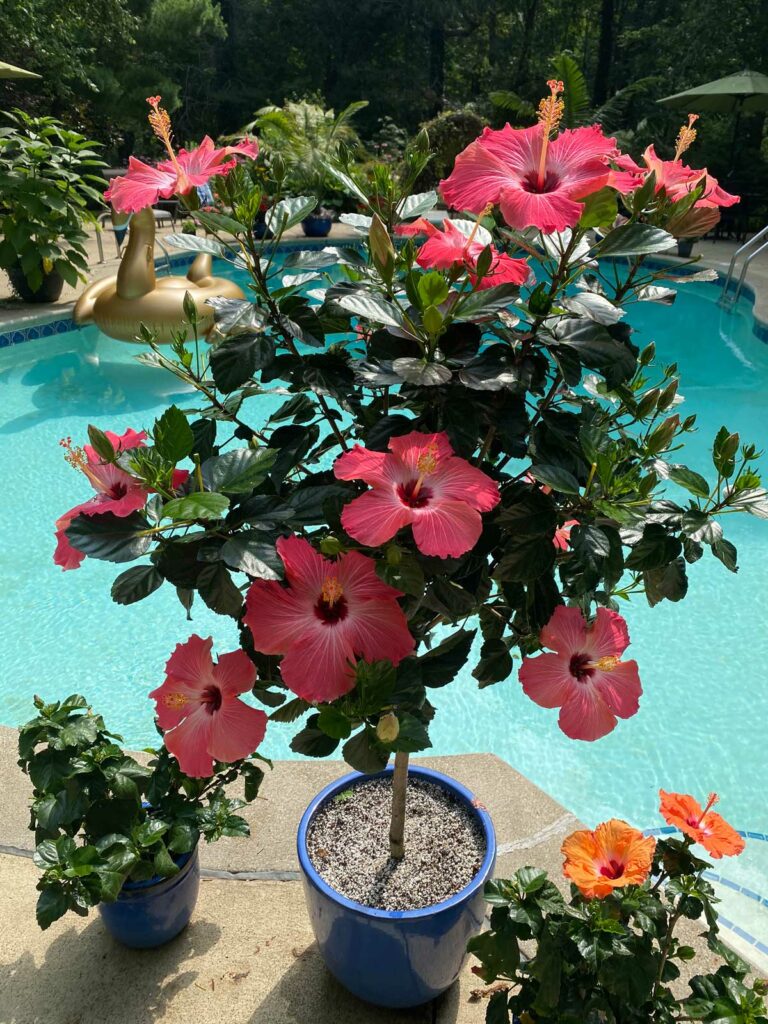
Do you have a favorite tropical hibiscus plant that you've enjoyed all summer and you want to keep your plant successfully through the winter? They're just too beautiful to let die! This article is all about overwintering hibiscus.
From bringing your plant back inside before the cold weather, to reintroducing it outdoors back in the Spring (and everything in between), keep reading to discover my 5 step plan for success.
Would you like to save this post?
Enter your email, and I will send this link straight to you!
The two main options that you have in overwintering hibiscus are the following:
Allowing your plant to go dormant and then reviving it in the spring
Keeping your plant in active growth
From personal experience, I will say that I strongly recommend the second option. If you let your plant go dormant completely, it will take far too long to bring it back to life and bloom.
One year, when I tried that, my hibiscus didn't bloom again until August, so it missed much of the summer. I'll focus this article on the second method, which I strongly recommended.
Table of Contents
OVERWINTERING HIBISCUS
Here is a 5 step process to prepare your tropical hibiscus for overwintering indoors.
1. PRUNE YOUR PLANT
A well grown hibiscus plant can grow quite larger over a single summer, and pruning your plant back will have many benefits:
Allows your plant to fit indoors more easily.
Creates a bushier plant.
You'll stimulate more flowering. Hibiscus grow flower buds right at the tip of each branch. By pruning your plant, you'll stimulate more branching, and this will result in a lot more flowers on your plant.
For hibiscus growing in pots outdoors that you'll overwinter indoors, pruning will be the first step of the process. Do this before the minimum temperatures outdoors get consistently below 50°F (10°C).
Use a pair of clean, sterilized pruners and prune about ⅓ of your plant back and up to about 50% or so. Do this on each branch.
2. INSPECT AND TREAT FOR PESTS
After you've pruned, you'll need to prepare your hibiscus so you're not bringing in any pests into your home.
First, rinse your hibiscus plants off with water to knock off any pests (particularly spider mites!). You can use a hose with a shower attachment. Rinse off the entire plant, and try and get the undersides of the foliage as well.
Do this a couple times per week for a couple weeks before you bring your plants indoors to overwinter them.
If you do notice any of the characteristic spider mite webbing, keep spraying with water as best as you can.
Lastly, apply horticultural oil to the entire plant, allow it to dry, and then move your plant inside.
Be sure to cover all leaf surfaces including the undersides of the leaves, stems, etc.
3. FERTILIZE
Typically, for other plants indoors, I will stop fertilizing during the winter months if the plant isn't actively growing.
For hibiscus, it is important to not let them slow down too much, otherwise it will delay blooming the following year.
An amazing fertilizer to use for hibiscus is the Hidden Valley Hibiscus special blend fertilizer. It's heavy on potassium, which hibiscus love. You will notice a big difference in the vigor and blooming of your plants with this fertilizer.
You can use this fertilizer year round. Use as directed on the label for best results.
In the winter time, fertilize less frequently than you would during the summer outdoors, but you should still fertilize.
4. MOVE INDOORS
Situate your hibiscus immediately in front of the sunniest window that you have.
Keep in mind that any location that you have indoors (including your sunniest window) will not be providing nearly as much light as a location in full sun outside.
The intensity of light indoors, just by virtue of light going through our windows (and only coming from one direction), is much less than outdoors, so for sun-loving plants like hibiscus, it will be best to place it in the sunniest window you have.
Don't be surprised if you get some yellowing of leaves after you move your plants indoors. This is perfectly normal and it's simply your plant shedding some leaves as it adjusts to lower light levels indoors.
Never allow the potting mix to go completely dry. Let the top inch or two of the potting mix dry out, and then water thoroughly.
5. RETURNING YOUR HIBISCUS OUTDOORS IN SPRING
When temperatures are warming up again in the Spring, don't be tempted to simply move your hibiscus out into full sun immediately or all your hard work will go to waste.
As I mentioned, the light intensity indoors is much less than it is outside, so you must allow your hibiscus plant to acclimate slowly when you place it back outside otherwise it will quickly scorch. How can you do this?
When you move your hibiscus from indoors to outdoors when minimum temperatures are consistently 50°F (10°C) at night, move your plant into FULL SHADE at first and leave it there for about 7-10 days.
Then, and only then, start to introduce some direct sun a little at a time (starting with morning sun only since it is gentler). Increase any direct sun a little each day over the period of another week or so.
Just keep an eye on your plant to make sure there is no sun scorch. You can't acclimate too slowly, but you can acclimate too quickly. If you noticed any whitish, bleached out areas on the top of your leaves, you haven't acclimated your plant slowly enough to direct sun.
I hope you've enjoyed this post on overwintering hibiscus. Have you overwintered hibiscus before? What has your experience been? Comment below. I'd love to hear!
Hi, I have several hibiscus plants even when I lived in Georgia, now I live in Texas when we had the bad weather in year 2020 I was scared that was it , my plants had ice on them for that time so I just waited and let me tell you that summer until now my plants are beautiful I had cut them back and fertilizer them before that weather . I say leave them along just fertilizer cut back and let them grow. I even had man in neighbor hood come ask me what kind tree are those ? my answer these are not trees and don’t look like trees you right they are plants they sure are beautiful now this was this year., and Texas have worse soil so have to work with soil. Good Luck Dot
I live in NE AL. I planted mine in my flower bed & it was spectacular. Tripled in size and exceeded my expectation. Before the frost, I cut it back & covered it with a tall 5 gal pail. What do you think I'll find in the spring?
Last winter I brought my hibiscus plant in, watered it occasionally, then brought the potted plant back outside, where it was the year before. The flowers were fabulous last year, but this year it took so long to re-establish branches & leaves that buds didn't appear until August, & they fell before flowering. This year I plan to follow your advice about pruning & regular watering throughout the winter. Thank you.
I brought both my Hibiscus inside for the winter. They both seem to be doing well. I do however have a braided trunk Hibiscus that has only flowered once. Not sure why. It's growing like crazy. Any thoughts.
There is a reduction in light indoors, so that is the likely cause. And depending on where you live, the days are probably shorter too. I would just wait it out. You may want to lightly prune your plant if you haven't done so already. It will cause more abundance blooming in the future 🙂
I have a huge hibiscus in a pot that I bring inside for the winter.
It needs to be cut back before I bring it in. My problem is that the entire plant
Is loaded with blossoms and buds. I can’t leave it out much longer because of the cold night temps. Is it bad for the hibiscus to cut back all the buds and flowers?
I live in Maine. I bought 2 hibiscus (with three plants in each pot) a few months ago with the intention of planting them in the yard. However, I tore my rotator cuff and haven't been able to do it. I've only been watering it and pruning off dead leaves and the flowers once they've bloomed out. They've been blooming like crazy, I've been very pleased with the results so far. I'm going to take your advice on the overwintering. My question, though, is can I plant them outside next year? Or will I have to keep bringing them inside every year? You should know that I have never been very successful with gardening and, by no means, have anything resembling a green thumb.
I'm assuming you have tropical hibiscus. You could plant them in the ground and treat them like annuals if you'd like. But they would probably do better in a pot. There are also a couple other types of hibiscus that are perennials and would probably come back in your climate depending on what growing zone you are in Maine. Here is a recent blog post that I wrote that talks about 3 types of hibiscus (two which are hardy and 1 which is not): https://www.ohiotropics.com/2023/08/05/hibiscus-plants-annuals-perennials/
Thank you so much for this article! Hibiscus are my favorite flower, I want to save them over the winter months. I will definitely use this method!
Thanks Again,
Sandy
South GA
I have.but that was five years ago in Ontario. I am now in Vancouver Island. My son said I should cut them back to five inches from the ground I dont thinks that's right. They are moscheutos. I always cut them back in the spring but I was not too sure how far back I should cut them. Thankyou Marlyn
Assuming you have the hardy hibiscus, those canes usually die back all the way to the roots, and then sprout back up from the root system in the Spring (usually pretty late). At least that's what they do in my climate. I usually prune my plant all the way to the ground in the spring. Do yours die all the way back in your climate?
I am new to the hibiscus plant. I bought one from the discounted rack at a nursery and repotted and babied it last summer. Overwintered it in the house, put it out on the deck in the spring, and now it is blooming gloriously. It is as tall as me. I’m worried that I won’t be able to handle the weight of the plant if I repot it does it have to be repotted? How do I tell for sure, if it’s a tropical or hearty hibiscus? Color of the bloom is: golden orange. I live in South Carolina near Charlotte. Can I plant it in the ground or is it too cold in the winter?
Hi Diane! I would be able to tell with a photo, but it sounds like it is probably a tropical one based on the flower color. I don't know of any hardy hibiscus flowers that are orange. Your area would be too cold in the winter to plant a tropical hibiscus in the ground. Eventually, it would need to be repotted as they can get very rootbound. Hope this helps a bit!
When we brought our hibiscus in to overwinter last fall it defoliated completely. It has continued to bloom all winter but the leaves bud out but die. This is a 20 year old plant which has been repotted, although it was quite a while ago.
Can I save it by repotting? Should I use a special mix of fertilizer to stimulate leaf growth instead of blooms?
It sounds like it probably needs to be pruned, and probably repotted too. Have you ever pruned it? It would take a while to get blooms though if you prune it, but it probably won't be full with leaves unless you prune it.
I’m afraid I’ve killed my hibiscus. I left it too late before bringing it inside and I think the leaves froze… they all dried up and fell off. It appears to be still alive, but dormant…. It’s inside now. Should I just leave it alone til spring and see what happens, or try to revive it slowly now?
I would put it in a sunny window and see if there are signs of life, and then resume normal care if it starts growing. Good luck! If it starts growing back, you may need to prune any dead parts of the stems.
We live in Pennsylvania. I cut back our hibiscus and moved it inside in early fall. It is continuing to grow more than I expected it to. Should I let it go or continue to cut it back over the winter? Thanks! Bob
Hi Bob! You can definitely cut it back again. Just trim back any new growth (not all the way though). This will further increase branching and should get you more flower buds down the line! And if you haven't already done so, try and give your plant as much direct sun as you can indoors to keep growth stronger and more compact. Good luck!
I came to your article too late in that I've already moved my hibiscus inside, but did not do any pruning beforehand. It's leaves are turning yellow and dropping like crazy (as expected). Should I go ahead and prune now or is that too much stress on the plant at once?
I have been overwintering my hibiscus for almost 20 years now and it's enormous. I would like to prune it back some this year, as I am running out of space inside. It's blooming now, but we are starting to have cold nights here in Illinois and I will be bringing it in this weekend.





Hi Bob,
May I add grow lamps to my hibiscus tree during the winter?
Yes of course! You can use grow lights for any plant.
Thank you! You offered the best information I’ve seen so far regarding the seasonal management of our Hibiscus plant.
So glad that you enjoyed the post Mark!
Hi, I have several hibiscus plants even when I lived in Georgia, now I live in Texas when we had the bad weather in year 2020 I was scared that was it , my plants had ice on them for that time so I just waited and let me tell you that summer until now my plants are beautiful I had cut them back and fertilizer them before that weather . I say leave them along just fertilizer cut back and let them grow. I even had man in neighbor hood come ask me what kind tree are those ? my answer these are not trees and don’t look like trees you right they are plants they sure are beautiful now this was this year., and Texas have worse soil so have to work with soil. Good Luck Dot
I'm glad that the plants rebounded for you Dorothy!
I live in NE AL. I planted mine in my flower bed & it was spectacular. Tripled in size and exceeded my expectation. Before the frost, I cut it back & covered it with a tall 5 gal pail. What do you think I'll find in the spring?
I assume we're still talking about tropical hibiscus? How cold does it get where you are? Minimum temperature.
Last winter I brought my hibiscus plant in, watered it occasionally, then brought the potted plant back outside, where it was the year before. The flowers were fabulous last year, but this year it took so long to re-establish branches & leaves that buds didn't appear until August, & they fell before flowering. This year I plan to follow your advice about pruning & regular watering throughout the winter. Thank you.
That was exactly my experience in the past! It's much better to keep them growing. Good luck!
I brought both my Hibiscus inside for the winter. They both seem to be doing well. I do however have a braided trunk Hibiscus that has only flowered once. Not sure why. It's growing like crazy. Any thoughts.
There is a reduction in light indoors, so that is the likely cause. And depending on where you live, the days are probably shorter too. I would just wait it out. You may want to lightly prune your plant if you haven't done so already. It will cause more abundance blooming in the future 🙂
I have a huge hibiscus in a pot that I bring inside for the winter.
It needs to be cut back before I bring it in. My problem is that the entire plant
Is loaded with blossoms and buds. I can’t leave it out much longer because of the cold night temps. Is it bad for the hibiscus to cut back all the buds and flowers?
It's not bad for the plant at all. Sometimes you just have to do what you have to do 🙂
I live in Maine. I bought 2 hibiscus (with three plants in each pot) a few months ago with the intention of planting them in the yard. However, I tore my rotator cuff and haven't been able to do it. I've only been watering it and pruning off dead leaves and the flowers once they've bloomed out. They've been blooming like crazy, I've been very pleased with the results so far. I'm going to take your advice on the overwintering. My question, though, is can I plant them outside next year? Or will I have to keep bringing them inside every year? You should know that I have never been very successful with gardening and, by no means, have anything resembling a green thumb.
I'm assuming you have tropical hibiscus. You could plant them in the ground and treat them like annuals if you'd like. But they would probably do better in a pot. There are also a couple other types of hibiscus that are perennials and would probably come back in your climate depending on what growing zone you are in Maine. Here is a recent blog post that I wrote that talks about 3 types of hibiscus (two which are hardy and 1 which is not): https://www.ohiotropics.com/2023/08/05/hibiscus-plants-annuals-perennials/
Thank you so much for this article! Hibiscus are my favorite flower, I want to save them over the winter months. I will definitely use this method!
Thanks Again,
Sandy
South GA
Glad you enjoyed it Sabdy!
I have.but that was five years ago in Ontario. I am now in Vancouver Island. My son said I should cut them back to five inches from the ground I dont thinks that's right. They are moscheutos. I always cut them back in the spring but I was not too sure how far back I should cut them. Thankyou Marlyn
Assuming you have the hardy hibiscus, those canes usually die back all the way to the roots, and then sprout back up from the root system in the Spring (usually pretty late). At least that's what they do in my climate. I usually prune my plant all the way to the ground in the spring. Do yours die all the way back in your climate?
I am new to the hibiscus plant. I bought one from the discounted rack at a nursery and repotted and babied it last summer. Overwintered it in the house, put it out on the deck in the spring, and now it is blooming gloriously. It is as tall as me. I’m worried that I won’t be able to handle the weight of the plant if I repot it does it have to be repotted? How do I tell for sure, if it’s a tropical or hearty hibiscus? Color of the bloom is: golden orange. I live in South Carolina near Charlotte. Can I plant it in the ground or is it too cold in the winter?
Hi Diane! I would be able to tell with a photo, but it sounds like it is probably a tropical one based on the flower color. I don't know of any hardy hibiscus flowers that are orange. Your area would be too cold in the winter to plant a tropical hibiscus in the ground. Eventually, it would need to be repotted as they can get very rootbound. Hope this helps a bit!
When we brought our hibiscus in to overwinter last fall it defoliated completely. It has continued to bloom all winter but the leaves bud out but die. This is a 20 year old plant which has been repotted, although it was quite a while ago.
Can I save it by repotting? Should I use a special mix of fertilizer to stimulate leaf growth instead of blooms?
It sounds like it probably needs to be pruned, and probably repotted too. Have you ever pruned it? It would take a while to get blooms though if you prune it, but it probably won't be full with leaves unless you prune it.
I’m afraid I’ve killed my hibiscus. I left it too late before bringing it inside and I think the leaves froze… they all dried up and fell off. It appears to be still alive, but dormant…. It’s inside now. Should I just leave it alone til spring and see what happens, or try to revive it slowly now?
I would put it in a sunny window and see if there are signs of life, and then resume normal care if it starts growing. Good luck! If it starts growing back, you may need to prune any dead parts of the stems.
We live in Pennsylvania. I cut back our hibiscus and moved it inside in early fall. It is continuing to grow more than I expected it to. Should I let it go or continue to cut it back over the winter? Thanks! Bob
Hi Bob! You can definitely cut it back again. Just trim back any new growth (not all the way though). This will further increase branching and should get you more flower buds down the line! And if you haven't already done so, try and give your plant as much direct sun as you can indoors to keep growth stronger and more compact. Good luck!
I came to your article too late in that I've already moved my hibiscus inside, but did not do any pruning beforehand. It's leaves are turning yellow and dropping like crazy (as expected). Should I go ahead and prune now or is that too much stress on the plant at once?
You can still do it! Don't remove more than about 1/3 of the plant though when you do it.
Hi,
I have been overwintering my hibiscus for almost 20 years now and it's enormous. I would like to prune it back some this year, as I am running out of space inside. It's blooming now, but we are starting to have cold nights here in Illinois and I will be bringing it in this weekend.
Do I wait until after blooming to prune back?
Thanks much!
Hi Karen! Sounds like quite a specimen! Late winter/early spring is a good time, before it starts any new growth. Good luck!!