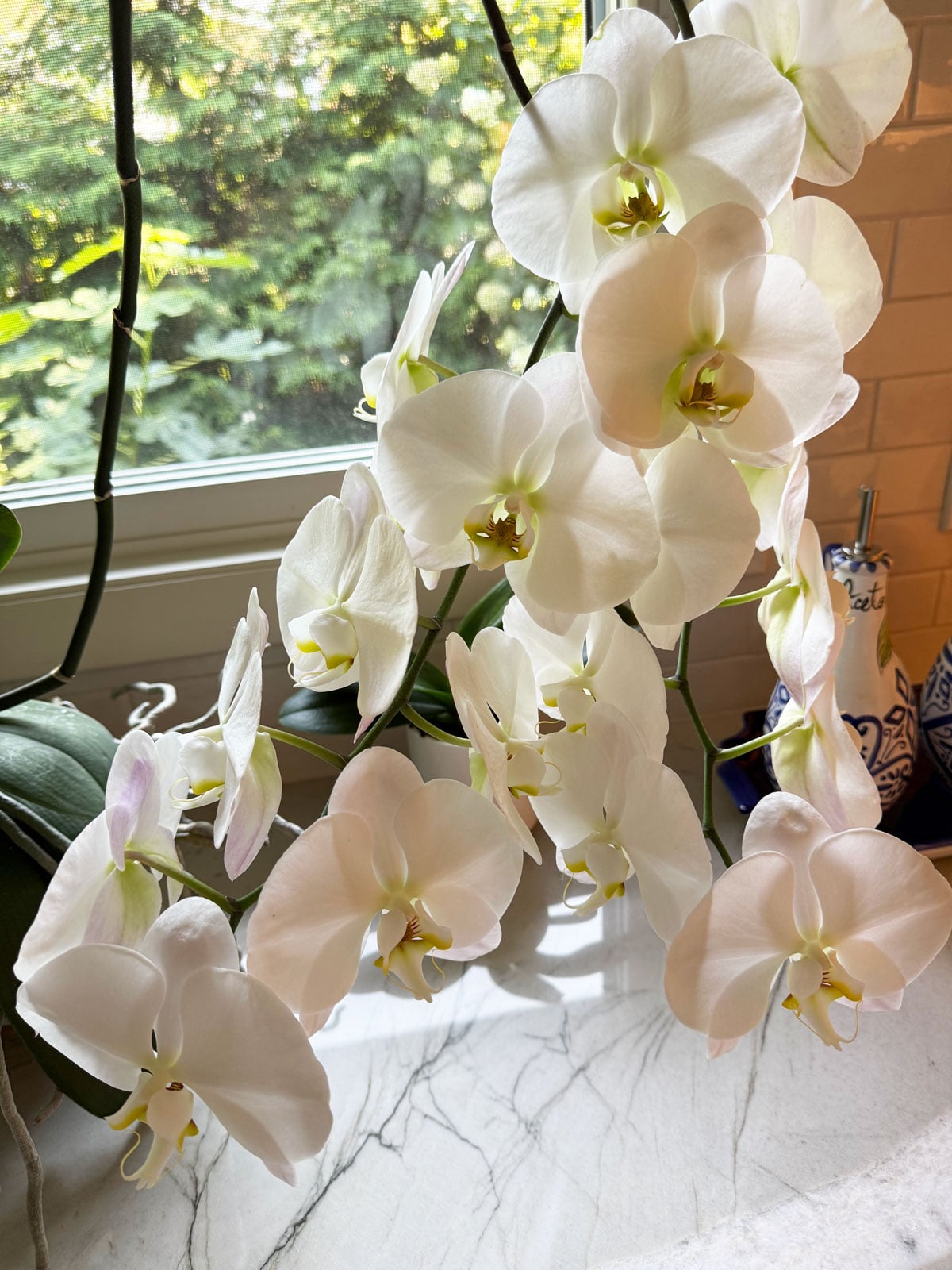
If you've ever stood at a nursery (or browsed online) trying to decide what to pot your orchid in, you've probably run into the same two contenders over and over: bark mix and sphagnum moss. They're by far the two most popular substrates for growing Phalaenopsis and other epiphytic orchids at home, and honestly, there's no single "right" answer between them.
The truth is that the best medium isn't a universal one. It's the one that matches your home, your habits, and your particular orchid's needs. In this post, I'll break down the pros and cons of each, show you how your growing environment should influence your choice, and give you the practical details you need to actually succeed with whichever one you pick.
Table of Contents
Why your orchid substrate matters
Most orchids, including Phalaenopsis orchids, are epiphytes. In nature, they grow attached to tree branches with their roots exposed to open air, not buried in soil. Only about 30% of orchid species are terrestrial (ground-dwelling). That single fact explains almost everything about why orchid substrates look so different from regular potting soil: the goal isn't to hold the plant in "dirt," it's to mimic that airy, fast-draining, high-oxygen environment their roots evolved for, while still delivering enough moisture between waterings.
Let's compare bark mixes vs. sphagnum moss.
Bark Mix: The Pros and Cons
Pros:
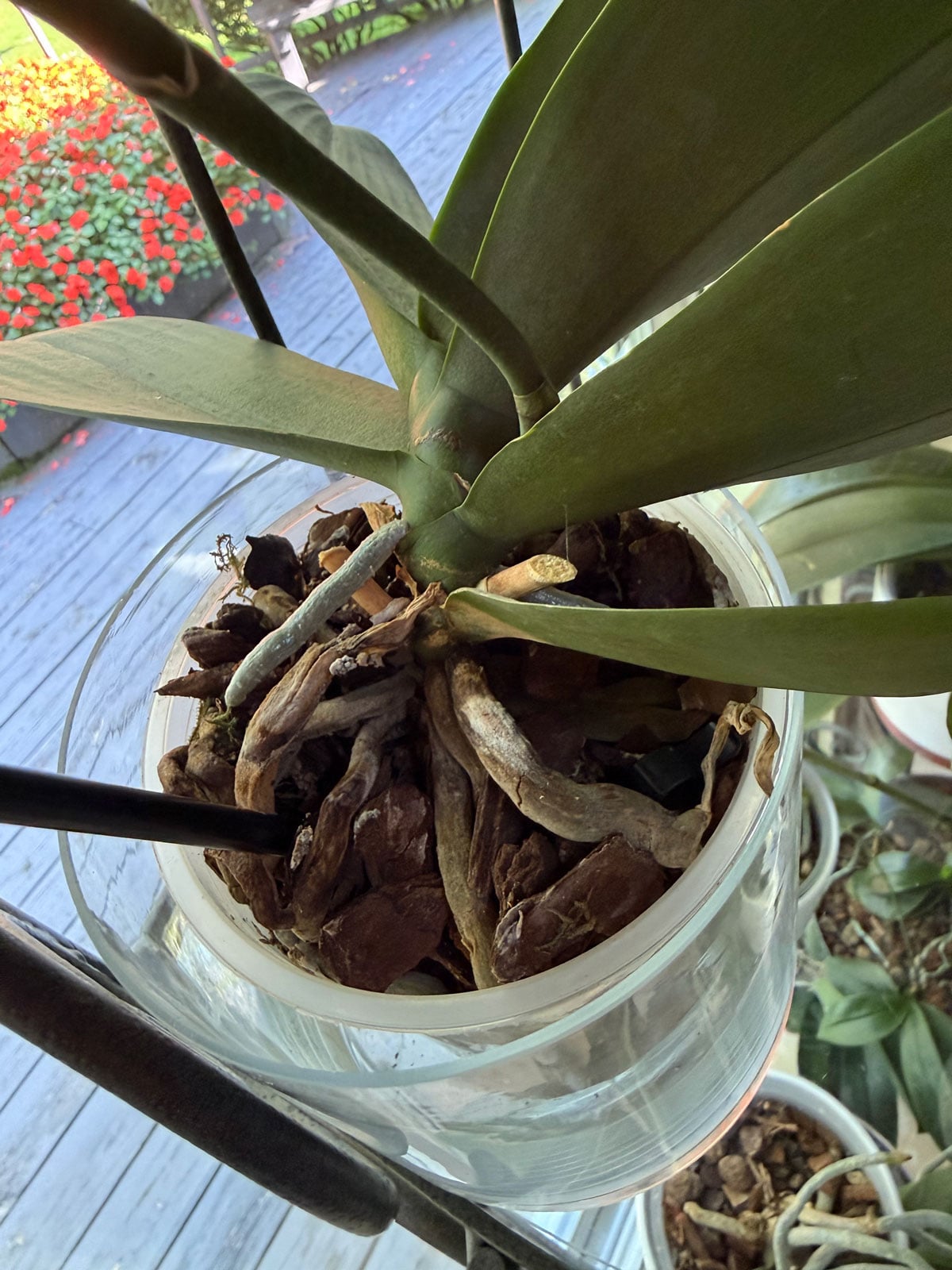
Excellent aeration. The chunky pieces create lots of air pockets around the roots, which orchid roots need to grow well and stay healthy.
Very hard to overwater. Because drainage is so sharp, bark dries out quickly, especially in bright, warm conditions. This makes it forgiving for people who tend to water on the heavier side.
Easy to read root health. Especially in a clear plastic pot, it's simple to see when roots have gone from green (hydrated) to silvery-white (dry and ready for water).
Works well on a loose schedule. Unlike moss, it's actually reasonably safe to water bark-grown orchids on a semi-regular schedule (roughly every 5-10 days for most home environments), checking dryness with a finger before each watering, or by looking at the color of the roots.
Cons:
Dries out fast - sometimes too fast. In average home conditions, bark can dry out quickly enough that plants get dehydrated between waterings if you're not staying on top of it. Since Phalaenopsis have no pseudobulbs to store water in, they don't tolerate drought well. Many other orchids that have pseudobulbs, like Cattleyas, are much more drought-tolerant.
More frequent watering required, particularly in low humidity or high light.
Doesn't absorb water well straight out of the bag. Fresh bark is very dry and repels water at first, so newly repotted orchids need extra-long soaks when watering (15-30 minutes) for the first couple of months until the bark becomes "conditioned." And before using fresh bark mixes, it helps to soak it overnight before repotting with it.
Breaks down over time. As bark decomposes, it loses its airy structure and becomes soil-like. At that point, it will start holding too much water near the roots, effectively suffocating them.
Sphagnum Moss: The Pros and Cons
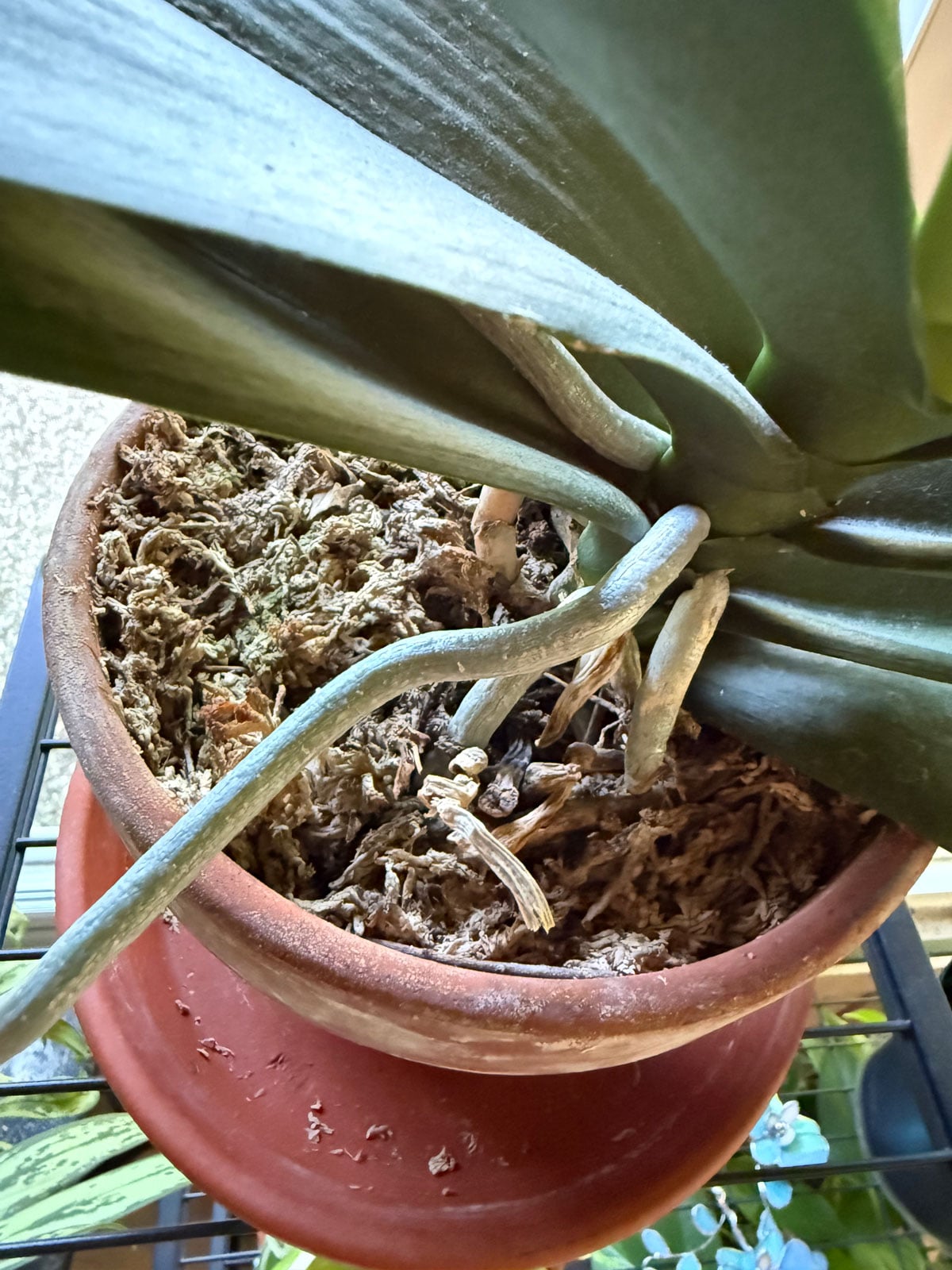
Long-strand sphagnum (not to be confused with sphagnum peat, which is a different, more acidic, water-repellent product) is a fine, fibrous material that holds an enormous amount of water, reportedly over 20 times its dry weight.
Pros:
Retains moisture extremely well, which means less frequent watering overall.
Distributes water very evenly and efficiently through the pot, so a little water goes a long way.
Great option for low-humidity or hot, dry environments, where a faster-draining medium like bark might dry out before you have a chance to keep up with it.
Lightweight and easy to work with and is great for mounting on a slab of wood or a cork slab.
Cons:
Very easy to overwater. Because it holds so much moisture, moss can stay wet for far too long if conditions aren't right, and orchid roots that stay wet for extended periods are prone to rot.
Often packed too tightly straight from the grower, which restricts airflow to the roots even more and compounds the wet, low-oxygen problem.
Hard to gauge by feel for beginners. You should never water sphagnum-grown orchids if the surface still feels moist - but figuring out "moist" versus "dry enough" takes some practice.
Can become hydrophobic if it dries out completely. If moss goes bone dry, it can start repelling water instead of absorbing it - water just runs across the surface or straight through the pot without soaking in. Recovering from this takes several repeated waterings a few minutes apart.
Not well suited to humid, low-light, or cooler environments, since it won't dry out fast enough between waterings in those conditions, raising the risk of rot substantially.
Watering Method Differs by Medium
The medium you choose also determines how you should water:
Bark mix does best with the soaking method: fill the outer decorative pot (or a sink/basin) with room-temperature water up to the rim of the inner pot, let it sit for 10-15 minutes, then lift the pot out and let it fully drain. This ensures the sharp-draining bark actually gets saturated all the way through, rather than water just running straight through with a quick top-watering.
Sphagnum moss does best with light top watering. You genuinely don't need much water at all, and you should never add so much that it drains heavily out the bottom. Because moss holds water so efficiently, a small amount distributes throughout the whole pot.
Whichever method you use, always use room-temperature (or slightly warm) water, never ice, and never cold water straight from the tap, since orchids are tropical plants that can be shocked by cold. And always remove any water that pools in the crown of the plant or in leaf joints, since standing water there can cause crown rot.
Would you like to save this post?
Enter your email, and I will send this link straight to you!
Which One Is Better for YOUR Growing Environment?
The "best" substrate depends on the conditions the plant is actually living in, not some universal ranking. Here's how to think it through:
Your Conditions
Better Suited To
High light, warm temps, low humidity, good airflow
Sphagnum moss (dries out at a reasonable pace, otherwise would need very frequent watering in bark)
Average home light, moderate humidity
Bark mix, or a blended mix (see below)
Lower light, higher humidity, cooler room
Bark mix (moss risks staying wet too long and rotting roots)
You tend to forget to water / travel often
Sphagnum moss (holds moisture longer)
You tend to water frequently / enjoy a routine
Bark mix (very hard to overwater; rewards frequent attention)
You're newer to orchids and want an easy visual cue
Bark mix in a clear plastic pot (you can literally watch root color change from silvery-white to green)
A few other environmental variables worth factoring in:
Pot material matters too. Terracotta pots are porous and breathe, helping either medium dry out faster. This is useful if you're leaning toward moss in a humid environment. Plastic pots (especially solid ones without side slits) hold moisture longer. Orchid pots with holes can be tricky because althoug they allow for air to the roots which is great, they further accelerate the rate of drying and if you're using bark, it can cause you to water a lot more frequently than you'd like.
Airflow accelerates drying for both mediums. A fan or simply good air circulation in the room can shift the balance in your favor if you're worried about rot.
Seasonal changes matter. The same orchid, in the same medium, will dry out at a different rate in summer versus winter, or if you turn on the heater. Expect to adjust your watering frequency throughout the year rather than sticking to a fixed calendar schedule, especially with moss.
Light is the biggest lever. Higher light dramatically increases how fast a plant uses water and how fast its medium dries out. If you upgrade your orchid's light situation, expect to water more often, regardless of which medium you're using.
Can You Get the Best of Both? Blended Substrate Recipes
You don't actually have to choose one or the other exclusively. Many growers blend ingredients to land somewere in between straight bark and pure moss, dialing in the exact moisture retention that fits their space. A few example starting points, generally scaled from driest to wettest:
Daily watering / very bright, warm spot: mostly bark, with a small amount of horticultural charcoal and vermiculite for structure.
Weekly watering (most common home setup): primarily bark and coco husk chips, with a little tree fern fiber, charcoal, and vermiculite mixed in for extra water retention.
Bi-monthly watering: a similar bark/coco husk base but with a portion of sphagnum (strand or fluff) blended in to hold more moisture longer.
Again, these are rough guidelines and it is up to you to figure out what works best for your environment and pay attention to an appropriate frequency of watering based on your growing conditions.
The idea is simple: the chunkier and more bark-heavy your mix, the faster it dries and the more often you'll need to water. The more moss, coco husk, or sphagnum fluff you add, the longer it holds moisture and the less frequently you'll need to water, but the higher your risk of rot if your light, temperature, and airflow aren't helping the mix dry out in between.
Signs You've Chosen the Wrong Medium (or Need to Adjust)
Your plant will tell you if the substrate isn't working for your space:
Roots consistently shriveled, silvery, and never plumping back up, even after watering → medium is drying out too fast for your watering habits (common with bark in a very dry, low-humidity home) or you're not watering thoroughly enough.
Roots turning brown, black, or mushy, with the outer velamen sloughing off → medium is staying wet too long (common with tightly packed sphagnum, or old broken-down bark) and rot has set in.
Bud blast (flower buds shriveling and dropping before opening) can also be a red flag tied to inconsistent moisture - the plant pulls water back out of developing buds when its roots are either too dry or drowning.
Leaves going limp or wrinkled → a sign of underlying dehydration, which, somewhat counterintuitively, can be caused by roots that have rotted from too much moisture just as easily as by a medium that's been kept too dry. Either way, the roots can no longer take up water properly.
If you're seeing these signs, it's a good moment to unpot, inspect the roots, and consider switching mediums (or adjusting your watering frequency and method) rather than assuming you just need to water more or less.
Important last words
There's no single best orchid substrate, only the best substrate for your specific plant, in your specific home. Bark mix rewards attentive, frequent watering and is very forgiving against overwatering, making it a solid default for most average home environments. Sphagnum moss is a fantastic option if your space runs hot, bright, and dry - or if your schedule doesn't allow for frequent watering, but it demands more care to avoid staying wet too long.
Pay attention to your light, humidity, airflow, and your own watering habits, start with a recipe that roughly matches your conditions, and then adjust based on what your orchid's roots are telling you. That's really the whole game: observe, adapt, and let the plant guide the process.
If you want something in between a typical bark mix and sphagnum moss, you can do one of two things:
Experiment with a 50/50 blend of bark and sphagnum moss (and adjust the ratio to tweak it to your liking for your own growing environment).
Buy Treehouse Tropical Epiphyte Blend from my Shopify store. It is a good balance in moisture retention! It absorbs more moisture than mixes that have mostly bark, but less than just pure sphagnum moss. I use it a lot myself, and my online orchid care course members are LOVING it!
If you want to learn all about how to get your orchid to rebloom reliably and have healthy, thriving moth orchid plants, don't miss my signature, online orchid care course, Become an Orchid Master. It also includes bonuses with support from me, personally, to guide you in your orchid journey!