When you have a peace lily (Spathiphyllum) that is extremely root bound and it is time to repot into a bigger pot, there is one important step that many people miss. And if you miss this step, your plant will not benefit from the repotting. In fact, it may even continue to decline!
Keep reading so you can ensure that you don't miss this very important step so that your plant will thrive after repotting.
Would you like to save this post?
Enter your email, and I will send this link straight to you!
Table of Contents
HOW TO REPOT A PEACE LILY THAT IS ROOT BOUND
Before I get into the steps of repotting a root bound peace lily, how do you know if your plant potentially needs repotting?
Before taking the plant itself out of its pot, there are a few indications that will tell you that your peace lily may need a bigger pot.
There are a lot of hard, matted roots on the surface of your soil.
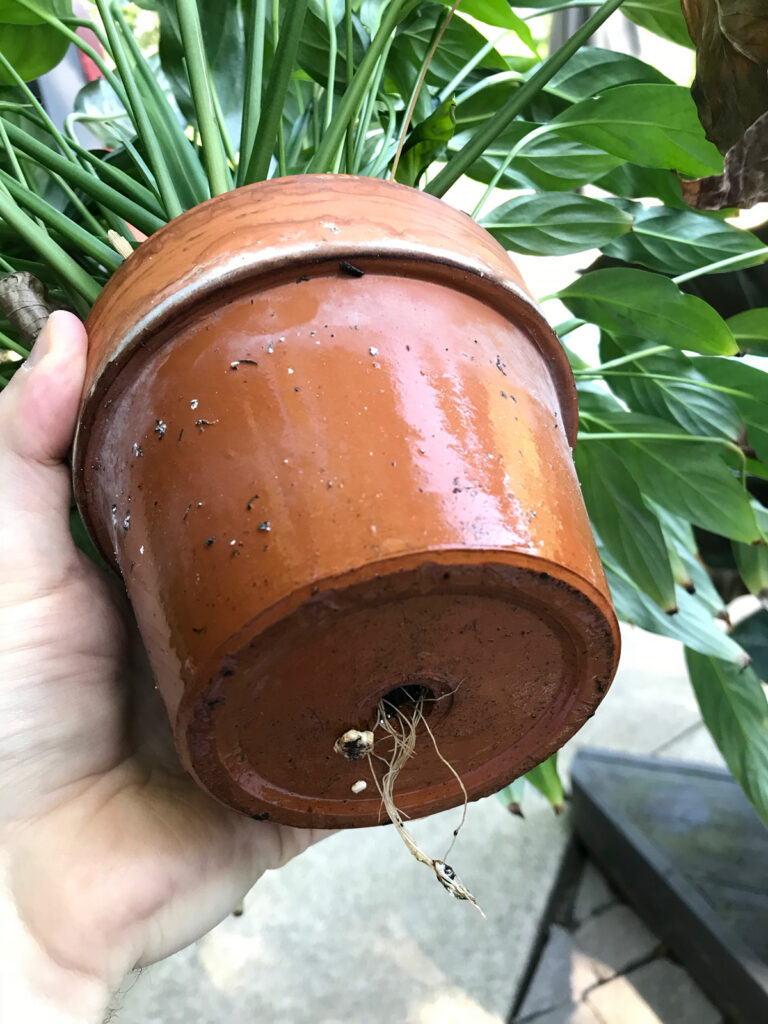
Roots may be growing out of the drainage hole(s).
Your peace lily's soil seems to be drying out much faster than it used to and you may find it difficult to keep up with watering it.
Roots growing out of the drainage hole is one indication that your peace lily is root bound.
These are all indications that your peace lily's roots are filling up the pot and that it needs help! Let's get into the 3 steps to repot.
1. Remove from the pot and loosen the root ball
First, remove your plant from the pot. If you have it growing in a plastic nursery pot, simply squeeze the perimeter of the pot and gently pull the plant out. If you have your plant in a rigid container, run a knife around the inside perimeter of the pot, and this should help you pull the plant out of the pot.
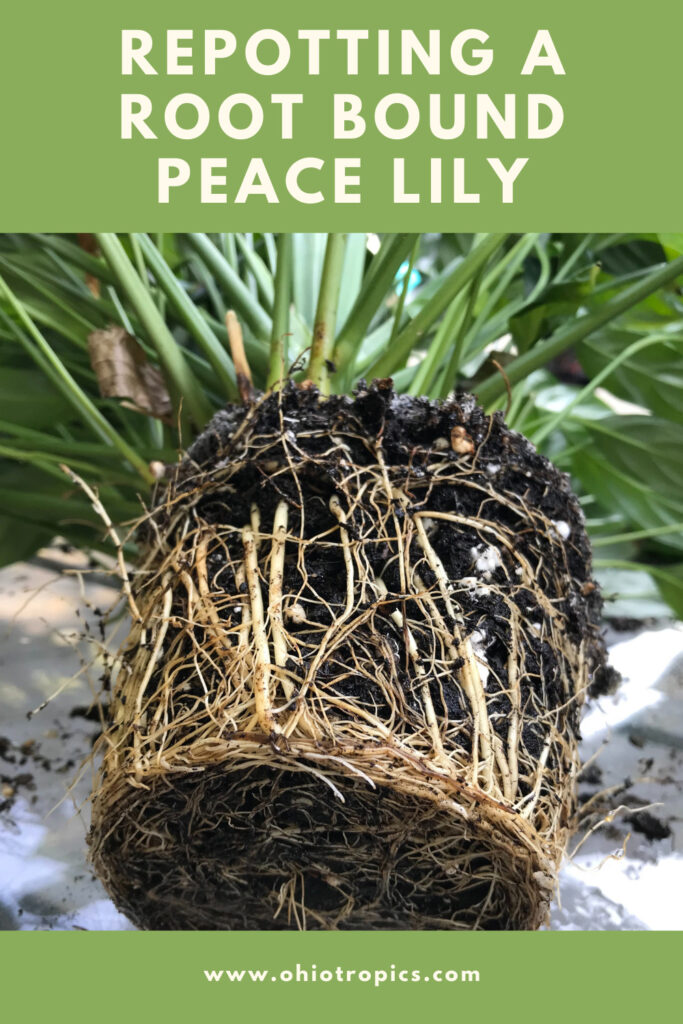
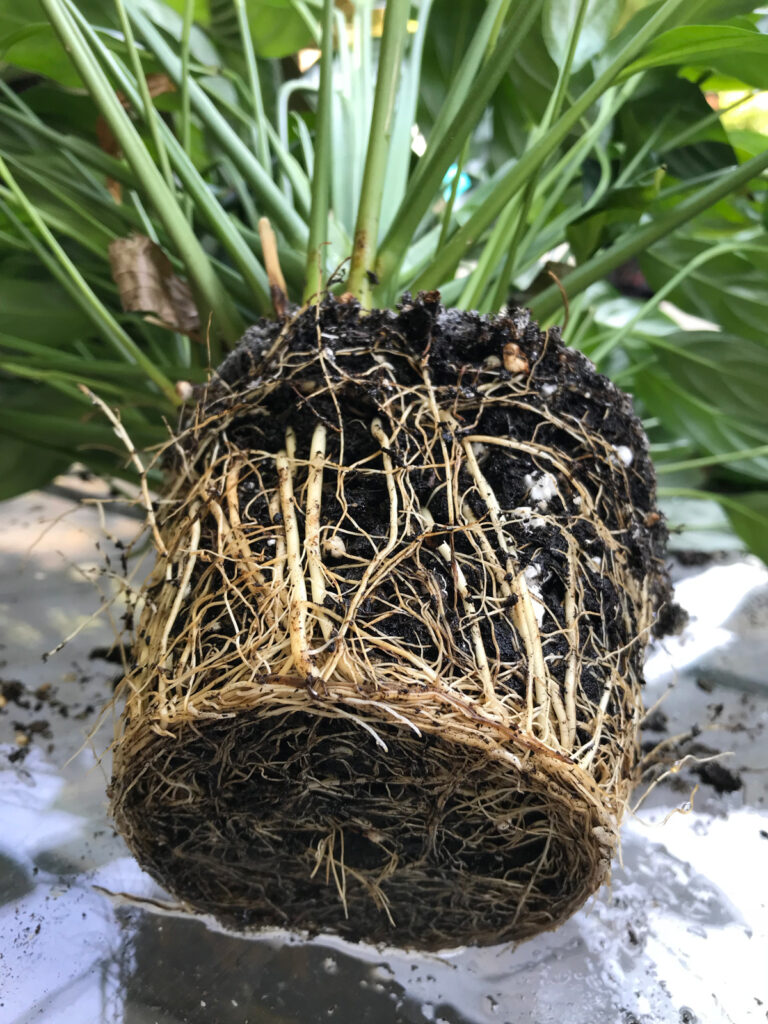
Here is one of my peace lilies after I removed it from its pot. Take a look at how root bound it is. Note the roots circled around the bottom and how tightly packed they are.
Loosening the rootball is a very critical step in repotting a plant. If you fail to do this (particularly for peace lilies or any plants that are extremely root bound), your plant will not benefit at all when you place it in its new pot.
Once I had a peace lily (Spathiphyllum) that I had in a big pot and I couldn't figure out why it wasn't doing well.
The plant was growing very little and had started to decline. I had repotting it a few years back, and the plant wasn't growing to my liking, so I decided to take it out of its pot to check it out.
What I found was a little shocking. No new roots had grown into the pot! And it had been in that pot for years! The roots stayed contained to the tight rootball, which I obviously did not loosen when I repotted. Shame on me! It was probably out of laziness, but at least I determined what happened.
How how do you loosen a peace lily root ball?
Two Ways to Loosen the Rootball
There are two ways that I would recommend to loosen the rootball.
I would always start by making sure that your peace lily is watered. Then wait for a few hours, or even the next day, to begin working on it. This will make it easier to tease the roots apart.
When you have your plant out of the pot, start by loosening the roots at the bottom, and then work on the sides.
Gently pry and separate the roots to loosen them up a bit. You don't have to go crazy, but this will go a long way in stimulating more root and plant growth once you repot into a larger pot.
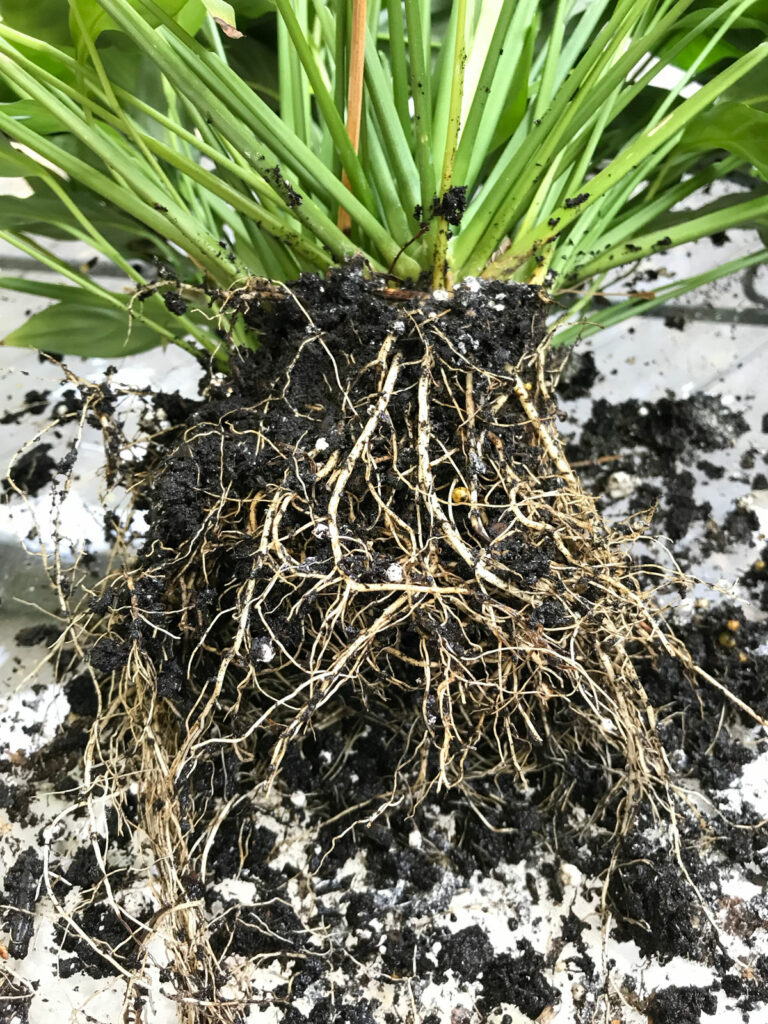
Here is what the peace lily looked like after I loosened the root ball.
You are essentially loosening the roots so that they are more available to start growing into new potting mix in its new pot.
Sometimes if you have a SUPER rootbound plant, especially plants with fine, tight and fibrous roots, it may not be possible to use your hands to loosen the rootball.
In these cases, simply take a sharp knife and make several vertical slashes or cuts (1-2 inches long or so) on the sides and at the bottom of the rootball. This will at least give your plant an opportunity to grow new roots where you made the cuts.
Don't worry about damaging a few roots here and there. They will recover, and your plant will be much better off!
If you have a tight rootball and you don't take either of the measures mentioned above, your plant might suffer the same fate of my poor Spathiphyllum that I mentioned above (which is doing great now by the way!)
2. Choose a new pot
Next, choose a new pot. My rule of thumb when repotting is to choose the next pot size up from the old pot. For example, if you have a plant in a 4 inch diameter pot, your new pot should be a 6 inch diameter pot.
If you choose a pot that is much bigger, the potting mix will potentially take too long to dry out.
By all means, always choose a pot with a drainage hole. I find myself planting directly into plain green nursery pots with drainage holes. Then I slip the plant into a decorative pot.
3. Pot it up using a well-drained potting mix
Lastly, choose a well-drained potting mix, but one that retains a good amount of moisture since these are moisture loving plants.
My go-to for peace lilies, and many other leafy tropicals, is 3 parts of a good potting soil (like Miracle-Gro or Espoma that you can purchase on Amazon) and 1 part perlite.
Another option, if you want to buy an AMAZING mix that you can use straight out of the bag is to use the Rainforest Soil Blend from Oh Happy Plants. You will receive 10% off at checkout automatically, for any product, if you use my link.
That's all there is to it! Be sure not to miss my peace lily care post which describes all the conditions that you plant needs to thrive. I've also written a post on all the causes of why your peace lily is drooping and what you can do to fix it.
Have you repotted your root bound peace lily lately? Comment below. I'd love to hear!
Hello! I just wanted to say that your article was so helpful and informative! I have a question about a plant I acquired though. I got a Kalanchoe plant from my local Walmart. A Pink Flaming Katy I think it's called. It was heavily overwatered and as such, I haven't watered since the 5th (when I got it) and even then I didn't. It IS rootbounded and I did get it a slightly bigger pot at 8x6 instead of the 4 inch deep one it's in now. I am against repotting it right now though cause it's still blooming wonderfully, only 1 flower has wilted. Mighty proud as it's my first plant but the soil is starting to dry and I can't water well due to the leaves being so squished and I don't want to break them. Is it fine to leave it in the pot as it is blooming and water best as I can? Or should I repot? I am afraid it might get a shock if I do it. Thank you again for the awesome article!
I wish I had looked this up a few hours ago. I just repotted my peace lily. I started to break up the roots but I could hear them breaking and I was so scared of damaging it that I reported it with just a couple of spots loose from the wrapped root ball. Should I take out and redo or do you think it should be good enough?
If you loosened it a bit, I would just leave it alone. For the future, if the root ball is really dry, it's helpful to water the plant maybe the day before you repot. It will make it a bit easier. If you break some roots, it's not a big deal. The plant will recover! Hope this helps.
@Raffaele,
I killed my 3 peace lilies.
2 were from my mom I lost her from a stroke and 1 from my husband. I recently lost him from Covid19 . They passed away so close that I am now finally able to morn the loss and accept and care for life. I’m not sure if I have killed them beyond repair. They look dead brown and crispy like the picture. Just want to know if I should put them in the garbage and replace them. Or can I salvage them?
I'm so sorry to hear that and am very sorry for your loss. If you send me a photo, I can try and make my best judgement. Use the contact form on my website, and when I reply, you can attach a photo.
Thanks so much for this article. I have a peace Lily that I’ve had for forever ?20yrs? It’s so important to me but now it’s down to two leaves from the same stem (?). I think it needs to be repotted to better soil but I’m terrified to try this. And I’m not sure if it should go in a smaller pot because it’s now just a small plant in a bigger pot. I’m not good at all with plants but this one I really want to somehow revive if possible... Any advice is appreciated.
Hi Susan, I'm sure it can be revived. Can you send me a photo and tell me how you care for it? Light, watering, etc? Use the contact form on my website, and when I reply, you can attach the photo.
Uh oh I just reported a snake plant yesterday that was exploding through the plastic container it came in. It wasn't draining, so I thought I should repot it. I did not break up the root ball because it has a big bulb and I was afraid of damaging it. Should I dump it out and break it up and rerepot?
Hi Raffaele,
Your above article will help me in repotting of my Epiphylum Oxypetallum in near future.Very nicely explained .
I want to know when to repot my Epiphylum Oxypetallum plant.It is in that small pot(8") since 4 years.
Can barely remember the glory of my Peace Lily, which had been maintained for maybe ten years. Now it’s stunted, eight shortened green-with-yellow-tinge leaves (half are also crispy edged). It got a bad batch of soil I think, repotted after to try to save it, but it has stayed stunted. I read your article abt watering so I can now surmise it’s been getting too dry in between. Moved to spot with morning light. Should I also downsize to smaller and plastic or glazed pot I wonder?
Thanks for the steady stream of plant reminders. 🙂
Hi Chris! Your new location for the plant should be great! Try and keep up the watering like you mentioned. If you already repotted it just leave it. Let it stay in its new, brighter location and be consistent with your watering and you will see it improve as the Spring progresses. Your plant will need a little time so let it do its thing! :-).
Thank you for an informative post. Have several plants in need of repotting, and it was very helpful to have a “refresher course” before doing the job.
Great information, thank you! If I have a particularly difficult root ball which I can't loosen, I will leave it soak in a bucket of water with a very diluted amount of Seasol for about 1/2 an hour (this is an Australian seaweed based product which is a plant 'tonic' and helps to prevent root shock. It's not a fertiliser). Epsom salts can be used as an alternative. This allows the old soil to float away, loosen up the root ball and the tonic will give the plant a boost when it's repotted.
You can definitely do a root trimming, but that is more if you want to return the plant into the same size pot. And it will not damage the plant as long as you aren't too severe with the pruning. There may be a transition period, but the plant will recover.
Loosening up the rootball is such a crucial part of re-potting and is probably the most overlooked step! I always imagine the roots letting out a big sigh and saying “We’re free!” after a particularly rootbound plant is re-potted! Thanks for sharing in such easy to understand language!

Hello! I just wanted to say that your article was so helpful and informative! I have a question about a plant I acquired though. I got a Kalanchoe plant from my local Walmart. A Pink Flaming Katy I think it's called. It was heavily overwatered and as such, I haven't watered since the 5th (when I got it) and even then I didn't. It IS rootbounded and I did get it a slightly bigger pot at 8x6 instead of the 4 inch deep one it's in now. I am against repotting it right now though cause it's still blooming wonderfully, only 1 flower has wilted. Mighty proud as it's my first plant but the soil is starting to dry and I can't water well due to the leaves being so squished and I don't want to break them. Is it fine to leave it in the pot as it is blooming and water best as I can? Or should I repot? I am afraid it might get a shock if I do it. Thank you again for the awesome article!
Glad you enjoyed the post Michayla! You can leave it until it's done blooming. I'm sure it will be fine!
I wish I had looked this up a few hours ago. I just repotted my peace lily. I started to break up the roots but I could hear them breaking and I was so scared of damaging it that I reported it with just a couple of spots loose from the wrapped root ball. Should I take out and redo or do you think it should be good enough?
If you loosened it a bit, I would just leave it alone. For the future, if the root ball is really dry, it's helpful to water the plant maybe the day before you repot. It will make it a bit easier. If you break some roots, it's not a big deal. The plant will recover! Hope this helps.
@Raffaele,
I killed my 3 peace lilies.
2 were from my mom I lost her from a stroke and 1 from my husband. I recently lost him from Covid19 . They passed away so close that I am now finally able to morn the loss and accept and care for life. I’m not sure if I have killed them beyond repair. They look dead brown and crispy like the picture. Just want to know if I should put them in the garbage and replace them. Or can I salvage them?
I'm so sorry to hear that and am very sorry for your loss. If you send me a photo, I can try and make my best judgement. Use the contact form on my website, and when I reply, you can attach a photo.
Thanks so much for this article. I have a peace Lily that I’ve had for forever ?20yrs? It’s so important to me but now it’s down to two leaves from the same stem (?). I think it needs to be repotted to better soil but I’m terrified to try this. And I’m not sure if it should go in a smaller pot because it’s now just a small plant in a bigger pot. I’m not good at all with plants but this one I really want to somehow revive if possible... Any advice is appreciated.
Hi Susan, I'm sure it can be revived. Can you send me a photo and tell me how you care for it? Light, watering, etc? Use the contact form on my website, and when I reply, you can attach the photo.
Thank you so much! The brown tips on my Peace Lily showed up literally over night! I will be repotting!
You're very welcome!
Ahhh haha repotted! REPOTTED
Hahahahaha
I meant reported, not reported... Autocorrect...
That is one of the most frustrating autocorrects LOL. Happens to me all the time!
Uh oh I just reported a snake plant yesterday that was exploding through the plastic container it came in. It wasn't draining, so I thought I should repot it. I did not break up the root ball because it has a big bulb and I was afraid of damaging it. Should I dump it out and break it up and rerepot?
As long as the roots were not really tightly wrapped around in circles, you should be OK.
Hi Raffaele,
Your above article will help me in repotting of my Epiphylum Oxypetallum in near future.Very nicely explained .
I want to know when to repot my Epiphylum Oxypetallum plant.It is in that small pot(8") since 4 years.
This makes my life easiest knowing what to be looking for and what to do with the plant When I am able to diagnose the problem
Glad to help!
Can barely remember the glory of my Peace Lily, which had been maintained for maybe ten years. Now it’s stunted, eight shortened green-with-yellow-tinge leaves (half are also crispy edged). It got a bad batch of soil I think, repotted after to try to save it, but it has stayed stunted. I read your article abt watering so I can now surmise it’s been getting too dry in between. Moved to spot with morning light. Should I also downsize to smaller and plastic or glazed pot I wonder?
Thanks for the steady stream of plant reminders. 🙂
Hi Chris! Your new location for the plant should be great! Try and keep up the watering like you mentioned. If you already repotted it just leave it. Let it stay in its new, brighter location and be consistent with your watering and you will see it improve as the Spring progresses. Your plant will need a little time so let it do its thing! :-).
Thank you for an informative post. Have several plants in need of repotting, and it was very helpful to have a “refresher course” before doing the job.
You're very welcome Diane!
I’m enjoying your emails especially on repotting orchids.. Thanks so much!!
You're very welcome Adrienne! 🙂 . I'm glad you're enjoying my blog and the newsletters.
Great information, thank you! If I have a particularly difficult root ball which I can't loosen, I will leave it soak in a bucket of water with a very diluted amount of Seasol for about 1/2 an hour (this is an Australian seaweed based product which is a plant 'tonic' and helps to prevent root shock. It's not a fertiliser). Epsom salts can be used as an alternative. This allows the old soil to float away, loosen up the root ball and the tonic will give the plant a boost when it's repotted.
What a fantastic suggestion! Thank you for sharing! I will have to try that out someday.
What about trimming roots? I've seen some people doing that but how much is too much? Can trimming roots before repotting damage the plant?
You can definitely do a root trimming, but that is more if you want to return the plant into the same size pot. And it will not damage the plant as long as you aren't too severe with the pruning. There may be a transition period, but the plant will recover.
I can see your reply now, thanks so much!
You’re more than welcome!
Loosening up the rootball is such a crucial part of re-potting and is probably the most overlooked step! I always imagine the roots letting out a big sigh and saying “We’re free!” after a particularly rootbound plant is re-potted! Thanks for sharing in such easy to understand language!
Thank you! 🙂