
Begonia Maculata: 7 Expert Care Tips and Growing Guide
Some of the links in this post may be affiliate links.
Begonia maculata 'Wightii' is another houseplant that has taken the plant world by storm and is super popular. And for good reason! The foliage is absolutely stunning and is nicknamed the Polka Dot begonia for obvious reasons. Begonias can be a bit touchy though, so it is important to know a few things to keep your plant in tip top shape.
Let me take you through 7 care and propagation tips that I've developed from personal experience that will help you take care of Begonia maculata 'Wightii' and keep it looking its best.
Would you like to save this post?
In this post you will learn how to take care of this plant, as well as discuss some common problems with Begonia maculata and what you can do to help prevent these issues.
Table of Contents
How do you care for a Begonia maculata plant?
1. LIGHT
Light (next to watering) is the most misunderstood topic in houseplant care. When grown indoors, Begonia maculata does like some partial sun.
This is not a low light houseplant. Cane-like begonias such as the maculata like brighter light. It is not necessary, nor desirable, to keep your plant in full sun all day, but some direct sun is beneficial indoors.
This plant absolutely MUST be in front of a window, otherwise it will grow weak and lanky. I find that they tend to need support regardless, and if you have these plants in conditions that are too dark, you will be disappointed.
Keep this in mind next time you see a staged photo of plants on Instagram. In many cases, photos are staged and those plants are not necessarily growing where you see them in the photo.
I have my own plant growing in my sunroom, which has nice light from a large wall of North widows, a smaller wall of East windows, and also a skylight.
Granted, in the winter, conditions in Ohio are quite dismal so you may be luckier than I am! Sunshine in the wintertime is beneficial for many plants (including ones that don't traditionally "need" direct sun).
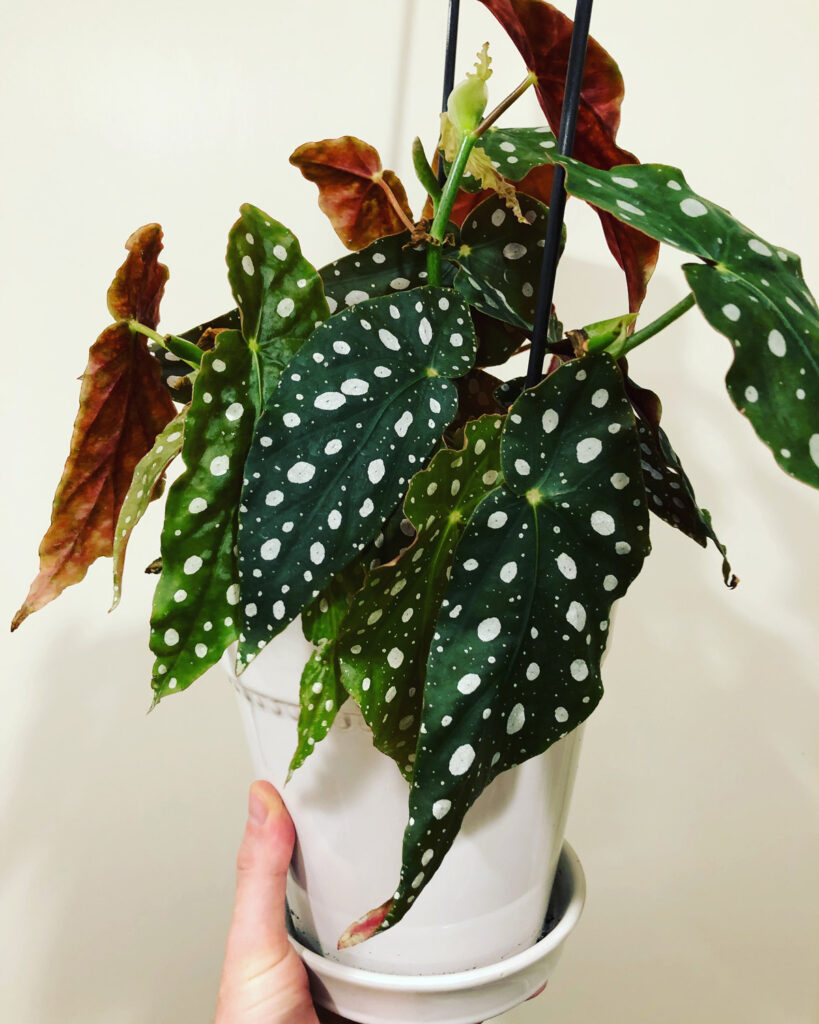
I would not recommend growing this plant in front of a North window. In most cases, it will not be enough light for this plant. A good East window, or West window, would be great.
If you are blessed with super sunny windows, you may want to diffuse the light with blinds or a sheer curtain. Too much direct sun can scorch these plants, at least wash out the color of the foliage, and bye bye polka dots!
If you are concerned about not getting enough natural light, the American Begonia Society says that begonias can grow very well under fluorescent lights and it doesn't have to be an expensive set up.
The ABS says that if you are on a budget, you can use a plain shop light with cool white bulbs and leave them on for 14 hours a day. Just be sure to have the bulbs 2 inches above the top leaves for best growth.
Just be careful as the plant grows, you will have to adjust the lights!
I actually have successfully grown begonias indoors even under LED lights (not the hideous purple ones...just plain LED).
2. SOIL MOISTURE, WATERING & HUMIDITY
Soil moisture for Begonias is CRITICAL! Read this section carefully because it could mean the difference between success and failure.
I've found that there is a delicate balance to strike in watering begonias indoors. They seem to demand very exacting conditions in soil moisture to really look their best!
As long as you don't expect a perfect looking plant (and begonias will rarely look perfect indoors), you will be ok if you heed everything I have to say.
If you keep the soil too dry (meaning completely dry, or even almost completely dry), I've found that Begonia maculata is prone to dropping brand NEW green leaves.
In addition, you will get more of the dreaded crispy brown tips. Some of the lower leaves will also turn ugly and drop off as well.
If you have leaves that are yellow and dropping off, you are potentially keeping it too wet. When you notice this happen, stick your finger in the soil and see if it is wet or dry in order to best diagnose the cause.
So don't let these plants completely dry out! To read more about crispy brown leaves in houseplants in general, be sure to read my blog post on why plant leaves turn brown and crispy.
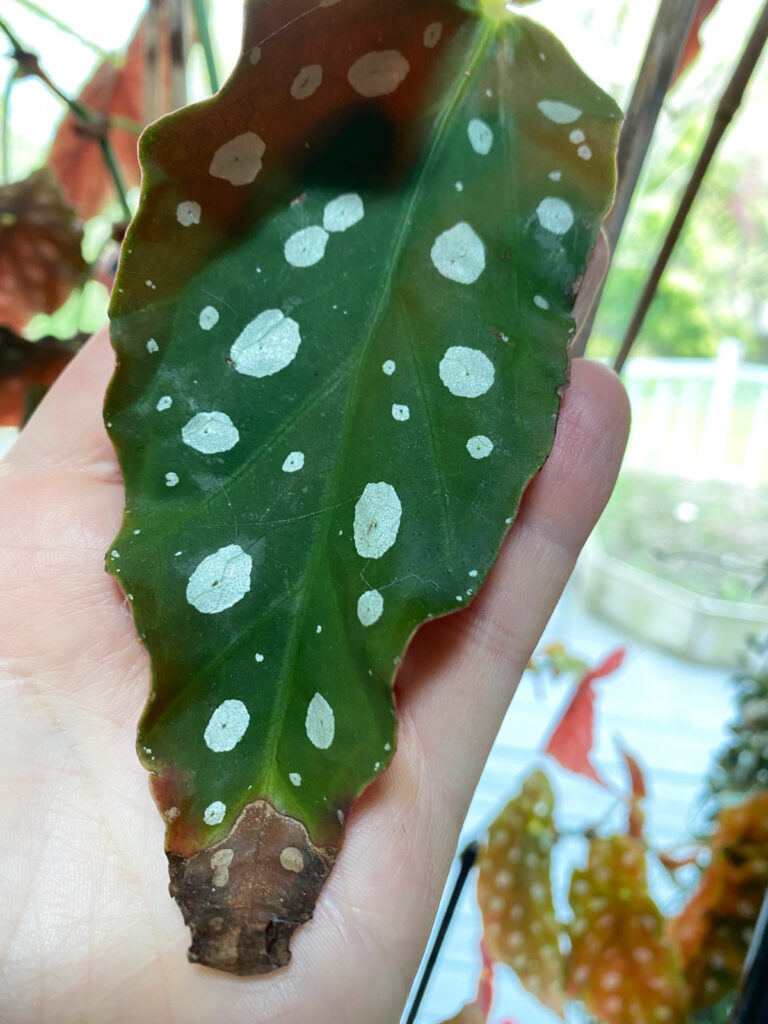
On the other hand, you must NOT keep any begonia too wet. This will cause rotting to occur and also invite various diseases that begonias can be prone to including powdery mildew, among others. My recommendation for watering would be to let the surface dry out (about the top ½ inch or 1 inch or so) and then water thoroughly. This should be a good rule of thumb.
Water your plant thoroughly until all excess water escapes the drainage hole, and discard the excess water. Do not let your plant sit in water.
And don't expect perfection with begonias indoors. For begonias to look their best indoors, they need high humidity, which is difficult to achieve indoors. These plants are native to the jungles of southeast Brazil, so they are used to high humidity.
Although being diligent with watering and NOT allowing your maculata to dry out completely is much more important than worrying about humidity, if you can
I do run a humidifier indoors in the months that our central heat is on, otherwise my plants (and my skin) will hate me. I wrote a blog post on the topic of increasing humidity for houseplants so be sure to check that out as well.
Before we move on, I talk about this in the humidity post that I referred you to above, but my absolute favorite humidifier, and the one I use in my home, is made by Levoit. I LOVE it and it has so many features.
My plants, and my skin, are much happier in the winter with the humidifier. My plants are already subjected to dark Ohio days in the winter, so I make sure that I can compensate a little bit by giving them extra love with more humidity!
I talk about the humidifier in my blog post that I linked to above, but if you want to go directly to Amazon to purchase it, check out the Levoit Ultrasonic Humidifier now. You won't regret and your plants and your skin will love you!
3. SOIL TYPE & REPOTTING
Cane-type begonias aren't as picky as some other types of begonias as far as soil goes. Many other begonias need a coarser mix.
Mine is just planted in an all-purpose Miracle Gro potting mix to which I've added some perlite to it. It seems to work just fine.
Just make sure that you don't keep your plants too wet and remember my advice from the watering section! One very important caution if you are repotting your begonia...be sure not to use a pot that is much larger than where it was previously in.
If you go too big, the soil will stay wet for much longer and you will risk disaster with your begonia! This is especially important for begonias. For example, if you are growing a plant in a 4 inch pot, go up to a 6 inch pot and no bigger. Be sure to loosen the root ball a little bit too before placing it into the bigger pot.
4. FERTILIZING
I've converted most of my houseplants to Dyna-Gro Grow fertilizer. I can't speak highly enough about this fertilizer. It is urea-free, is balanced enough for pretty much all foliage plants, and has all the major and minor nutrients.
I add ¼ to ½ teaspoon per gallon of water and use this with every watering throughout the growing season. I refrain from fertilizing in the winter when growth slows or comes to a halt.
Dyna-Gro Grow is simply the best all purpose fertilizer that I've used for my indoor plants and should be part of anyone's houseplant care routine.
6. PRUNING BEGONIA MACULATA
Over time, your plant may get a little leggy and you might want to rejuvenate your plant.
If you want a bushier plant, you can trim and prune your plant. I trimmed mine in the photo further down below, and you can see that it is growing back.
My plant had started to look a bit ragged because I unintentionally let it dry out multiple times (life happens...) but I took action to improve it. Don't be afraid to prune! You'll see shortly how beautifully my plant responded to a hard pruning.
I followed these tips from the American Begonia Society. In late winter or early Spring, when plants start back up into growth, you can do some maintenance.
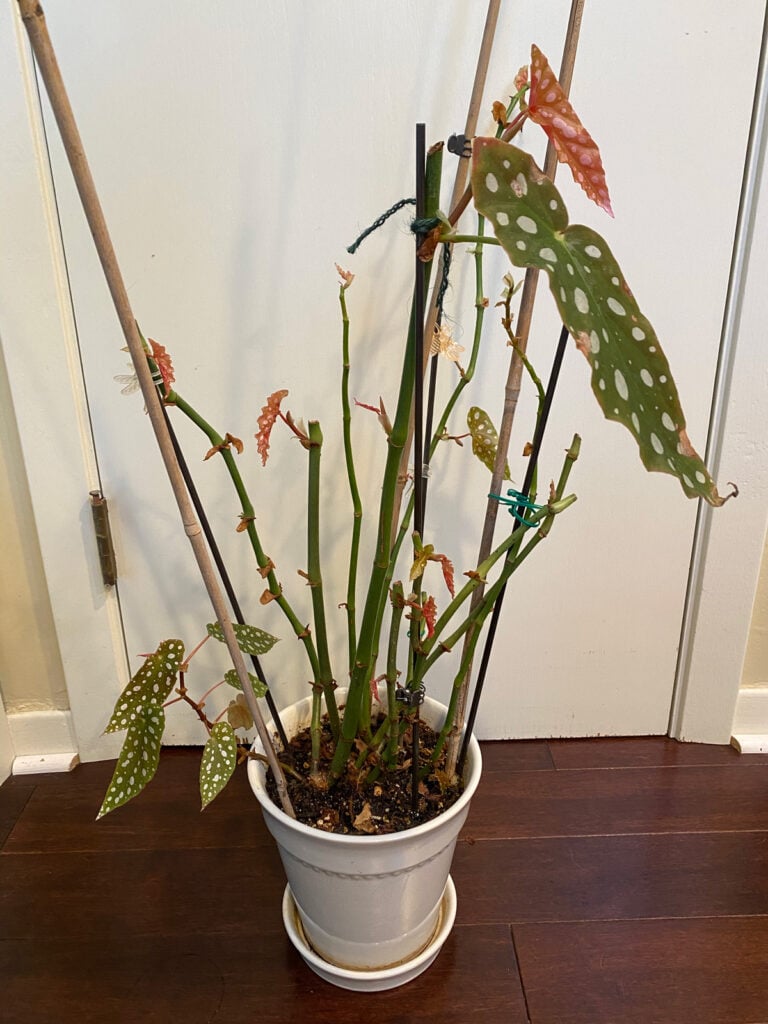
If there are very old, woody canes, especially with not that many leaves, just cut the whole canes down to the soil line.
For any green canes, you can shorten them a bit, but leave at least 4 nodes like I did in the photo above. A node is where the leaves meet the stems.
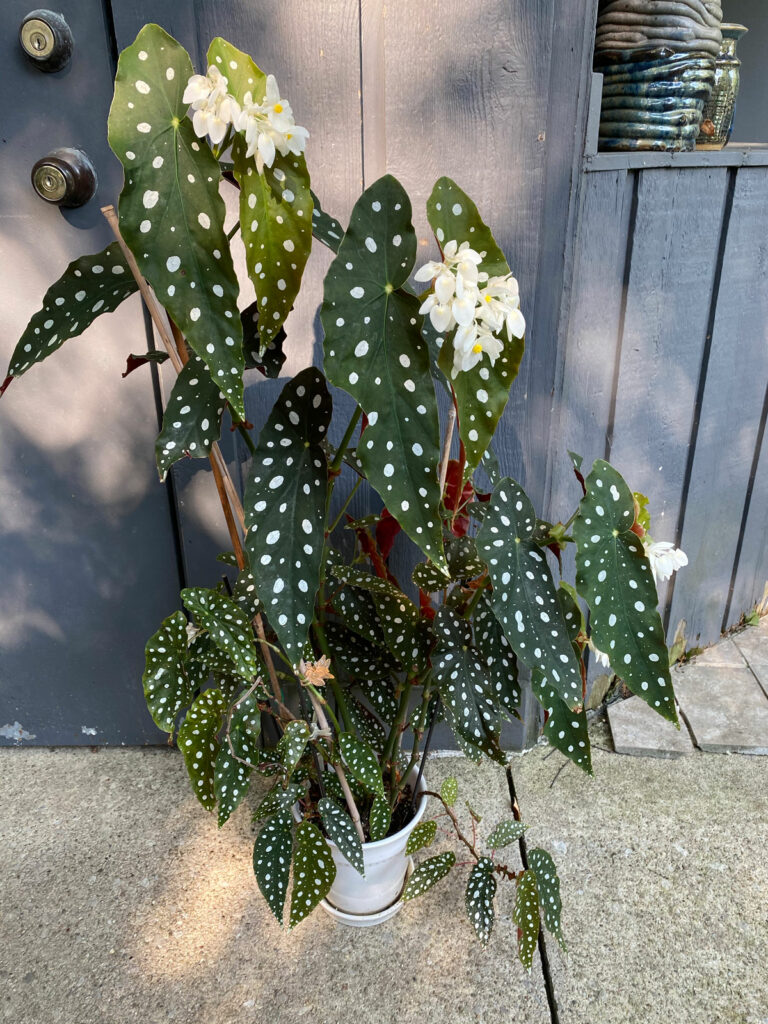
A few months later, this is what the plant that I chopped back looked like. Granted, I also had it outdoors during the summer, but look at the transformation!
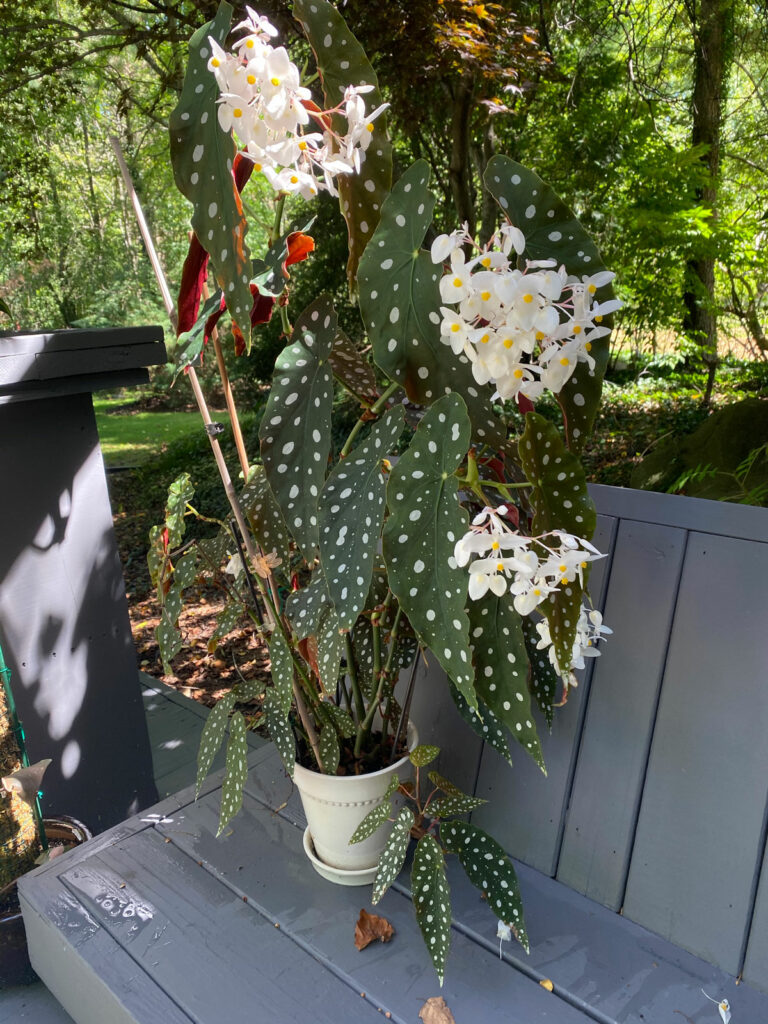
And the flowers are just stunning! After the flowers are spent, they will fall off. If the flowers fall onto the foliage, make sure you remove them promptly, otherwise it could damage the foliage and encourage pests and disease if they left for too long.
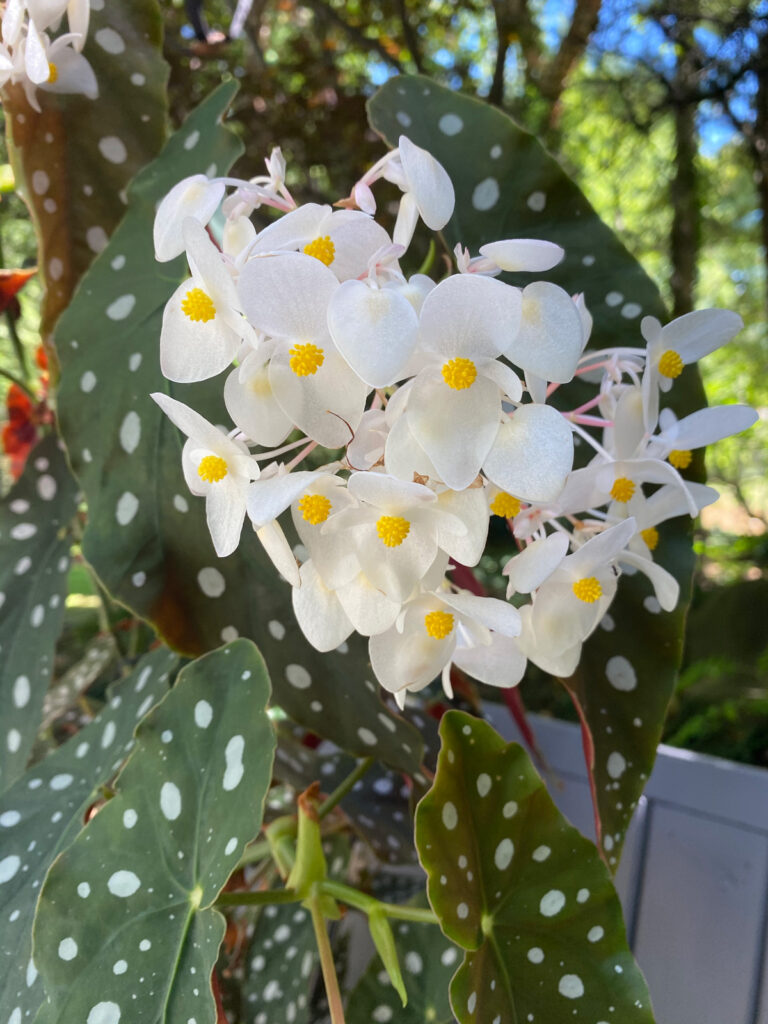
Note that if your plant is not blooming, it's probably not getting enough light. Fertilizing will help increase the show, but light is what will help your plant bloom.
Throughout the growing season, if you pinch the growing tips of the canes, this will help to encourage brand new cane growth from the base of the plant. This will result in a fuller plant.
And of course after all that trimming and pruning, you can use the cuttings to propagate your plant.
7. HOW TO PROPAGATE BEGONIA MACULATA
Propagating this plant is very easy. Just take any clippings that you may have taken from pruning your plant and use this material to propagate.
You'll want to have one or two nodes on the stem. Again, the node is where the leaf meets the stem.
Here is an example of where you can cut to make a cutting.
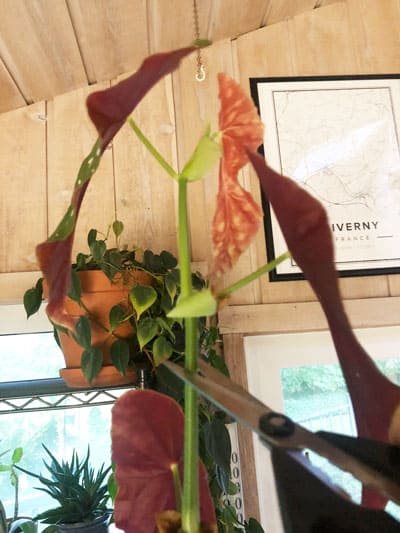
If you then remove the leaf right above where the scissors are, you are left with one node where the roots can grow from, and the cutting still has two leaves at the tip.
Whatever you do, make sure each cutting has one or two leaves left on it.
Then simply just place the cutting in water to root, or you can even insert the cutting into a pot with moist perlite. Once it is rooted, pot it up. Don't wait forever to pot it up into soil.
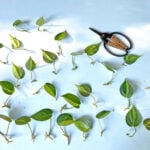
Here are all the cuttings I made after I pruned my plant.
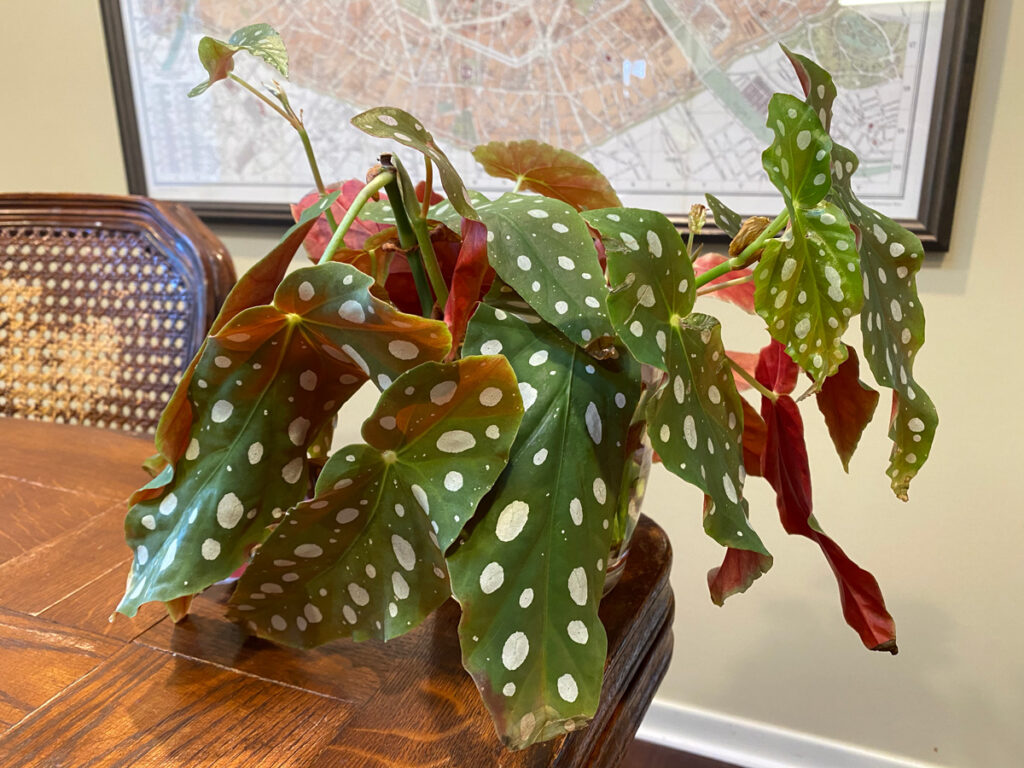
And here is an example of one of the rooted cuttings! All the cuttings I made rooted. There is evidence of rooting on the node and also on the internodes (between the nodes).
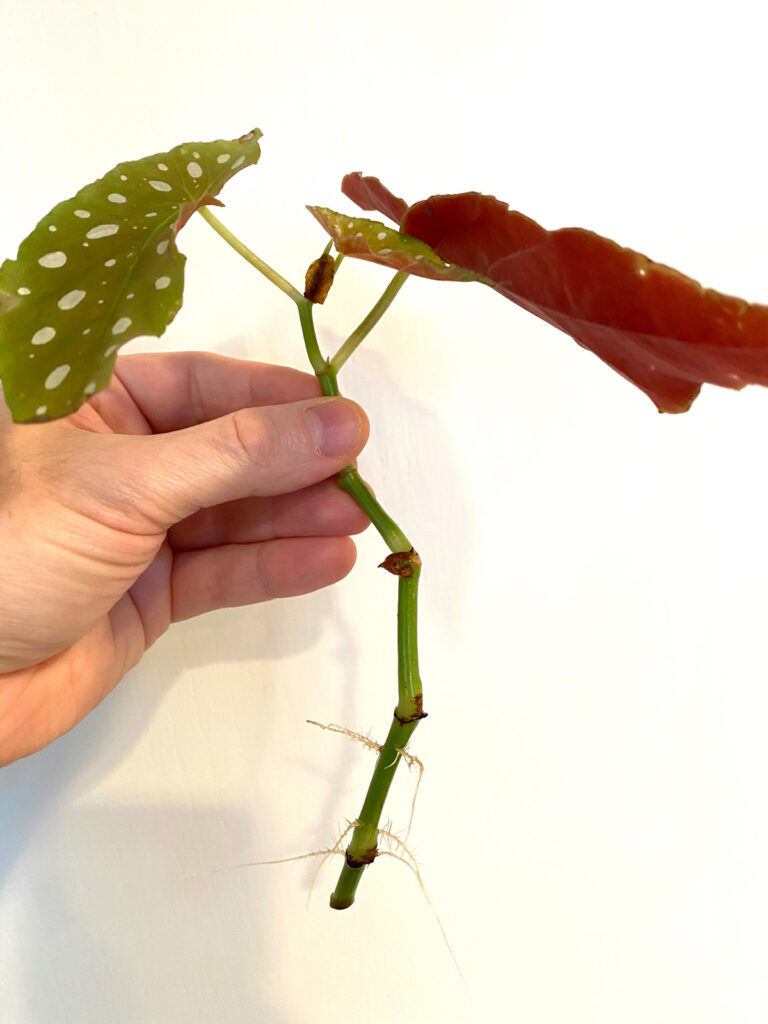
And here is a close up of the roots.
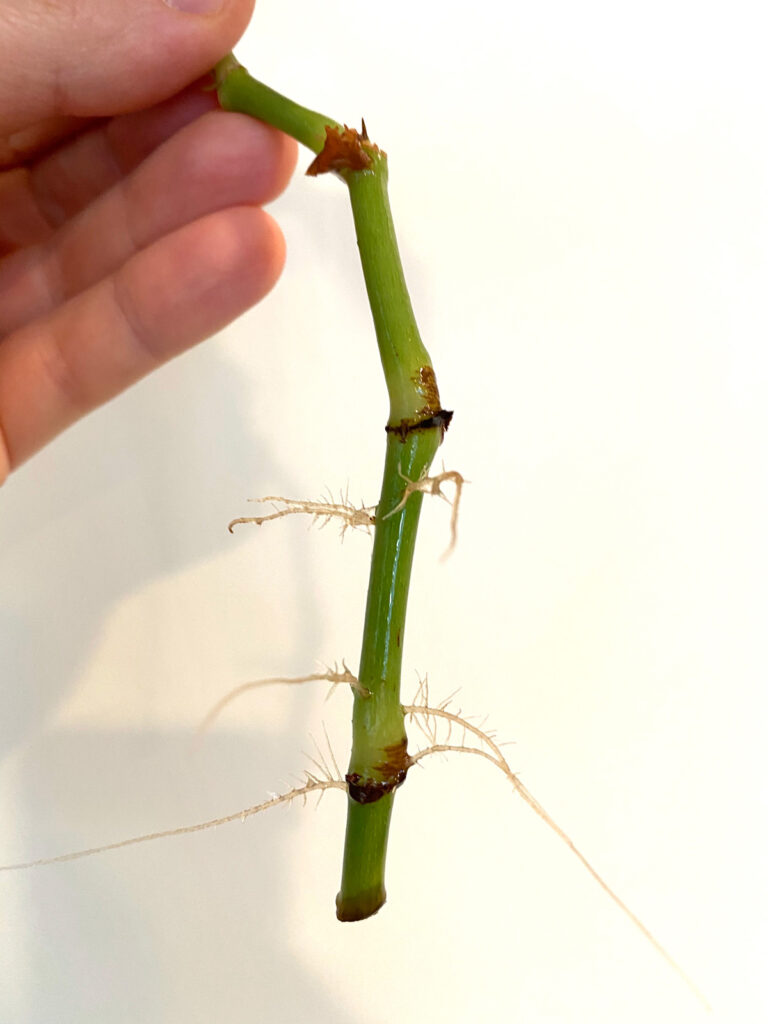
If you love water propagation, you may also enjoy my post on the best houseplants to propagate in water.
BEGONIA MACULATA PROBLEMS
POWDERY MILDEW
Begonias in general are prone to powdery mildew, which is a fungus that starts to appear as small white spots on the foliage and will quickly spread.
Remove any affected leaves and spray the entire plant with an appropriate fungicide. Powdery mildew tends to be an issue when you have high humidity and poor air circulation.
If you are using a humidifier or have your plant growing in high humidity, you'll want to take care to increase air circulation in order to help avoid powdery mildew.
A ceiling fan, or even a portable fan, set on low to gently circulate the air will help avoid this issue if you've had problems with it in the past.
BROWN TIPS ON LEAVES
This is most commonly caused by allowing your potting mix to become too dry. Humidity levels that are too low can also cause this.
YELLOW LEAVES
There are many reasons why plants get yellow leaves. Yellow leaves can be caused by potting mix that has gone too dry, or has stayed too wet for too long.
It is up to you to feel the potting mix and determine which could have caused it. In addition, too much direct sun can wash out the foliage color as well.
DROPPING LEAVES
These are definitely touchy plants, and if conditions are not even and stable, your plant may protest and drop leaves.
Leaf drop is common if you have recently brought your plant home.
It needs some time to adjust to its new environment. Striving for consistent condition (soil moisture), stable, warm temperatures and sufficient light will help avoid this issue.
LEANING OVER
Is your plant leaning over to one side as it's growing? Over time, as your begonia canes get long enough, they'll require support.
Simply insert thin bamboo stakes, or a similar support, in the pot and loosely clip or tie the canes for support.
BEGONIA TOXICITY
Begonia maculata is toxic to cats and dogs due to calcium oxalate according to the ASPCA.
COMMONLY ASKED QUESTIONS
Should you mist Begonia maculata?
Misting does NOT increase humidity. Begonias benefit from higher humidity, so use a humidifier for best results, but remember to also provide good air circulation in order to prevent powdery mildew that begonias are often prone to.
How fast does Begonia maculata grow?
It is considered a pretty rapidly growing species and can even grow up to a foot or more during a growing season with good conditions.
Why are leaves falling off my Begonia maculata?
Many factors can cause this including a drastic change in environment, soil that is too dry or too wet, low humidity, and even very inconsistent conditions.
How do you make Begonia maculata bloom?
Blooming is always triggered by sufficient light. If you plant is not getting enough light, it will not bloom. Aim to have very bright, but mostly indirect or filtered sun for best results.
Why is my plant tall and leggy?
If you find that your plant is growing but there is more and more space between the new leaves (the internodes), this means that your plant is not getting enough light. You may want to prune your plant back, and move it to higher light.
If you love begonias, be sure not to miss my blog post on dazzling begonia types that you can grow in your home.
That's about it folks! Do you have a Begonia maculata? What are your experiences with this plant? Comment below! I'd love to hear from you.
Hi I purchased my plant two weeks ago, I've noticed that the green of the leaf is fading and purple/red colour underneath is coming through. It is an indoor plant and I am in student accommodation, I have one window. Originally my plant was on my bedside table but after reading your article I moved it to the window sill. Are you able to halp me please?
Hi Anja! Did you check your soil moisture? One of the reasons the color can fade is when the soil goes really dry. If that wasn't the case, it could be something else. Check that out first and let me know.
I'm afraid it appears that my little begonia has blight. I initially thought it may have recieved too much sun and leaves got sunburnt and/or lack of humidity. The plant was in rough shape when I got it. It was until someone suggested fungus. How can you be sure? Should I remove all infected leaves and treat?
So disheartening.
I wish I could attach photos.
If you suspect a fungal issue, definitely remove the affected leaves. You can send me an email through my contact form on my site. Once I respond, you can attach photos and I can try to help.
I LOVE how beautiful your begonia is! I recently purchased a small one that had gorgeous leaves. However, over the last three days almost every leaf has had red from the back seeping through to the front. Once this happens, the entire leaf goes from healthy to shriveled and falls off. I keep the soil moist, humidity high, and light abundant but despite this it seems as if soon all of the leaves will be affected. Have you ever encountered this? Sadly, I can’t find any answered anywhere.
Hi Mona! Perhaps you're keeping the soil too wet? Does the pot have a drainage hole?
@Raffaele,
Hello! I have the begonia in a nursery pot with drainage. I did notice that it was overwatered when I got it so I let it dry out at first. The soil is now at a perfect moisture level but it doesn’t seem to be happy. There is a new leaf growing but all of the older leaves have fallen off. The new leaf doesn’t show signs of red seeping through but I am worried that it will also have them when it matures more. Could it be a sign of root rot?
Beautiful !!! Impressive! !Excellent!Congratulations the best tips I find all over the net.awesome information.
Glad you enjoyed it Juan!
Hi! Thanks for all the info!
I purchased a maculata about 2-3 weeks ago and I’ve been watering once a week, the biggest leaf is folding and the red back is starting to show through the green front. What is going on? Thanks!
Hi Blanca! It could just be going through a transition period. Try not to let them go completely dry as this will cause it to go downhill pretty quickly!
Hello! For propagation, is it a must to remove a leaf at the node for it to root? May I propagate the cutting with the node and leaf attached, like how a pothos cutting may be done? They are such pretty leaves to lose haha
Hi Anee, that is a great question! You do not need to remove the leaf :-). It just sometimes makes it easier, but you can definitely leave it attached!
Do I need to keep the cuttings near window as well if they are placed in water or a bright bathroom would do?
They should still be kept in good light. If your bathroom is bright and has a window, that's a good location as well because of extra humidity.
Hi. My Begonia is browning at the edges and some have turned black. Would it be beneficial to invest in a humidifier?
Humidifiers are always a good idea if you have low humidity. I have mine running during all months that we run our central heat. Watch your soil moisture carefully though and try not to let it dry out completely.
@Raffaele, Thank you for the post. I was wondering how long do you let your humidifier run for. I have bought a small one and placed by my Begonia (no other plants around). Should I leave it on all day. It has a 4/8h feature. Is one round enough? Thank you in advance!
Hi Sarah! I go by the humidity level instead of time. Do you measure your humidity with a hygrometer? I aim for 40-60% relative humidity.
I got mine from my sister. All the leaves are curly and brown tips that has been going up day by day. What should i do?
Once they have the brown tips, you can just cut the tips off. Those leaves won't recover. If you've had your plant a very short time, it needs time to adjust. I would do your best to follow all the watering and light tips in the post and hope for the best!
Hello, I received a cutting of the plant to propagate and I have had in water for about two weeks. I am happy because since then it has sprouted a new leaf! However I am concerned that the stem might be too thick to root. Is there such a thing? Also, should I be changing the water? Thank you!
It should be fine and I've rooted them easily in water. Try changing the water at least once a week or so (and also any time you see cloudy or dirty water). Keep an eye on the water level as it's rooting to make sure that it doesn't go dry. Hope this helps!
I purchased a Polka Dot maybe before or right after Valentine. There hasn’t been new growth at all & I noticed it was holding water for a long time, so this past week I let it dry out & moved it to a sunnier location. Is it possible the pot I bought it in is too big?
Hi Natalie. It's hard to say without seeing a photo. You can use the contact form on my website if you want to send me a message. Once I reply, you can attach a photo. If there is no growth, it's probably due to poor light. But you moved it to a brighter location so you should start to see growth soon. They grow quickly.
Hi! I've got a begonia thats lost all its leaves - It has been repotted once, but I don't think there was enough drainage - the soil is heavy and very moist. I'm worried repotting it again with lots of drainage will shock it too much... What do you think? Thanks!
Honestly, now is the time to repot and if the soil is heavy and wet, that could have been why. It's better to correct that now than leave it in the heavy/wet soil which could kill it. I would follow the soil mix described in this blog post and all the care tips for best results.
Hello! I've been growing a begonia from a cutting and it's been great! Fast growing, beautiful leaves. My problem is that all the leaves are growing on the same side! I fear once they grow larger the plant will start slowly falling due to the weight.
Is it because of the way the leaves are facing the light? I've turned it around but I don't know if this will help... If you could help me with this it'd be great 🙂 thanks!
Hi Fabiola! If you want to send me a picture, it may help. But you can give it a stake and secure it to the stake for support. Eventually as it grows, it will be more balanced. But definitely keep turning it regularly to encourage even growth! I'm assuming you're giving your plant enough light 🙂
@Raffaele, you give such awesome plant advice!
I'm so glad you're enjoying it Dee!
Hi! I just bought on also on the brink of death. All the leaves are curled in and crunch, one is almost slimy. The top of the stem can't hold itself up. I staked the plant up but wanted ot know if i should cut off the leaves and the top of the stem. How else can I try to nurse this plant to health? Thanks!
Hi Menna! Can you please email me some photos? It would be easier to help you out that way!
Hi, I purchased one that was on the brink of death. The leave tips are all brown and crunchy. Can I cut the dead leaves off or just leave them?
Hi Rosanna! You can just cut off the brown parts and leaf the rest of the leaves. If the entire leaf is brown, you can surely cut it off.
I love My plant. Had it since September. It’s doing ever so well. Stopped growing in winter but it’s woken up again.
My only concern is I have never ever seen any flowers on it yet!
Will try the propagation becoz unlike u I prefer a bushy plant rather than a tall one. Also can I put that rooted stem back in the same pot.?
Hi Zubin! Have some patience with the flowers. If your light is good enough, you should get some flowers at some point :-). Yes, you can certainly put the rooted stem back in the same pot if there is room. If the plant needs to be repotted though into a larger pot, you can do it at that point too.
@Zubin, Superthrive for blooms!