
Eliminating Fungus Gnats: 3 Easy Steps for Your Houseplants
Some of the links in this post may be affiliate links.
Have you been struggling with fungus gnats infesting your houseplants and are desperate to get rid of them? If so, you've come to the right place! I will give you the complete picture of how to get rid of this nuisance pest. There are many remedies out there, but I will share ones that I have personally used and know that work.
Most of the solutions provided are organic solutions, but I will also discuss other methods. You can use your own discretion in terms of what you're comfortable with.
Would you like to save this post?
FUNGUS GNAT LIFE CYCLE
Before I get into how to eliminate fungus gnats from your houseplants, it is very important that you understand their life cycle, and also the conditions that help them to thrive.
Once you understand this, the 3 main things that you need to do to eliminate them will make more sense, and you will be more inclined to take all the necessary steps!
According to Cornell University, the lifecycle for fungus gnats consists of:
- ADULT: Flying adults will only live up to 8 days.
- EGG: The adult females then lay up to 200 eggs on the surface of the potting mix and they can about 3-6 days to hatch.
- LARVA: The eggs then hatch into Larvae and will start feeding for about 2 weeks.
- PUPA: Finally the Larvae pupate for 3-7 days and the adult fungus gnats emerge and starts the cycle all over again.
The temperature that your houseplants are growing in greatly affects the length of the life cycle. Lower temperatures will cause the life cycle to take more time.
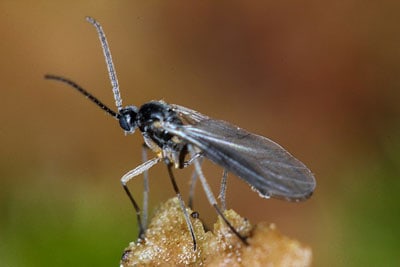
Photo Credit: Andy Murray, CC BY-SA 2.0
Cornell University also states that the optimal temperatures for fungus gnat development is about 70-75F. I found this really interesting because I seemed to validate this in my own home!
I've only noticed fungus gnats in my basement (where I have a grow light set up) and the temperature stays around 74-75F. In my sunroom, which normally stays in the upper 60s F, I'm not sure I've seen a single fungus gnat there.
Lastly, fungus gnat larvae mostly hang out in the top 1-2 inches of your potting mix and they like moist conditions so if your potting mix never dries out, you are helping to proliferate the problem!
Why is all this necessary to know? Because you need to attack on all fronts in order to effectively control fungus gnats.
3 STEPS TO GET RID OF FUNGUS GNATS
There are 3 main things you need to do in order to effectively control fungus gnats in your houseplants:
- Control Your Cultural Conditions
- Capture Adult Fungus Gnats With Traps
- Treat Potting Mix to Kill the Larvae
If you only see a couple fungus gnats here and there, it's really not a big deal, but sometimes you will be surprised just how many fungus gnats you can have once you start to trap them!
Fungus gnats are called "fungus" gnats because they feed on fungi growing in your soil or potting mix. Adult fungus gnats are harmless, but the larvae in the potting mix, if present in large numbers, can damage roots, particularly in younger plants.
CONTROL CULTURAL CONDITIONS
TEMPERATURE
Like I mentioned earlier, 70-75F (about 21-24C) is optimal for fungus gnat development. You may not have too much control over this factor, but it is worth noting.
MEDIA TYPE
Also worth noting is that fungus gnats get their name because the larvae in the potting mix/soil feed on fungi and other microbes. They will naturally be more attracted to mixes that have compost, blood meal, kelp, etc. because there are a lot of microbes (which are also extremely beneficial for plant growth so it is a catch-22).
This is not to say that you should avoid organic mixes, because I think you can successfully use mixes like this, but is also worth noting. There are some wonderful potting mixes that include compost and organic materials.
POTTING MIX MOISTURE
What you can control that will have a huge impact on fungus gnats is the degree to which you let the potting mix dry out. Fungus gnats thrive in moist potting mix, especially in the top inch or so of your pot.
In order to manage fungus gnat larvae from proliferating in your pots, allow the top inch of the potting mix to dry out before thinking about watering again.
By allowing the top portion of your potting mix to dry out, you're making it less hospitable for fungus gnat eggs and larvae, and this will result in less gnats that will reach adulthood and pester you and your plants!
CAPTURE ADULT FUNGUS GNATS WITH TRAPS
While you are controlling your potting mix moisture, you will need to also trap any of the adult fungus gnats. Fungus gnats are weak flyers and you will see them normally flying pretty close to your plants.
It is critical that you capture the adults so that they won't continue to lay eggs in your potting mix. There are a number of sticky yellow traps available.
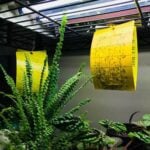
Adult fungus gnats are attracted to the yellow traps, and once they land on them, they stick to the traps and aren't able to fly away.
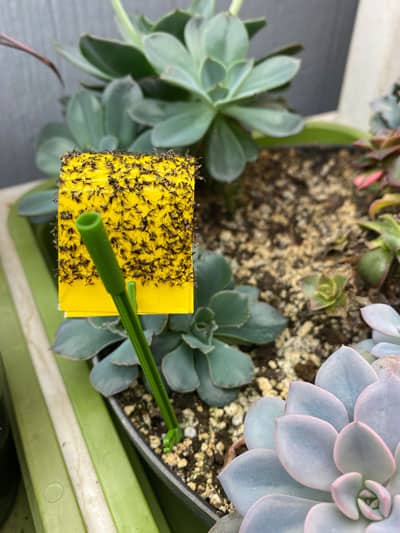
Pretty gross looking right? This is essential though since you need to trap all the adults that you can so that they can no longer continue to reproduce.
I buy my yellow sticky traps on Amazon. Simply bend the yellow sticky paper and insert it on the clip so that the sticky side is on the outside, and insert the plastic rod into the potting mix in your pots.
There are quite a few different kinds of yellow sticky traps, including ones that you can hang, so just choose one that works for you.
However, if all you're doing is placing yellow sticky traps and not doing anything else, you will not get rid of your fungus gnat problem.
TREAT POTTING MIX TO KILL THE LARVAE
The last step that you'll need to take is to treat the potting mix to kill the larvae so that they don't turn into flying, adult fungus gnats.
There are some home remedies which I haven't tried so I can't speak to their effectiveness, but here are two very effective methods to kill fungus gnat larvae in your potting mix. One is a biological control, and the other is a systemic pesticide.
BIOLOGICAL CONTROL
If you are opposed to harsher treatments, one excellent product to use is Mosquito Bits. Mosquito bits are basically corn cob granules which are coated in BTI bacteria (Bacillus thuringiensis subspecies israelensis).
Always read the label for any of these products for proper use. When BTI is eaten by fungus gnat larvae, it kills them. Under proper use, BTI is not toxic to people and will not harm pets.
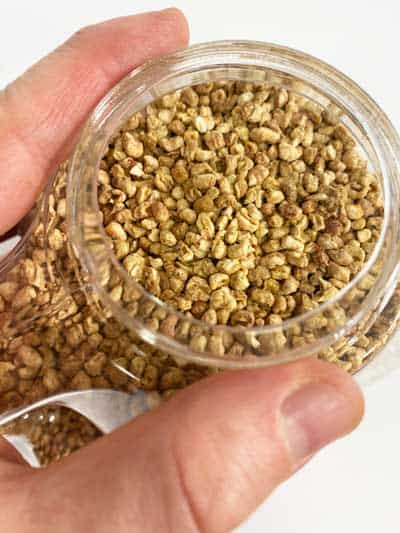
I buy my mosquito bits on Amazon. Refer to the label for directions, but all you have to do to treat fungus gnats using mosquito bits is to sprinkle them on the surface of your potting mix until there is a layer completely covering the surface.
Water as you normally would, and each time you water, you'll release BTI into the potting mix. The fungus gnat larvae feed on it and then die.
Repeat this process once a week for at least 3 weeks. You can even do it for a full month to be safe. Remember that you must be persistent with any pest control and it is a good idea to treat even after you don't see anymore pests.
SYSTEMIC CONTROL
Another option is to use a systemic insecticide. Unfortunately, these are not available everywhere and some countries don't allow their use.
I sometimes use Bonide Systemic Houseplant Insecticide and it is very effective to kill fungus gnat larvae. You simply apply it to the potting mix as directed on the label and water it in.
The insecticide is then absorbed all throughout the plant. Not only does it kill fungus gnat larvae, but it will also help to protect against many other pests. Protection will last up to 8 weeks.
With some other pests, I often use Bonide Systemic Houseplant Insecticide in combination with sprays to add a little more "oomph" and it works very well.
FUNGUS GNAT TREATMENT SUMMARY
In order for effective control, you must do all of these items simultaneously:
- Control your conditions so that you don't encourage a proliferation of fungus gnats. If you allow the top inch of your potting mix to dry out, it will go a long way in controlling them.
- Capture the flying adult fungus gnats using sticky traps so that they can't lay eggs in your potting mix and continue the life cycle.
- Kill the larvae in your potting mix so that they don't even make it to adulthood. Depending on what your preference is, you can use Mosquito Bits or a systemic houseplant insecticide.
If you do all 3 of these things, you will have gone a long way to minimize huge infestations. Be diligent for 3-4 weeks, and you can be successful!
Have you dealt with fungus gnats? Comment below. Interested in how to treat other pests? Check out my other posts on:
I have used yellow traps in the past, but I just decently bought the black sticky traps. Do you think that SAS a mistake? Hitting
Hm, I've actually never seen black sticky traps. I would see how well they work. If you see fungus gnats flying around and none on the sticky traps, maybe switch back to yellow. Or maybe if you use both a yellow and black one next to each other, and see which one works better. Just a thought!
I’ve been using the Mosquito Bits tea at 1 tsp/quart of water, with little effect. also using sticky traps. I tried the bits spread on the soil but they got moldy though I think they helped more than tea. Do you add a new layer of bits each week if you are doing a three week treatment or just water the original bits you put down? Thanks.
If you're not seeing any effect, try them weekly like you mentioned.
Hi I bought diatomaceous earth; haven't recieved book yet -
Do I just sprinkle the powder on the top soil?
Fiddle fig trees
thank you
I've never personally used it myself, but from what I hear, you just sprinkle it until the surface of the soil is covered.
Forgot to add that the size of the chunk varies depending on the size of your watering can. For a 1 gallon water can, use 1/4 of a dunk. Mine are less than 1/2 gallon, so I use 1/8th of a dunk.
Another option for dealing with Fungus Gnat larvae is mosquito dunks. Dunks come in a doughnut shaped circle. Break or cut them into eighths, put a chunk in your watering can, and let sit over night. Just water your plants as you normally would. I've been using the dunks for a couple of weeks, and I catching a lot less adults.
Thanks for sharing Barb!
ive been fighting with fungus knats since last fall they have managed to kill several plants for me so i am certainly going to try all three things to get rid of them i do have what i need for it and im going to be verry dilligent on it
If you follow the advice in this blog post, it should help a lot 🙂 Good luck!
Regarding getting rid of fungus gnats, I have got them under control by sucking them up with the vacuum cleaner! This method is very effective at catching the fungus gnats in flight as they fly quite slowly, but you have to be careful not to get the nozzle too close to the plant or it may suck a leaf up and damage it (obviously depending on how powerful your vacuum suction is)
Whatever works! Lol
I was wondering if it is safe to use these methods when having Kant problems with herb plants like basil?
I've never tried on edible plants, so I can't really comment unfortunately.
Hi Raffaele,
I after some further research on methods to eradicate fungus gnats and the recommended products I found that the reason the Bonide product is not available in California is because it kills honeybees at even very small doses. Even when using it only on indoor plants, the toxic chemical has been found to leach into the soil and ground water and find its way into our precious bees which are vital to sustaining our worldwide agriculture. Honeybee death is a a huge problem worldwide and so products such as these should not be recommended without a warning on the potential deadly environmental impact of using such a product. I wasn’t sure if you were aware of the reason behind the restriction of this insecticide in some areas. Some readers may prefer to put up with fungal gnats rather than risk killing honey bees. Thank you for your informative website.
Hi Danielle, thanks for commenting, and I was not aware of this until fairly recently, and thank you for bringing it to my attention.
I have a fungus gnat problem in my houseplants and I have been using the suggestions above except I cannot get the Bonide here in Orange County, California. Any other suggestions? I have also been using neem oil and it is not helping.
If you use the sticky traps and the mosquito bits, that should do the trick as well!
I just found your site. I will browse in after this message.
Fungus gnats: Almost all my plants had these bugs. It was horrible. I found that mosquito bits did not do the job for this infestation.
I bought Nematodes for fungus gnats and it is doing much better. I have to repeat the treatment for a few plants but it did wonderful. I highly recommend it.
Thanks for sharing Linda!
I spray diluted hydrogen peroxide on the potplant soil and this kills the gnats’ eggs and larvae. Use a fine spray and make sure you cover the entire surface of the pot.
Thanks for sharing Pamela!
@Pamela, can you tell me the ratio of hydrogen peroxide to water please?
@Sharon Speicher, I’ve been trying the cinnamon and yellow sticky traps approach, but they only seem to be increasing. Yesterday I did the watering with peroxide and water mixture - 1 part peroxide to 4 parts water. 🤞🏻 I’ve also read 1:3 ratio, but have also seen 1 teaspoon peroxide to a quart of water, that seems pretty weak. Hoping the 1:4 works. The plant stand is in the bathroom with no heat ducts and the temp is low to mid 60s, so the temp hasn’t been a deterrent.
Never had a problem with them until I repotted an orchid. I got orchid mix, suspect it may have been contaminated.
@Chris, I tried the 1 to 4 ratio of peroxide and water, I was hopeful, but it was a no go. Every method involves water and my seedlings can handle just so much and overwatering is part of the problem—sigh.
I’ve been growing seeds for awhile now and I never had such problems. Last year the coco coir held too much water and molded as I should have added equal amount of Perlite to it. This year I made an error and used an open bag of potting mix. OMG! I not only have mildew and gnats, But APHIDS! I don’t even have those problems all summer outside. I found 2 lady bugs in the house and they are happy with aphid patrol and doing a good job.
So, I sprinkled Mosquito Bits on all plants in house, but I didn’t thoroughly cover the soil with the Bits and then watered. Was hopeful and seen very few after 5 hours, but the adults are still buzzing and I use sticky traps. I’ve heard some people made the tea and it didn’t work, but I will mix 1/4 cup to gal of water and water for at least 3 weeks maybe 4 when needed. It’s hard to tell, but if All plants in the house are not treated it will not work. That was a problem because I was growing indoor lettuce successfully and didn’t want to use on food even though BT is safe. So I harvested the lettuce as the gnats were heavy under lettuce leaves and threw the pots outside.
I’m only in 1 week and 1 room has very few right now, but I won’t let my guard down and continue to water with tea mix. It will soon be time to plant out. These buggers have killed several non stop begonia seedlings and they weren’t doing so well until I realized they needed heat and 72*F with fan was too cold, but those gnats are not helping.
From now on sterilizing ALL potting soil used inside and no plants brought indoors unless treated and isolated.
I had a very bad fungus gnat problem. I tried sprinkling mosquito bits on top of the soil then watering, but it wasn’t doing much and the bits looked moldy after a few days. I used cheese cloth to make little pods with 4 T of mosquito bits to a gallon of distilled water. I let it sit overnight then watered my plants with it. I also used the yellow sticky traps for the adults. It did take about 3 weeks but they are now gone! I didn’t know about the Bonine systemic insect control product until I read your article. I will try it next time. Thanks for all of your articles. They have helped me keep my plants healthy!
Hi Cathy! Thanks for sharing your tip with soaking in distilled water, and I'm very happy that you find my blog useful! I'm glad you were able to get rid of the fungus gnats.
Thank you so much for such an informative site!
A few months ago I realized I was overwatering which was definitely contributing to a gnat issue in at least one room in the house. So....I decreased the watering schedule around here. In tandem with reduced watering I sprinkled some diatomaceous earth on the top of the soil in the affected pots, figuring it works for garden critter reduction so why not try it for these. Happy to report it does help quite a bit. I need to do another treatment, as it's been about 3 weeks and I noticed a couple gnats flying around the last couple of days.
Glad you're enjoying my site Heidi! Be sure to also use yellow sticky traps in order to catch the adult fungus gnats so that they can't lay anymore eggs in your plants 🙂
What about neem oil? I read about it all the time.
Hi Colleen, I'm personally not a fan of Neem oil for various reasons, though it can work for some pests. Even if it does work for the adult fungus gnats, it's not really practical. It would only be for the adult flying gnats, and you'd have to spray constantly and still need to kill the larvae that are present in the potting mix anyway. It's definitely not a practical solution for fungus gnats. Hope this helps!
I have used Ceylon cinnamon to keep the larva off the roots. Looks to be working. Certainly smells good.
Good to know! :-). I haven't tried that.
@Dorothy, what is Ceylon cinnamon?