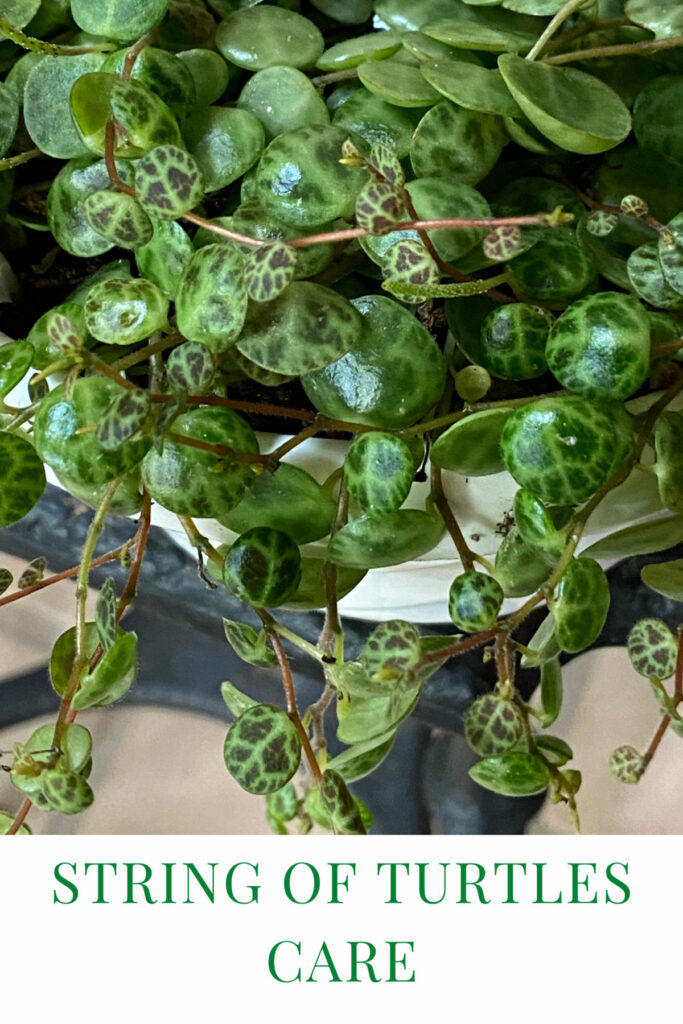
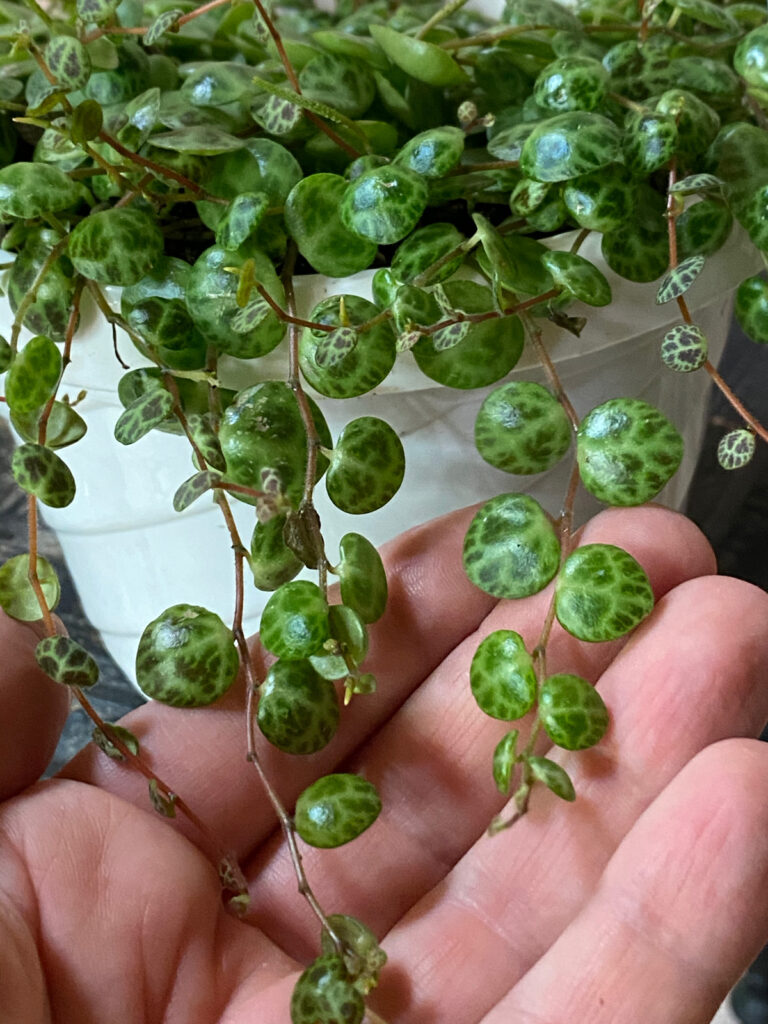
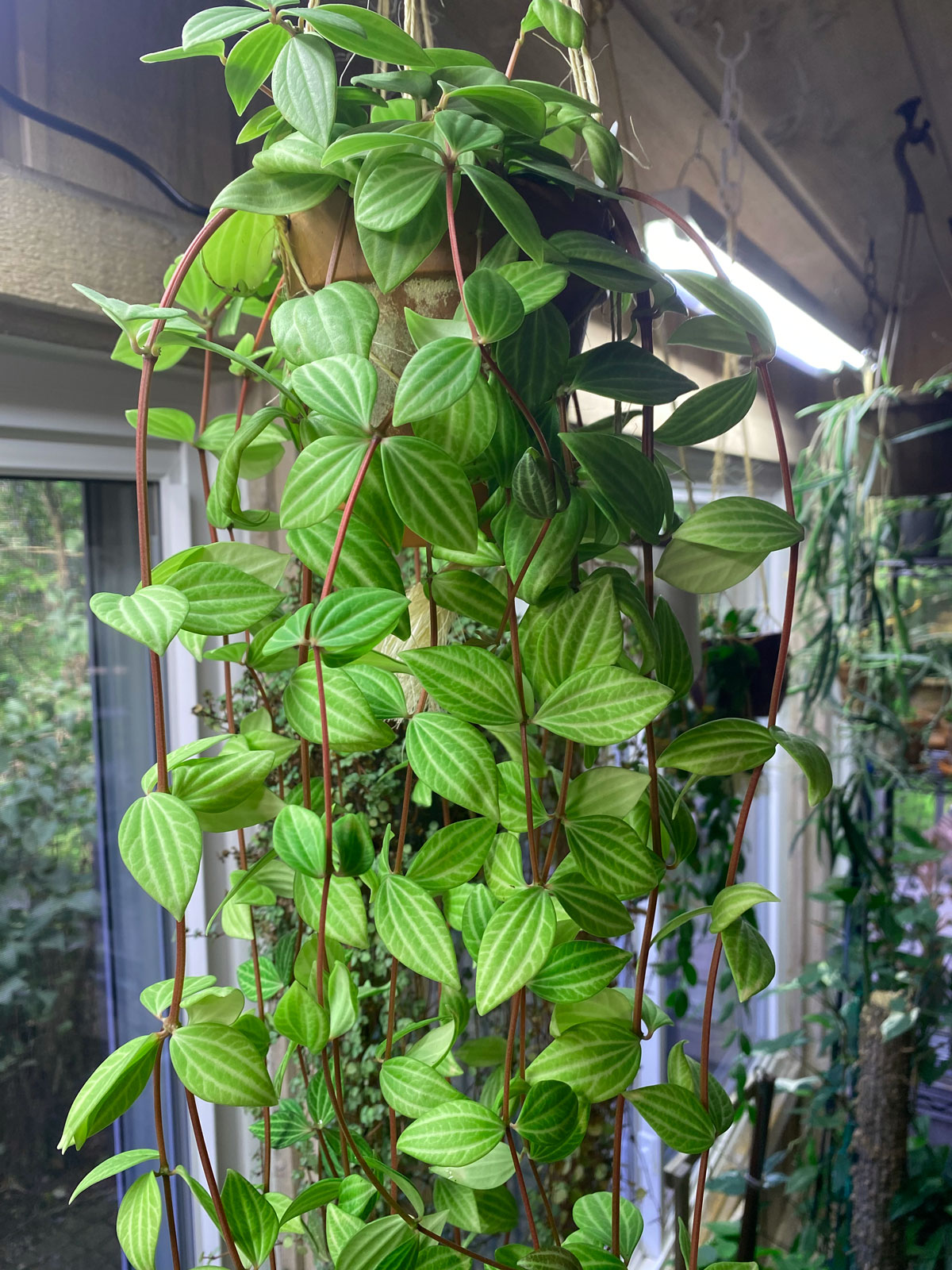
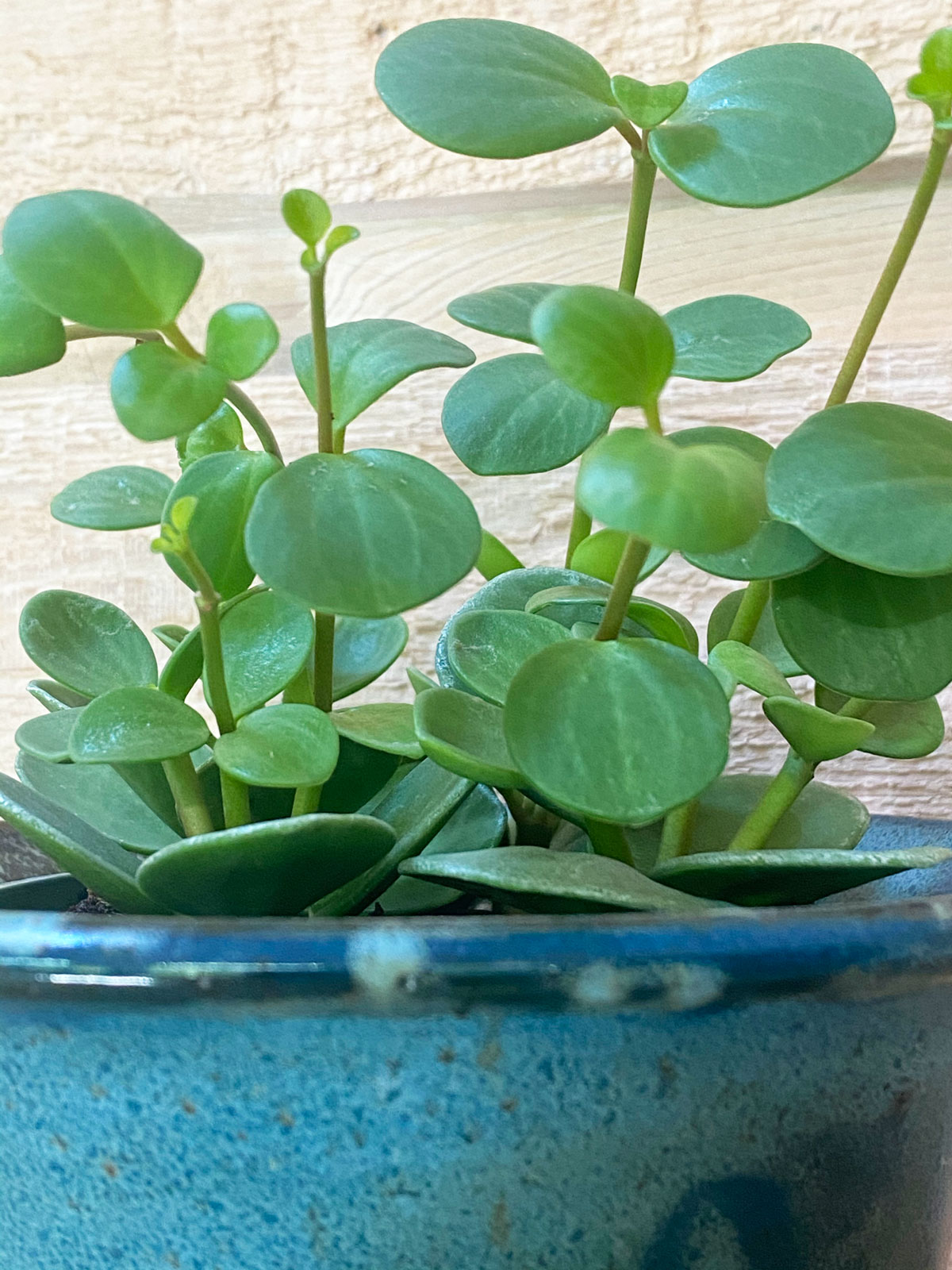
Peperomia prostrata, commonly known as String of Turtles, is a delightful, easy to care for species in the Peperomia genus. Some other common names include Turtle Vine, Chain of Turtles, and Jade Necklace. This native of Ecuador is a trailing species with small, round and succulent leaves and is a perfect plant for smaller spaces.
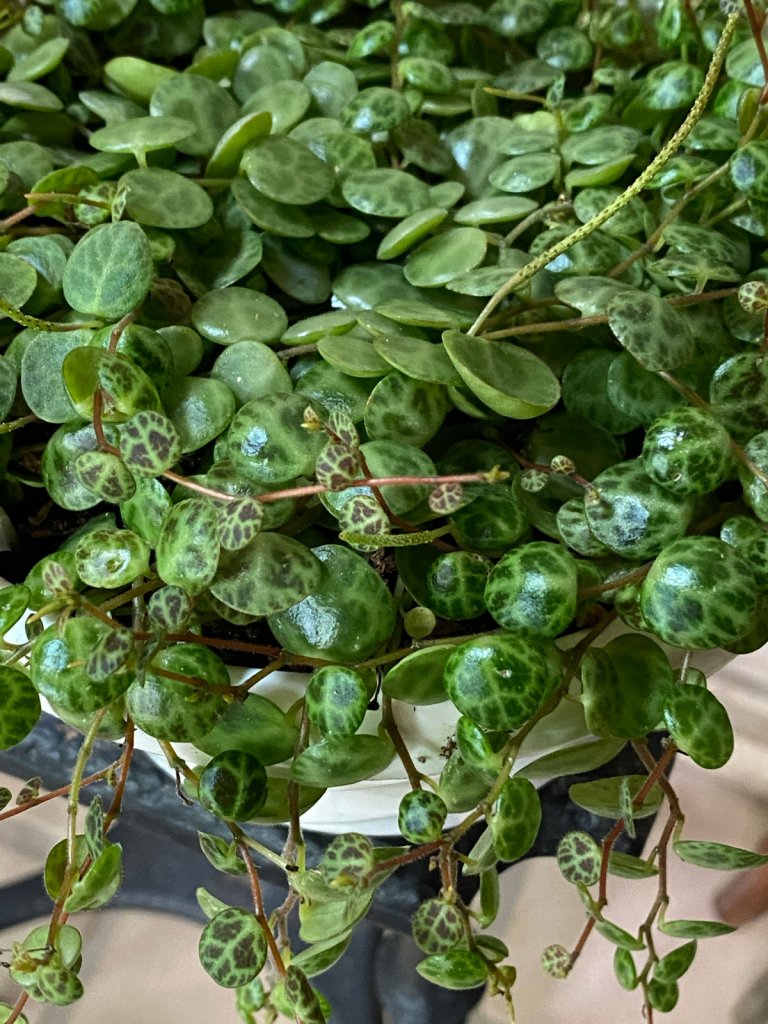
Like the common name suggests, the leaf pattern of String of Turtles is reminiscent of turtle shells. It has a vining habit and forms a beautiful, lush mat of foliage and is perfect for smaller hanging baskets or to trail down from a shelf.
Keep reading to learn all about how to care for this dainty species!
Would you like to save this post?
Enter your email, and I will send this link straight to you!
Table of Contents
STRING OF TURTLES CARE TIPS & GROWING CONDITIONS
1. LIGHT
Place your String of Turtles immediately in front of a nice, bright window that gets mostly indirect light. Providing your plant with 2-3 hours of direct sun is very beneficial, but avoid all day full sun.
At a bare minimum, it should be immediately in front of a northern facing window (if you live in the Northern hemisphere) or in front of a southern facing window (if you live in the Southern hemisphere).
Regardless where you live, for best growth, East or West facing windows would be ideal for these plants.
2. WATER
Watering is a very important topic to get right with Peperomias since most of them have pretty thick, succulent leaves, and Peperomia prostrata is no exception.
It is important to always water thoroughly, but you should allow at least the top half of the potting mix to dry out before watering again.
If your potting mix has stayed too wet for too long ("overwatered" as many people call it, but I despise the term!), you may notice one of 3 things:
The first is that your plant can wilt. Keep in mind that wilting can also result from the potting mix having gone completely dry. You will have to feel your potting mix to determine which it is. Do not use a soil moisture meter as they are notoriously unreliable and drive the wrong behavior.
The second thing that can happen with potting mix that has stayed wet for too long is that your plant can exhibit symptoms of edema (sometimes spelled oedema). These include raised bumps or protrusions on the leaves.
The third thing is that your String of Turtles' relatively fragile stems can rot pretty easily.
To be completely safe, allow ¼ to ½ of your potting mix to dry out and then water thoroughly until water escapes the drainage hole.
It is also important to get the potting mix right for this plant so keep reading to learn my special mix for Peperomia.
My String of Tutles (Peperomia prostrata)
3. FERTILIZING
My go-to fertilizer for most of my houseplants, including all Peperomia species, is Dyna-Gro Grow. It is a urea-free fertilizer and unlike many on the market, contains ALL of the macro and micro nutrients that plants needs for good growth.
I've used Dyna-Gro Grow for years now and the results are wonderful! Fertilizing should be a important part of any houseplant care routine so make sure to get yourself some and try it out for yourself.
Click below to get your own, and you will not be disappointed!
If your plant has been growing well in a nice, bright location and looks good, but the pattern and color of your leaves has faded, it could be due to a lack of fertilization. I also find that the older foliage will not have as many distinct markings.
4. SOIL & REPOTTING
Peperomia prostrata, like any any Peperomia species, is very sensitive to potting mixes that stay too wet or that have poor drainage.
You'll also want to be aware that you should not over-pot these plants by any means. By giving this plant a pot that is much larger than its previous pot, the potting mix will take a lot longer to dry out, and it may spell death.
String of Turtles likes to remain at least slightly root-bound. If your plant is very root-bound, only go up by one pot size (for example, from a 4 inch pot to a 6 inch pot and no larger).
This plant probably will never need to be in a pot that's larger than 6" in diameter and can stay in this size pot for quite a number of years!
The following is my potting mix recipe for Peperomia plants and it works beautifully for me.
I like to use 2 parts of a good cactus/succulent potting mix such as Espoma Cactus Mix and 1 part¼" pumice (link to Amazon). Mix those together and you will have a beautifully draining mix for your String of Turtles!
If you don't want to mix your own, Oh Happy Plants makes AMAZING potting mixes. Try out their String of Things Soil Blend, and if you use my link, you will get 10% off automatically applied at checkout on any products.
As far as pot types go, ALWAYS choose a pot with a drainage hole. This is an absolute must for all plants, especially Peperomias and other plants will succulent foliage.
If you tend to be heavy with the watering can, you may want to choose a terra cotta pot to grow your String of Turtles.
5. TEMPERATURE & HUMIDITY
Average household temperatures and humidity is fine for your String of Turtles, but let's discuss this topic a bit. I always like to say that if you are comfortable, chances are that your plant will be comfortable too.
Try and maintain temperatures between 65-85F (18-29C). Avoid any minimum temperatures below 55F (13C). Temperatures that are too cold can cause excessive leaf drop. Remember, these are tropical plants and they hate the cold!
Although average indoor humidity is OK for these plants, it will benefit from additional humidity, especially during very dry periods. If you live in a cold-winter area and you run forced air heat, it will be beneficial to run a humidifier.
If you can keep humidity in the 40-60% range, this is great for most indoor plants (as well as our sinuses and skin).
Looking for a good humidifier? Be sure to check out my blog post on my 3 favorite humidifiers.
6. PRUNING AND PROPAGATION
If your plant is getting too long and unkempt for your liking, do not be afraid to trim and prune your plant back lightly. This will keep the plant more vigorous and full, and you can use the cuttings to propagate!
Here are some simple methods that you can use to propagate. Spring and summer are the best times to propagate in general since your plant will be in a phase of most active growth.
Which ever method you choose, don't place your cuttings in a dark space. Place them wherever you'd normally have your plants growing. Cuttings still need light!
Sphagnum Moss Method
Snip some cuttings of the plant. Make sure that your cuttings are taken from healthy-looking vines.
Lay them right on top of moist sphagnum moss.
Cover the pot loosely with clear plastic wrap, or insert two bamboo stakes or another similar support, and suspect a clear plastic bag over them to provide humidity while the cuttings are rooting.
Periodically remove the plastic to air things out, let your plant breathe for a few hours and then replace the plastic.
After cuttings are rooted, you can transfer them to soil.
Water Propagation Method
Snip some cuttings of the plant. Make sure that your cuttings are taken from healthy-looking vines.
Remove the lowest leaf or two.
Place your cuttings in water and make sure that the nodes (where you removed the leaves) are under water.
Wait for rooting to occur and then plant in potting mix once roots are about half an inch long.
Soil Propagation Method
Snip some cuttings of the plant. Make sure that your cuttings are taken from healthy-looking vines.
Remove the lowest leaf or two.
Insert the cuttings in potting mix and make sure that the nodes (where you removed the leaves) are buried in soil.
Keep the potting mix moist while rooting and you can also create a humidity dome with a plastic bag as described above.
Once the cuttings are rooted and you see signs of new growth, you can remove the humidity dome and start your normal care routine.
7. PESTS
String of Turtles are relatively pest free, but if you do encounter any pests, it is likely to be the dreaded mealybug. Mealybugs will appear as white, cottony masses on your plant.
If you do notice mealybugs, use a good insecticidal soap. You can easily purchase a bottle from Amazon and I really like the Bonide Insecticidal Soap.
Always use as directed on the label, spray the entire plant and repeat application even after you don't see mealybugs anymore to be sure that you eradicated them.
STRING OF TURTLES QUESTIONS AND ANSWERS
Here are some of the most commonly asked questions about Peperomia prostrata.
Can you grow String of Turtles under a lamp or grow light?
Yes absolutely! Any plant can be grown under a grow light.
Is String of Turtles toxic to pets?
According to the ASPCA, String of Turtles is non-toxic to cats and dogs.
Should I cut off the flowers on my String of Turtles?
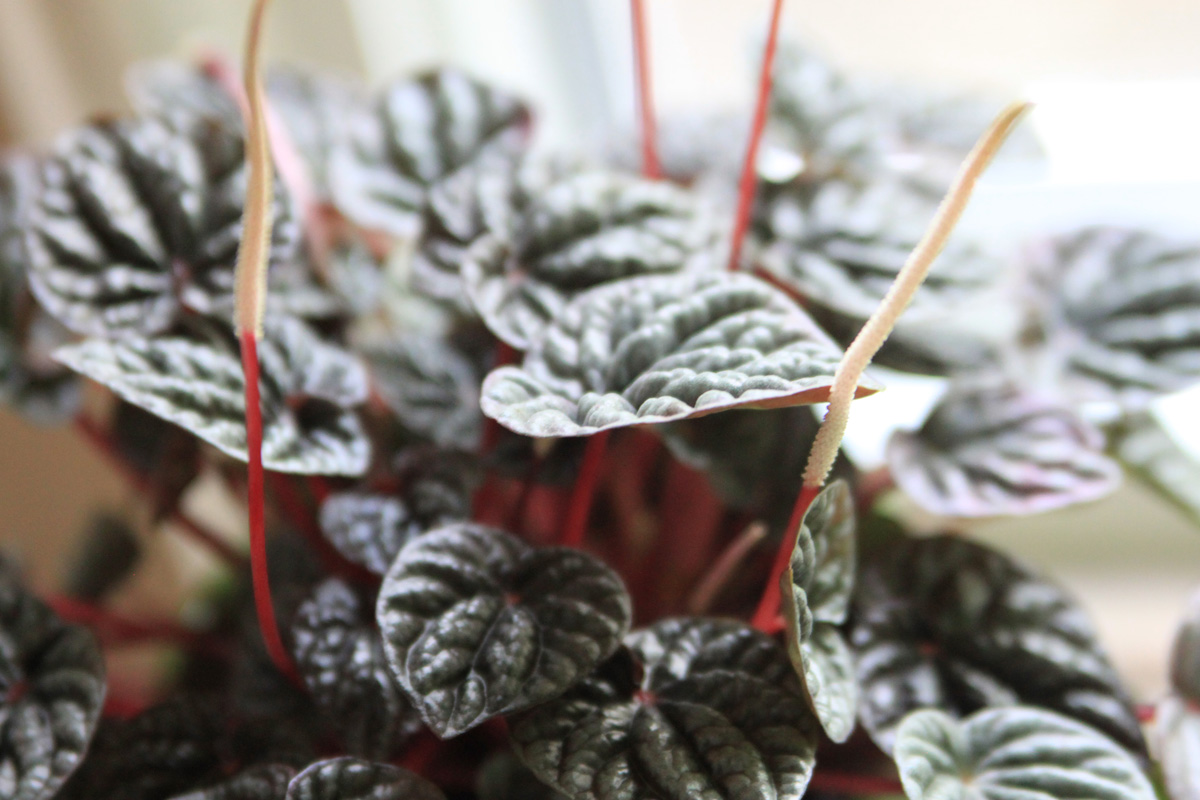
The inflorescences appear as long, narrow, whitish spikes. It is best to cut them off so you can preserve the plant's energy and so it can focus on growing more foliage. If you enjoy the flowers, there is no harm in leaving them, but make sure to cut them off when they are spent.
Why does my String of Turtles have dry ends?
If you notice that your vines have ends that have shriveled and dried up, immediately check your potting mix. In the vast majority of cases, your plant's potting mix has completely dried out. Verify this first by checking the potting mix with your finger, and/or lift your pot to see if it's really light. Give your plant a good watering if it has dried out completely.
Why is my String of Turtles dropping leaves?
Typically, this would be due to two factors. Temperatures that are too cold is one reason. Another reason would be an imbalance in soil moisture. Potting mix that has gone too dry, or stayed too wet, will cause your plant to drop leaves.
Does String of Turtles flower?
Yes it does! As you can see in the photo, the inflorescence looks like a rat tail. The flowers are actually very tiny and grow on the long inflorescence.
Does String of Turtles grow fast?
Growth rate is relative, and highly dependent on growing conditions. String of Turtles can actually grow pretty quickly under conditions that are to its liking. If you find that growth is very slow, it's probably due to insufficient light, warmth, poor potting mix, or all of the above.
Why is my String of Turtles not growing?
Mostly likely, you are not providing enough light, period. Providing sufficient light and sufficient attention to potting mix moisture will solve your issues.
Why does my String of Turtles have small leaves?
Although new leaves will be small, if your mature leaves are small and/or thin, you're likely not providing your plant with enough light. Another indication of low light will be a very slow growth rate and leaves that are more spaced out from each other than they used to be.
Why are my String of Turtles leaves reddish in color?
You may be providing too much direct sun for your plant. Back off a little bit on direct sun, and your plant will turn green again. These plants do not want to be in full, direct sun all day, but they can do well with 2-3 hours of direct sun per day while indoors.
Why are my String of Turtles leaves turning brown and crispy?
Go ahead and feel your potting mix. It is likely that your plant has stayed dried out for much too long.
Why are my String of Turtles leaves turning yellow?
Feel your potting mix. Has your plant stayed wet for too long? Perhaps it Is it sitting in water, is growing in a pot much too large, has poorly draining soil, or any combination of the above. If your plants leaves are yellow and also starting to turn mushy, your plant has been kept wet for too long.
That's all folks! Do you have a String of Turtles? Comment below. I'd love to hear!
Excelente articulo, llevo 6 meses con esta planta, aunque la chica que me la vendió me recomendó no regar tan seguido, hice un ajuste en el riego dada las condiciones ambientales de mi casa y ha mejorado creciendo y hasta floreciendo. estamos en verano en España y le ha sentado bien mantener la humedad en su entorno, la tengo en un estante junto a las alocasias y anthurium. Todas son bebes asi que van creciendo a la par.
Hello! I can’t seem to find advice for my specific problem. My string of turtles has been doing awesome. I got the plant in April 2023 and it was SOAKED. I didn’t water until the top layer of soil was dry. I’ve been only watering when I feel the top layer is dry. It’s getting good light, been growing new leaves and flowering but just today I noticed the lower leaves are dropping like crazy. The leaves are stiff some are normal color and some are more yellow and they have these brown spots, almost like they got too much water? Now the soil is totally dry so I only wet the top layer with a sprayer. I’m not really sure what to do here. I’m not seeing any posts that describe brown spots without the leaves being crispy or mushy. The leaves are neither crispy or mushy.
Hi Allie! You may have gone too far in the other direction. They don't like to go completely dry either. If you're just using a mister, the soil at the bottom of the pot will stay dry. You'll have to try and strike a balance between the two extremes. That's what I can gather from the information you provided. Good luck! You can always propagate and start a new plant and use a more porous potting mix.
I don’t know if I over watered or under watered mine. It has turned crispy brown. I bought it in 6" hanging basket. It does have a few green strands left. Any help/advice is greatly appreciated.
I am am new at working with plants and I am having difficulty with my string of turtles. I water from the bottom but I think the top soil is not gettin enough water. I transplanted to a smaller pot hoping it would help but after reading your info, I doubt if the soil was right. I’m not too sure I’ll be able to save it. Also the plant has never had bright green color. What would you do?
I'd need to know all your growing conditions, especially light, in order to best help. What is the window exposure? How far from the window is the plant? I would top water from now on. Bottom watering can be tricky.
Thank you so much for this post! I just got a string of turtles and wanted to research it more to ensure success. This post contained everything I need to know to start caring for it. So useful!
I just finished reading the care guide for a String of Turtles plant and I found it very informative and extremely helpful in many ways. Thank you very much!! I do have a question about something I’m noticing with my own SoT.
Mine is hanging in a South Easterly facing window above my kitchen sink. I have a little humidifier going that sits on the windowsill in front the sink and I try to keep it running 24/7. When I’m home, I check it periodically through the day so that it doesn’t run out of water and then I make sure to refill it before I go to bed and before I go to work or whenever I’ll be gone for a while. I’ve had it hanging there now for almost two months now and I’m noticing that I’m getting alot more growth on the side of the pot that’s facing away from the window. I’ve also noticed that some of the leaves on the side of the pot facing the window have started to loose the brown coloring to them and of the leaves that have lost the brown coloring, some of them…instead of looking like a flat leave that has the brown patterns on it, they have become almost like a little pocket and it looks like it could have some kind of liquid inside. It actually reminds me of what a blister looks like. Like you can see where the brown pattern used to be but instead of being brown, it’s now green and it’s like your seeing it through a layer of some kind of fluid or gel or something…it’s very odd looking and it’s only happened to a few of the leaves so far. I can get pictures if you would like to see.
As far as watering goes, I keep a log book of date and time. How I watered and for how long. Also what kind of water I used and any added supplements. She was last watered on 02.26.23 at 12:30AM. She had a full out of pot soak for 10 mins in 1 qt of distilled water that had 8 pumps of Mircle Grow Succulent Plant Food which is the recommended amount for 1 qt of water.
Other than the difference in growth from the window facing side and the side facing away from the window and whatever is happening with these leaves, the over all health of the plant seems to be very good! The leaves on the side facing away from the window are all nice and round with sharp distinct edges on the brown patterns of the leaves. You’re clearly able to see new and continuing growth. I honestly didn’t even know any of this was going on until I got out my step ladder and actually got up in the window and looked down into the pot and then turned it to look at the growth on the window facing side. I’m really surprised because it looks like it’s doing so well. What’s strange too is that the leaves that have been affected, they don’t necessarily look “unhealthy” they are green and even dare I say lush looking. They don’t appear “mushy” or “rotting”. The only thing that has my warning flag up is the difference in appearance to what I know a healthy looking leaf looks like.
I’m sorry my question is so long, I just wanted to provide as much info as I could to be as helpful as I could. As I stated, I can provide pictures if you would like. Thank you so much in advance!!
Hi Brooke! Photos would be helpful. If you can use the contact form on my website to email me...then when I respond, you can attach photos so I can take a look.
I have a string of turtles! I’m glad I read this article. I was thinking of up potting it but I guess it likes to be a little root kind. So I think it can stay in its pot much longer. I have Troy le checking the soil because I can barely fit my finger through the dense leaves covering it. I cut the flower spikes off of mine in the summer/fall and by now it’s got sooo much more growth and new leaves. Even my husband stops to notice how long it has gotten! It was just barely hanging over the edge of the pot when I first got it.
My daughter came home from college and forgot and left her string of turtles in her car during cold to freezing temperatures. It dropped a bunch of leaves, but still has plenty. Will it survive?
I noticed my SOT's leaves were falling off near the soil end more often when I came back from a 10 day trip. I did water the plant before I left, so I assume this is due to a dry out. Do I cut the strings that have no leaves near the soil end or should I leave it be?
Hi Amy, it's really up to you. If the vines have no leaves at all though, I would trim those to maybe an inch from the soil. They may start to grow back! It's worth a try.
My indoor String of Turtle plant is doing well. The only thing I'm questioning is the three-leaf-clover leaves that are growing with the other beautiful leaves. Why is it growing three-leaf clover leaves? I imagine I should remove them, no?
Thank you.
Teresa
Clover is a common "weed" that finds its way into many pots. I would just be diligent in pulling it out, especially before it blooms and releases seeds. It can be quite annoying!
Hello - I recently received a string of turtles gift plant from a friend who doesn't know much about plants. Immediately I noticed clumps of it falling off. Upon investigation, it seems the soil was very saturated so I'm assuming its roots are rotting from her over-watering it for some time. Is there anyway to save this poor thing? It has plenty of green left despite how fragile it is. Any advice would be appreciated. Thank you in advance.
Hi Tricia! I'd need more details to help as there are many factors that contribute to the potting mix not drying out quickly enough: pot size, potting mix type, the amount of light, etc. You can live with the plant for a while with the tips I shared in this post and see if things improve. If you're nervous, you can always propagate it and start a new plant. I hope this helps a bit, but each case is very different and would need more details to be able to help.
It was still in the pot it came in in the store, which is a plastic one with large holes (very cheap, it's almost bottomless??) about four inches across. I do not know the potting mix, it appears to be lacking anything that'll help it drain (it's pretty mushy, I squish it and it drips water, no perlite/pumice/just general. chunks. that I can see).
I do not know how long she kept it/where it was kept, but I had placed it in a window that gets about 4 hours a day direct light and indirect light for the rest of the day. It was only there for two days though.
I took it out of the store mix and have trimmed and placed what I could salvage over some succulent mix that I happened to have ( peat moss, pine bark, and perlite) on a tray, to hopefully propagate it, since it did just seem to be rotting away and dropping bits nonstop. Do you think this soil mix should suffice?
I suppose I panicked a bit and I'm apologetic I ran to comment before I tried more things myself. The thought of it already being a goner was too sad for me at the moment.
That mix should be fine! As far as the propagations, try and keep it really humid. It will help it root tremendously. As you pointed out, the mixes that are used in commercial greenhouses often don't work well in our home conditions. I hope your plant recovers!
Hi! My string of Turtles seem very fragile. If I bump the mother plant the babies fall off. This is how I got it from the Nursery. I have it in a window that gets indirect light all day not too hot, not too cold, I sometimes put it in a Cloche or "Bell Jar" for humidity. It is growing babies like crazy so I know it is happy but I worry about the older turtles falling off. Any advise would be wonderful.
I have a small string of turtles in a 2 in. nursery pot with drainage. It overall is doing very well. However, I've noticed that its oldest leaves, those nearest to the soil, have turned yellow and don't have the beautiful 'turtle shell' markings. It sounds like I've been overwatering it. I have cut back on the watering. will those yellowed leaves ever darken in color and get their 'turtle shell' markings back? Thanks!
Hi Kimberly! Those yellow leaves will not turn green again unfortunately. They will eventually fall off on their own. Have you felt the soil with your finger when you noticed the yellow leaves? In many cases, people think they're "overwatering" and in fact, the soil is in fact, too dry when you go to feel it... Yellow leaves can be caused by both soil being too dry, and also being too wet...and in most cases as I'm helping people, it's usually due to the soil being too dry. The only way you'll know is to feel the soil and observe your plant closely. I hope this helps a bit! Maintaining consistent conditions for this plant is important. They can quickly go downhill if left too dry. I hope this helps a bit...without knowing exactly what happened in your particular case, what I just described is something that I've seen over and over again.
Very helpful and informative article! I just adopted a String of Turtles and now feel like I have a much better understanding of it’s needs and how to interpret it’s behaviors. I’m very excited to watch it grow! Thank you for all the insightful information! 🪴💚

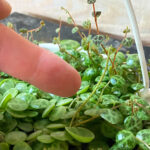

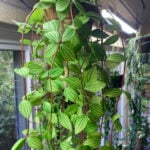
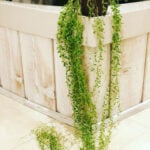
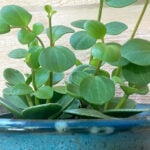
Excelente articulo, llevo 6 meses con esta planta, aunque la chica que me la vendió me recomendó no regar tan seguido, hice un ajuste en el riego dada las condiciones ambientales de mi casa y ha mejorado creciendo y hasta floreciendo. estamos en verano en España y le ha sentado bien mantener la humedad en su entorno, la tengo en un estante junto a las alocasias y anthurium. Todas son bebes asi que van creciendo a la par.
Me alegro que hayas disfrutado el artículo. 🙂
Hello! I can’t seem to find advice for my specific problem. My string of turtles has been doing awesome. I got the plant in April 2023 and it was SOAKED. I didn’t water until the top layer of soil was dry. I’ve been only watering when I feel the top layer is dry. It’s getting good light, been growing new leaves and flowering but just today I noticed the lower leaves are dropping like crazy. The leaves are stiff some are normal color and some are more yellow and they have these brown spots, almost like they got too much water? Now the soil is totally dry so I only wet the top layer with a sprayer. I’m not really sure what to do here. I’m not seeing any posts that describe brown spots without the leaves being crispy or mushy. The leaves are neither crispy or mushy.
Hi Allie! You may have gone too far in the other direction. They don't like to go completely dry either. If you're just using a mister, the soil at the bottom of the pot will stay dry. You'll have to try and strike a balance between the two extremes. That's what I can gather from the information you provided. Good luck! You can always propagate and start a new plant and use a more porous potting mix.
when is their dormancy peorid
They don't really have one. Though they may slow down in the wintertime if you have short, dark days where you live.
I don’t know if I over watered or under watered mine. It has turned crispy brown. I bought it in 6" hanging basket. It does have a few green strands left. Any help/advice is greatly appreciated.
It sounds like it probably got too dry. You can always start over and propagate.
I am am new at working with plants and I am having difficulty with my string of turtles. I water from the bottom but I think the top soil is not gettin enough water. I transplanted to a smaller pot hoping it would help but after reading your info, I doubt if the soil was right. I’m not too sure I’ll be able to save it. Also the plant has never had bright green color. What would you do?
I'd need to know all your growing conditions, especially light, in order to best help. What is the window exposure? How far from the window is the plant? I would top water from now on. Bottom watering can be tricky.
Thank you so much for this post! I just got a string of turtles and wanted to research it more to ensure success. This post contained everything I need to know to start caring for it. So useful!
Glad you found it useful Tania!
Hi!
I just finished reading the care guide for a String of Turtles plant and I found it very informative and extremely helpful in many ways. Thank you very much!! I do have a question about something I’m noticing with my own SoT.
Mine is hanging in a South Easterly facing window above my kitchen sink. I have a little humidifier going that sits on the windowsill in front the sink and I try to keep it running 24/7. When I’m home, I check it periodically through the day so that it doesn’t run out of water and then I make sure to refill it before I go to bed and before I go to work or whenever I’ll be gone for a while. I’ve had it hanging there now for almost two months now and I’m noticing that I’m getting alot more growth on the side of the pot that’s facing away from the window. I’ve also noticed that some of the leaves on the side of the pot facing the window have started to loose the brown coloring to them and of the leaves that have lost the brown coloring, some of them…instead of looking like a flat leave that has the brown patterns on it, they have become almost like a little pocket and it looks like it could have some kind of liquid inside. It actually reminds me of what a blister looks like. Like you can see where the brown pattern used to be but instead of being brown, it’s now green and it’s like your seeing it through a layer of some kind of fluid or gel or something…it’s very odd looking and it’s only happened to a few of the leaves so far. I can get pictures if you would like to see.
As far as watering goes, I keep a log book of date and time. How I watered and for how long. Also what kind of water I used and any added supplements. She was last watered on 02.26.23 at 12:30AM. She had a full out of pot soak for 10 mins in 1 qt of distilled water that had 8 pumps of Mircle Grow Succulent Plant Food which is the recommended amount for 1 qt of water.
Other than the difference in growth from the window facing side and the side facing away from the window and whatever is happening with these leaves, the over all health of the plant seems to be very good! The leaves on the side facing away from the window are all nice and round with sharp distinct edges on the brown patterns of the leaves. You’re clearly able to see new and continuing growth. I honestly didn’t even know any of this was going on until I got out my step ladder and actually got up in the window and looked down into the pot and then turned it to look at the growth on the window facing side. I’m really surprised because it looks like it’s doing so well. What’s strange too is that the leaves that have been affected, they don’t necessarily look “unhealthy” they are green and even dare I say lush looking. They don’t appear “mushy” or “rotting”. The only thing that has my warning flag up is the difference in appearance to what I know a healthy looking leaf looks like.
I’m sorry my question is so long, I just wanted to provide as much info as I could to be as helpful as I could. As I stated, I can provide pictures if you would like. Thank you so much in advance!!
Sincerely,
Brooke Hoeffner
Hi Brooke! Photos would be helpful. If you can use the contact form on my website to email me...then when I respond, you can attach photos so I can take a look.
I have a string of turtles! I’m glad I read this article. I was thinking of up potting it but I guess it likes to be a little root kind. So I think it can stay in its pot much longer. I have Troy le checking the soil because I can barely fit my finger through the dense leaves covering it. I cut the flower spikes off of mine in the summer/fall and by now it’s got sooo much more growth and new leaves. Even my husband stops to notice how long it has gotten! It was just barely hanging over the edge of the pot when I first got it.
Sounds like your plant is doing just fine Courtney! 🙂
My daughter came home from college and forgot and left her string of turtles in her car during cold to freezing temperatures. It dropped a bunch of leaves, but still has plenty. Will it survive?
If it still has plenty of leaves, it will survive. If any vines are particularly bare or damaged, you can always propagate and start over if needed 🙂
I noticed my SOT's leaves were falling off near the soil end more often when I came back from a 10 day trip. I did water the plant before I left, so I assume this is due to a dry out. Do I cut the strings that have no leaves near the soil end or should I leave it be?
Hi Amy, it's really up to you. If the vines have no leaves at all though, I would trim those to maybe an inch from the soil. They may start to grow back! It's worth a try.
My indoor String of Turtle plant is doing well. The only thing I'm questioning is the three-leaf-clover leaves that are growing with the other beautiful leaves. Why is it growing three-leaf clover leaves? I imagine I should remove them, no?
Thank you.
Teresa
Clover is a common "weed" that finds its way into many pots. I would just be diligent in pulling it out, especially before it blooms and releases seeds. It can be quite annoying!
Hello - I recently received a string of turtles gift plant from a friend who doesn't know much about plants. Immediately I noticed clumps of it falling off. Upon investigation, it seems the soil was very saturated so I'm assuming its roots are rotting from her over-watering it for some time. Is there anyway to save this poor thing? It has plenty of green left despite how fragile it is. Any advice would be appreciated. Thank you in advance.
Hi Tricia! I'd need more details to help as there are many factors that contribute to the potting mix not drying out quickly enough: pot size, potting mix type, the amount of light, etc. You can live with the plant for a while with the tips I shared in this post and see if things improve. If you're nervous, you can always propagate it and start a new plant. I hope this helps a bit, but each case is very different and would need more details to be able to help.
It was still in the pot it came in in the store, which is a plastic one with large holes (very cheap, it's almost bottomless??) about four inches across. I do not know the potting mix, it appears to be lacking anything that'll help it drain (it's pretty mushy, I squish it and it drips water, no perlite/pumice/just general. chunks. that I can see).
I do not know how long she kept it/where it was kept, but I had placed it in a window that gets about 4 hours a day direct light and indirect light for the rest of the day. It was only there for two days though.
I took it out of the store mix and have trimmed and placed what I could salvage over some succulent mix that I happened to have ( peat moss, pine bark, and perlite) on a tray, to hopefully propagate it, since it did just seem to be rotting away and dropping bits nonstop. Do you think this soil mix should suffice?
I suppose I panicked a bit and I'm apologetic I ran to comment before I tried more things myself. The thought of it already being a goner was too sad for me at the moment.
Thank you for your reply. 🙂 I appreciate it.
That mix should be fine! As far as the propagations, try and keep it really humid. It will help it root tremendously. As you pointed out, the mixes that are used in commercial greenhouses often don't work well in our home conditions. I hope your plant recovers!
Hi! My string of Turtles seem very fragile. If I bump the mother plant the babies fall off. This is how I got it from the Nursery. I have it in a window that gets indirect light all day not too hot, not too cold, I sometimes put it in a Cloche or "Bell Jar" for humidity. It is growing babies like crazy so I know it is happy but I worry about the older turtles falling off. Any advise would be wonderful.
Hi Laura. Do you just mean the lower leaves are falling off?
Hi There! Can you tell me what the number reading would be on a moisture meter?
Thanks!
Hi Julie, I personally don't recommend moisture meters. I have a blog post on that topic if you'd like to see why: https://www.ohiotropics.com/2020/01/03/soil-moisture-meters-indoor-plants/
I have a small string of turtles in a 2 in. nursery pot with drainage. It overall is doing very well. However, I've noticed that its oldest leaves, those nearest to the soil, have turned yellow and don't have the beautiful 'turtle shell' markings. It sounds like I've been overwatering it. I have cut back on the watering. will those yellowed leaves ever darken in color and get their 'turtle shell' markings back? Thanks!
Hi Kimberly! Those yellow leaves will not turn green again unfortunately. They will eventually fall off on their own. Have you felt the soil with your finger when you noticed the yellow leaves? In many cases, people think they're "overwatering" and in fact, the soil is in fact, too dry when you go to feel it... Yellow leaves can be caused by both soil being too dry, and also being too wet...and in most cases as I'm helping people, it's usually due to the soil being too dry. The only way you'll know is to feel the soil and observe your plant closely. I hope this helps a bit! Maintaining consistent conditions for this plant is important. They can quickly go downhill if left too dry. I hope this helps a bit...without knowing exactly what happened in your particular case, what I just described is something that I've seen over and over again.
Very helpful and informative article! I just adopted a String of Turtles and now feel like I have a much better understanding of it’s needs and how to interpret it’s behaviors. I’m very excited to watch it grow! Thank you for all the insightful information! 🪴💚
I'm so glad you enjoyed the post Rebekah! Good luck with your plant! I'm sure it will do great!