I'm not a dainty gardener by any means. I love bold, colorful, and unexpected elements in my garden. Each year, my garden looks less and less like Cleveland, Ohio, and more and more like the Seychelles.
Tropical plants are my passion, and each year I incorporate more and more of them into my garden. Elephant ears, or Colocasia esculenta give me that tropical look that I'm looking for!
With their rapid growth, gigantic leaves that come in an array of different colors, and ease of growth, Colocasia esculenta will give you a big bang for your buck in creating a tropical feel in your garden!
I started out growing the plain old Colocasia esculenta. This species is actually the taro plant which is widely grown in many tropical regions as a food source.
Taro roots provide a starchy food source for many, but I grow them for their colossal leaves. My goal is for you to be inspired to grow elephant ears in your garden. Your neighbors will be amazed and they are easy to grow!
Years ago, I picked up a packet of Colocasia esculenta at a local garden center and planted them in my garden.
It was an encouraging first encounter because although they are said to be hardy only in zones 8 and above, mine somehow managed to survive our sometimes nasty Ohio winters and returned year after year!
Please note though that my Colocasia esculenta behaved as a perennial in my Ohio garden because they were planted in a protected area and it provided an effective microclimate for them to survive.
Be sure to read my blog post on Pushing Your Hardiness Zone to find out how I accomplished this feat, and others as well!
The clump grew bigger and bigger each year and there was no additional mulch or protection added!
They simply returned as any perennial would on its own. I attribute them surviving our winters in our zone 6 climate because they were planted in a protected corner of our home, close to a concrete pad and brick foundation of the house.
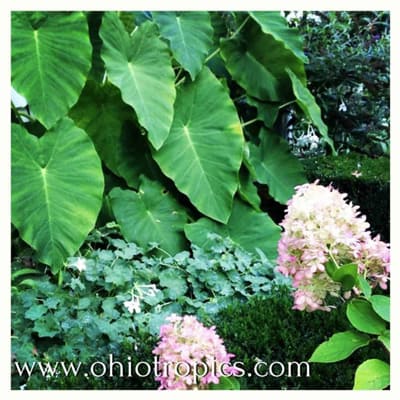
This created a microclimate and helped to defy where this is "supposed" to grow. As shown in the photograph below, it created a lovely pairing with Lady's Mantle, boxwood, and hydrangea.
My Colocasia esculenta that ended up being perennial because of a microclimate I created
One year I had 8 different types of elephant ears in my garden! They are hard to resist and there are so many varieties.
I planted the same Colocasia esculenta at our new house, but I dug up the corms and replanted them in the Spring since I didn't want to risk them freezing.
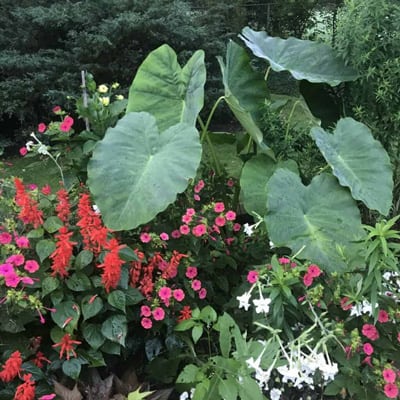
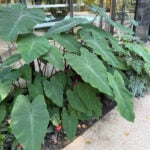
I planted some in the ground, like the photo below. I love the contrast they provide against the surrounding flowering plants.
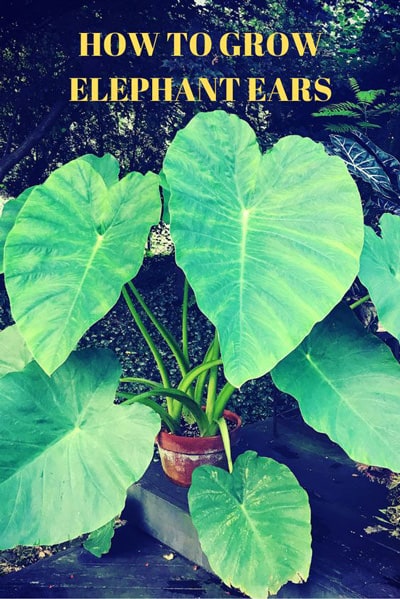
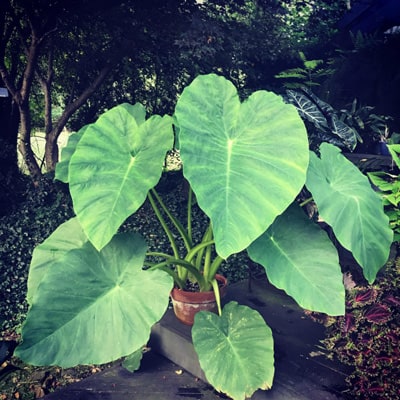
I had 3 extra corms that I didn't have room for in the ground, so I decided to plant them in a 14 inch clay pot. I did not expect them to grow as large as they did in the photo below.
Needless to say, I'll be planting some in that pot every year. Look how big they grew!
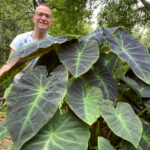
And yes, the pot in the picture below is 14 inches in diameter. The large leaf in the middle of the picture is over 2 feet long, and it was close to 2 feet wide.
Table of Contents
Planting Elephant Ears
I suppose you probably clicked on this blog post to find out how to grow elephant ears, so let me tell you about the cultural conditions that they like.
I've found that elephant ears grow best in partial sun or filtered sunlight. Morning sun works beautifully, but afternoon sun may be a little much sometimes for these plants.
You'll know if they are upset if the edges of the leaves turn brown. They also like areas protected from high winds.
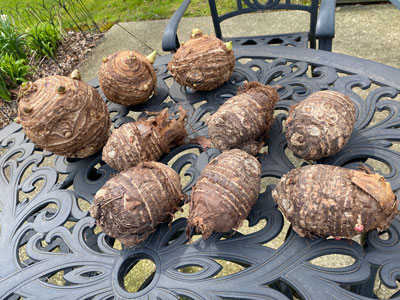
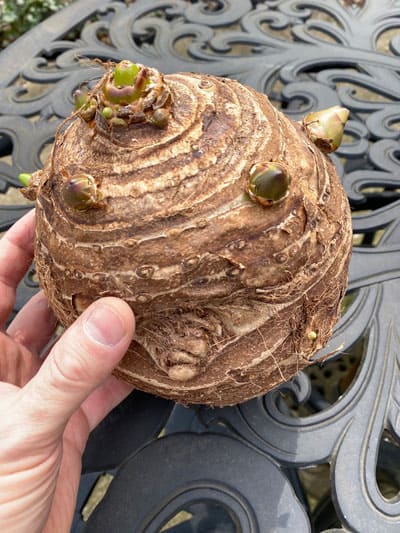
Colocasaia corms
Watering Elephant Ears
Colocasia esculenta LOVE water. They grow best in consistently moist soil. If you are heavy handed with watering, these are the right plants for you!
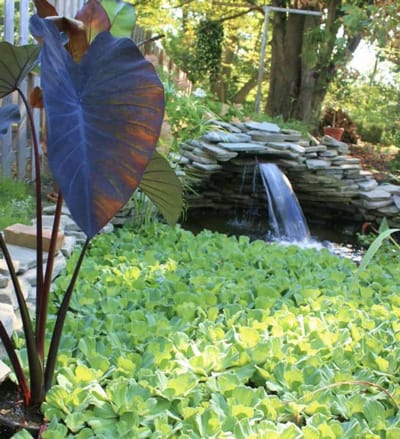
In fact, the taro plant is often cultivated for their edible corms in flooded fields. Take a look at the photo below showing a dark leaved variety, growing directly in our old pond!
Whatever you do, do not let this plant go bone dry! Keeping these plants well watered is the most important thing you can do to keep them looking great.
This is one plant that you can "overwater" with profound results! So take out that hose and watering can and go to town.
I will have to add though that you should go light on the water if you are starting out with a bare corm. Wait until the leaves start to grow before increasing the watering.
For a newly planted corm, give it a good watering, but wait until the top of the soil dries out before watering again. As the plant grows and get bigger, you can safely increase the watering.
With the exception of the ones growing in the ground, I water the potted elephant ears daily in the summer.
Soil Requirements
These plants prefer a loamy soil with a lot of organic matter, but the ones I planted directly into the ground in an amended clay soil do just fine! These are really not picky plants as long as you keep them moist.
If you are planting in a pot, any good potting mix will do. Mixing in compost into the potting soil would be very beneficial.
Fertilizer Requirements
Make sure you regularly fertilize these plants for the best show possible! For ease and convenience, I always order my fertilizers on Amazon so check out my recommendations below:
Elephant ears are heavy feeders and will grow quickly, so be sure to regularly feed them.
When I'm planting them directly into pots, I love mixing in Oscomote right at that time.
This is one of the best fertilizers, in my opinion, for outdoor plants. It is time-release so you can mix it into the potting mix once and it will last for months. I use this product on all my pots outdoors.
Would you like to save this post?
Enter your email, and I will send this link straight to you!
I also like to supplement with liquid fertilizers every week or two. My favorite product to use is Neptune's Harvest Fish and Seaweed fertilizer. It is a natural product and results in great growth.
Don't skip the fertilizer if you want your elephant ears to grow luxuriantly!
Planting Elephant Ears
You can either start these in pots ahead of time, or you can also plant these directly into the soil.
I've learned that these plants sometimes take a long time to start growing after you replant the bare corms.
They will eventually catch up with rapid growth once they start growing leaves, but starting them into growth sometimes takes a very long time!
PLANTING IN POTS TO GET A HEAD START
If you can, I would recommend planting these indoors in the spring, at least 2 months or so before it is warm enough to plant these outside.
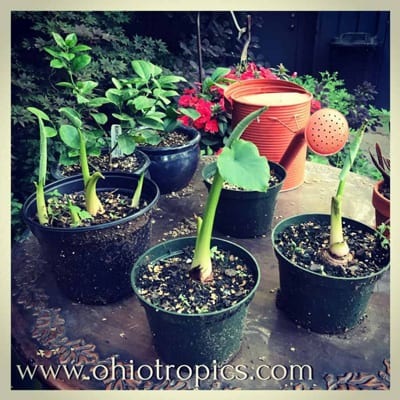
This will give you a good head start on the season. Look at the cute little baby elephant ears below!
Once it's safe to plant outdoors in your particular climate, you can then place them in larger pots to grow, or you can plant them directly into the ground.
Giving them a head start like this will get your bigger plants for the season!
PLANTING DIRECTLY IN THE GROUND
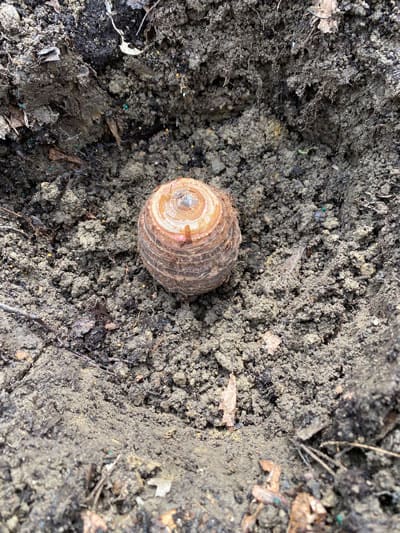
You can also plant the corms directly into the ground. Here is how to do that.
CHOOSE A SITE
First, choose an area that is shady or up to half a day sun. These plants can grow in full sun but they'd need tons and tons of water and it's hard to keep up sometimes.
PREPARE AND AMEND THE SOIL
Loosen up the soil with a shovel and dig in some good organic matter if you can. I like to dig in bags of compost and manure.
Then dig a hole about a foot wide. As far as the depth, you should still loosen up several inches below where you place your corm, but you'll want only 1-2 inches of soil covering the top of your elephant ear corm.
Before you place your corm in the hole, mix in some Osmocote into the soil at the bottom of the hole. This will continually fertilize your plants throughout the season. Colocasia are heavy feeders!
BACKFILL THE HOLE
Lastly, backfill the hole and only cover your Colocasia corm with 1-2 inches of soil. If the soil is already moist, I don't even bother watering.
Once they start growing though, try and keep them continually watered and never let them go dry. They THRIVE on plenty of water.
Note that it can take a while for them to start growing so have patience! Once the weather warms up, they will take off and grow quickly.
Overwintering Elephant Ears
Elephant ears are easy to overwinter if you live in areas colder than zone 8 like I do. I will dig up the corms, cut most of the stems off, and shake off all the extra soil.
After letting the corms air dry for a couple days, I'll store them in our heated garage completely buried in perlite which I purchase in bulk on Amazon.
I follow the same procedure when I overwinter my dahlias. If you are interested in growing dahlias, check out my how to guide on growing dahlias!
You can also store them in dry peat moss if you have that handy. I like to use old plastic pots and will bury the corms completely in perlite, and then place them on a shelf for the winter.
If you don't have a heated garage, any cool area that stays somewhere in the range of 40F-60F or so will work well.
More Elephant Ears!
I hope you've been inspired to grow some Colocasia esculenta in your garden. They come in a variety of colors and all of them are rewarding.
In case you haven't been inspired, here are some more photos from my garden.
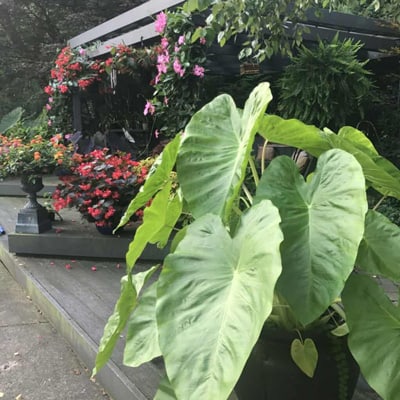
Colocasia esculenta Royal Hawaiian 'Maui Gold'
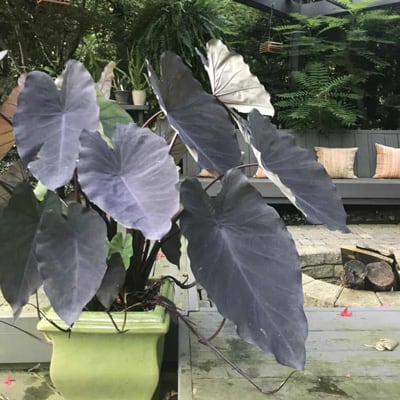
Colocasia esculenta 'Black Magic'
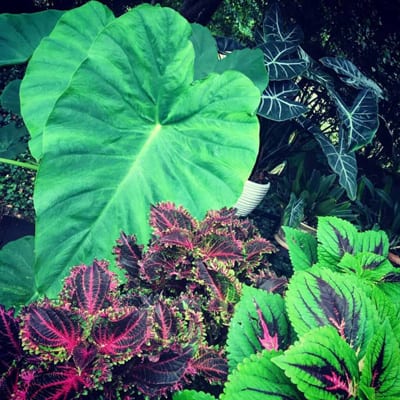
Colocasia esculenta with Coleum in the foreground, and an Alocasia in the upper right corner.
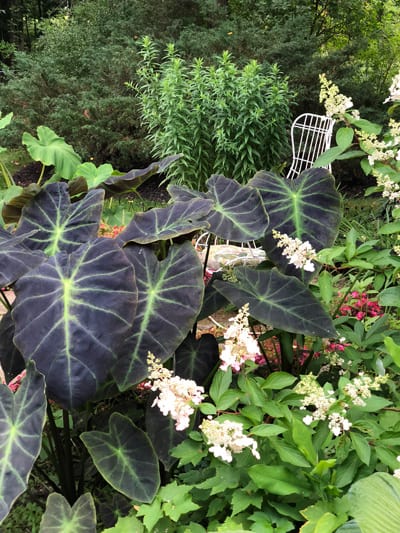
And last but not least, a dark leaved Colocasia from my garden below. I neglected to document the variety, but isn't it gorgeous? I grew a huge patch of these one year in my garden.
Why not add some Colocasia esculenta in your garden this year? Few plants will have as big of an impact as these delightful plants.
I’ve heard of an elephant ear that’s reliably hardy to zone 5 with a slight bit of mulch, it’s called Colocasia ’polar green’ and it looks very pretty!
I haven't heard of that variety, but that sounds amazing! It's fun to experiment with hardiness (especially if you can create a good microclimate at the planting site!)
Hey there, I need wise advice not about the Colocasia but its elephant ear relative Xanthosoma. I ordered one a couple of months ago and it got stuck in a warehouse and went into cold shock. I'm down to the last few leaves which are fading fast. Repotted it out of the squishy nursery soil into a nice and airy aroid mix, and saw that the corm and the roots are still going strong and even setting out new ones. What should I do if my Xanthosoma loses all of its leaves? Do I need to lift the corm so it doesn't rot or is it ok to stay in the soil? Have been looking for advice specific to the xanthosoma but haven't seem to have found any. Any help would be greatly appreciated! Thank you 🙂
I live in middle Alabama, our winters are usually mild. This is our first years with our elephant ears. They grew to 7 feet tall. It is Thanksgiving day and they are still mostly green, some yellow, we had a few cold nights. Do I need to dig them up for winter? Do I cut off like Flags, 5 or 6 inches from ground? We love them as do our neighbors, I want to keepthem. What to do? Thanks
Hi Connie! Wow, they sound spectacular! What garden zone is your home in? Colocasia esculenta is said to be winter hardy in zone 8 or warmer. Enjoy them while they last and you can cut them down. If you're in zone 8 or warmer, you can leave them in the ground. Otherwise, you'll have to dig them up.
Great post! I just purchased by first Elephant Ear from a local nursery. Was doing great but then something has gone wrong. I'd water it every morning when I saw the leaves drooping. It was still in the throwaway pot in a saucer so I also put a little water in the saucer. The roots soaked up the water instantly so I added more. Next day, the leaves had started turning yellow and looking very sad/droopy again (like touching the floor droopy). I trim off at the base when the leaf looks like it's not going to bounce back... each morning, another leaf sad, droopy, yellowing. It's near an east facing window but not in direct sunlight. I can't for the life of me figure out where I've gone astray. Help???
Do you have the plain old Colocasia esculenta? It sounds like the soil was super dry and sometimes when that happens, you have to work at it a little moisten it up again. It can take a few minutes to saturate the soil again so you have to repeatedly add water until it absorbs and holds water again instead of running straight through. Also, Colocasia doesn't make the best houseplant. I only grow these outdoors. Hope this helps!
Do you have a fb page , blog where you can be followed. I'm a newbie and would love to learn more . Can you recommend other sources as well to learn especially on elephant ears? Thank you.
Hi Patti, you commented on my blog. I have a lot of articles on this blog (ohiotropics.com). I have a Facebook page but I only really post there through my Instagram (@ohiotropics). I have the most detailed information right here on my blog. If you use the search feature, you can find whatever you're looking for. Hope this helps.
Hi David. No, I've always just used them outdoors (I have enough plants indoors!). I dig them up, let them dry out a bit, and save them over the winter until I plant them again the following Spring.
Hi! I was wondering if you could help me with splitting off the pups? I have never done it before and want to give them the best chance. Should they have thief own roots? Do I bisect them off the mother plant and root in water? Or plant in soil? Could I bisect and ship right away to my pops or plant in soil and let rest for a bit?!?!
Hi Jennifer! Where do you live? Do you have cold winters where you'd have to dig them up anyway? If so, I would dig them up in the Fall and separate them then. Separate the individual corms and let them air dry for a day or two. No need to keep any roots while dormant. They will grow new ones when they are replanted. Then you should be free to ship them over to your pops! Maybe reread the section in the post that talks about overwintering. Hope this helps!
great commets, great explanations! I have 1,000m2 garden with different corners and micro climates. At present starting to grow a shadow garden in the back...and planning to include some of these black beauties!!
I live in Rosario, Argentina
I live in the bank of Rio Grande in Texas. Wondering if planting elephant ears directly close, but not in the water would be ok. The river bank needs some life besides bamboo. Thanks.
Thank you so much for this post. Very informative! I was looking for information as to why my corms weren't sprouting especially my black magic. Patience.
I live down in Athens OH and would love to use elephant ears in some stepped garden bed areas up on our hillside property (lots of light, a fair mix of sun and shade due to trees and our house being directionally diagonal). Any recommendations for 1. species that might thrive in this setting and 2. Ohio greenhouses/ online resources to purchase?
Any Colocasia should work, but I would just be concerned over moisture if it's on a hill. Just pick a variety that you like! If you can keep them well watered (they love water!) then you should be OK! Normally hardware stores like Home Depot or Lowes will sell the plain old Colocasia esculenta, which is the taro root plant. They'll sell the bare corms and you'll have to plant them yourself. They're common but so beautiful. Also, I try not to shop there, but I've also seen them at Walmart. As far as online resources, you can find many varieties of Colocasia at Plant Delights Nursery: https://www.plantdelights.com/ They are a wonderful nursery with many unusual varieties! Happy planting!




I’ve heard of an elephant ear that’s reliably hardy to zone 5 with a slight bit of mulch, it’s called Colocasia ’polar green’ and it looks very pretty!
I haven't heard of that variety, but that sounds amazing! It's fun to experiment with hardiness (especially if you can create a good microclimate at the planting site!)
Hey there, I need wise advice not about the Colocasia but its elephant ear relative Xanthosoma. I ordered one a couple of months ago and it got stuck in a warehouse and went into cold shock. I'm down to the last few leaves which are fading fast. Repotted it out of the squishy nursery soil into a nice and airy aroid mix, and saw that the corm and the roots are still going strong and even setting out new ones. What should I do if my Xanthosoma loses all of its leaves? Do I need to lift the corm so it doesn't rot or is it ok to stay in the soil? Have been looking for advice specific to the xanthosoma but haven't seem to have found any. Any help would be greatly appreciated! Thank you 🙂
I live in middle Alabama, our winters are usually mild. This is our first years with our elephant ears. They grew to 7 feet tall. It is Thanksgiving day and they are still mostly green, some yellow, we had a few cold nights. Do I need to dig them up for winter? Do I cut off like Flags, 5 or 6 inches from ground? We love them as do our neighbors, I want to keepthem. What to do? Thanks
Hi Connie! Wow, they sound spectacular! What garden zone is your home in? Colocasia esculenta is said to be winter hardy in zone 8 or warmer. Enjoy them while they last and you can cut them down. If you're in zone 8 or warmer, you can leave them in the ground. Otherwise, you'll have to dig them up.
Great post! I just purchased by first Elephant Ear from a local nursery. Was doing great but then something has gone wrong. I'd water it every morning when I saw the leaves drooping. It was still in the throwaway pot in a saucer so I also put a little water in the saucer. The roots soaked up the water instantly so I added more. Next day, the leaves had started turning yellow and looking very sad/droopy again (like touching the floor droopy). I trim off at the base when the leaf looks like it's not going to bounce back... each morning, another leaf sad, droopy, yellowing. It's near an east facing window but not in direct sunlight. I can't for the life of me figure out where I've gone astray. Help???
Do you have the plain old Colocasia esculenta? It sounds like the soil was super dry and sometimes when that happens, you have to work at it a little moisten it up again. It can take a few minutes to saturate the soil again so you have to repeatedly add water until it absorbs and holds water again instead of running straight through. Also, Colocasia doesn't make the best houseplant. I only grow these outdoors. Hope this helps!
Do you have a fb page , blog where you can be followed. I'm a newbie and would love to learn more . Can you recommend other sources as well to learn especially on elephant ears? Thank you.
Hi Patti, you commented on my blog. I have a lot of articles on this blog (ohiotropics.com). I have a Facebook page but I only really post there through my Instagram (@ohiotropics). I have the most detailed information right here on my blog. If you use the search feature, you can find whatever you're looking for. Hope this helps.
Have you tried moving an elephant ear in the house for the winter?
Hi David. No, I've always just used them outdoors (I have enough plants indoors!). I dig them up, let them dry out a bit, and save them over the winter until I plant them again the following Spring.
Hi! I was wondering if you could help me with splitting off the pups? I have never done it before and want to give them the best chance. Should they have thief own roots? Do I bisect them off the mother plant and root in water? Or plant in soil? Could I bisect and ship right away to my pops or plant in soil and let rest for a bit?!?!
Hi Jennifer! Where do you live? Do you have cold winters where you'd have to dig them up anyway? If so, I would dig them up in the Fall and separate them then. Separate the individual corms and let them air dry for a day or two. No need to keep any roots while dormant. They will grow new ones when they are replanted. Then you should be free to ship them over to your pops! Maybe reread the section in the post that talks about overwintering. Hope this helps!
great commets, great explanations! I have 1,000m2 garden with different corners and micro climates. At present starting to grow a shadow garden in the back...and planning to include some of these black beauties!!
I live in Rosario, Argentina
Glad you enjoyed the post Maria! Good luck with your garden!
Great post,, Thank you. I live in New Jersey and Would like to know if the deer might try to eat this?
You're very welcome Anne! In my experience, I've never had any eaten by deer.
I live in the bank of Rio Grande in Texas. Wondering if planting elephant ears directly close, but not in the water would be ok. The river bank needs some life besides bamboo. Thanks.
Hi Irma. Yes that would be perfectly fine! These plants can even grow submerged in water so you should be good to go!
Thank you so much for this post. Very informative! I was looking for information as to why my corms weren't sprouting especially my black magic. Patience.
Gardening definitely teaches us patience! : )
I live down in Athens OH and would love to use elephant ears in some stepped garden bed areas up on our hillside property (lots of light, a fair mix of sun and shade due to trees and our house being directionally diagonal). Any recommendations for 1. species that might thrive in this setting and 2. Ohio greenhouses/ online resources to purchase?
Any Colocasia should work, but I would just be concerned over moisture if it's on a hill. Just pick a variety that you like! If you can keep them well watered (they love water!) then you should be OK! Normally hardware stores like Home Depot or Lowes will sell the plain old Colocasia esculenta, which is the taro root plant. They'll sell the bare corms and you'll have to plant them yourself. They're common but so beautiful. Also, I try not to shop there, but I've also seen them at Walmart. As far as online resources, you can find many varieties of Colocasia at Plant Delights Nursery: https://www.plantdelights.com/ They are a wonderful nursery with many unusual varieties! Happy planting!