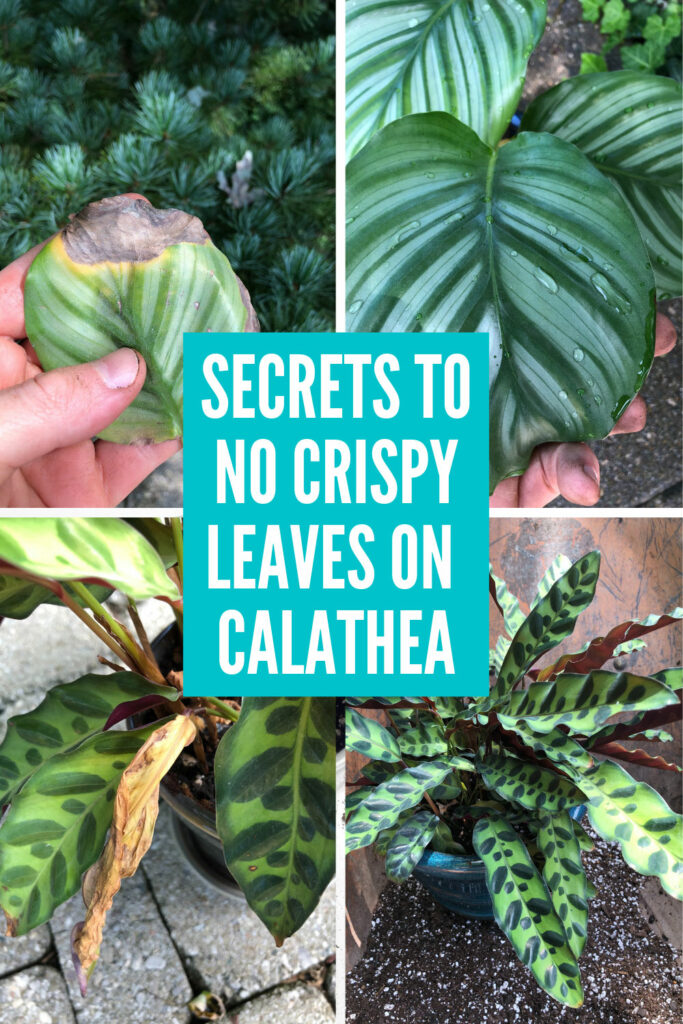
There is nothing like the stunning foliage of Calathea plants (now reclassified as Goeppertia)! If you can keep them in good condition that is! There are a few things to keep in mind to keep these plants in beautiful condition and avoid the dreaded brown, crispy edges!
Keep reading to find out all about Calathea care, including light requirements, repotting, and how to prevent your Calathea from dying.
Would you like to save this post?
Enter your email, and I will send this link straight to you!
And by dying, most people tend to overreact to every little crispy leaf, but you can quickly kill a Calathea if you are not aware of a few things!
In this post, I will provide my personal experience with Calathea.
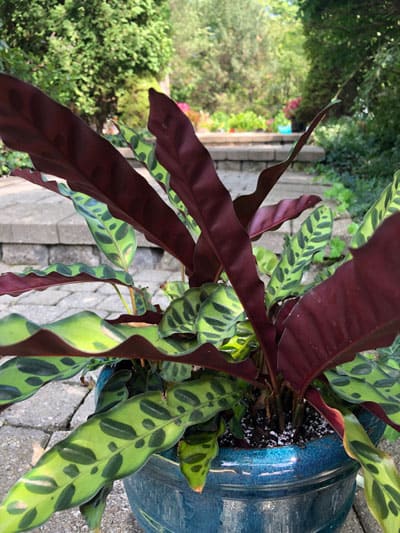
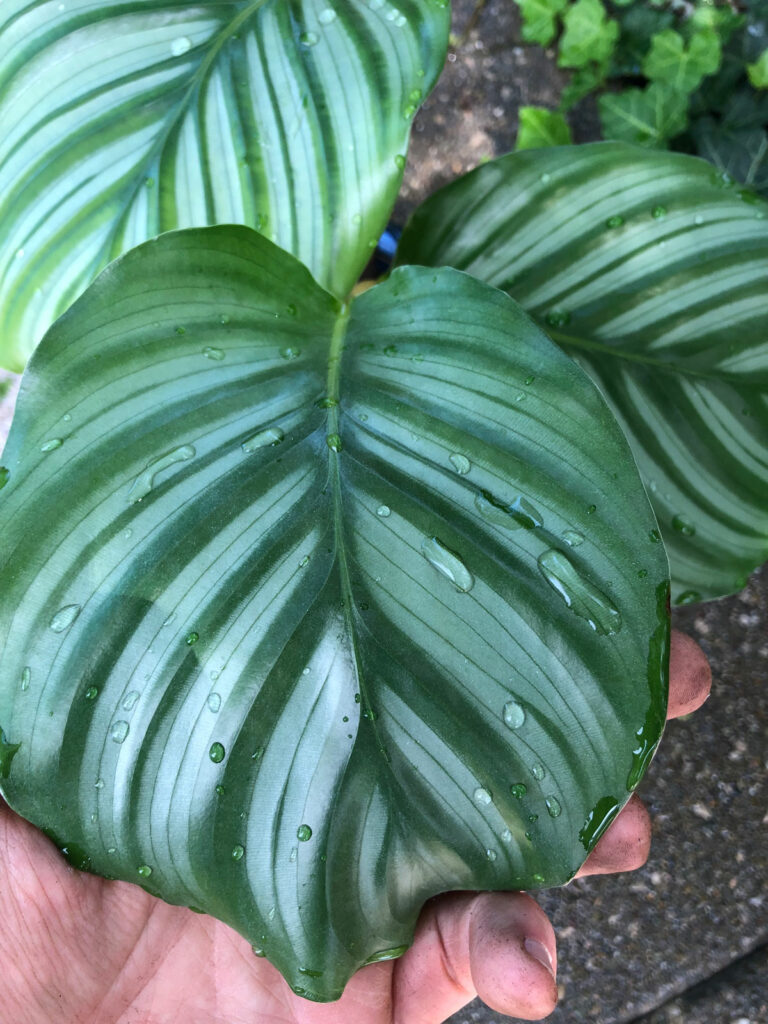
In particular, I will show my Calathea lancifolia (also known as Rattlesnake Plant) and Calathea orbifolia.
However, the care and advice will apply broadly to all plants in the Calathea genus.
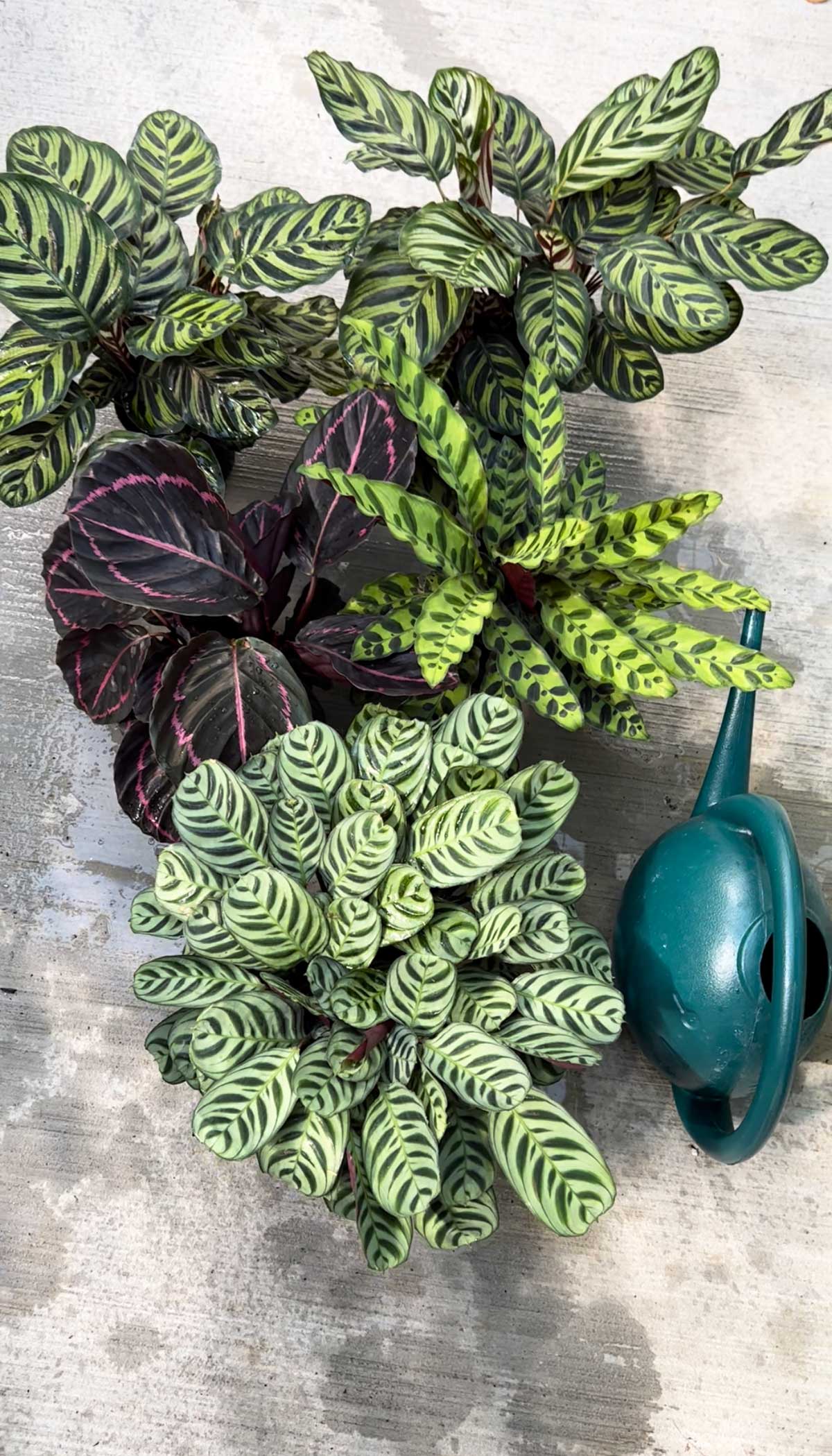
Some other gorgeous Calathea species include Calathea makoyana, Calathea ornata, and Calathea roseopicta, among many others!
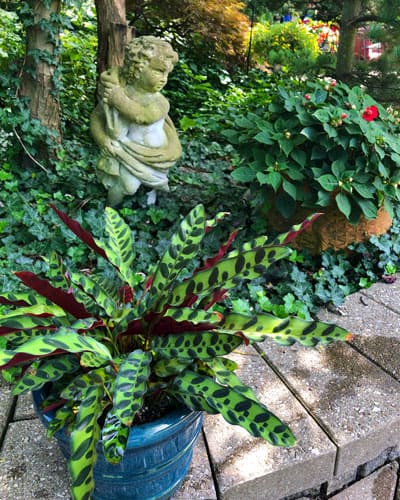
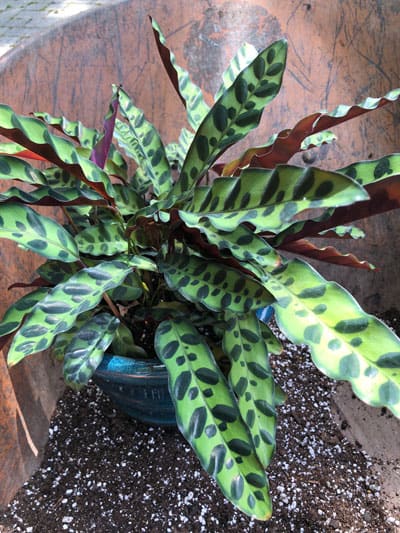
I will go into the care very shortly, but let me show you my plants. Here is my Calathea lancifolia.
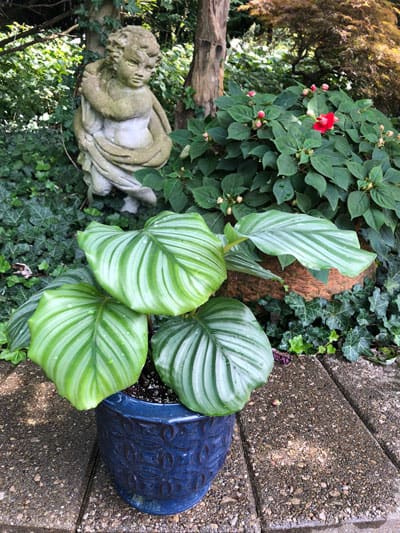
I absolutely love the stunning patterns on the leaves! And here is my Calathea orbifolia.
These plants can grow HUGE. A friend actually sent me a tiny orbifolia in a mail and she is starting to grow into a beautiful specimen.
I would encourage you to read this entire post because you can't really separate elements of houseplant care. You have to look at them all together to get a good picture of how to take care of your plants.
By the end of this post, you will understand how to care for your Calathea and how to do your best to keep them in great shape and minimize those crispy leaves and edges that plague many people.
Table of Contents
HOW TO AVOID BROWN, CRISPY EDGES IN CALATHEA
1. HUMIDITY FOR CALATHEA
I wanted to start out first by talking about humidity. There are MORE important topics than low humidity actually, but I will get to those very soon.
If you can provide higher humidity for your Calathea plants, please go ahead and do so.
It is NOT the most important factor in keeping most of your Calathea species in good shape, but they DO prefer humid environments.
First of all, misting will do nothing to increase humidity! Humidity is a measure of moisture in the air. You are just wetting the leaves by misting.
That being said, Calathea can be prone to spider mites and misting can actually help deter spider mites (since spider mites like very dry conditions). There is one benefit to misting!
However don't expect misting to increase your humidity. There are better ways. If you do have a spider mite infestation, read my blog post on Spider Mites: 3 Things You Can Do to Stop Them.
Just don't overdo misting your calathea's leaves otherwise you can encourage fungal diseases, especially if your air circulation is poor.
One great way to achieve high humidity for your Calatheas and other plants is to simply get a humidifier. I honestly only run mine in the winter months when our indoor air is super dry.
My absolute favorite humidifier, and the one that I personally use is the Levoit Humidifier. It honestly is the best one I've used and I've used a lot.
It will cost a little more but is well worth it. It has many features including cool and warm mist, and is quiet and very effective. Not to mention, it is built very well and will last you much longer if you take care of it!
I run it all winter long in my sunroom. Not only is it good for my plants, but it is also great for my dry skin and my dry winter nasal passages! 😀
Central heating can result in really dry air, so I make sure to run my humidifier diligently all winter long.
The Levoit Ultrasonic Humidifier is by far the best humidifier I've tested and I will not use any other.
Another way to increase humidity is to group plants together. Plants naturally release water into the air by a process called transpiration.
The more you group together, the more the localized humidity will increase.
There are no secrets in houseplant care. A lot of people ask me frequently "what is your secret" for taking care of [insert plant of the day here].
The only "secret" is just proper houseplant care techniques, like proper watering. If you have proper watering down, in conjunction with proper light, you are most of the way there in ensuring that your plants are healthy.
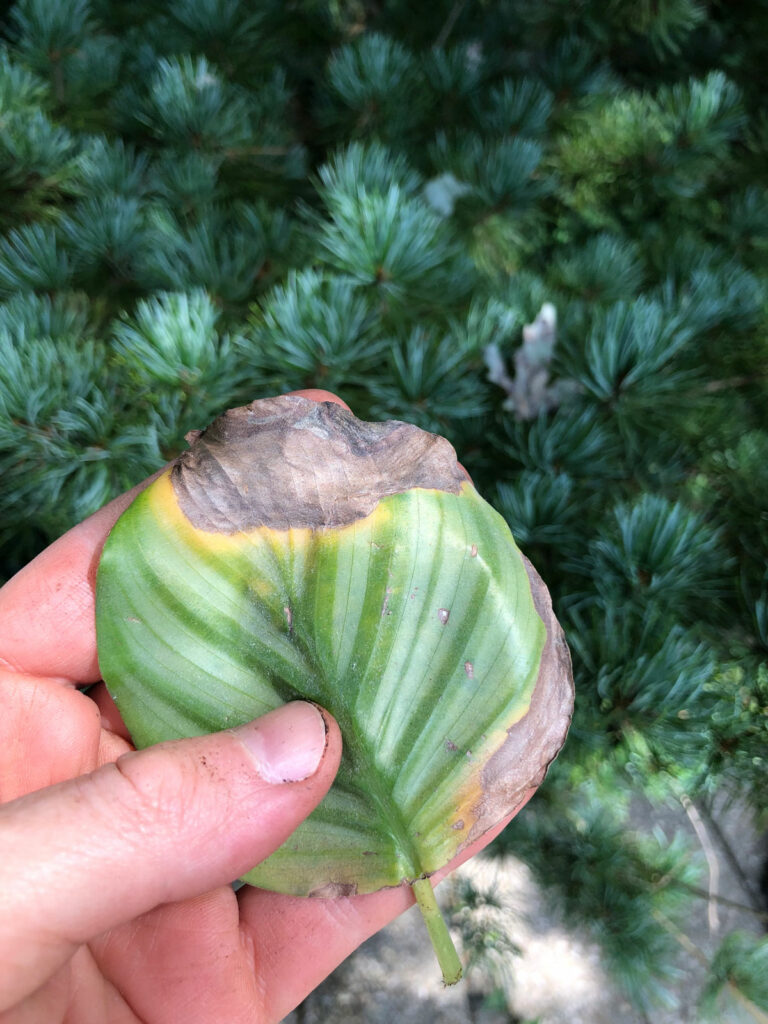
Those dreaded Calathea crispy leaves and edges, more times than not, are due to inconsistent watering and/or improper watering! NOT humidity (though high humidity will help).
Proper watering is a much bigger factor in ensuring that your Calathea leaves are in great condition. If you have good humidity on top of all that, all the better! Think of it as a bonus.
You must get your watering practices down and have proper light first. THEN focus on increasing humidity. If you have all 3, you are golden.
That being said, PROPER AND CONSISTENT WATERING is the key to avoiding excessive crispy and brown leaf edges in Calathea (and other plants!)
There are so many watering myths concerning houseplants in general and the word overwatering is terribly misunderstood.
Be sure to read these two blog posts that I just linked to above after you're done with this post. They are critical to growing beautiful houseplants.
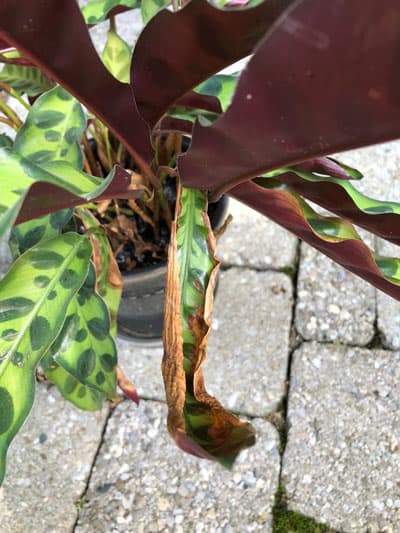
Take my Calathea lancifolia plant above. This plant was in great condition for a long time when I was very attentive and consistent in watering.
But sometimes, something called life happens, and I either get too tired or busy and I let my plants dry out more than I normally do. If you keep doing this over and over, you will get crispy leaves.
Your Calathea is not dying if you have one crispy leaf. Keep that in mind. But neglect watering over and over again, and it just may die!
So how much do Calathea like to be watered? How often should you water your Calathea? The short answer is that it DEPENDS!
People ask me all the time how often to water plants. And it really just depends. Don't go by your calendar!
Go by your soil moisture instead! Everyone's conditions are different. The size of your pot, the type of pot you have (terra cotta vs. plastic for example), the temperature, type of soil, all play a role in how quickly the soil dries out.
So forget that calendar schedule for watering and use your finger instead.
Calathea plants like to grow in a consistently moist soil, but they do NOT like to dry out completely.
A good rule of thumb that I like to use for these plants is to allow the surface of the soil to dry out, and then water again.
Maybe the top inch or so smaller pots. If you have a huge pot, maybe allow the top 2 inches to dry out.
But when do you water, water thoroughly! Let all the water drain out of the drainage hole, and you are done.
Then just keep observing and repeat. It really is as simple as that!
By having good watering practices and never allowing your Calathea soil to completely dry out, you will avoid those ugly crispy and brown leaves.
On the other end, make sure that your plant is never sitting in watering for extended periods of time and always ensure that you have a drainage hole. Like most plants, you can have root rot if this continues.
Once you have root rot, you can start to get yellow leaves and also brown tips as well.
You may still get very small brown tips on the leaves even with good care, but seriously...don't stress about those.
As long as the rest of the plant looks healthy and vigorous, you have come a long way!
3. WATER QUALITY FOR CALATHEA
Last but definitely not least, Calathea plants can be pretty sensitive to hard water and fluoride in tap water. You can grow them with hard tap water, but depending on the quality of your tap water, this can also cause brown leaf edges.
Many people have been very successful using distilled water for their Calatheas and have reported great results with minimal to no brown edges of the leaves.
If you don't want to bother with buying distilled water or setting up a complicated RO water system, don't miss my post on the best distilled water alternative for Calathea plants. You will thank me for it! It has worked wonders for my plants.
Of course, you'll also have to make sure that you're not letting your soil dry out too much either.
Avoid cold water, and always use room temperature or lukewarm water. Being native to tropical rainforest, it makes sense to avoid cold water.
Calatheas don't need a ton of fertilizer, but be sure to use some throughout the growing season, especially if you are using distilled water.
My favorite fertilizer that I use for most of my houseplants is Dyna-Gro Grow (easily purchased on Amazon).
Simply add ¼ to ½ teaspoon in a gallon of water and for Calathea, I might use with every other watering, or even once a month or so during the growing season.
You don't want to overdo it because of their sensitivity to salts, but they still need some fertilizer for best growth.
You can water periodically with just plain distilled water in order to flush away any build up of salts.
Watering with pure distilled water in between fertilizer applications will help flush out any salts that can potentially cause brown leaves.
Rain water is also a wonderful water source if you can collect it.
CAN CALATHEA GROW IN LOW LIGHT?
This is a loaded question too! Let me talk a little about "low light" and what Calathea like.
Low light is just too vague and everyone interprets it differently. Let me just tell you what works for me.
Calathea are among the "lower" light plants if you would like to call them that, but they still need to be in front of a window for best results. And by in front of a window, I mean within a couple feet (in most cases).
Light intensity decreases DRAMATICALLY the further you get from a window. You would be shocked!
Calathea do not like a lot of direct sun. The most I would do is some morning sun (which Eastern windows provide) but no more than that. Northerns windows will work well.
If you have any windows that are very sunny, you can either move your plant back a little, or use a sheer curtain to diffuse the direct sun so that the plants are not getting direct sun on their leaves.
Too much direct sun, or even short periods of hot, intense sun, can burn their leaves.
That's it! You're most of the way there now. Giving your Calatheas proper light and proper watering will go a long way in ensuring a beautiful plant.
There is more to consider though that is very important so keep on reading!
WHAT KIND OF SOIL DOES CALATHEA NEED?
Plants can really grow in a variety of mediums and soil mixtures, but the most important thing that you need to keep in mind is that the soil should be well drained.
There is no one "magic" soil mixture.
Many pre-packaged soil mixes can use some help though in the area of drainage!
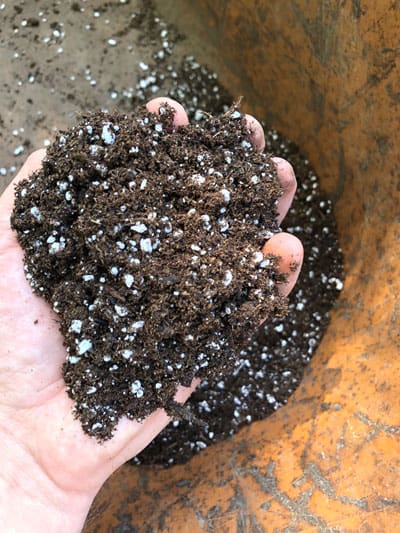
As a general potting mix, I love using Miracle Gro potting mixand I do amend it a bit to make it fluffier and lighter, depending on what plants I'm growing.
For Calathea, I like to add perlite to mix.
I like to use my wheelbarrow outside for this to keep the mess down and keep it easy! My ratio will vary, but 2 to 3 parts of Miracle Gro potting mix to 1 part of perlite is a good rule of thumb!
The reason that you want good drainage all has to do with oxygen to the roots. If you incorporate things like perlite, which I buy often all the time from Amazon, it will increase drainage and oxygen to your plant's roots.
This is very important for all plants.
ORGANIC POTTING MIX
If you don't want to mix your own, I HIGHLY recommend the Oh Happy Plants mixes that you can use straight out of the bag. The Pray For Us soil blend is formulated specifically for Calathea and plants in the prayer plant family. If you use my link, you will automatically receive 10% off at checkout on any product.
The Pray For Us soil blend also contains no chemical fertilizer additives, and uses organic additives instead to slow-release nutrients over time, so you won't have to add fertilizer for a while and there are no chemical fertilizer salts to worry about giving you brown leaf tips since they are sensitive to salts.
There are also concerns with perlite being a source of fluoride which can cause brown tips in Calathea leaves, but Oh Happy Plants does not use perlite in their blends.
As a basis for that blog post, I survey my readers about all of their frustrations with potting mixes. All of these questions have been answered, and I also talk about my amazing experiences with using the mix.
In fact, I'm currently transferring most of my plants to this mix after seeing the amazing results it produces!
Let's talk about how to repot Calathea now.
CALATHEA REPOTTING
Are you ready to repot your Calathea? How do you know when to repot Calathea, or any other plant for that matter?
Has your plant been in that same small pot for a long time? You can simply slip your plant out of its pot to see if it is root bound. If it is, it is time to repot.
Maybe you see roots coming out of the drainage holes. Time to repot.
Or maybe you just have a lot of surface roots, and the pot just seems to dry out really quickly. Much more quickly than before.
These are all indications that you may want to repot.
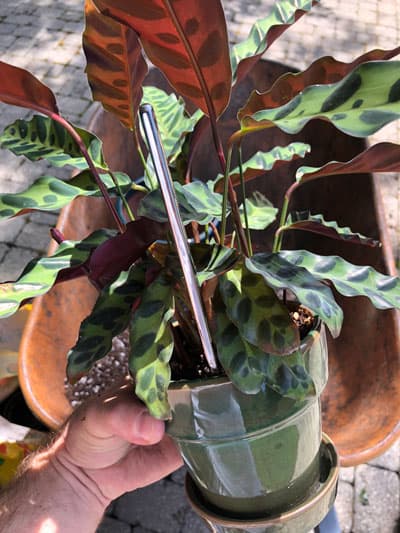
Let's take a look at my steps that I used to repot my Calathea lancifolia. This applies to almost all houseplants.
If you have a flexible plastic pot, you can just squeeze the pot gently to loosen it so you can take it out.
I had mine in a ceramic pot so I just used a metal chopstick and passed just inserted it around the whole perimeter of the plant.
You can also use a knife to do this as well. Once you do this, gently see if the plant comes out of the pot. If it doesn't, keep using the chopstick or knife until it does.
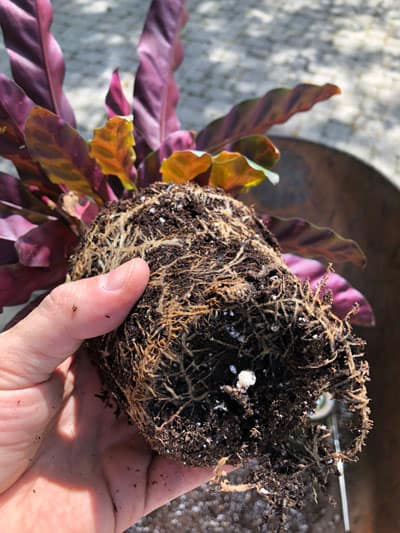
You can see from the photo above that it is pretty potbound. It could be worse though!
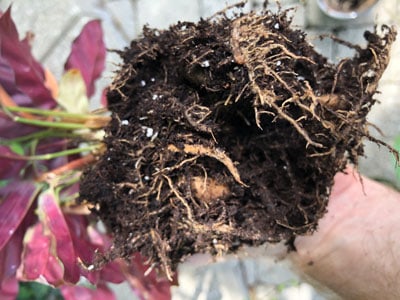
Then the next thing you want to do is to loosen the root ball. Gently take both hands and loosen the bottom and the sides of the rootball.
If you break a couple roots, please don't worry. This step is necessary! Your plant will thank you!
If you don't do this step, your plant's roots will find it much more difficult to grow into the new soil in your new pot.
Once I had a peace lily that I didn't do this do, and years later when I repotted it again, none of the roots had grown into the new soil! The original pot-bound look was still in-tact!
I ended up combining two plants into one pot. When you add your soil mixture, be sure that there are no air gaps. You want the roots to have contact with the new soil.
Gently press down to ensure that this occurs. Then give your plant a good watering, and you are done!
CALATHEAS HATE THE COLD
Lastly, I'd like to talk a little bit about temperature. Calathea plants HATE cold temperatures! Aim to have temperatures no lower than 60F (15.5 C)
Numerous people have written to me about their Calatheas suddenly having these issues:
Leaves are starting to curl.
The plant is no longer upright and leaves seem to droop.
The plant is no longer "praying." Healthy Calathea plants should move their leaves upward at night and then lower them during the day.
I've come to find out that many of those plants with these issues have been exposed to cooler temperatures. Calatheas prefer temperatures in the 65F-80F range (18C-27C).
Temperatures much below 60F (15.5C) will cause many of the issues described above. So try your best to avoid cold drafts, or cooler temperatures as described above!
CALATHEA PROBLEMS AND QUESTIONS
Should i bottom water Calathea?
I do not recommend bottom watering Calathea, especially if you are using tap water or using fertilizer. Fertilizer salts and minerals from tap water will accumulate through bottom watering. If you do bottom water, be sure to periodically top water with distilled or filtered water to remove any accumulated salts that can cause damage to your plant over time.
Does Calathea like coffee grounds?
Although Calathea like a soil pH of around 6.5 and coffee grounds tend to be around a pH of 6.5-6.8, making it acceptable from a pH standpoint, it is not recommended to add coffee grounds directly to your Calathea soil. In order to make any nutrients in coffee grounds available to plants, the coffee grounds must be composted first. Adding coffee grounds directly to soil before composting will rob the soil of nitrogen and can actually harm your plants. Using any uncomposted kitchen scraps will actually create conditions that are favorable to fungus, mold, bacteria and also can attract fungus gnats.
Do Calathea like to be misted?
Misting does NOT increase humidity. It will only wet your leaves and if you overdo it (especially if air circulation is poor), you can also invite fungal issues. Raise humidity by using a humidifier.
Does Calathea like small pots?
They should be up-potted to a larger pot once root bound. Leaving them constricted in a small pot will eventually inhibit growth.
Should I shower my Calathea?
Yes, it would benefit your Calathea if you periodically took your plant to a shower or a sink in order to be rinsed off to remove accumulated dust on the leaves that can inhibit photosynthesis. Be sure to use lukewarm water and never cold. Rinsing your plants off will also help to deter any pests that may be present, especially spider mites.
Can I put my Calathea outside?
Yes, absolutely. Remember that there is no such thing as a "houseplant" since all plants evolved outdoors. When you move your plants outdoors, be sure that conditions are warm (above 60F) and that you have your plants in the shade.
Is Calathea safe for pets?
According to the ASPCA, Calathea are non-toxic to dogs, cats and horses.
Can I put Calathea in the bathroom?
Yes! Bathrooms typically provide higher humidity which can benefit Calathea plants. Just make sure that your bathroom has sufficient light for your plant.
RELATED POSTS
If you want to explore different kinds of Calathea, check out my blog post with 39 Calathea varieties that you can hunt down for your own collection!
I have a Calathea Vittata and it is struggling. Half the leaves are curling and brown and I am determined to revive him. I now know that this is due to lack of humidity (I was mostly misting) and I am now waiting on a humidifier in the mail. Do you recommend putting peat moss in the potting soil? I put regular potting mix and perlite in there as well, but I was just curious about whether or not I should have peat moss in there as well?
Hi Sarah! Did you let your plant's soil go very dry at any point? This can be very detrimental to Calatheas. Much more so than even low humidity. Do you know what potting mix your plant is using now? If it's retaining moisture adequately, there is no reason to mix in any peat moss. You need good drainage, but you also don't want your soil to dry out terribly quickly for these plants. They like to stay more moist.
@Raffaele, no I don't think I let the soil get dry. I think I way overwatered at one point because the plant started to smell like urine, but I've been letting it dry out for 2 weeks to get it healthy again and mostly get rid of the smell. I've had him for a month or 2 and he was out on my porch at first, but I brought him inside when it started getting cold. I'm using mostly Miracle Gro potting mix with about 1/4 of the planter with peat moss and a couple handfuls of perlite. I just got a humidifier from your Amazon store in the mail, so he's a little better now, but the leaves are still curling and yellow 🙁 One of his neighbor plants has a grow light and I'm not sure if the Calathea even needs the light from it. It is in a room with a North facing window (not super bright in there) - should I just let the light from the window take care of it, or should I continue using some of the grow light?
Did you let the plant sit in water for any period of time? Also you mentioned that you left the plant outside and it was starting to get cold. How cold did it get when it was still outside? These plants despise the cold weather. The grow light definitely will be beneficial if your northern window seems pretty dim.
@Raffaele, So I re-read the entire article and I think the problem is just that he needs water and I am going to take out the peat moss (I am not a big fan of peat moss). I am worried that the bad smell was from root rot, though. Is that a symptom? (the smell was 100% from the plant itself, not an animal - I swear!)
Hello, I have a Calathea Zebrina and I was advised to repot the plant into a bigger pot. Having done this, all the leaves have rotted and I've had to cut them off. Any tips on whether or not I can bring this beautiful plant to life? I used a potting mix. Look forward to receiving some good news. Many thanks
I'd have to see photos to help out, and details on your conditions. You can use the contact form on my website to email me, and when I respond, you can attach photos.
I have a Calanthea Gecko, it used to have pink flowers and lots of them all year round. Then we moved houses and it’s just such a sad plant now. I don’t know what to do to it anymore! Please help ? I would love to send a photo I just don’t know how?
Hi! Okay I know it is strongly discouraged for newbies to own Calatheas but I really couldn't help myself, they're so beautiful and I bought 5... oh no! I've read so much about how finicky and tricky this plant species can be and I am so scared of killing them. I bought them all in pretty good condition but for some I've noticed browning on the edges which I get, can be normal. However, I noticed my Calathea Maranta isn't going down during the day and most leaves stay upwards, and I can't tell why. And also, I bought it with its leaves in a very faded green which I suspect is the cause of too much exposure to sunlight since the nursery has glass windows all around. How can I help it become more vibrant?
Also, would you advice that I complete repot them into new soil? I don't know what kind of soil mix they are in at the moment and obviously they came with fungus gnats which is annoying. What do you suggest? Thanks!
Hi there! I would give it some time and not repot right now (unless your plants are very root bound and they are drying out quickly as a result). Wait until Spring to repot as it is pretty late in the season and would only repot now if it is a dire emergency. Are you following everything I mentioned in the blog post? Try your best to keep your plants warm, humid, in good light like I describe in the post, and pay attention to watering. There are many reasons why Calathea don't "pray" and it might just be that it needs to adjust to your home so give it a little time and monitor your plant closely for now. For now, you can get those yellow sticky traps for the fungus gnats. They tend to thrive in wet soil. I hope this helps. Calathea are not the easiest houseplants, but you will learn a lot from growing them 🙂
It's hard to say because I don't know exactly the process that you followed and materials you used... give it some time to adjust and try and follow all my information in my blog post for best results.
Hi, I bought a Calathea Medallion about a month ago and watered it once about a week ago. I have noticed that the soil is still wet according to my moisture meter and I am wondering how to dry out the soil as I understand it likes to be moist not wet. I've been putting tampons in the soil to help absorb the moisture but its still wet. I have also noticed that I have two new leaves uncurling; however, the color isn't quite as green as the other leaves, any ideas? I have a diffuser/humidifier next to it and had it on top of a pebble tray but removed it while the soil is still wet. Any help would be appreciated. Thanks
I would avoid using sand for Calathea. Perlite has a different function and will create a fluffier mix with more air at the roots, but still allow water retention. Coarse sand (not fine sand) is good to mix in for plants like succulents and cacti.
This article is so helpful, thank you! I have a calathea lancifolia and it's looking super healthy but isn't 'praying'. I'm worried that this is the start of a problem! Hopefully by following your tips it starts moving again.
If my rattlesnake plant is directly up against a west facing window, should I move it a few feet back? The edges of the leaves are all dried and I believe I have been watering it consistently. I've put the plant there for months but missed a week or two of watering. I'm not sure if the plant is just recovering from the break in the watering or its from the window. The leaves have been that way for about two months or so. Thank you so much!
It could be due to a combination of both. Dry soil will definitely do it. Is it an unobstructed West window? How many hours of actual direct sun does it receive?
My rattlesnake plant is producing new leaves but then they dry up before they become bigger than 4 in or so. What could be the cause of this? The rest of the plant looks great
Great tips!
I recently got a small Calathea orbifolia but among that the soil is not drying. I watered it about two weeks ago and the top soil is very wet. Pot has many drainage holes and is currently on a plate of rocks with water for humidity. Any advice? Thanks!
Does the pot look disproportionately large for the size of the plant? Do you have your plant in good light? Other factors that can affect how quickly the soil dries out are the soil type too. Just some things to consider!
So very informative, thank you for the tips!
I've got an ornata & a lancifolia, both I've had about 7 months. The ornata leaves lately have just been pointing straight upward. I'm not really complaining, the underside of the leaves are a gorgeous deep plum color! They just never come down, otherwise the plant seems very healthy.
The lancifolia is right next to it in the same conditions but its leaves are moving around all day. The only info I can find online is for drooping or curly/crispy leaves. Mine are fully open leaves, just always pointing up. I assume it's a light situation but I don't want to try the wrong thing & damage the plant. What would you suggest? Thanks!
Have you had any changes in your plants' conditions since you've had the ornata? Have you moved the plant at all? Any changes in temperature, or maybe extremes in soil moisture?
Hi, your articles have been very helpful. I have a Calathea beauty star that I think was kept outside. I repotted it a few days after I got it because the roots were coming out the drain holes of the small pot. I used potting soil mixed with some perlite and coconut peat. It seems to be doing fine and has even shot up a new leaf, but the new leaf has a brown tip. It was already poking up when I got it and was already brown at the tip and many of the other leaves have brown or torn tips. A few of the leaves were also curled when I got it. Not curled like the pictures that show up when I Google curled leaves, but more like rolled tightly into a cylinder. Is that normal? Will it unroll? I have it on a pebble tray next to two other plants, above the sink. It gets light from windows but it's not directly next to a window. I was afraid to give it too much light since it had brown. I hope it's ok!
Hi Rachel! I don't have that particular Calathea, but I noticed that my Calathea zebrina leaves will curl more into a cylinder when I neglect my plant and forget to water and the soil goes completely dry. Perhaps this is the case with yours too? Good luck!
My calathea medallion, which is a few months old, has all of sudden started drying out and even the new leaves are browning. There has been no sudden change in weather and watering conditions. Can you please help?
Hello, your article gives me hope.. I had ordered my first Calathea by post, Warscevizeiigiveupospelling. The plant arrived shaken out of its pot and bag, just bare root, it was horrifying. I’ve potted it gently and over watered the first two days hoping to rehydrate the roots. Some of the small leaves are done for as the root damage must have affected them badly. It’s been a week, the majority if the plant looks great, lush leaves, but it hasn’t lifted its leaves up yet. The stems are upright but the leaves stay neutral, fairly low. Do you have tips on recovery? Should I over water again?





I have a Calathea Vittata and it is struggling. Half the leaves are curling and brown and I am determined to revive him. I now know that this is due to lack of humidity (I was mostly misting) and I am now waiting on a humidifier in the mail. Do you recommend putting peat moss in the potting soil? I put regular potting mix and perlite in there as well, but I was just curious about whether or not I should have peat moss in there as well?
Hi Sarah! Did you let your plant's soil go very dry at any point? This can be very detrimental to Calatheas. Much more so than even low humidity. Do you know what potting mix your plant is using now? If it's retaining moisture adequately, there is no reason to mix in any peat moss. You need good drainage, but you also don't want your soil to dry out terribly quickly for these plants. They like to stay more moist.
@Raffaele, no I don't think I let the soil get dry. I think I way overwatered at one point because the plant started to smell like urine, but I've been letting it dry out for 2 weeks to get it healthy again and mostly get rid of the smell. I've had him for a month or 2 and he was out on my porch at first, but I brought him inside when it started getting cold. I'm using mostly Miracle Gro potting mix with about 1/4 of the planter with peat moss and a couple handfuls of perlite. I just got a humidifier from your Amazon store in the mail, so he's a little better now, but the leaves are still curling and yellow 🙁 One of his neighbor plants has a grow light and I'm not sure if the Calathea even needs the light from it. It is in a room with a North facing window (not super bright in there) - should I just let the light from the window take care of it, or should I continue using some of the grow light?
Did you let the plant sit in water for any period of time? Also you mentioned that you left the plant outside and it was starting to get cold. How cold did it get when it was still outside? These plants despise the cold weather. The grow light definitely will be beneficial if your northern window seems pretty dim.
@Raffaele, So I re-read the entire article and I think the problem is just that he needs water and I am going to take out the peat moss (I am not a big fan of peat moss). I am worried that the bad smell was from root rot, though. Is that a symptom? (the smell was 100% from the plant itself, not an animal - I swear!)
Hello, I have a Calathea Zebrina and I was advised to repot the plant into a bigger pot. Having done this, all the leaves have rotted and I've had to cut them off. Any tips on whether or not I can bring this beautiful plant to life? I used a potting mix. Look forward to receiving some good news. Many thanks
I'd have to see photos to help out, and details on your conditions. You can use the contact form on my website to email me, and when I respond, you can attach photos.
Hey!
I have a Calanthea Gecko, it used to have pink flowers and lots of them all year round. Then we moved houses and it’s just such a sad plant now. I don’t know what to do to it anymore! Please help ? I would love to send a photo I just don’t know how?
Hi Shirley! Sure, go ahead and use the contact form on my website, and once I reply to that email, you can attach photos.
Hi! Okay I know it is strongly discouraged for newbies to own Calatheas but I really couldn't help myself, they're so beautiful and I bought 5... oh no! I've read so much about how finicky and tricky this plant species can be and I am so scared of killing them. I bought them all in pretty good condition but for some I've noticed browning on the edges which I get, can be normal. However, I noticed my Calathea Maranta isn't going down during the day and most leaves stay upwards, and I can't tell why. And also, I bought it with its leaves in a very faded green which I suspect is the cause of too much exposure to sunlight since the nursery has glass windows all around. How can I help it become more vibrant?
Also, would you advice that I complete repot them into new soil? I don't know what kind of soil mix they are in at the moment and obviously they came with fungus gnats which is annoying. What do you suggest? Thanks!
Hi there! I would give it some time and not repot right now (unless your plants are very root bound and they are drying out quickly as a result). Wait until Spring to repot as it is pretty late in the season and would only repot now if it is a dire emergency. Are you following everything I mentioned in the blog post? Try your best to keep your plants warm, humid, in good light like I describe in the post, and pay attention to watering. There are many reasons why Calathea don't "pray" and it might just be that it needs to adjust to your home so give it a little time and monitor your plant closely for now. For now, you can get those yellow sticky traps for the fungus gnats. They tend to thrive in wet soil. I hope this helps. Calathea are not the easiest houseplants, but you will learn a lot from growing them 🙂
The edges turned brown . And when I re potted ,it is lossing it's leaves. Will it do better soon. Because I have re potted it today's morning.
It's hard to say because I don't know exactly the process that you followed and materials you used... give it some time to adjust and try and follow all my information in my blog post for best results.
Hi, I bought a Calathea Medallion about a month ago and watered it once about a week ago. I have noticed that the soil is still wet according to my moisture meter and I am wondering how to dry out the soil as I understand it likes to be moist not wet. I've been putting tampons in the soil to help absorb the moisture but its still wet. I have also noticed that I have two new leaves uncurling; however, the color isn't quite as green as the other leaves, any ideas? I have a diffuser/humidifier next to it and had it on top of a pebble tray but removed it while the soil is still wet. Any help would be appreciated. Thanks
Newer leaves are often lighter in color so if you give it more time, it will darken. Do you have your plant in appropriate light?
can use sand instead of perlite.?
I would avoid using sand for Calathea. Perlite has a different function and will create a fluffier mix with more air at the roots, but still allow water retention. Coarse sand (not fine sand) is good to mix in for plants like succulents and cacti.
This article is so helpful, thank you! I have a calathea lancifolia and it's looking super healthy but isn't 'praying'. I'm worried that this is the start of a problem! Hopefully by following your tips it starts moving again.
Glad to help! Keep me posted!
If my rattlesnake plant is directly up against a west facing window, should I move it a few feet back? The edges of the leaves are all dried and I believe I have been watering it consistently. I've put the plant there for months but missed a week or two of watering. I'm not sure if the plant is just recovering from the break in the watering or its from the window. The leaves have been that way for about two months or so. Thank you so much!
It could be due to a combination of both. Dry soil will definitely do it. Is it an unobstructed West window? How many hours of actual direct sun does it receive?
Daming hanash
My rattlesnake plant is producing new leaves but then they dry up before they become bigger than 4 in or so. What could be the cause of this? The rest of the plant looks great
Is your soil really dry? Humidity levels really low?
Great tips!
I recently got a small Calathea orbifolia but among that the soil is not drying. I watered it about two weeks ago and the top soil is very wet. Pot has many drainage holes and is currently on a plate of rocks with water for humidity. Any advice? Thanks!
Does the pot look disproportionately large for the size of the plant? Do you have your plant in good light? Other factors that can affect how quickly the soil dries out are the soil type too. Just some things to consider!
So very informative, thank you for the tips!
I've got an ornata & a lancifolia, both I've had about 7 months. The ornata leaves lately have just been pointing straight upward. I'm not really complaining, the underside of the leaves are a gorgeous deep plum color! They just never come down, otherwise the plant seems very healthy.
The lancifolia is right next to it in the same conditions but its leaves are moving around all day. The only info I can find online is for drooping or curly/crispy leaves. Mine are fully open leaves, just always pointing up. I assume it's a light situation but I don't want to try the wrong thing & damage the plant. What would you suggest? Thanks!
Have you had any changes in your plants' conditions since you've had the ornata? Have you moved the plant at all? Any changes in temperature, or maybe extremes in soil moisture?
Hi, your articles have been very helpful. I have a Calathea beauty star that I think was kept outside. I repotted it a few days after I got it because the roots were coming out the drain holes of the small pot. I used potting soil mixed with some perlite and coconut peat. It seems to be doing fine and has even shot up a new leaf, but the new leaf has a brown tip. It was already poking up when I got it and was already brown at the tip and many of the other leaves have brown or torn tips. A few of the leaves were also curled when I got it. Not curled like the pictures that show up when I Google curled leaves, but more like rolled tightly into a cylinder. Is that normal? Will it unroll? I have it on a pebble tray next to two other plants, above the sink. It gets light from windows but it's not directly next to a window. I was afraid to give it too much light since it had brown. I hope it's ok!
Hi Rachel! I don't have that particular Calathea, but I noticed that my Calathea zebrina leaves will curl more into a cylinder when I neglect my plant and forget to water and the soil goes completely dry. Perhaps this is the case with yours too? Good luck!
My calathea medallion, which is a few months old, has all of sudden started drying out and even the new leaves are browning. There has been no sudden change in weather and watering conditions. Can you please help?
Has the soil been drying out much more quickly than it used to?
Hello, your article gives me hope.. I had ordered my first Calathea by post, Warscevizeiigiveupospelling. The plant arrived shaken out of its pot and bag, just bare root, it was horrifying. I’ve potted it gently and over watered the first two days hoping to rehydrate the roots. Some of the small leaves are done for as the root damage must have affected them badly. It’s been a week, the majority if the plant looks great, lush leaves, but it hasn’t lifted its leaves up yet. The stems are upright but the leaves stay neutral, fairly low. Do you have tips on recovery? Should I over water again?
Just practice consistent, regular care and it will take some time for your new plant to adjust!