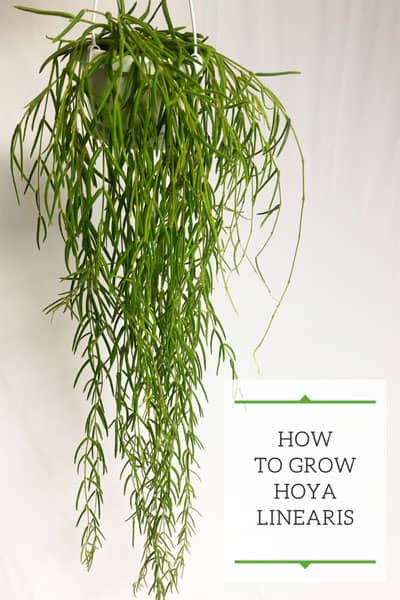
Hoya linearis is another super hot plant that growers can't keep up with demand. There are many types of Hoya out there that are much more commonly available, but Hoya linearis is distinctly unique and quite a bit different.
Challenging to find, they are also reportedly one of the most challenging Hoyas to grow, but I've found them to be easy! It is all about knowing what each plant species likes.
Would you like to save this post?
Enter your email, and I will send this link straight to you!
If you can give it what it likes, it will be a cinch to grow! Let me show you how I take care of mine.
Table of Contents
Where Hoya Linearis Grows
Before I go into how exactly I care for my Hoya linearis, I would like to introduce where this plant grows in nature.
If you can approach the conditions that this plant grows in nature, you will have no problems growing this plant.
This plant grows as an epiphyte (on trees) in the Himalayan region in Northern India and in the nearby vicinity. It actually grows on trees in higher altitudes, and dangles down similar to how Spanish moss grows.
If you can gather from the region that it grows in, it does prefer cooler nighttime temperatures as compared to some other types of Hoyas.
How to Grow Hoya Linearis
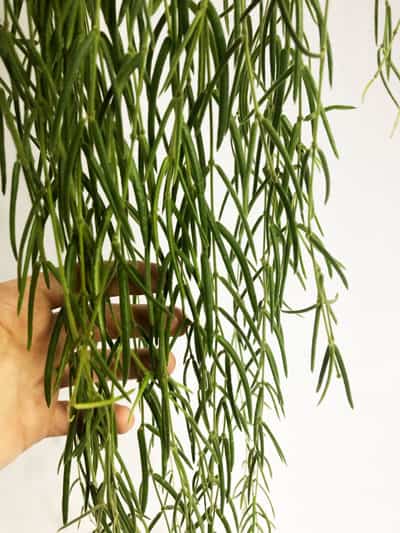
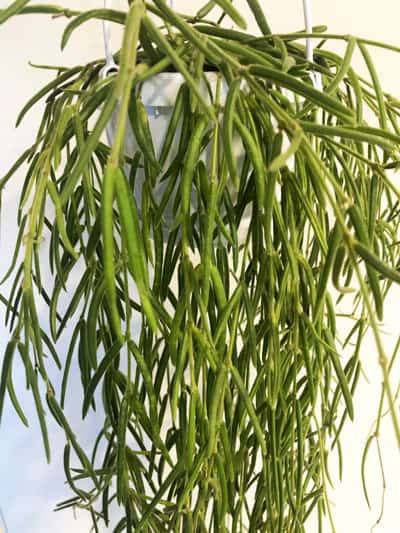
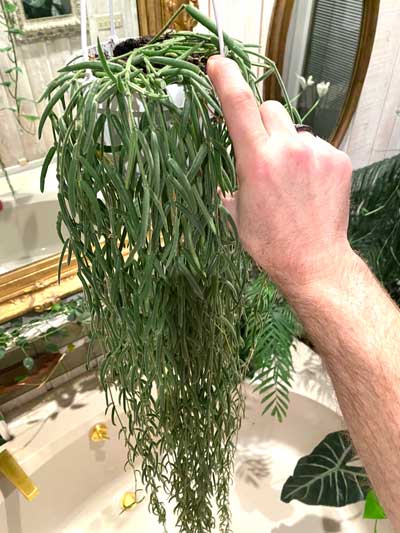
This plant is different from many other hoyas in that it doesn't have large, firm, waxy leaves. Instead, the leaves are skinny, soft, and slightly hairy. It really has a lovely growing habit.
They also will give you white, star-shaped flowers that reported have a lemon scent to them. Mine has not flowered yet, but I will update my post when it does to show you.
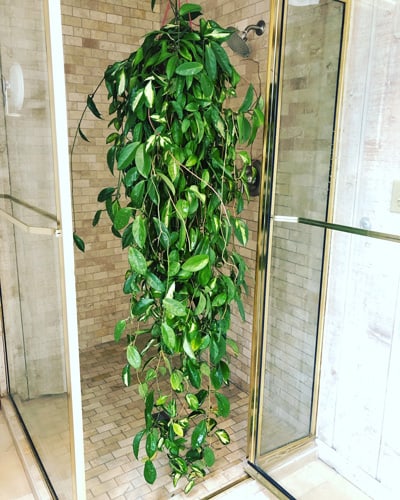
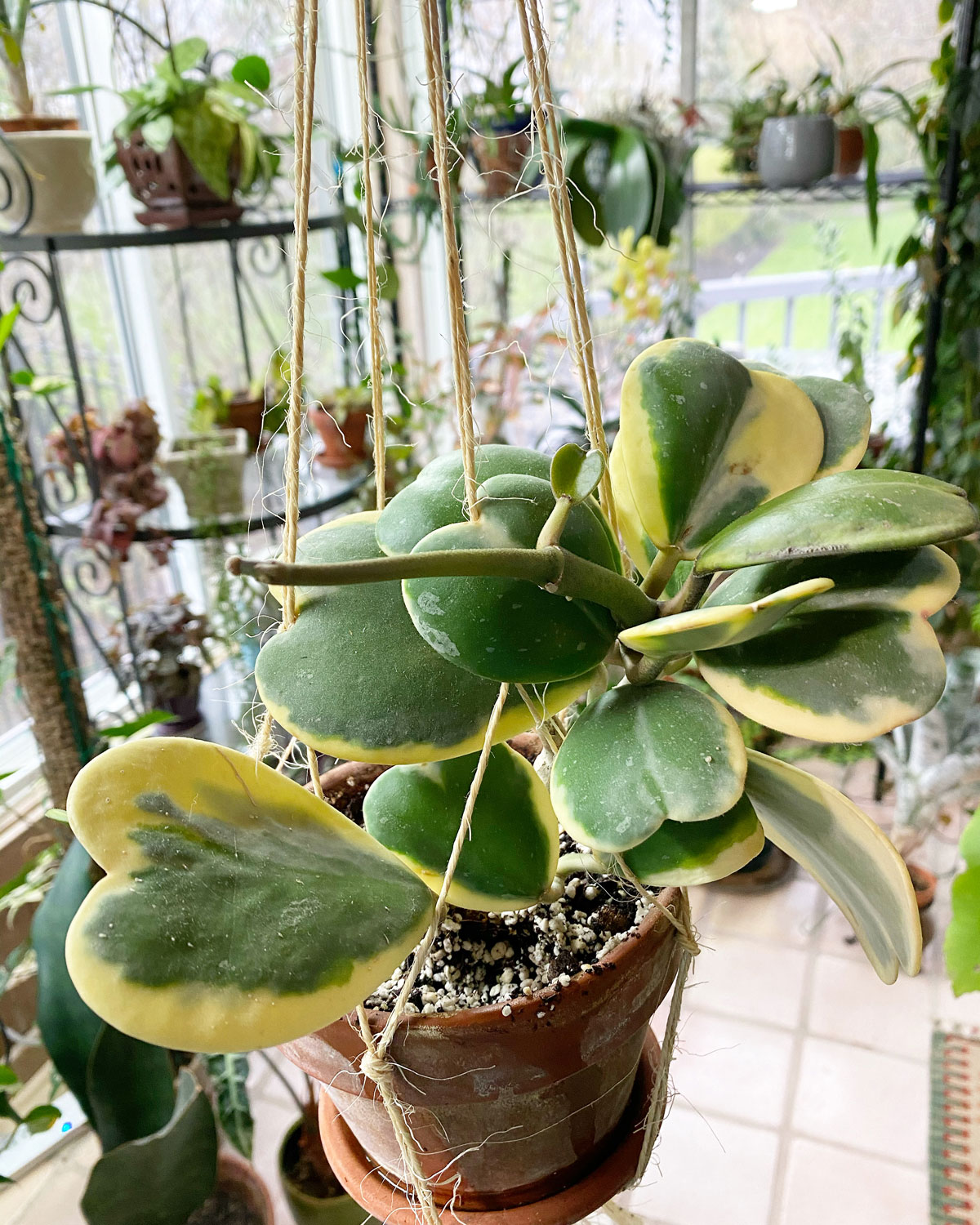
Take a look at the difference between my Hoya linearis below...
In my experience so far with growing this plant, despite the rumors and hype that you may have heard that Hoya linearis is one of the more difficult hoyas, I've had no troubles at all!
I strongly believe that this is because I am providing the right conditions for this plant. So what are the conditions that it likes?
Let's talk about that a little bit, and you'll want to read ALL of this post because you can't just get one thing right when it comes to houseplant care. A number of combinations working together will give you true, lasting results.
There are NO shortcuts or magic buttons to houseplant care!
1. WATERING
Improper watering and soil moisture conditions is probably one of the most common downfalls in houseplant care.
This is especially the case with Hoya linearis. These are very easy plants as long as you keep the soil on the dry side (but at the same time, you need proper watering habits)!
I do my best to teach people about my watering methods so let me elaborate more on this. Like all hoyas, these plants like to dry out well between watering.
This does NOT mean that when you water, that you'd only want to add a tiny bit of water. So many people are scared of overwatering, but it is a very misunderstood term! Always water thoroughly.
I preach a holistic view on houseplant care. You can't just get one thing right, and have complete disregard for everything else.
Good watering practices are paramount.
When you water, you should thoroughly soak the potting media. Water until all the soil is saturated and all excess water drains away through the drainage hole. ALWAYS have a drainage hole!
This is especially important for epiphytes, like Hoya linearis, which literally grows hanging on trees. They DEMAND excellent drainage and this is apparent because of how they grow in nature.
Like any hoya though, they like to dry out between watering. So allow the entire potting mix to dry out before you consider watering again.
On that note, feel the potting mix with your finger to know when it is dry. Pick up the pot and also notice when it is very light. You will get to know when the soil has completely dried out.
I strongly caution against the usage of water meters. I've known so many people that have devastated their plants because they trust the water meter too much in order to tell them when to water.
Think about it, many epiphytes will get poured on by heavy rains (the entire plant is thoroughly soaked), but since they are epiphytes (growing on trees and exposed to a lot of air circulation), they will dry quickly.
In the winter, you can go even longer in between watering since reduced light and perhaps cooler temperatures indoors will slow down, or even halt, growth.
Watch out for signs of stress. You don't want to push it too far that the plant is stressed and becomes shriveled or dried out.
This brings us to the next point which you NEED to have for hoyas.
2. POT SIZE and SOIL
Hoyas in general like smaller pots and like to be root bound. My own plant came in a tiny pot and I will leave it in there for quite a while.
As a general rule of thumb, Hoyas need repotting much less frequently than other plants and are content to be in the same pot for years.
Remember the Hoya carnosa I showed you in the picture earlier in this post? I've had it in the same pot for over 15 years and it is thriving!
If you'd like to read about how I care for that plant, be sure to check out my blog post on Hoya carnosa for growing tips.
POT SIZE
If it comes time to repot a hoya, only go up by one pot size. These plants despise being over-potted and are content in smaller pots for long periods of time.
Take my own Hoya linearis plant below.
When I received it, it was in a 5 inch diameter pot and I've kept it in there for over two years. I have no plans of repotting it at all because it is still growing beautifully and is showing no indications of slowing down.
Keeping Hoyas pretty root bound will also help to encourage flowering as well, so this is another plus!
I will not repot this plant until I notice the growth has slowed down and I'm having trouble keeping the potting mix hydrated enough. This will likely indicate that the pot is full of roots, so I would gently take the root ball out of the pot to inspect and see if it necessary at that point. Heavily root bound plants will have roots circled around the bottom.
In general, you can keep hoyas in the same for many years and they enjoy pot bound conditions.
POTTING MIX
As far as potting mixes go, light and airy is the way to go. You have a few options that you can use for Hoya linearis, or any hoya for that matter.
A good succulent or cactus mix, to which you add some perlite would make a wonderful mix for this plant. Remember, sharp drainage is important for any plant, but especially for epiphytes.
Horticulture magazine recommends 2 parts of a soilless mix to 1 part of fine-grain bark mix and a good mix for epiphytic plants in general (please don't use this mix for moth orchids though!). This mix is very appropriate for hoyas.
If you don't have fine-grain bark mix, you can substitute perlite. I tend to use a good cactus/succulent potting mix and add perlite. Experiment to see what works for you. This blend has worked very well for me.
I always have a succulent mix and perlite on hand myself so I typically use those for most of my houseplants.
I buy the following from Amazon to make my blends:
For a step-by-step guide with photos, be sure not to miss my Hoya repotting guide.
If you want an amazing mix to use right out of the bag, check out the amazing Hoya soil blend from Oh Happy Plants. This is an amazing mix and you will get 10% off at checkout automatically if you use my link.
3. LIGHT
LIGHT! Another super important topic. I have my own Hoya linearis in my sunroom in the corner of a North window and East facing window.
When the sun does decide to come out in Ohio, it does receive morning sun 🙂 . Be sure to keep this plant right in front of a window for best results, and if you can give it morning sunshine, it will greatly benefit this plant, especially in the winter time.
I know it may seem so basic to do this, but you'd be surprised how many people I have to remind that they should have plants right in front of a window for best results.
If you do live in warmer regions, be careful of too much sun, especially extended periods of strong sun. This is a cooler growing species.
As a general rule for houseplants, make sure your minimum nighttime temperature doesn't go much below 55F.
During the summertime, depending on where you situate your plant, you may want to diffuse the direct sunshine a bit. Just keep an eye on your plant and it will tell you if it doesn't like something.
And remember, having Hoya linearis in appropriate lighting will help the potting medium to dry out more quickly, which is absolutely critical for this plant.
4. FERTILIZER
To keep things simple, I have greatly simplified my fertilizing routine and pretty much consolidated to one fertilizer. It is readily available on Amazon.
I use Dyna-Gro Grow fertilizer and have had great results with all of my houseplants! It's an amazing all-purpose, urea-free, complete fertilizer that contains all the major micro and macro nutrients that plants need to thrive.
It has become my go-to all-purpose fertilizer that I use for most of my plants (because it works really well and I'm lazy and like to consolidate!)
I simply mix ¼ teaspoon into a gallon of water, and use it every time I water (or try to at least) during the growing season.
You can mix it as you go, or prepare the solution in a gallon jug to use whenever you need it.
As a general rule, I don't fertilize any of my plants from about October through February or so. When I notice plants perking up in February or March, I will slowly start my Dyna-Gro Grow fertilizer routine.
Remember that the key to growing Hoya linearis is allowing its potting mix to dry out completely fairly quickly in between through watering. This can only be achieved by a combination of good light, small pot size, and an appropriate potting mix.
5. HUMIDITY
Hoya linearis does enjoy higher humidity, but honestly, I've found that average indoor humidity is sufficient.
I do run my humidifier though in the wintertime when my indoor air is very dry.
If you can maintain at least 50% humidity, your plant will enjoy that. If you need tips on this subject, check out my detailed blog post on how to increase humidity.
Remember that misting does NOT increase the humidity in the air, but since this is an epiphyte, it will benefit from misting. When I take my plant to the bathroom to give it a good watering, I also wet the foliage.
6. TEMPERATURE
Being a higher altitude Hoya, this plant can handle pretty cool nighttime temperatures. To be safe, don't allow minimum temperatures to go below 15F (10C).
In general, try and maintain daytime temperatures between 60-80F (16-27C) for best growth.
7. PRUNING
Eventually, if your plant likes your conditions, it can get extremely long! My plant reached over 6 feet long before I gave it a trim and used the cuttings for propagation.
When you trim your plant, just be careful not to cut the flowering spurs, or peduncles, if you can avoid it. The flowers will emerge from the same peduncles each time it blooms.
8. FLOWERING
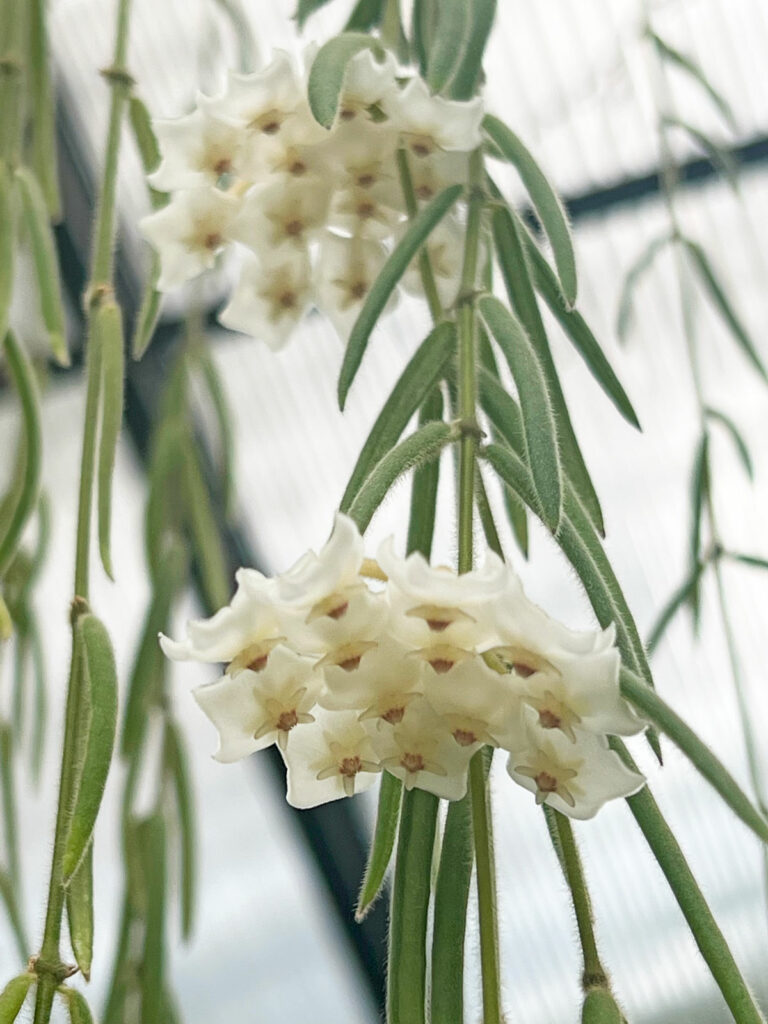
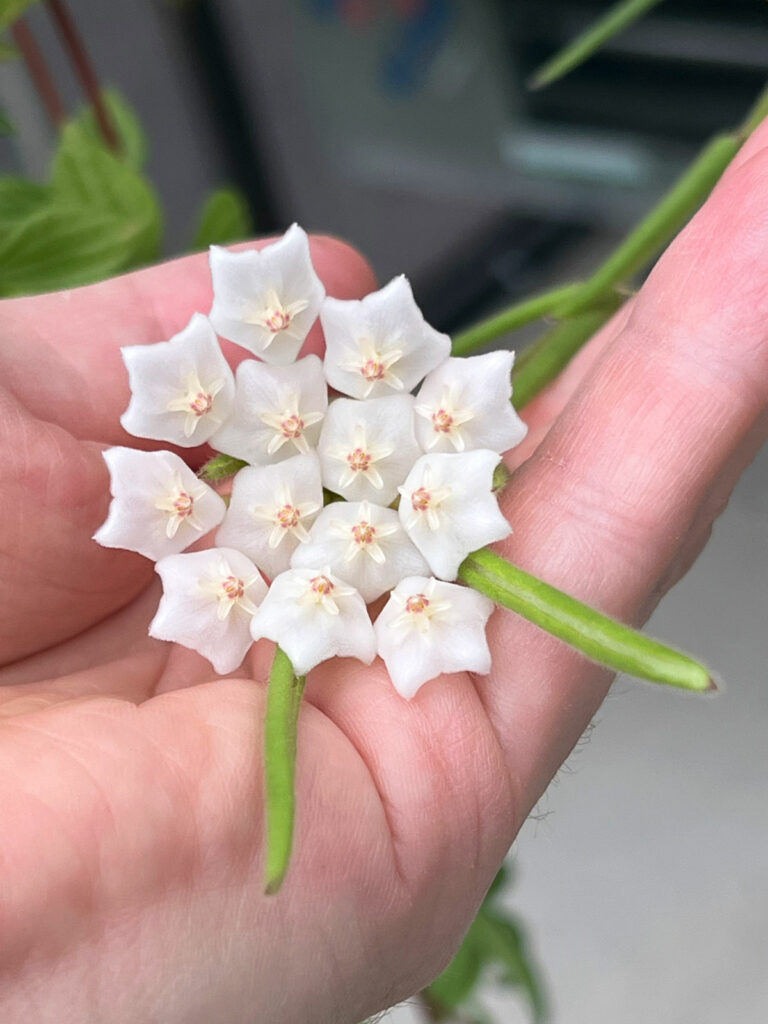
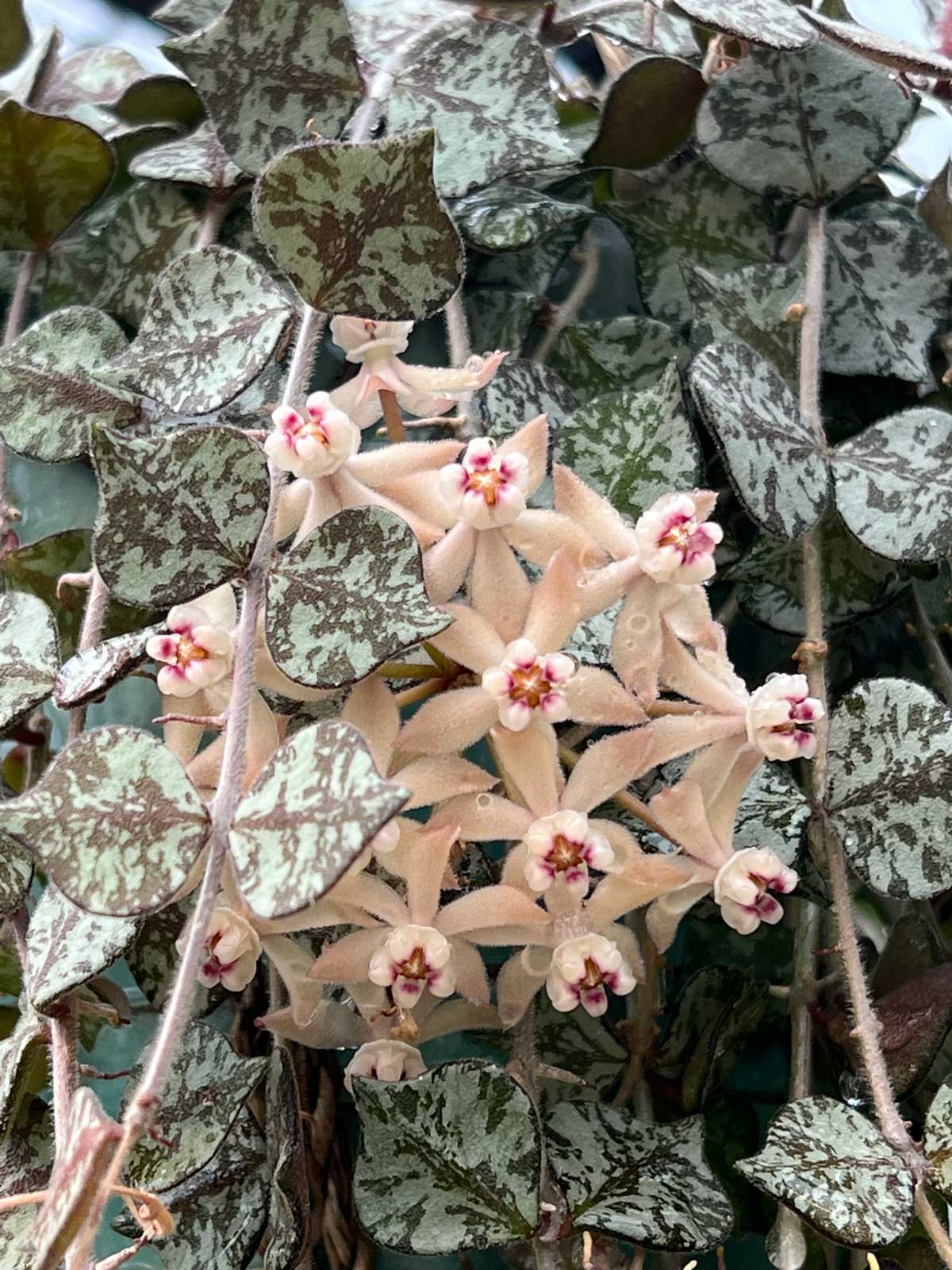
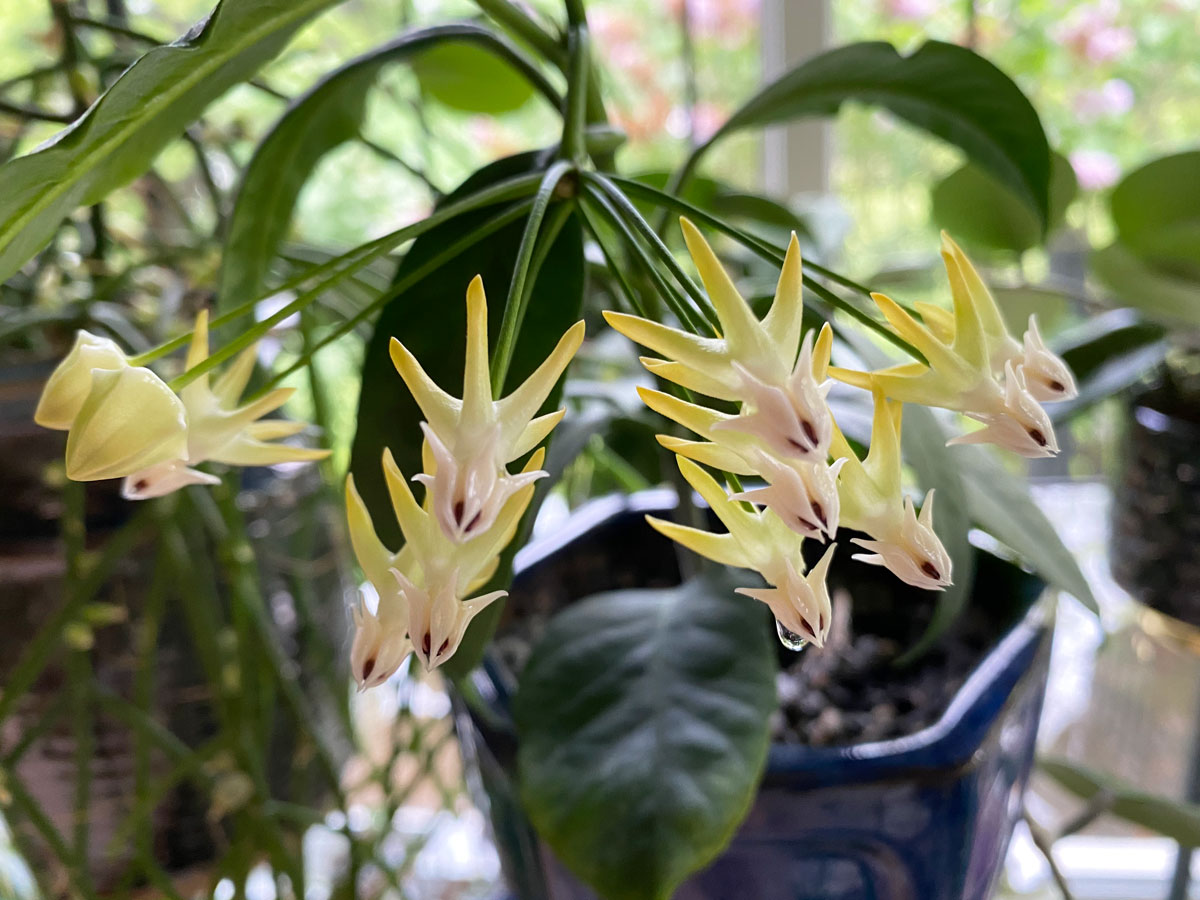
Clusters of fragrant, start shaped flowers, characteristic of many Hoyas appear typically in late summer or Autumn and can easily last at least 2 weeks.
Here are two photos of my Hoya linearis flowering.
The flowers have a wonderfully sweet fragrance, and remind me a little of cinnamon with a touch of lemon.
What are some factors that encourage blooming?
Enough light is the top concern.
Age (you must have a mature plant that is at least 2-3 years old)
Root bound conditions often encourage Hoyas to bloom.
A dry rest period of a few weeks will often help trigger flowering.
I can tell you from personal experience that providing enough light is the number 1 reason why Hoyas don't flower.
My linearis didn't bloom indoors for years simply because I didn't have it in a location with enough light. Once I moved it into my greenhouse, it rewarded me with plentiful blooms.
HOYA LINEARIS PROPAGATION
I've known people to propagate these plants in water. You can certainly do so, but let me discuss what the International Hoya Association recommends for Hoya propagation.
Take stem cuttings and ensure that each cutting has 2 or 3 nodes (where the leaf meets the stem).
Remove the leaf from at least one of the lowest nodes.
Dip the end into a rooting hormone, and insert each cutting into a pot. The IHA recommends using soilless mixture to which you add 30-40% perlite.
Water the soil and make sure it drains. Don't allow the soil to dry completely. Conversely, don't let the pot sit in standing water.
If you are able to increase humidity while the plant is rooting, this can be very beneficial. You can place the pot in a clear plastic bag to increase humidity. Keep it out of direct sunlight though while it is rooting so that you don't cook your cuttings!
The clear plastic bag can help you keep humidity high while it is rooting, but these plants also like to generally grow in higher humidity.
I wrote a blog post on the topic of humidity and I also talk about my favorite humidifier. I've tested many humidifiers and this one is by far my favorite!
To check it out, be sure to read my humidity blog post. This is especially important during the winter months when dry air can be big issue!
If you are more of a visual person, be sure not to miss my Hoya linearis propagation blog post where I visually show the entire process step-by-step with photos.
HOYA LINEARIS FAQ
Why is my plant dropping leaves?
Cold drafts can often cause this, as can keeping your plant too dry for extended periods of time.
Why is there a large distance between leaves?
This is simply due to insufficient light. My own plant currently grows right under a skylight. After it had reached a few feet long, the internodes (distance between leaves) was larger. This is simply because the base of the plant was not receiving as much light as the top of the plant.
Are Hoyas toxic?
Hoyas are considered non-toxic, but Hoya linearis has a white, milky sap that it exudes when you cut or break a leaf or stem. This sap can irritate your skin.
Why is my plant not blooming?
There are multiple factors that influence blooming. The top reason is light. You can also encourage blooming by keeping your plant pot bound and introducing a dry period of a few weeks right before the blooming season.
Why are my leaves shriveled?
This is likely due to improper soil moisture. Feel your potting mix. Is it bone dry? If so, this likely caused your plant to develop shriveled leaves, so go ahead and water.
If your potting mix has stayed wet for a long time (due to sitting in water, or other reasons), it may have started to rot. Check out the root system, and if you detect root rot, it is probably best to start propagating your plant and start out fresh again so you can save your plant.
What do I do if I see mealy bugs on my plant?
I like to use a good insecticidal soap to eradicate mealybugs. Be sure to spray the entire plant down entirely and repeat weekly. You should repeat even AFTER you don't notice mealybugs anymore for a week or two. This will ensure that you took care of all of them. Check out my post on treating for mealybugs for all the details.
Do you grow Hoya linearis? Share your comments or questions below! I'd love to hear from you. Interested in other Hoyas? Be sure not to miss my other posts on:
Hi Raffaele, I read your post on Hoya Linearis and found it very informative and interesting. I wanted to ask you if you think a good solution for the soil could be bonsai soil, thanks!
Hi Rossella! Yes, that would be an interesting option and could work well as long as you can maintain the moisture requirements of your plant. If you're switching substrates, always keep an eye on it and adjust your watering as needed. 🙂
Hi there! I just read your blog on the linearis and follow you on IG, love all your content!
When I bought my hoya it was pretty long ( maybe about 2’ over the 8” HB) so I can’t take all the credit. I’ve had it for about 8 months or so, it’s now about 4’ hanging over. The growth has been fine and I haven’t seen any pests. But, there are strands that are discolored that I wonder about. Not the vines themselves but the leaves have yellow splotches on them. Nothing I’ve seen before. Any ideas? Can’t upload a picture, I know that makes it difficult to diagnose
Glad you enjoy my content Kat! :-). Have you perhaps let your soil dry out for too long? This could cause that. Another thing I can think of is this. I'm not sure where you live, but I live in a cold/dark winter area and less light can also cause some plants to shed some leaves. Just a couple things to think about while you diagnose your situation. I hope this helps!
Thank you for sharing! I am always interested in earning more about Hoyas. I have several of the Hoya species and really appreciate learning something new.
I received this as a gift to myself haha yes.
It started growing really well.
Now it's just died off (the new growth).
Looked flattened.
I don't really know what that means?
I've wanted to repot it since I don't like the medium she used for it.
Nothing against her, she is a nice girl.
I've just heard it's not good to do that often.
It's been tough seeing what I had to cut off.
Please help? ? If possible. Anticipating hearing back
I’ve had my plant over 4 years it’s over 4ft in length and flowers twice a year, thank you for all the information you have provided. I live in the southwest of England UK
Hi Teresa. Wow, that's great!! The comments here don't allow photos unfortunately, just text. If you were meaning to share the photo with me, you'd have to use the contact form on my website to email me. When I reply back by email, you can then attach your photo(s).
Hey there! I'm thinking of buying one of these to hang in a south facing window but I'm worried it will be too bright. The window isn't massive and I live in Scotland, so it's not exactly like it will be getting full sunshine most days. It will also sit in front the window blind so I will be able to give it shade if needed. Do you think these light conditions will be suitable, or shall I look for something that likes full sun? Thanks!
Hi Karena! You will probably be fine in Scotland! Direct sun, especially in the darker months, will be perfectly fine and actually beneficial! You may want to filter things a bit maybe during the summer months if necessary. I'd say you're good to go! Like you mentioned, you can always your your blinds to diffuse the light if there is a lot of direct sun coming in.
@Karena, I have 2 of these plants in very bright rooms in cornwall, they get diret sun for some of the day via a skylight and they are doing brilliantly, they are one of my favourite house plants
Mine is under a skylight as well and it is very happy there. Similar conditions to what you're describing. It has really grown a lot this year!
Would this be likely to do well in a fairly big terrarium where the humidity is around 70-80%? It's also warm in the terrarium, close to 90F at the top, and maybe 10 degrees cooler at the bottom, there's about 30" of space between the top and bottom.
Someone local has some for sale, but I'd like to plant it on cork bark in the terrarium and grow it more like it grows naturally, if you think the conditions won't just melt the poor thing.
Hi Karen! It's hard to say....but Hoya linearis grows in higher altitudes and grows in cooler temps compared to other Hoyas. The high humidity is great, but continual 80-90F range may be too hot. You can always get the plant, propagate a small piece and place it in the terrarium to see how it does, and keep the original plant somewhere else. That way if the terrarium cooks it, it's no big loss! 🙂
I propagate my Hoya linearis by cuttings, rooted in water. Or by stemcuts with 2 leaves directly in soil. It works very well. My hoya grows very fast, so I can share a lot of plants... thanks for your growing tips! It’s true what you say, by placing cuttings with the motherplant, you can get a nice, full plant with beautifull flowers.
Thank you for the article. It was super interesting and helpful to read. Whenever I propagate my hoya linearis, I get lots of white mold on the leaves and they shriveled up. The soil is kept moist. Do you have any suggestions on how to stop the mold from forming and the stems from shriveling?
Hi Kelly, can you please send me photos showing your plant? Are you maybe confusing the "mold" with mealy bugs perhaps? Hoyas are prone to mealy bugs. If you send me some photos, I will be able to tell you. Also, these plants should dry out in between watering. I wouldn't keep them moist all the time.
Thank you for writing such an informative article. I purchased one off E bay and its tiny. Hoping it will stay healthy and thrive. Your article answered a few questions I had about this beautiful Hoya. Thanks again. ~~
It's really personal preference! All will work, but keep in mind that pots like terra cotta will dry out much more quickly than plastic or glazed pots.
Thank you for a fantastic article! I just picked up an inexpensive H. linearis and wanted to make sure that it would like similar conditions to my other hoyas. The plant came in a huge pot that weighed about 8 lbs since it was so saturated in water. They had it in a huge pot and soil that was mostly peat.





Hi Raffaele, I read your post on Hoya Linearis and found it very informative and interesting. I wanted to ask you if you think a good solution for the soil could be bonsai soil, thanks!
Hi Rossella! Yes, that would be an interesting option and could work well as long as you can maintain the moisture requirements of your plant. If you're switching substrates, always keep an eye on it and adjust your watering as needed. 🙂
Hi there! I just read your blog on the linearis and follow you on IG, love all your content!
When I bought my hoya it was pretty long ( maybe about 2’ over the 8” HB) so I can’t take all the credit. I’ve had it for about 8 months or so, it’s now about 4’ hanging over. The growth has been fine and I haven’t seen any pests. But, there are strands that are discolored that I wonder about. Not the vines themselves but the leaves have yellow splotches on them. Nothing I’ve seen before. Any ideas? Can’t upload a picture, I know that makes it difficult to diagnose
Glad you enjoy my content Kat! :-). Have you perhaps let your soil dry out for too long? This could cause that. Another thing I can think of is this. I'm not sure where you live, but I live in a cold/dark winter area and less light can also cause some plants to shed some leaves. Just a couple things to think about while you diagnose your situation. I hope this helps!
Thank you for sharing! I am always interested in earning more about Hoyas. I have several of the Hoya species and really appreciate learning something new.
You're very welcome Chris!
I received this as a gift to myself haha yes.
It started growing really well.
Now it's just died off (the new growth).
Looked flattened.
I don't really know what that means?
I've wanted to repot it since I don't like the medium she used for it.
Nothing against her, she is a nice girl.
I've just heard it's not good to do that often.
It's been tough seeing what I had to cut off.
Please help? ? If possible. Anticipating hearing back
Have you done anything differently from what I described in the post?
Mine is flowering! Thank you for your advice.
That's great! Enjoy!
I’ve had my plant over 4 years it’s over 4ft in length and flowers twice a year, thank you for all the information you have provided. I live in the southwest of England UK
You're very welcome Gillian! Sounds like your plant is very happy!
can't figure out how to link mypic of my liniares...about 20 plus blooms coming
Hi Teresa. Wow, that's great!! The comments here don't allow photos unfortunately, just text. If you were meaning to share the photo with me, you'd have to use the contact form on my website to email me. When I reply back by email, you can then attach your photo(s).
I just bought a cutting and I have a question, ¿can I put it in water for propagation? I live in the Caribbean, Puerto Rico.
Yes it should easily root in water 🙂
Hey there! I'm thinking of buying one of these to hang in a south facing window but I'm worried it will be too bright. The window isn't massive and I live in Scotland, so it's not exactly like it will be getting full sunshine most days. It will also sit in front the window blind so I will be able to give it shade if needed. Do you think these light conditions will be suitable, or shall I look for something that likes full sun? Thanks!
Hi Karena! You will probably be fine in Scotland! Direct sun, especially in the darker months, will be perfectly fine and actually beneficial! You may want to filter things a bit maybe during the summer months if necessary. I'd say you're good to go! Like you mentioned, you can always your your blinds to diffuse the light if there is a lot of direct sun coming in.
@Raffaele, brilliant, thank you. My new plant friend is on its way!
@Karena, I have 2 of these plants in very bright rooms in cornwall, they get diret sun for some of the day via a skylight and they are doing brilliantly, they are one of my favourite house plants
Mine is under a skylight as well and it is very happy there. Similar conditions to what you're describing. It has really grown a lot this year!
Would this be likely to do well in a fairly big terrarium where the humidity is around 70-80%? It's also warm in the terrarium, close to 90F at the top, and maybe 10 degrees cooler at the bottom, there's about 30" of space between the top and bottom.
Someone local has some for sale, but I'd like to plant it on cork bark in the terrarium and grow it more like it grows naturally, if you think the conditions won't just melt the poor thing.
Hi Karen! It's hard to say....but Hoya linearis grows in higher altitudes and grows in cooler temps compared to other Hoyas. The high humidity is great, but continual 80-90F range may be too hot. You can always get the plant, propagate a small piece and place it in the terrarium to see how it does, and keep the original plant somewhere else. That way if the terrarium cooks it, it's no big loss! 🙂
I propagate my Hoya linearis by cuttings, rooted in water. Or by stemcuts with 2 leaves directly in soil. It works very well. My hoya grows very fast, so I can share a lot of plants... thanks for your growing tips! It’s true what you say, by placing cuttings with the motherplant, you can get a nice, full plant with beautifull flowers.
That's great Tine! They have quickly become one of my favorite plants! I'm glad you are enjoying my growing tips 🙂
Thank you for the article. It was super interesting and helpful to read. Whenever I propagate my hoya linearis, I get lots of white mold on the leaves and they shriveled up. The soil is kept moist. Do you have any suggestions on how to stop the mold from forming and the stems from shriveling?
Hi Kelly, can you please send me photos showing your plant? Are you maybe confusing the "mold" with mealy bugs perhaps? Hoyas are prone to mealy bugs. If you send me some photos, I will be able to tell you. Also, these plants should dry out in between watering. I wouldn't keep them moist all the time.
Thank you for writing such an informative article. I purchased one off E bay and its tiny. Hoping it will stay healthy and thrive. Your article answered a few questions I had about this beautiful Hoya. Thanks again. ~~
You're very welcome! Thanks for taking the time to comment and good luck with your linearis! 🙂
I just received my 1st hoya linearis, it has VERY TINY white bumps on the end of most strands, are these the beginning of blooms?
Hi Leslie! It is hard to say without looking at a photo. If you can send me a photo, I can maybe better help you.
What type of pot is best. Plastic or other?
It's really personal preference! All will work, but keep in mind that pots like terra cotta will dry out much more quickly than plastic or glazed pots.
Thank you for a fantastic article! I just picked up an inexpensive H. linearis and wanted to make sure that it would like similar conditions to my other hoyas. The plant came in a huge pot that weighed about 8 lbs since it was so saturated in water. They had it in a huge pot and soil that was mostly peat.
Hi Rebecca! Wow, that sounds like a huge one! Good luck! Hopefully it has dried out by now for you. It's best if they're shipped a bit drier.