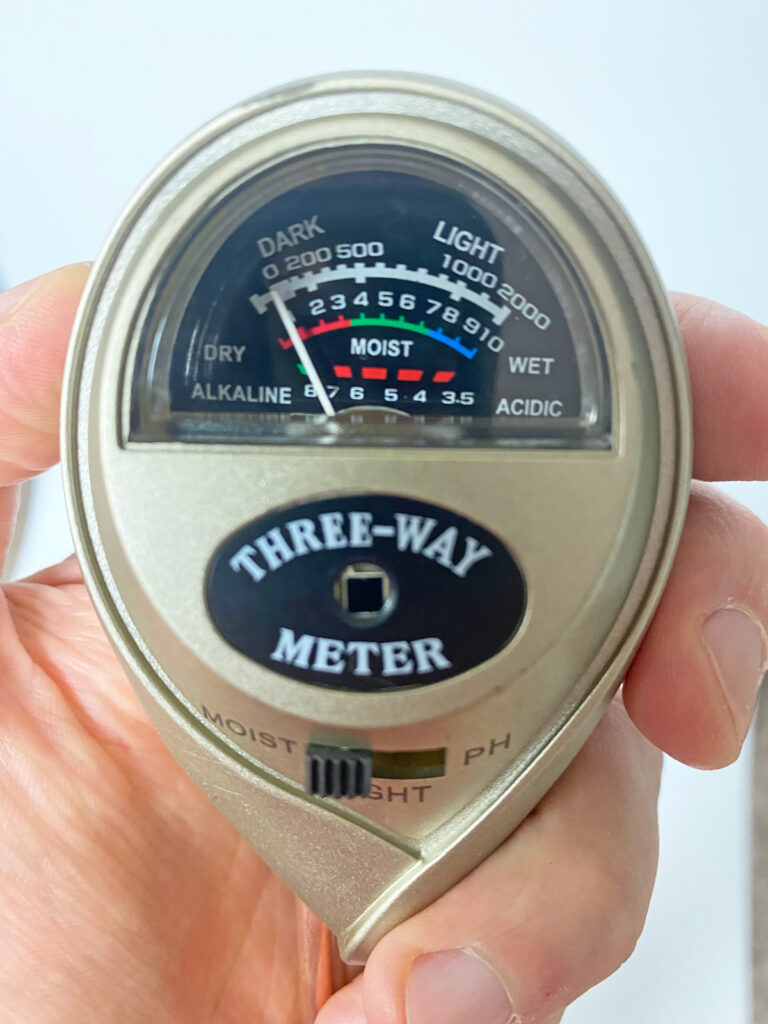
Should you be using a soil moisture meter for your houseplants? After so many people using these instruments came to me complaining about their plants dying, I wanted to give you my thoughts on using moisture meters for houseplants.
I have 3 main reasons not to use soil moisture meters, and 3 things that you can do instead of using these instruments.
Would you like to save this post?
Enter your email, and I will send this link straight to you!
I could easily include an affiliate link and try to get you to buy various moisture meters, but I'm not going to do that. Why?
Because I would not promote something that I don't believe in and that doesn't work. Period. My reputation is worth more to me than that, and I would be doing a disservice to my readers!
Soil moisture meters are not only unnecessary, but they can also be very dangerous to your indoor plants!
Countless people have messaged me, both through my blog and my Instagram site (@ohiotropics), that were using moisture meters with disastrous results.
Yet they trusted them and thought that they were doing the right thing, despite their plants drooping from dehydration.
Let me give you one example of one particular case that illustrates my point very well. I wanted to share this example and then tell you what you should be doing instead of using a soil moisture meter.
The question came from a friend:
"Do you have any suggestions as to how to keep these plants from dying? I use a water meter and they haven't needed to water them for months."
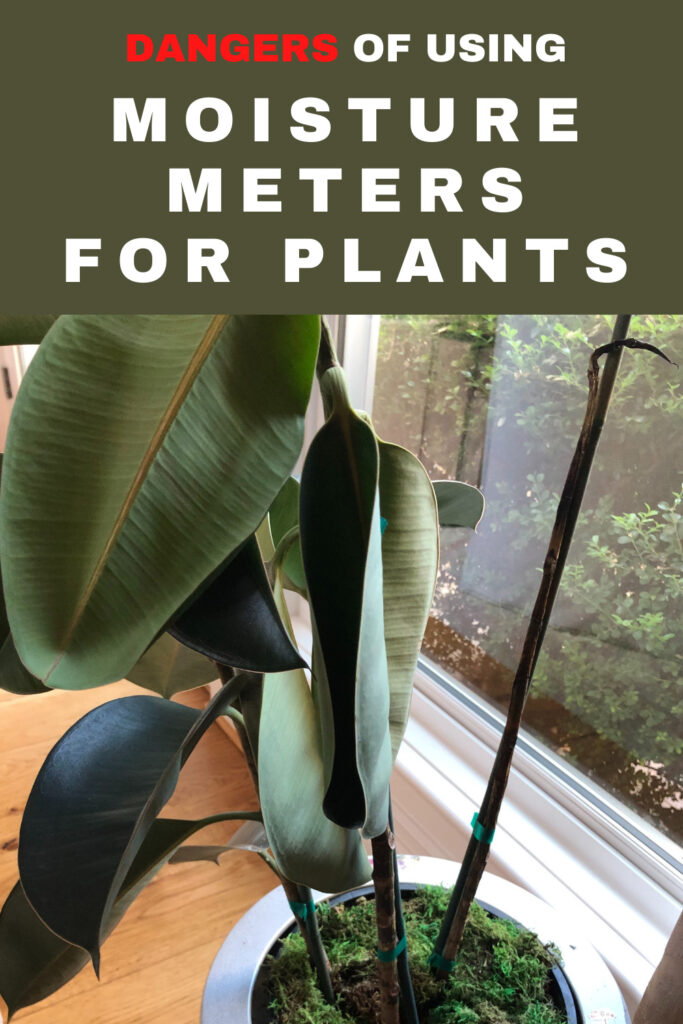
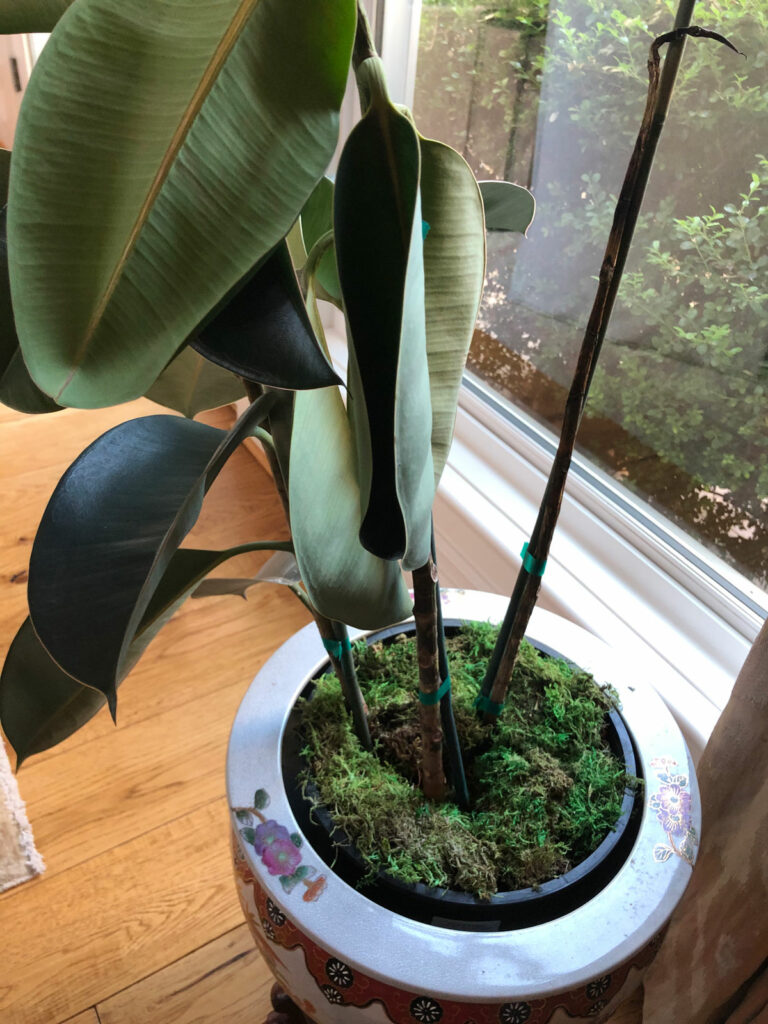
For months! Take a look at her poor rubber plant below. It is severely dehydrated and one of the trunks appears to be completely defoliated.
A Ficus elastica that has suffered from its owner relying on a moisture meter
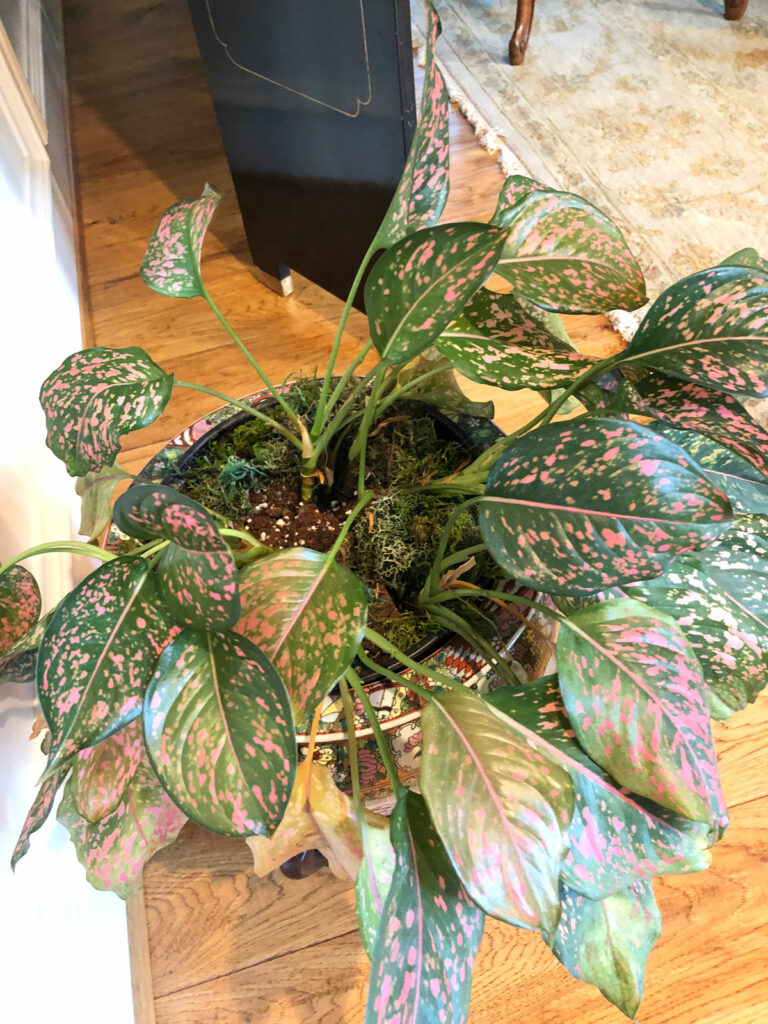
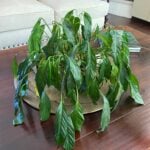
And her Aglaonema doesn't look like it suffered quite as badly, but the plant has collapsed and and is very dehydrated.
A dehydrated Aglaonema resulting from using a moisture meter.
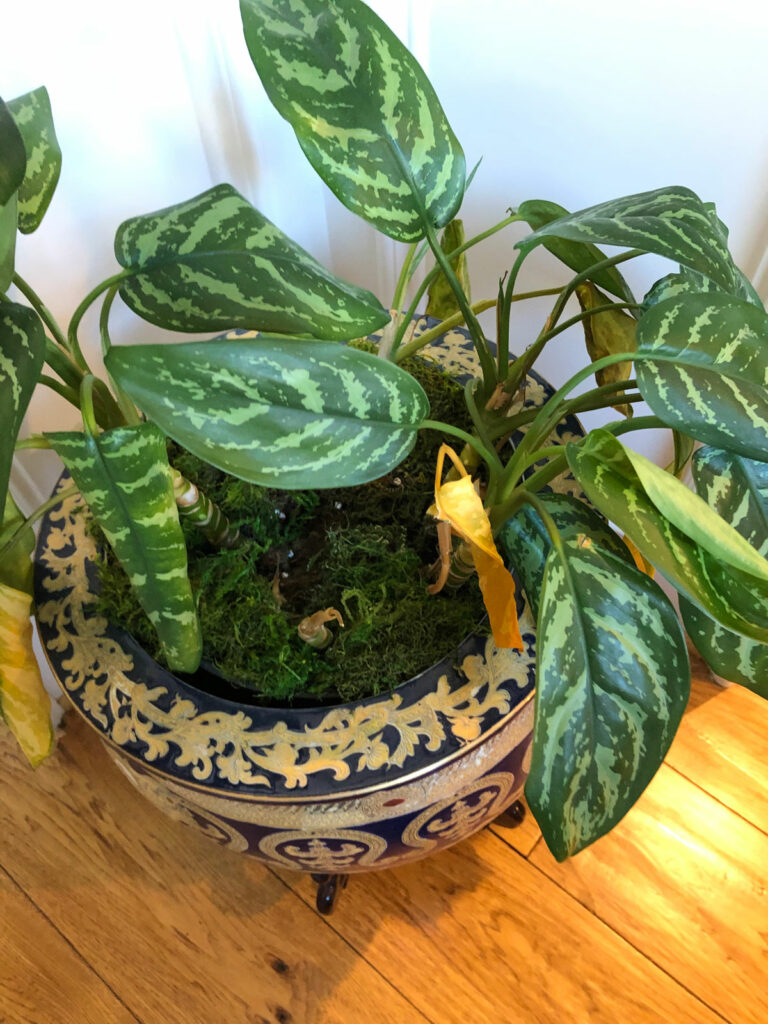
Lastly, here is another Aglaonema that suffered from using a moisture meter.
Table of Contents
Why You Shouldn't Use a Soil Moisture Meter for Indoor Plants
1. They don't measure water content
Shockingly enough, they don't actually measure water content!
They measure (or try to measure) conductivity. While water is a good conductor of electricity, it is not the only factor.
Depending on the composition of the soil you have, as well as the presence of various fertilizer salts that are present, you can get very different and very misleading results.
Even if it you use tap water that has is very hard, over time, minerals can build up in the soil and your moisture meter will give false readings.
If you have a very porous, chunky mix with a lot of air, such as orchid bark mixes, it will yield very awful, misleading readings.
2. Most are junk and you can't calibrate them
Most of the soil moisture meters available on the market are just plain junk. They're not even worth the few dollars that you spend on them.
We've all seen them in nurseries and hardware stores. Don't be tempted to buy one. Most of them will give you false readings that you simply can't trust.
They may work initially when brand new (maybe), but they won't withstand frequent use. Besides, any good piece of measuring equipment will need to be calibrated.
The simple fact that you can't calibrate them against a known standard is troublesome. But what would you expect from something that only costs a few dollars?
3. It drives the wrong behavior
There are many factors that go into houseplant care, and using a moisture meter takes the thinking out of plant care and this can be very dangerous.
"My soil moisture meter tells me that it doesn't need anymore water." I've heard this so many times.
If your meter indicates "wet" and your soil is actually dry to the touch, you would likely be inclined to ignore your plant for a while because the meter told you so. When in fact the soil is dry and probably needs to be watered NOW!
Even if you do get a decent moisture meter, you'll be paying a lot more money for something that that will be adding a lot of unnecessary work and that still may not be that accurate.
So what should you use instead?
How to Judge Soil Moisture for Indoor Plants
I'll recommend 3 ways that you can check soil moisture for your plants.
1. Use your finger to feel the soil
Sorry to disappoint you, but no gadget is required for this one! A good rule of thumb in general is to wait to water until the top inch or so (more for big pots) is dry before watering again.
Simply stick your finger into the soil and feel it. Does it feel dry to the touch? If so you may need to water. Is it still slightly moist and maybe some soil is sticking to your fingers? Time to hold off watering.
This is an oversimplification though but is a good rule of thumb in most cases! Soil moisture requirements vary depending on what plant you have.
Some plants like ferns hate to dry out much at all, while succulents and some others like to dry out completely in between watering.
For most tropical foliage plants, this rule of thumb (pun intended!) works quite well. Though I tend to use my forefinger and not my thumb...
You'll also want to visually look at the soil too. Does it look dry? Is it maybe lighter in color? Over time, you will be able to visually judge soil moisture by the color of the soil.
But use both your sense of touch and sight though to be sure.
In one case, I misjudged soil moisture because I only felt it with my finger, but the plant was placed too high to actually see if the soil is dry.
I did that once with my lipstick plant. It was hanging high up and I would reach to feel it. It felt a little cool, but I misjudged it since I couldn't see the soil. So I kept putting off the watering.
After realizing that I hadn't watered it in a while, the lower leaves were yellowing so I took the plant down. I could visually see that the plant was bone dry, so I promptly gave it a thorough watering.
If you don't trust yourself, you can use the next method.
2. Use a chopstick
Take a plain old bamboo chopstick and insert it into your soil at least a couple inches deep.
Leave the chopstick there for 10-15 minutes.
Take the chopstick out and evaluate the color. If the part of the chopstick that was in the soil has darkened, it means it has absorbed water and you should wait to water again.
If there is no color change at all, you'll probably want to water at that time.
You can also feel the soil with your finger as reassurance if you're not sure.
3. Lift the pot
Another way to help you judge if your plant needs to be watered is to lift the pot.
You can learn to judge if your plant needs to be watered by picking up your plant and feeling the weight of the pot.
After you water your plant, pick up the pot and see how heavy it feels. Periodically lift your plant after a few days. If the soil has gone bone dry, it will feel substantially lighter. Especially if it is in a lightweight plastic pot.
Closing Comments on Watering Houseplants
Ditch the moisture meter.
Use your senses to judge soil moisture. Feel the soil, look at the color of the soil, lift your pot, or use the chopstick method. Figure out what works for you.
Overtime, the longer you grow plants, you will develop a good instinct and it will become second nature.
Commonly Asked Questions About Moisture Meters
Can moisture meters be wrong?
Like any instrument, quality can vary drastically. Low-end, inexpensive moisture meters are notoriously unreliable. Higher end devices can be helpful, but in the majority of cases, aren't worth the expense and trouble.
Should you use a moisture meter?
I strongly advise against using them for your houseplants. I've seen too many people kill their plants by relying on a moisture meter. Use the other methods described in this post as an alternative.
Are cheap moisture meters any good?
No, they are notoriously inaccurate and should not be relied upon to judge soil moisture for your plants.
If you enjoyed this post, there is of course much more to houseplant care. It is important to know not only when to water, but HOW to water. You may enjoy the following blog posts that I wrote on watering topics:
If you don't get watering quite right, it can result in a variety of symptoms. Here are two super-helpful blog posts that will help you troubleshoot your plant problems that are related to improper watering:
Thank you for this post, it is very clear and I think just what I needed to hear. I would like to ask your advice on an issue I currently have with a ficus binnendijkii (quite a large tree) that I bought about 2,5 months ago. It kept losing leaves and after 1,5 months I bought a moisture meter to see if it was due to the wetness of the earth. It showed me the moisture level was far beyond the 10 and that's why I cut the tree off from watering. The water level didn't go down for weeks, even when I took the tree out of the pot to try to let the soil dry through air exposure. So finally I decided I had to get rid of the wet earth in order to stop the roots from rotting. I now put the tree in a completely new batch of soil, didn't water it in any way and the moisture meter is still telling me it's at moisture level 10. That's when I started to seriously doubt if it was giving me the correct moisture level. And that's also why I found this post on your website. As my ficus hasn't gotten any water now in a month I suppose I've been fooled by the meter and should start watering it immediately? Thanks in advance!
Hi Tim! Did you feel the soil with your finger? I would definitely ditch the moisture meter and use your finger to evaluate the soil moisture. Depend on how big your pot is, I'd let at least the top inch dry out before watering again. It sounds like it may be quite a big pot though, so maybe allow the top 2-3 inches, if not a little more, dry out before watering. Hope this helps a bit.
There are a whole lot of reasons why plants, even the same plant dries out, or stays moist longer. The biggest culprit is the pot itself. Pot material, drainage and depth all play a part and you should change your watering habits accordingly. Soil is also a big factor in how often to water, some soil materials hold water longer than others. Plants themselves have different watering habits. The key to success is educating yourself about how different pots, plants, locations and soil actually can impact your plants health.
How do you recommend checking the soil for very crowded and fragile plants? Like string of turtles, string of hearts, piccalo bando, or crowded succulent plants? It's hard to put your finger in the soil because there is no room to do so and also the plant is very fragile. Even putting a chopstick in would make me nervous to damage the plant in some cases. Thank you!
In that case, I would recommend trying to judge the soil moisture by lifting up the pot and determining how light/heavy it is. I know it can be subjective, but it's definitely a viable option! If they're very root bound, you may consider repotting them though.
Hi Raffaele! We've messaged back and forth a few times on Instagram and I so appreciate your help with my plants. I purchased Bonsai Jack gritty mix and switched ALLLLL of my succulents and cacti over to it (from regular succulent soil containing soil) Well, I have found out that they dry out so very quickly and I feel like I am watering them a few times a week. They dry out so quickly. Can you please tell me if this is the correct soil to put succulents in or what should I do? Thanks so much! Cindy
Hi Cindy! There are really a lot of different things that you can change to accomplish what you mentioned. Do you have your succulents in terra cotta pots? If you do, perhaps you can keep using the same gritty mix that you purchased, and then use plastic pots or glazed ceramic pots, for example, instead to conserve moisture. Or if you DON'T have your plants in terra cotta and the mix is drying out too fast still, maybe you need a more moisture retentive potting mix for your specific environment. Ideally, we want a mix that will give us enough moisture retention, but that will dry out in a reasonable amount of time (we don't want it to dry out too soon otherwise you're watering very frequently, but at the same time, you don't want it to stay wet for too long). You can try using regular succulent soil to which you can add a little pumice in it. That's normally what I do. But the type of pot makes a big difference as well, like I mentioned earlier. I hope this helps a bit and gives you things to consider! I talk about all the factors that affect how quickly soil dries out in my book Houseplant Warrior: https://www.ohiotropics.com/houseplant-warrior/
Very helpful advice. Do you have any thoughts on watering bonsai? I have a new gardenia bonsai and want to avoid missteps. I do have experience with several types of bonsai, but inside the house in SW Virginia with a gardenia that is getting ready to bloom? I am keeping the moisture level by placing my plant near others and on a shallow tray of pebbles in watwe.
Do you think that these plants need a period of rest after blooming: as in fall temps and winter shelter indoors? How about light?
Hi Carol! Gardenias can be very finicky indoors. Just be careful not to let them get too dry otherwise they will pout. They're also prone to spider mites indoors so keep an eye on them. You're doing a good thing placing them on moist pebbles to increasing humidity. They don't need a rest period. Try and provide as much sun as you can while they're indoors.
I just stumbled on this article while searching for the best soil meter. I’m so glad I did! You saved me 15 bucks! I am currently battling fungus gnats and as a last resort, I’ve put a layer of gravel on top of the soil in all my plants. But now I don’t have visual or finger access to the soil which is driving me nuts. Will the chopstick method alone be sufficient? With some of my plants I am able to tell by their weight but some I can’t pick up because they are too heavy. It seems like every solution I try for the fungus gnats leads to another problem!
I am new to all of this and after purchasing a Musa dwarf cavendish and 2 x Calathea plants yesterday, I ordered a moisture meter in an attempt at watering them as they need, but after reading your blog, I have since canceled the order. After reading the comments, I hope my plants will adjust nicely to the conditions in my living room (and not die). I have kept them all in their nursery pots whilst I figure out which decorative pots I can put them in that will keep them happy but also look nice. Feeling both very nervous and excited about owning living plants (i usually opt for artificial). I hope I will learn quickly how to make these plant babies thrive. Thank you for your informative and very helpful blog.
Hi Virginia! I'm glad you enjoyed this post, and you did the right thing by canceling that order! Good luck with your plants :-). I would also recommend getting some less finicky plants as well. There are a lot...ZZ Plant, Pothos, various Philodendron, Sansevieria (now reclassified as Dracaena). Don't be afraid to explore 🙂
I recently planted some azaleas and rhododendrons outside, and the soil that they came with were pretty compact, near impossible to stick my fingers into. Normally the solution would be to loosen the soil, but rhodos in general grow near the top of the soil, meaning it is very dangerous to do so. What do you recommend I do in order to properly test how moist the plants are?
So far, I did plant them in a space that's significantly wider than the pots themselves, which means that I can indeed my finger into the surrounding vicinity, but not the original potted soil mix itself. Would two inches deep in the surrounding soil be a good enough measure?
I regularly water once a day, or twice if it's visibly dry (because of the sun evaporating all the water). Thanks, and an e-mail would be helpful as I don't actively check.
Hi, so happy this came up in my google search on moisture meters! My question about the chopsticks is, would it work still if i left a chopstick in the soil at all times? And just pulled it out to check? Our should I stick to 10-15mins before checking? Im short on time sometimes (read awlays) and know im likely to forget 🙂 thanks!!
Glad you enjoyed the post Renae :-). I probably wouldn't leave it in there all the time otherwise it may give you misleading results. Honestly, I would just use your finger. It's quicker and easier and you'll get a better feel (literally) for it, and over time you'll learn to be able to tell very easily.
Raffaele,
I have ditched my moisture meter! Thank you for the wonderful advice! I am new to your blog and love your approach to gardening! Your kindness warms my heart and that means so much during these difficult times.
Just started having house plants. Saw you when looking up water meters, so glad I did. I have a new, large peace plant with 3 unopened flowers. Today I noticed brown Mark's on them and the leaves look like they might yellow. Have just had the plant 1 week. Have not repotted, but did put miracle grow sticks in the pot. Did the finger test and is still moist. We have large windows so I think its getting light. Any suggestions would be helpful. Thank you. You have a great sight.
Glad you are enjoying my site Joellen! Give your plant a little time to adjust since you've only had it a week. I'd make sure that it is not sitting in water. The important part for peace lilies is the potting mix moisture. They hate to go completely dry, but at the same time, don't let it sit in excess water. Always discard excess water from the saucer that it may be sitting in. Give it a little bit of time, and remembering that our home conditions are not as ideal as where the plant was previously growing in a greenhouse, so an adjustment period is expected. Many times this means a yellow leaf or two, despite our best efforts, but the situation should stabilize as your plant becomes accustomed to your home. Hope this helps!
Moisture meters should come with a WARNING. I have relied on this to tell me when to water my plants and they have deteriorated to the point of near death because the meter told me they were moist. I had noticed the soil pulling away from the sides of the pot but trusted this silly meter to be correct. Today after reading your information I have given them all a good watering. Maybe I have only lost one of my Ficus plants but I’m hoping I have watered the rest in time. I am watching to make sure there is water filtering right down through the pot until it comes out the drains holes in the bottom. However I’m not sure what to do with the self-watering pots as they don’t have drain holes. The water collects into a cavity in the bottom of the pot. How can I judge if these ones have had enough water (or too much)? Your help would be appreciated.
Hi Tanya! Your experience is exactly why I don't recommend moisture meters :-). It is far better and safer to just use your finger. As far as self watering pots, you just have to maintain the indicated water level and that's it. The key for self watering pots though is to make sure that you use a more open potting mix and not one that is too dense, otherwise you will be suffocating the roots. I've used equal parts all-purpose potting mix, perlite, and vermiculite in the past with good success. These pots are great for moisture loving plants like ferns. Hope this helps!
Question: how to measure moisture when you have a big plant? I mean if I put my finger in soil and top couple inches is dry but the bottom or middle part may not be then I will be over water the plant. That’s the only reason I purchased the moisture meter. Please advise thank you
Hi Chloe! That is a great question, and often something that is misunderstood. If you let the top couple inches of your soil dry out, there should be no concern at all with "overwatering." Assuming you have your plant in good light, have a decently draining soil, and your plant is not overpotted (in a pot that is too big for its root system), you shouldn't have anything to worry about. Does this help?
I a have been depending on my moisture meter too much. Thanks for the article. I believe they are incorrect most if the time after noticing the soil was wet when it said it was partially dry.
Hi Ann! You will see a big transformation in your plants once you stop relying on the moisture meter. I'm glad you enjoyed the article, and good luck! 🙂
This is just what I needed to hear. I had switched to using chopsticks but I wasn't leaving them in at all so this will be very helpful. Thanks so much, I feel so lucky to have come across this blog.




Hi Raffaele,
Thank you for this post, it is very clear and I think just what I needed to hear. I would like to ask your advice on an issue I currently have with a ficus binnendijkii (quite a large tree) that I bought about 2,5 months ago. It kept losing leaves and after 1,5 months I bought a moisture meter to see if it was due to the wetness of the earth. It showed me the moisture level was far beyond the 10 and that's why I cut the tree off from watering. The water level didn't go down for weeks, even when I took the tree out of the pot to try to let the soil dry through air exposure. So finally I decided I had to get rid of the wet earth in order to stop the roots from rotting. I now put the tree in a completely new batch of soil, didn't water it in any way and the moisture meter is still telling me it's at moisture level 10. That's when I started to seriously doubt if it was giving me the correct moisture level. And that's also why I found this post on your website. As my ficus hasn't gotten any water now in a month I suppose I've been fooled by the meter and should start watering it immediately? Thanks in advance!
Hi Tim! Did you feel the soil with your finger? I would definitely ditch the moisture meter and use your finger to evaluate the soil moisture. Depend on how big your pot is, I'd let at least the top inch dry out before watering again. It sounds like it may be quite a big pot though, so maybe allow the top 2-3 inches, if not a little more, dry out before watering. Hope this helps a bit.
There are a whole lot of reasons why plants, even the same plant dries out, or stays moist longer. The biggest culprit is the pot itself. Pot material, drainage and depth all play a part and you should change your watering habits accordingly. Soil is also a big factor in how often to water, some soil materials hold water longer than others. Plants themselves have different watering habits. The key to success is educating yourself about how different pots, plants, locations and soil actually can impact your plants health.
I agree 100% Robert!
How do you recommend checking the soil for very crowded and fragile plants? Like string of turtles, string of hearts, piccalo bando, or crowded succulent plants? It's hard to put your finger in the soil because there is no room to do so and also the plant is very fragile. Even putting a chopstick in would make me nervous to damage the plant in some cases. Thank you!
In that case, I would recommend trying to judge the soil moisture by lifting up the pot and determining how light/heavy it is. I know it can be subjective, but it's definitely a viable option! If they're very root bound, you may consider repotting them though.
Hi Raffaele! We've messaged back and forth a few times on Instagram and I so appreciate your help with my plants. I purchased Bonsai Jack gritty mix and switched ALLLLL of my succulents and cacti over to it (from regular succulent soil containing soil) Well, I have found out that they dry out so very quickly and I feel like I am watering them a few times a week. They dry out so quickly. Can you please tell me if this is the correct soil to put succulents in or what should I do? Thanks so much! Cindy
Hi Cindy! There are really a lot of different things that you can change to accomplish what you mentioned. Do you have your succulents in terra cotta pots? If you do, perhaps you can keep using the same gritty mix that you purchased, and then use plastic pots or glazed ceramic pots, for example, instead to conserve moisture. Or if you DON'T have your plants in terra cotta and the mix is drying out too fast still, maybe you need a more moisture retentive potting mix for your specific environment. Ideally, we want a mix that will give us enough moisture retention, but that will dry out in a reasonable amount of time (we don't want it to dry out too soon otherwise you're watering very frequently, but at the same time, you don't want it to stay wet for too long). You can try using regular succulent soil to which you can add a little pumice in it. That's normally what I do. But the type of pot makes a big difference as well, like I mentioned earlier. I hope this helps a bit and gives you things to consider! I talk about all the factors that affect how quickly soil dries out in my book Houseplant Warrior: https://www.ohiotropics.com/houseplant-warrior/
Very helpful advice. Do you have any thoughts on watering bonsai? I have a new gardenia bonsai and want to avoid missteps. I do have experience with several types of bonsai, but inside the house in SW Virginia with a gardenia that is getting ready to bloom? I am keeping the moisture level by placing my plant near others and on a shallow tray of pebbles in watwe.
Do you think that these plants need a period of rest after blooming: as in fall temps and winter shelter indoors? How about light?
Hi Carol! Gardenias can be very finicky indoors. Just be careful not to let them get too dry otherwise they will pout. They're also prone to spider mites indoors so keep an eye on them. You're doing a good thing placing them on moist pebbles to increasing humidity. They don't need a rest period. Try and provide as much sun as you can while they're indoors.
I just stumbled on this article while searching for the best soil meter. I’m so glad I did! You saved me 15 bucks! I am currently battling fungus gnats and as a last resort, I’ve put a layer of gravel on top of the soil in all my plants. But now I don’t have visual or finger access to the soil which is driving me nuts. Will the chopstick method alone be sufficient? With some of my plants I am able to tell by their weight but some I can’t pick up because they are too heavy. It seems like every solution I try for the fungus gnats leads to another problem!
You're very welcome Amy! I'll refer you to my fungus gnat blog post for treatment: https://www.ohiotropics.com/2021/01/31/killing-fungus-gnats-houseplants/
I am new to all of this and after purchasing a Musa dwarf cavendish and 2 x Calathea plants yesterday, I ordered a moisture meter in an attempt at watering them as they need, but after reading your blog, I have since canceled the order. After reading the comments, I hope my plants will adjust nicely to the conditions in my living room (and not die). I have kept them all in their nursery pots whilst I figure out which decorative pots I can put them in that will keep them happy but also look nice. Feeling both very nervous and excited about owning living plants (i usually opt for artificial). I hope I will learn quickly how to make these plant babies thrive. Thank you for your informative and very helpful blog.
Hi Virginia! I'm glad you enjoyed this post, and you did the right thing by canceling that order! Good luck with your plants :-). I would also recommend getting some less finicky plants as well. There are a lot...ZZ Plant, Pothos, various Philodendron, Sansevieria (now reclassified as Dracaena). Don't be afraid to explore 🙂
I recently planted some azaleas and rhododendrons outside, and the soil that they came with were pretty compact, near impossible to stick my fingers into. Normally the solution would be to loosen the soil, but rhodos in general grow near the top of the soil, meaning it is very dangerous to do so. What do you recommend I do in order to properly test how moist the plants are?
So far, I did plant them in a space that's significantly wider than the pots themselves, which means that I can indeed my finger into the surrounding vicinity, but not the original potted soil mix itself. Would two inches deep in the surrounding soil be a good enough measure?
I regularly water once a day, or twice if it's visibly dry (because of the sun evaporating all the water). Thanks, and an e-mail would be helpful as I don't actively check.
I just sent you an email John.
Hi, so happy this came up in my google search on moisture meters! My question about the chopsticks is, would it work still if i left a chopstick in the soil at all times? And just pulled it out to check? Our should I stick to 10-15mins before checking? Im short on time sometimes (read awlays) and know im likely to forget 🙂 thanks!!
Glad you enjoyed the post Renae :-). I probably wouldn't leave it in there all the time otherwise it may give you misleading results. Honestly, I would just use your finger. It's quicker and easier and you'll get a better feel (literally) for it, and over time you'll learn to be able to tell very easily.
Raffaele,
I have ditched my moisture meter! Thank you for the wonderful advice! I am new to your blog and love your approach to gardening! Your kindness warms my heart and that means so much during these difficult times.
Hi Lisa! I'm so happy that you're enjoying my blog! Thank you for your support!
Just started having house plants. Saw you when looking up water meters, so glad I did. I have a new, large peace plant with 3 unopened flowers. Today I noticed brown Mark's on them and the leaves look like they might yellow. Have just had the plant 1 week. Have not repotted, but did put miracle grow sticks in the pot. Did the finger test and is still moist. We have large windows so I think its getting light. Any suggestions would be helpful. Thank you. You have a great sight.
Glad you are enjoying my site Joellen! Give your plant a little time to adjust since you've only had it a week. I'd make sure that it is not sitting in water. The important part for peace lilies is the potting mix moisture. They hate to go completely dry, but at the same time, don't let it sit in excess water. Always discard excess water from the saucer that it may be sitting in. Give it a little bit of time, and remembering that our home conditions are not as ideal as where the plant was previously growing in a greenhouse, so an adjustment period is expected. Many times this means a yellow leaf or two, despite our best efforts, but the situation should stabilize as your plant becomes accustomed to your home. Hope this helps!
Moisture meters should come with a WARNING. I have relied on this to tell me when to water my plants and they have deteriorated to the point of near death because the meter told me they were moist. I had noticed the soil pulling away from the sides of the pot but trusted this silly meter to be correct. Today after reading your information I have given them all a good watering. Maybe I have only lost one of my Ficus plants but I’m hoping I have watered the rest in time. I am watching to make sure there is water filtering right down through the pot until it comes out the drains holes in the bottom. However I’m not sure what to do with the self-watering pots as they don’t have drain holes. The water collects into a cavity in the bottom of the pot. How can I judge if these ones have had enough water (or too much)? Your help would be appreciated.
Hi Tanya! Your experience is exactly why I don't recommend moisture meters :-). It is far better and safer to just use your finger. As far as self watering pots, you just have to maintain the indicated water level and that's it. The key for self watering pots though is to make sure that you use a more open potting mix and not one that is too dense, otherwise you will be suffocating the roots. I've used equal parts all-purpose potting mix, perlite, and vermiculite in the past with good success. These pots are great for moisture loving plants like ferns. Hope this helps!
Question: how to measure moisture when you have a big plant? I mean if I put my finger in soil and top couple inches is dry but the bottom or middle part may not be then I will be over water the plant. That’s the only reason I purchased the moisture meter. Please advise thank you
Hi Chloe! That is a great question, and often something that is misunderstood. If you let the top couple inches of your soil dry out, there should be no concern at all with "overwatering." Assuming you have your plant in good light, have a decently draining soil, and your plant is not overpotted (in a pot that is too big for its root system), you shouldn't have anything to worry about. Does this help?
I a have been depending on my moisture meter too much. Thanks for the article. I believe they are incorrect most if the time after noticing the soil was wet when it said it was partially dry.
Hi Ann! You will see a big transformation in your plants once you stop relying on the moisture meter. I'm glad you enjoyed the article, and good luck! 🙂
Super helpful! I was using moisture meters but stopped months ago after noticing they were inaccurate. It makes total sense too because, science!
They can be very dangerous and so many of them are just junk!
This is just what I needed to hear. I had switched to using chopsticks but I wasn't leaving them in at all so this will be very helpful. Thanks so much, I feel so lucky to have come across this blog.
Thanks Terri, I'm so happy that you are enjoying my blog!