
How to Fertilize Houseplants: And the 1 BEST Fertilizer!
Some of the links in this post may be affiliate links.
I continually get tons of questions on how to fertilize houseplants over the past months, so I've decided to write a comprehensive post on the topic. Fertilizing can be so confusing for the beginner houseplant lover, but I will make it easy for you, I promise!
You are probably wondering...When do I fertilize? Which fertilizer should I use? How often should I fertilize? Should I fertilize in the winter? What do the numbers on a fertilizer label mean?
The answers to this and MORE is up ahead, so keep reading! And I will present to you my absolute favorite fertilizer that I'm sticking with because it is so amazing and easy to use!
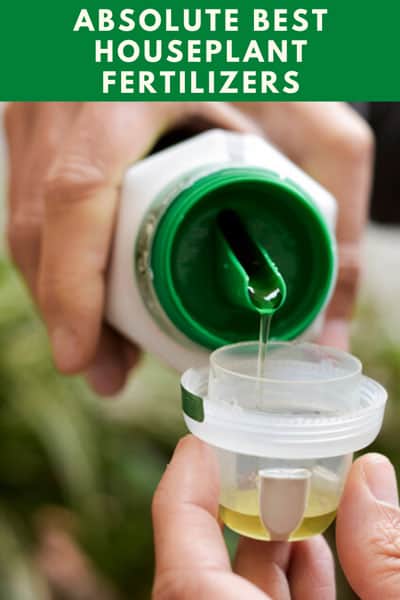
Would you like to save this post?
After reading this post, you should feel more empowered with basic fertilizer knowledge and know how and when to properly fertilize your houseplants.
Why Should You Fertilize Houseplants
In nature, plants constantly replenish their nutrients from decaying organic matter.
As leaves, branches, animal life, and other organic matter decompose, they'll slowly release and recycle their nutrients into the soil and make it available for plant growth.
In your houseplant pots, the soil can be quickly depleted of any nutrients rather quickly and it will be your job to fertilize.
Most houseplant potting mixes are "soilless" mixes using peat, so they intrinsically have little to no nutrient levels, and many have added fertilizer that will support plant growth for a few months.
Potting mixes like Miracle Gro Potting Mix are fabulous. This is one that I use very often. It already has some fertilizer mixed in and your plant will be good for up to 6 months, but after that, you'll need to fertilize regularly.
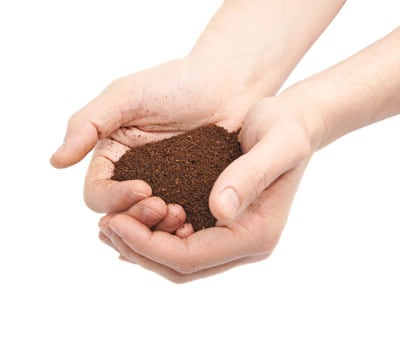
Fertilizing and soil chemistry is a very complicated topic, but this post will cover very basic knowledge that will be helpful for you and your houseplants.
Basic Fertilizer Information
When you look at a fertilizer label, you will see 3 numbers. For example, 10-10-10.
These represent the 3 primary nutrients that plants need to grow. Soil nutrients are classified based off of the amount that they are needed by plants.
The following list shows the most important plant nutrients in decreasing order of usage by plants:
Primary nutrients are needed in the largest quantity and these are Nitrogen (N), Phosphorus (P) and Potassium (K).
The 3 numbers on every fertilizer label is called the NPK ratio where N, P, and K represent the chemical symbols for those elements.
Historically though, the amount of "P" or phosphorus in fertilizers is expressed as phosphate (P2O5). And the amount of "K" or Potassium is expressed as potash (K2O). Just a bit of technical information.
If you don't understand, that's ok! Just move on (my background is in chemical engineering so it makes sense to me...but keep reading!)

Secondary nutrients are needed in smaller amounts, but are still important. These include Sulfur (S), Calcium (Ca), and Magnesium (Mg).
Micronutrients are only needed in very small amounts, but they are still very important. Micronutrients include Zinc (Zn), Iron (Fe), Copper (Cu), Manganese (Mn), Boron (B), Molybdenum (Mo), Chlorine (Cl).
In very simplistic terms, here is an explanation of NPK:
Nitrogen (chemical symbol N) is needed for growth of leaves.
Phosphorus (chemical symbol P) is important for flower and root development.
Potassium (chemical symbol K) helps to bolster disease resistance, cold tolerance and protection against drought.
So when you see a fertilizer label, for example with 10-15-10, this is telling you the NPK ratio.
This tells you that the fertilizer container 10% Nitrogen, 15% Phosphorus (expressed as phosphate), and 10% Potassium (expressed as potash), respectively.
When to Fertilize Your Houseplants
In general, you should only fertilize your houseplants when they are in active growth.
In my climate, most of my houseplants are in active growth from approximately February through September or October.
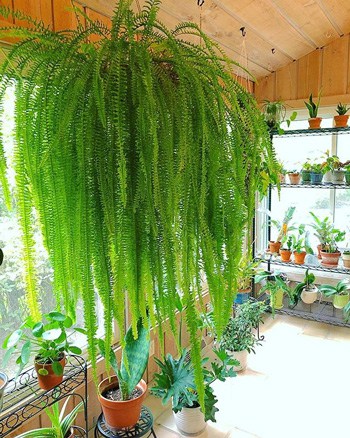
During the dismal winter months, with short days and reduced light, I stop fertilizing. The only exception I make are for moth orchids if they are growing a flower spike.
If you are growing plants under lights year round, they may keep growing year round, so go ahead and fertilize year round! Unless your plant decides that it is taking a break.
When NOT to Fertilize Your Houseplants
Fertilizing is not a fix for poor cultural conditions! If you have a plant in poor light that is not growing, your focus should not be fertilizer.
You should first position your plant in a brighter area. Light is paramount for growth!
First fix your plant's lighting conditions, and then when it starts to grow, you can further support the growth by fertilizing.
In the same way, if you have a plant that is not flowering, don't think that adding a fertilizer high in phosphorus will help you.
Fertilizer will not cause your plant to bloom. Ensuring the proper light for your plant WILL!
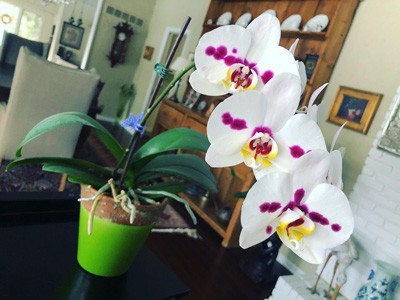
The fertilizer will simply increase the size and amount of your flowers. When you have the combination of appropriate light along with an appropriate fertilizing, then you are winning!
Do not fertilize your houseplant if it is in a period where it is not growing. Most of my houseplant growth pretty much comes to a halt in the winter months, so I completely cut out fertilizing when light levels are low.
If your plant's potting mix has gone completely dry, don't apply fertilizer, especially if it's at full strength. You may burn the plant roots.
A good idea would be to first moisten the soil with plain water first, and then come back and fertilize later.
And whenever you do fertilize, be sure to follow the direction on the label and actually measure out exactly the amount that is needed!
Fertilize with Every Watering
This is my preferred method to fertilize houseplants. You could fertilize at full strength at whatever frequency the fertilizer label recommends, but I prefer to fertilize with every watering at a diluted strength. Why?
Number 1 reason...I don't have to remember when I last fertilized since I'm doing it every time!
There is also a much lower risk of burning your plant, depending on the type of fertilizer that you're using.
It is also a much more natural way for a plant to receive nutrients. In nature, plants receive nutrients slowly from decomposing organic matter.
Many fertilizers are designed to be used at every watering. If you have one of these fertilizers, simply follow the directions!
If you have a fertilizer label that says to dissolve a teaspoon per gallon per month, I would recommend reducing it to one fourth and use that every time you water.
Or if the fertilizer label says to add a certain amount and use it every 10-14 days, reduce that quantity in half to use for every watering.
Every so often, I would recommend watering your plant with just plain water, even during the growing season.
This will help flush out any excess fertilizer salts that may be building up in your pot. Terra cotta pots are notorious for fertilizer salt build up since they are so porous.
Also, you may see some crusty buildup on the surface of your soil, or along the inside perimeter of the pot. This indicates excess fertilizer salts, or even salts from hard water that built up over time.
Flushing with clear water every so often, once every month or every few weeks, will help with this issue.
Types of Fertilizer for Plants
I have several recommendations of fertilizers in this section and have used all of them with great results. All of them are available on Amazon.
All-Purpose Fertilizers
Dyna-Gro Grow
My favorite all-purpose liquid fertilizer by far is Dyna-Gro Grow. I've achieved fantastic results with this fertilizer and I use it on all of my tropical houseplants and orchids!
This fertilizer has an NPK ratio of 7-9-5, which is good for both foliage growth and for blooming so you can get away with not switching to a bloom booster fertilizer.
It's a premium, complete fertilizer that contains all of the 16 minerals that are essential for plant growth. Not all fertilizers are equal, and Dyna-Gro Grow is an exceptional one. You won't be disappointed.
It is the one-stop shop of houseplant fertilizers. If you only want to use one fertilizer for everything, use Dyna-Gro Grow. You can even use it for hydroponic growing (growing plants with just water) and even as a foliar spray.
It is even urea-free and won't burn your plants! If you are serious about plants, don't waste your time with poor quality fertilizers.
Just be sure to follow the directions on the label for the various uses!
Be sure to measure out the amounts exactly! I have dedicated measuring spoons to measure out the amount of fertilizer, and I mix it with water in 1-gallon jugs when I need to water.
Osmocote
Have you ever wondered what those little tiny balls in your potting soil are when you purchase a houseplant?
Those are actually balls of time-release fertilizer, like Osmocote, which slowly releases fertilizer with every watering.
The beauty of Osmocote for houseplants, or even for outdoor plants, is that you can apply the fertilizer, mix it into the soil and not have to worry about fertilizing again for up to 6 months!
This is definitely the easiest method to fertilize, although it is not a complete fertilizer like Dyna-Gro Grow.
There are some specialty fertilizers which you may choose to branch off into once you get comfortable with fertilizing.
Other Specialized Houseplant Fertilizers
There are some fertilizers on the market for specific types of plants. Here are some of the ones that I have used.
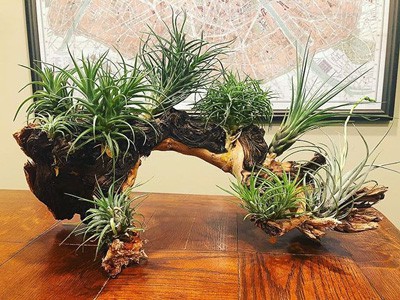
Airplants
For my air plants (Tillandsia) and bromeliads, I use the Grow More 17-8-22 fertilizer which has produced amazing results for me!
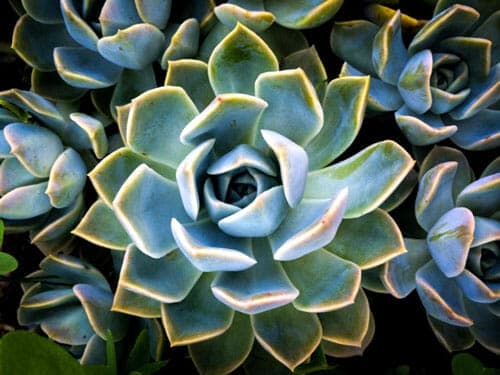
Succulents and Cacti
For cacti and succulents, I'm currently using a Schultz 2-7-7 formulation.
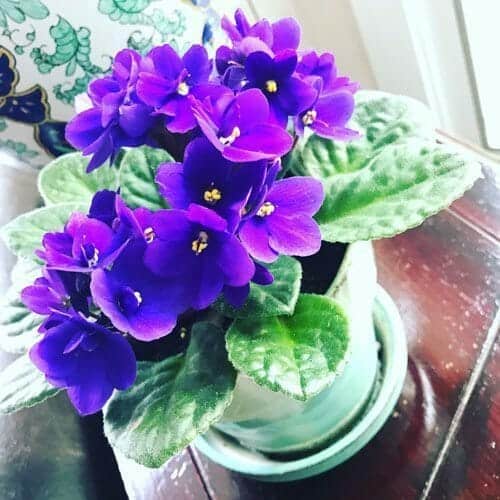
African Violets
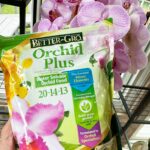
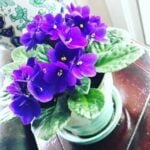
My African Violets respond very well to the Optimara 14-12-14 fertilizer made specifically for these plants. They absolutely thrive on this and the growth and flowering has been out of control!
Natural Fertilizers for Houseplants
If you are looking for an organic, natural fertilizer for your houseplants, look no further than fish emulsion.
Be careful what kind of fish emulsion fertilizer that you use though because they can be stinky. Alaska Fish Emulsion Fertilizer is FABULOUS stuff.
Even though it is "deodorized," I find that it still has a smell so I don't like to use it indoors. When I bring my houseplants outside though, this is what I use and they just LOVE it.
I use Alaska Fish Emulsion Fertilizer all summer on my houseplants that I bring outdoors. If you do bring your houseplants outdoors, which I highly recommend doing, be sure to harden your plants off.
Final Thoughts on Fertilizing
Fertilizer is NOT a fix for improper light and poor watering habits.
You should ensure that your houseplants have the appropriate lighting for the variety of plant that you have, and that you are using proper watering techniques FIRST.
Once you have these down, then you can focus on fertilizing your plant in order to achieve the best growth that you can in our artificial indoor conditions!
Fertilizing a plant that is in poor light can cause more harm than good.
If you have a flowering houseplant that is not flowering, the reason is likely not enough light. Fertilizing your plant will not cause it to bloom. Moving it to higher light will. The fertilizer will simply enhance the blooming.
Lastly, I can't overemphasize how great Dyna-Gro Grow is. As some now to your normal plant care routine and you will be pleased with the results!
Hopefully this post has helped you understand some important aspects of fertilizing your plants. Comment below with any questions!


I am currently using the Dyna-gro regimen for my semi-hydro setups and would love to find more information about when and how to use the supplements with semi-hydro. There isn't much info out there!
Can succulents be fertilized the same way as houseplants? I make several gallons of water + nutrients to water all of my babies so succulents have been getting foliage-pro + protekt too...is this a bad idea?
Hi Taylor! Yes succulents can be fertilized too. Just don't give them anything that has a high nitrogen content. I'm not familiar with the other fertilizers that you mentioned unfortunately. You can use Dyna-gro for hydroponic setups. It is a completely fertilizer so you don't have to use any other fertilizers if you are using that.
Thank you, I will try the Dyna-Gro Grow as I’ve read excellent reviews on it. I have about 5-6 houseplants still in soil and about 6 semi-hydro and about 10 readying for semi-hydro, but I use General Hydroponics Trio and wonder how Dyna-Grow compares to it.
On this page you state your go to houseplant fertilio is, Schultz All Purpose 10-15-10 and on another paged that discussed fertilizing you said you are also currently using Dyna-Gro Grow 7-9-5 as your go to. Can you please clarify which one you use for your indoor houseplants as Im pretty particular on “trying” to implement a good regimen for my plants as a new plant mom.
Thanks
Hi Gail. I've used both with success. I used the Schultz for longer, but recently have switched to the Dyna Gro. You can get good results with both, but I prefer the Dyna Gro now. I just need to update the Fertilizer post. The most important part is to make it part of your regular care routine, but ensuring that you also give your plants the proper light and care as well. Good luck!
I just read an article saying I should fertilize my thanksgiving Cactus 2-4 per year, is this true? Or should I fertilize every time it's dry at half strength? Thanks again for all your help.
Love your article, very informative. One question... I also use the same fertilizer for my moth orchids, the grow more 20-10-20 at half strength. Can I also use it for my Thanksgiving/Christmas Cactus?
I don't see any reason not to. You could try using that during most of the growing season, but if you want more of a show for flowers, I would switch to a bloom booster just for a couple months in late summer before the blooming period. 🙂
Sorry buy I'm new at this. Which bloom booster would you recommend?
Basically any fertilizer for houseplants that has a larger second number in the NPK ratio. For example, 10-15-10 or 10-20-10. They even sell fertilizers labeled as bloom boosters.
Above, you state: "One of my favorite fertilizers ever, especially for potted outdoor annuals and plants is Osmocote." I suggest you change the link of Osmocote to take you to Amazon rather than to a blurry picture. Just as you did with the Miracle-gro link. Great article.
Oh my, thank you very much for catching that. I just fixed the issue. I like when my readers look out for me! Glad you enjoyed the article.
The solution of npk used for Watering pots completely?
I'm not sure exactly what you are asking? Can you try and clarify? I would still water thoroughly when you are fertilizing.
The solution of npk used for Watering pots completely? Or not?
Thankyou fir your input
You're welcome!
I have read that many people water there plants regularly with fish tank water. Do you have any thoughts on that method? Is it that easy..are you aware of anything in aquarium water that would be harmful to my tropical and succulents? Thankyou for any information you are able to share.
It should be ok! As long as you haven't applied any medicine/treatment to the water for any diseased fish or anything like that. It should be very good for your plants.
So glad that you mentioned the Schultz Cactus/Succulent because so many people forget that succulents benefit from fertilizing and the drops are so easy to use! ! I also use the Schultz African Violet drops 8-14-9 diluted in my self watering pots and my AV’s love it! Love your posts...so many people will benefit from this one!
Absolutely! I would like to try a self-watering pot for AV. It might be easier! Mine are getting huge and they're sucking up water more quickly 🙂
Thank you for this thorough article, Raffaele. I plan on printing it so that I have a list of the recommended fertllizers when I go to the nursery. I currently use Miracle Grow and the Schultz cactus and succulent one. I sometimes use the Schultz African violet one for my bromeliad, but I think I will go with your recommendation for the bromeliad.
They are all wonderful choices! Best of luck!
Thank you so much for writing this Raffaele. I’ve been searching for a read about fertiliser and this is probably one of the most comprehensive yet easy to understand guide I’ve found.
Best,
Benji
You are more than welcome Benji. I'm glad that you found it helpful!
Hey what about using organic fertiliser? My dad swears by sheep poo granules. How does that compare? What about those slow release round granules? They remain in the soil for a while and leaves a outer shell as it slowly releases.
There are so many different fertilizers that it's hard to list them all. Organic fertilizers are good too, but I don't like using them inside due to the odor of some of them. I prefer using organic fertilizers (like fish emulsion, kelp, etc.) outdoors for things like vegetables. Time release fertilizers like Osmocote are good too, but I tend to use those more for outdoor annuals but you can use them for houseplants as well! There are a lot of options so experiment and use what works for you!
So I'm not sure I understand the reduced portion for fertilizing. You say reduce by one-fourth. So do you mean reduce to 3/4 of a teaspoon, or reduce TO one fourth and use 1/4 of a teaspoon of fertilizer?
I just edited the post. I meant to say reduce it TO 1/4 teaspoon in that particular example. Thank you for catching that!
One of the best posts yet! So helpful, thank you!!
I'm glad you found it helpful! 🙂
Just found your site! I live in Glendale, CA, a suburb of Los
Angeles. Summer's are getting hotter and drier every year. So indoor plants for me! Does your advice also cover bromeliads? TYIA
Hi Linda. Yes absolutely! I fertilize my bromeliads as well dilutely with most waterings.