This hard to find, super popular houseplant has a bit of scandal and mystique surrounding it. I will explain shortly, but like any Hoya, Hoya kerrii is a fantastic houseplant and will make a very long-lived addition to your indoor jungle with minimal care!
I will go through some care tips for both the plain old green Hoya kerrii, as well as the variegated Heart Leaf Hoya. These plants are also called Sweetheart Hoya or Valentine's Hoya, but this is all is part of the "trap" that I will share with you now!
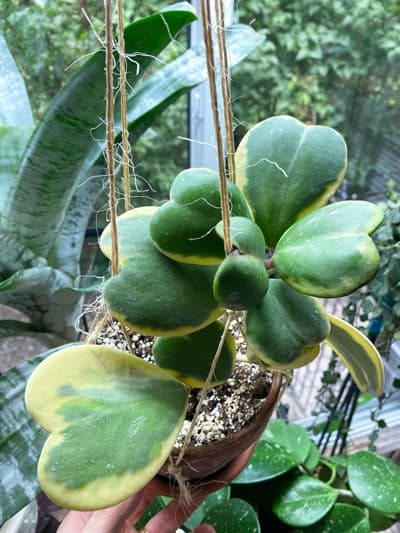
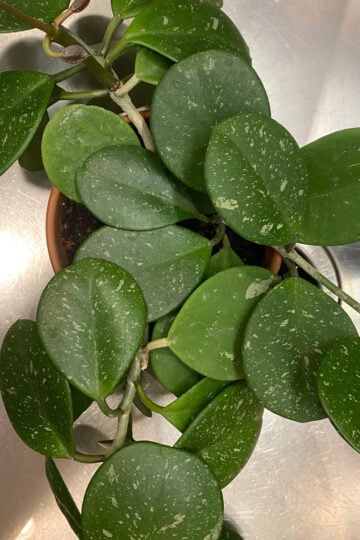
My variegated Hoya kerrii
Table of Contents
THE HOYA KERRII TRAP
This plant is very popular and most often found around Valentine's Day in a garden center near you or big box hardware stores. You can't find a more appropriate plant for Valentine's Day with its big heart shaped leaves!
The problem with these specimens that are offered for sale is that most of them will remain as a single leaf and will not grow any vines at all!
Although you can get a single heart shaped leaf to root, unless you get part of the stem (which has the node, the part where the leaf meets the stem and that produces actual new growth), it will remain as a single leaf!
There is really no way of knowing if your starter leaf contains a node when you purchase your plant, unless you take it out of the pot, but the store owner might frown upon this!
The rooted leaves that are sold CAN remain green for years, but unless there is a node present, you will never get a vining plant! Even if you do have a node, it may take a very long time to develop into a plant.
So if you really want a real plant, I would recommend buying an actual plant and not just a rooted leaf otherwise you will likely be disappointed!
Alright, let's go on to some growing tips!
LIGHT
These plants are a bit slow in the growing department, and if you don't give them enough light, they will be REALLY slow growing! :-).
What kind of light should you give these indoors? SUN! These plants like at least a few hours of direct sun indoors. Only if you give your plant plenty of light will you experience any satisfying growth.
I would avoid North facing windows. Your plant will certainly survive and look just fine, but give your kerrii an Eastern window (morning sun), Western window (afternoon sun) or even Southern exposure for best results.
Know that all your plant's leaves will all turn a lighter shade of green, or even a yellowish green, if it is getting a lot of direct sun. If you don't like the look of it, simply reduce the number of hours of sun, or diffuse the sun with thin curtains or blinds, and it will green up a bit.
Having sunny windows is a blessing! You can always reduce the amount of light coming in, but it's hard to get MORE light unless you get artificial lighting.
If you have a variegated Hoya kerrii, like the one below, these require more light than the plain green ones. Otherwise the care is identical. You will probably experience slower growth in the variegated plant since they have less chlorophyll.
Hoyas in general are great for neglectful gardeners! They can remain dry for quite a while and it will not phase them.
I allow my Hoya kerrii soil to dry out completely, and then I give it a good soaking.
Try not to let your plant stay in completely dry soil for too long though, especially during the active growing season. DO let at least the top inch or two of the soil dry out completely before watering again.
If you've let your soil dry out for long periods of time, and the water seems to go straight through and not absorb into the soil, you will need to work at it a bit.
Water it several times in a row until the medium moistens. And don't worry, you are NOT overwatering. Allow all excess water to drain away.
POT SIZE
This is a crucial topic for Hoyas! Hoyas like to stay a bit tight in their pots so DON'T overpot your plants. If your plant is pot-bound, which they like and even will respond well by blooming (but only if you have good light as well).
Hoyas can stay in the same size pot for years, but when you do repot to a larger pot, only go up ONE pot size. For example if you have a plant in a 4 inch pot, don't go any larger than a 6 inch pot.
I personally prefer terra cotta pots for Hoyas (unless it's hanging, and then I prefer plastic).
For a step-by-step guide with photos, be sure not to miss my Hoya repotting guide where I discuss all the important steps to be successful.
POTTING MIX
There are a variety of potting mixes that you can use. There isn't one "magic" potting mix. What you do have to be concerned about for Hoyas is that these plants need amazing drainage.
ALWAYS have a drainage hole. But this is not enough! You need very sharp drainage in your soil mix. These are epiphytes in nature, so they attach onto and grow on trees and therefore have amazing drainage and air all around their roots.
As a result of this, your potting mix should be nice and porous and airy.
Here are a couple options that work well (links go to Amazon):
2 parts of succulent soil to 1 part perlite OR 1 part ¼" pumice
Some people like their own special blends, but like I said, there is no magic mix, as long as you have excellent drainage and your mix dries out fairly quickly.
If you want an amazing mix to use right out of the bag, check out the amazing Hoya soil blend from Oh Happy Plants. This is an amazing mix and you will get 10% off at checkout automatically if you use my link.
FERTILIZER
Hoyas really don't need a lot of fertilizer because they grow pretty slowly, especially the variegated Hoya kerrii.
My favorite all purpose fertilizer that I use is called Dyna-Gro Grow which is available on Amazon.
If you only want to use one fertilizer for all your houseplants, get this one. I've been really pleased with the results of using this amazing, premium fertilizer on my houseplants.
It contains all the micro and macro nutrients that plants need and there will never be any nutrient deficiencies if you use this fertilizer.
Follow the directions for use on the label, but I fertilize from about March through October or so.
HUMIDITY
Hoyas in general are tropical plants and grow as epiphytes in tropical Asia. So they love humidity! But they are remarkably tolerant of average humidity indoors.
However, it's always a good idea to increase humidity for your Hoyas and other plants, especially if you have forced air heat. Winter air can be painfully dry (both for your skin and your plant!)
I run a humidifier all winter in my sunroom where I keep a lot of my plants. I describe my favorite humidifier in the link that I included above.
SUPPORT
The beauty in growing these plants is that they're versatile in how you can display them. You can have them as hanging plants, or if you'd like something more structured, you can give them a support.
Would you like to save this post?
Enter your email, and I will send this link straight to you!
If you give them a support, it will be more similar to how they grow in nature since they're epiphytes and will have tree trunks and branches as supports.
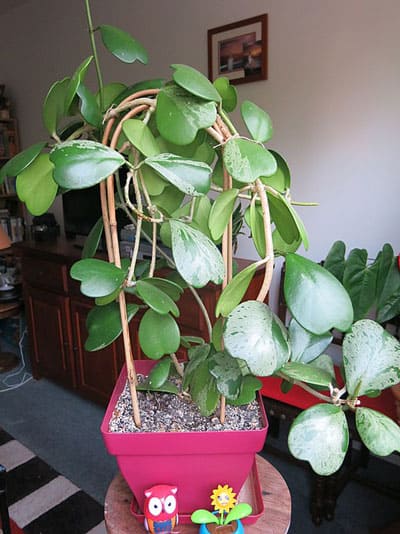
Many people train their Hoya vines with U shaped bamboo supports that are simply inserted into the pot. You can train and tie the vine to the support as it grows and you will have a lovely plant with a little time and care!
You may notice that your Hoya kerrii has long, bare stems at the growing tip. This is normal!
Hoyas put out vines that have large internodes (the area of the stem between the leaves). This is simply how they grow. Give them time and the leaves will eventually grow and look not-so-bare anymore!
FLOWERING
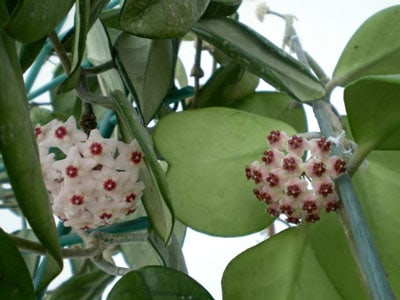
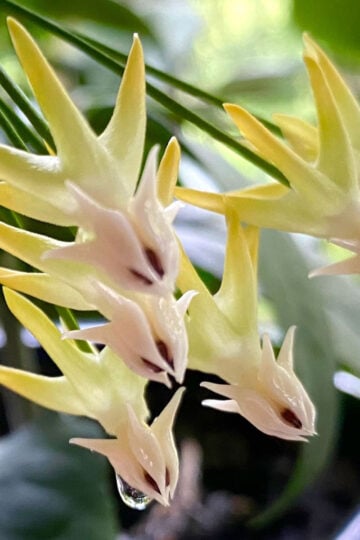
Hoya kerrri will flower for you eventually. Here are some tips to encourage flowering.
Good light is important! Be sure to follow my tips in the light section. This is paramount for flowering.
Keep the roots tighter and don't grow these plants in huge pots.
A dry period in the winter time of a few weeks may help encourage blooming during the active growing season.
Just be careful when they do flower though. The flowers have a sticky nectar that they exude so be careful if you have a piece of furniture that you care about in the proximity 🙂
Hoyas are rarely bothered by pests in general, except for mealybugs! Mealybugs will appear as white, cottony spots on your Hoyas.
When you do notice mealy bugs, you should spray your entire plant down with either a horticultural oil, insecticidal soap, or 70% isopropyl alcohol. Check out my post on treating for mealybugs in order to get the best results.
Be sure to spray the entire plant including the undersides of the leaves as well.
Always follow the directions on the label when using any pest control product.
And it is not a one-time spray! You should continue for a few weeks, even after you don't see the mealybugs anymore. This is because there may still be little critters crawling around that are hard to see with your naked eye.
HOYA KERRII TOXICITY
fHoya kerrii is non-toxic to cats and dogs according to the ASPCA.
OTHER HOYAS SPECIES TO GROW AT HOME
Have you caught the Hoya bug? And I'm not talking about mealy bugs! There are so many beautiful Hoyas to grow in your home, so be sure not to miss my other blog posts on other Hoyas that I grow:
There are so many factors that affect when you should water your plant, so don't rely on a calendar to tell you when and timing will be different for all of us.
Water your Hoya kerrii whenever the top 1-2 inches or so of soil have dried out. They can easily take all of their soil drying out completely but don't wait too long.
Why is my Hoya kerrii turning yellow?
There are many reasons for yellowing leaves, but the most common reason is an imbalance in your soil moisture. If your soil has dried out completely for too long, the lower leaves on your plant will turn yellow.
On the opposite end, if your soil is not drying out quickly enough, this can cause root rot and you can get yellowing leaves that way too. Factors that contribute to soil not drying out quickly enough include:
Low light conditions is a huge factor contributing to soil drying out slowly.
Using pots that are too big for the root system (excess volume of soil will take too long to dry).
Not using a well-draining soil (for a turn-key mix that you can use right out of the bag, try the Hoya soil mix from Oh Happy Plants!) Good drainage is essential!
Using a pot with no drainage holes is a big no-no! Always ensure that whatever pot you use has at least one drainage hole at the bottom of the pot.
This is a relatively slow-growing plant, especially if you don't have ideal growing conditions. To speed up the rate of growth, consider:
Increasing the amount of light. If you don't have sufficient natural light, try using a grow light.
Warm temperatures will help your plant grow faster. Try and maintain at least 70°F (21°C) or warmer for best growth. Keep in mind that the natural habitat of this plant is the tropics of southeast Asia, so that should give you clues into what it likes.
Not fertilizing is another reason. They don't require much fertilizer, fertilizing should be part of your routine.
When is the best time to repot Hoya kerrii?
During the growing season when your plant is actively growing, is best. Avoid repotting during the winter months if you can.
Make sure your new pot is only one size up from your old pot (about 2 inches more in diameter) otherwise the potting mix can take too long to dry out sufficiently.
Why do I have long vines with no leaves on my Hoya kerrii?
This is simply how they grow, so the tips of the vines will be leafless for a while. Over time, they will grow their characteristic heart-shaped leaves so just give them time!
If you look closely at the vines, you will start to see very small, new leaves start to grow where the nodes are.
I brought a small plant and its flowered and grown well, I keep it on a sunny easy facing window sill however its now falling over as its top heavy. I can try and repot it but then it wont fit onto the window cill. Any suggestions
Hi Diane! You can give it a support and train it to grow vertically. It is a vine so you can save space that way 🙂 Or maybe try hanging it from the ceiling.
Hi I need help... My plant is dying so I cut it up to salvage what I can. I noticed black spots showing up at the stem where the leaf comes out. Is this something of concern? I am also dealing with scale bugs on some of my other hoya kerriis. Should I worry about the black spots I see?
Hi Jasmine! I would need to see a photo to better gauge the situation. If you can use the contact form on my website, please include your care details and routine (light, watering etc), and when I reply, you can attach photos of your plant so I can see those black spots you're referring to.
Could maybe be a fungal issue. Try spraying with a fungicide. Maybe spray one leaf first, and wait a day, and then look at the leaf to make sure it didn't have any adverse effect. Then spray the whole plant.
i just bought four Hoya Kerrii leaves for my grandchildren and was looking on line and found your column and several others that call these "leaves" a hoax. I bought them because they are adorable and I knew exactly what I was buying and am not feeling "trapped." I wish you had used the space you filled with why this was a mistake to tell me how to care for these lovely tokens of love for little ones.
Hi there! The article describes how to care for it. Did you read the entire thing? Whether you just have one leaf or a larger plant, the care would be identical.
I have a Hoya Kerrii Heart single leaf that was beautiful green one month ago. I water about 1 oz once/week. Did not have it in direct sun in my office, just on top of file cabinet. It was about 15 feet in front of a window a/c unit (in Florida). 3 days ago the base started turning yellow! This scared my. The nursery I bought it from shrugged their shoulders and said "Maybe direct light outside...?" The yellow continues to spread. It now covers 80% of the heart. Is this normal? If not, how can I save it?
Hi Vicki! There are a few things going on here. When you water, I would not recommend measuring the amount of water. Your goal in watering any plant is to thoroughly moisten ALL of the potting mix and let the excess drain. Too many people are scared of "overwatering," that they actually go too far in the other direction and dehydrate the plant from improper watering. Shallow watering is very detrimental to the roots, and if you have pockets of roots that remain dry from not soaking everything well, your plant will suffer because those roots will die. Secondly, was your plant 15 feet away from a window? If so, that's much too far. Lastly, if you only have a single leaf, it may not ever grow into an actual plant. If they didn't get a node when it was propagated, it will stay as just a single leaf. I hope this helps and gives you some information to think about.
One of my hoyas seems dehydrated (thin, concave leaves), and another one is following its steps 🙁
I cannot figure out what I’m I doing wrong. The room I keep them in is 24 C in average and have great light (no direct sunlight). I water them and let them drain. I put some water in a cup to keep the humidity... could you please shed some light?
@Raffaele, they are right next to the window (it has one of those films you put for privacy, so I don’t have any drapes). I water them with a shower in small quantities about once a week (it could be twice, depending on the weather). This is a fairly warm room and keeps its temperature (last night at midnight it was 20C, I usually keep the door closed to keep the heat). I appreciate your comments!
Hi Thankyou for your informative words.Im in New Zealand and thought I would try my luck at buying a Hoya Kerrii Splash on Trademe (like ebay). The two leaf node went for $1250 NZ dollars that's near $2000 US ! Crazy days!
Hello!
I live in a condo with not the greatest light source. I also live in Canada with winter climate. I watch the watering...I don’t have my larger variegated plant near the winter and I lost my 7th leaf today! Brown spots and softness on some before falling off (tried a cinnamon paste on spot but no luck in recovery)
Any advise would be appreciated!
Ps your plant make me jealous!
Did you mean that you don't have it by the window (instead of winter.)? These really need to be right in front of a window, especially since you are so far up north and during winter time. Without enough light, all plants will suffer.
@Raffaele, I too live in Canada. Vee needs to use artificial light as many of us do especially if the plant is not in a window. Vee doesn't say if her windows are drafty. If they are then her plants would get too cold/frosty and they would die. The softness in the leaves that she talks about could be rotting from overwatering. We have extreme cold in winter and some extreme heat in summer so we need to adjust the amount of light and watering. Also depending on the type of heating and humidity you have watering needs to be adjusted. I have gas heat and water less but I always check my soil because the humidity varies. There is a facebook page Canadians Only Hoyas that may help. https://www.facebook.com/groups/2484215185130378
Hi Dorothee! I'd have to see a photo to better help. If you want, you can email me through my contact form, and when I reply, you can attach a photo, but I also need to know about your light conditions, and how you approach watering.


I brought a small plant and its flowered and grown well, I keep it on a sunny easy facing window sill however its now falling over as its top heavy. I can try and repot it but then it wont fit onto the window cill. Any suggestions
Hi Diane! You can give it a support and train it to grow vertically. It is a vine so you can save space that way 🙂 Or maybe try hanging it from the ceiling.
thank you for all this amazing information! I can't wait to nurture and experience this plant.
You're very welcome Joan!
Hi I need help... My plant is dying so I cut it up to salvage what I can. I noticed black spots showing up at the stem where the leaf comes out. Is this something of concern? I am also dealing with scale bugs on some of my other hoya kerriis. Should I worry about the black spots I see?
Hi Jasmine! I would need to see a photo to better gauge the situation. If you can use the contact form on my website, please include your care details and routine (light, watering etc), and when I reply, you can attach photos of your plant so I can see those black spots you're referring to.
Help please, my Kerrii has some brown spots on some of her leaves! What can I do?
Could maybe be a fungal issue. Try spraying with a fungicide. Maybe spray one leaf first, and wait a day, and then look at the leaf to make sure it didn't have any adverse effect. Then spray the whole plant.
Hi there. Thank you for the. Wry informative article. I need your help with my kerrii. Where can I email you so I can send pictures or videos?
You're very welcome! You can use the contact form on my website, and after I reply back, you will be able to attach anything.
i just bought four Hoya Kerrii leaves for my grandchildren and was looking on line and found your column and several others that call these "leaves" a hoax. I bought them because they are adorable and I knew exactly what I was buying and am not feeling "trapped." I wish you had used the space you filled with why this was a mistake to tell me how to care for these lovely tokens of love for little ones.
Hi there! The article describes how to care for it. Did you read the entire thing? Whether you just have one leaf or a larger plant, the care would be identical.
I have a Hoya Kerrii Heart single leaf that was beautiful green one month ago. I water about 1 oz once/week. Did not have it in direct sun in my office, just on top of file cabinet. It was about 15 feet in front of a window a/c unit (in Florida). 3 days ago the base started turning yellow! This scared my. The nursery I bought it from shrugged their shoulders and said "Maybe direct light outside...?" The yellow continues to spread. It now covers 80% of the heart. Is this normal? If not, how can I save it?
Hi Vicki! There are a few things going on here. When you water, I would not recommend measuring the amount of water. Your goal in watering any plant is to thoroughly moisten ALL of the potting mix and let the excess drain. Too many people are scared of "overwatering," that they actually go too far in the other direction and dehydrate the plant from improper watering. Shallow watering is very detrimental to the roots, and if you have pockets of roots that remain dry from not soaking everything well, your plant will suffer because those roots will die. Secondly, was your plant 15 feet away from a window? If so, that's much too far. Lastly, if you only have a single leaf, it may not ever grow into an actual plant. If they didn't get a node when it was propagated, it will stay as just a single leaf. I hope this helps and gives you some information to think about.
Do you mean the Dyna-Grow Grow fertilizer? The link to the fertilizer produced a variety of results for me.
Hi Liza! Yes, Dyna-Gro Grow. Sorry about that link! I'll have to fix it. Thanks for bringing it to my attention.
Hello!
One of my hoyas seems dehydrated (thin, concave leaves), and another one is following its steps 🙁
I cannot figure out what I’m I doing wrong. The room I keep them in is 24 C in average and have great light (no direct sunlight). I water them and let them drain. I put some water in a cup to keep the humidity... could you please shed some light?
Hi Arlette! How far are your plants from a window exactly? What exposure? Tell me about your watering routine?
@Raffaele, they are right next to the window (it has one of those films you put for privacy, so I don’t have any drapes). I water them with a shower in small quantities about once a week (it could be twice, depending on the weather). This is a fairly warm room and keeps its temperature (last night at midnight it was 20C, I usually keep the door closed to keep the heat). I appreciate your comments!
Hi Thankyou for your informative words.Im in New Zealand and thought I would try my luck at buying a Hoya Kerrii Splash on Trademe (like ebay). The two leaf node went for $1250 NZ dollars that's near $2000 US ! Crazy days!
Hi Kate! Wow, that is really crazy! I've heard from others that plant prices in New Zealand are insane!
Hello!
I live in a condo with not the greatest light source. I also live in Canada with winter climate. I watch the watering...I don’t have my larger variegated plant near the winter and I lost my 7th leaf today! Brown spots and softness on some before falling off (tried a cinnamon paste on spot but no luck in recovery)
Any advise would be appreciated!
Ps your plant make me jealous!
Did you mean that you don't have it by the window (instead of winter.)? These really need to be right in front of a window, especially since you are so far up north and during winter time. Without enough light, all plants will suffer.
@Raffaele, I too live in Canada. Vee needs to use artificial light as many of us do especially if the plant is not in a window. Vee doesn't say if her windows are drafty. If they are then her plants would get too cold/frosty and they would die. The softness in the leaves that she talks about could be rotting from overwatering. We have extreme cold in winter and some extreme heat in summer so we need to adjust the amount of light and watering. Also depending on the type of heating and humidity you have watering needs to be adjusted. I have gas heat and water less but I always check my soil because the humidity varies. There is a facebook page Canadians Only Hoyas that may help. https://www.facebook.com/groups/2484215185130378
Is it normal for the new Hoya Kerii leaves to be thin and concave?
Hi Dorothee! I'd have to see a photo to better help. If you want, you can email me through my contact form, and when I reply, you can attach a photo, but I also need to know about your light conditions, and how you approach watering.
Why do my variegated hoya Kerrii leaves concave. The leaves thin and bent like spoons in different directions.
I'd need to know how you care for it (light, water, temperature, etc.). Could be potentially related to soil moisture.
A weird question is what make hoyas more silver splashy?
Not a weird question at all Nina! Normally the markings will be more pronounced when you give your plant more light.
I would like to get more information about Hoyas, and all deferent kinds and names of them.
Thank you ?
That's a great idea! I'll keep that in mind for a future post.
Classic .......,,
@Vaman Dhenavi,