
Syngonium Plant: 7+ Expert Care & Propagation Tips!
Some of the links in this post may be affiliate links.
Syngonium podophyllum, or Arrowhead Vine, makes for an incredibly satisfying houseplant! It is relatively easy to care for, grows very quickly with good care, and is super easy to propagate!
If you don't provide good, consistent care, it can look a bit ratty. Or over time, it may become unruly like my
Keep reading because I will show you all my best
Would you like to save this post?
Table of Contents
Syngonium Care
Many people think that there is something wrong with their plant when it starts to stretch out and vine, but the fact is that these plants ARE vines in nature!
They will start growing at the base of a tree and climb up at least a few feet. We are used to seeing juvenile leaves, but the mature leaves will look much different and have deeper lobes.
These plants are native to rain forests ranging from southern Mexico through Central and South America. As you can imagine, they like warm temperatures so try not to let these plants get below 60F. They will simply sulk if it gets colder than that.
When you purchase a
1. LIGHT
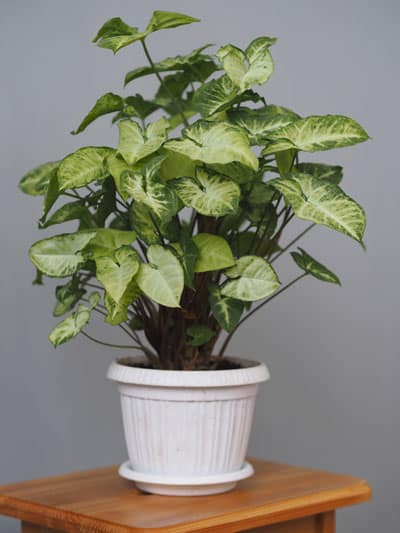
These are often touted as "low-light" plants which is a pretty confusing term. I find that
Placing your plant right in front of a Northern or Eastern exposure window is ideal. Morning sun is gentle enough in most areas. Avoid extended periods of direct sun, especially if you live in areas that have really hot summers.
If you have very sunny Western or Southern windows, you may want to set your plant back a bit so that it doesn't get too much direct sun.
2. WATERING
I follow my standard watering practices for leafy tropicals. Always water thoroughly and completely until water escapes the drainage hole.
Then wait until maybe the top inch or so of the soil is dry before watering again. Don't let your soil get completely dry.
It's really as simple as that. So many people are scared of overwatering and there are a lot of houseplant watering myths out there.
Overwatering does not mean what you may think it means, so be sure to become an informed houseplant parent and read the blog posts I linked to after you'e done with this post.
What you read here is really ALL you need to remember when it comes to watering! Don't overcomplicate it! Be sure to keep your plant in good light though, like I described above, otherwise you may be asking for trouble.
YELLOW LEAVES
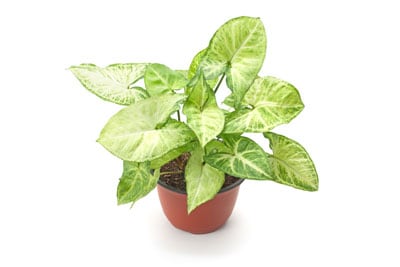
If you let your plant dry out completely, and repeatedly, you'll find that the lower leaves will start to yellow one by one until you're left with a naked, bare vine with a tuft of leaves.
Try to avoid letting the soil dry out completely in order to keep as many leaves on your plant as possible. Sure, it is normal for some of the older leaves to yellow over time, but if you are negligent with watering, you will make the issue much worse.
There are other reasons too why houseplants get yellow leaves.
3. FERTILIZING
For my leafy tropicals like
I like to tell people that fertilizing is NOT a fix for poor plant culture. If you have been neglecting your plant and growing it in poor light, you have greater things to worry about than what fertilizer you are going to use.
Fertilizing should be a way to supplement your plant's health after you have mastered proper culture (light, watering, etc.). Dyna-Gro Grow is truly amazing! I've been using it for a while now and have great results.
It is a premium, urea-free, complete fertilizer and I simply mix ¼-/1/2 teaspoon per gallon of water and use it every time I water my plants from about late Winter through about October or so.
I stop fertilizing when the days get shorter throughout most of the Fall and Winter since plants simply aren't growing much.
Why not give it a shot? You will notice a wonderful difference!
4. HUMIDITY
It makes sense that these plants love high humidity, since they grow in rain forests, but in most cases, you will be fine with average indoor humidity as long as you have good watering practices!
Good watering practices are much more important than providing high humidity, but if you can provide both (along with good air circulation), then it's even better! This is true even for the "finicky" maidenhair fern that I've been able to grow very successfully!
I always run a humidifier in my sunroom during the months that our central heat is on. I talk about my favorite humidifier in my blog post on increasing humidity.
If you look closely in the photo below, you can see my
I later chopped that plant up and propagated it so I'll show you how I did that soon!
5. POTS & SOIL MIX
For all my leafy tropical plants, I use the following soil mix which is a great, well-draining all purpose mix!
You can easily get everything on Amazon and I like to use:
3 parts of Miracle Gro Potting Mix
to 1 part of Perlite.
Mix it all up together, and you're golden!
Remember that if you purchased a plant in a small pot at a nursery, chances are you may need to repot it (always allow at least a couple weeks of adjustment at home before you repot anything).
Small pots often dry out very quickly, so keep this in mind!
When you do repot, a good rule of thumb is to only repot into a pot that is one size bigger than the old pot. For example, if you have a plant in a 4 inch pot, don't go any larger than a 6 inch pot.
And always choose a pot with a drainage hole!
If you don't want to bother mixing your own, I HIGHLY recommend the Rainforest Soil Blend from Oh Happy Plants. These are AMAZING, sustainable potting mixes and you can use them straight out of the bag. If you use my link, you will automatically receive 10% off at checkout on any products.
6. PRUNING
Depending on what your goal is for your plant, you may or may not want to prune.
If you desire to have a bushy plant, don't be afraid to prune your plant back. This will shorten any vines that are starting to lengthen, and help encourage new growth so it can remain more compact.
And if you do prune, you also have the benefit of being able to propagate your plant to make more! I'll show you how I propagated my variegated
If you prefer not to prune your plant, know that the vines will extend and get long. At this point, you can display them in a number of ways:
- You can use your
Syngonium in a hanging plant. The vines will eventually reach the floor so you'll have to prune at that point anyway!
- You can let your plant's vines ramble on your plant shelf, or dangle off your shelf.
- Or, one of the most interesting ways would be to give your plant a moss post and let it climb like the specimen below! Check out my DIY Moss Post tutorial to make your own!
7. Propagation
Now comes the fun part! This is one of the easiest plants to propagate by cuttings. It roots very quickly in water.
One of my readers approached me once with a question about her plant. All of the lower leaves were gone and she didn't like the bare look of her plant.
I showed her exactly where to cut her plant to quickly make cuttings to replant.
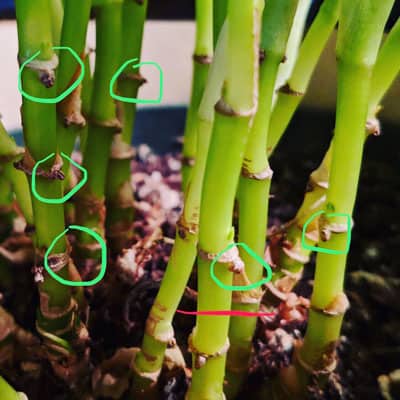
You can see on each of the vines, there are roots already growing at the nodes (where the leaves meet the vine). In this case, the leaves had yellowed from the plant drying out too much.
You would simply cut right below any of these nodes, indicated by the red line in the photo, and place the cuttings in water.
Just be sure to include one or two nodes (circled in green in the photo) in water in your propagation vessel. Keep your cuttings shorter and make sure that each cutting has one or two leaves.
Be sure to change the water weekly at least in order to keep it fresh, and remove anything that may have rotted.
My variegated
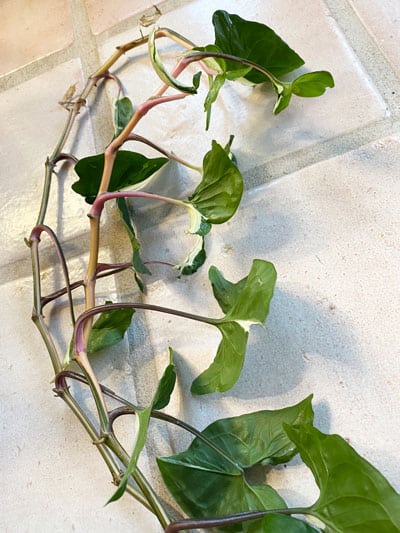
I love the beautiful variegation on the leaves.
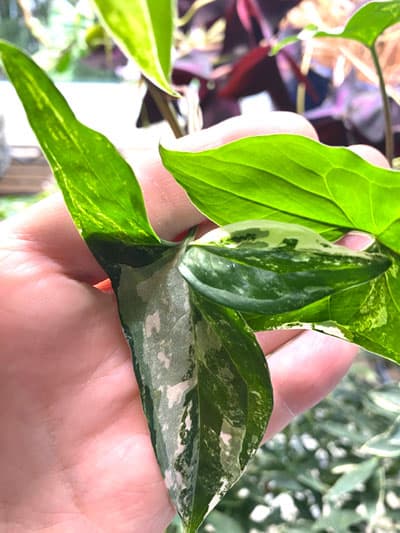
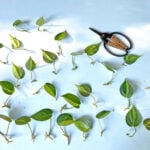
Following the same process that I described above, I took multiple cuttings, and placed them in a vase of water.
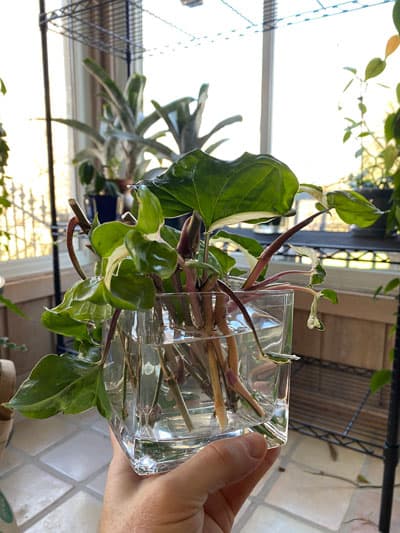
Pretty soon after you take the cuttings, the roots will grow fairly quickly from the nodes (where the leaves meet the vine).
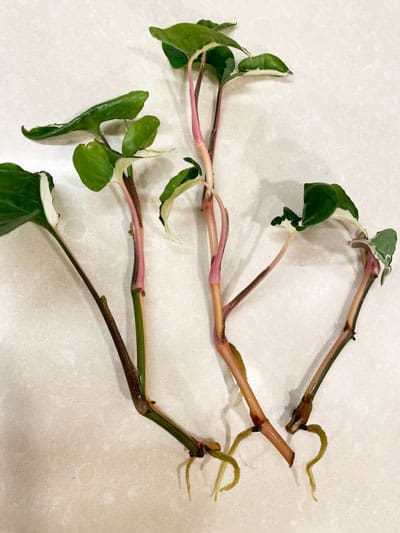
Once the roots start growing, go ahead and pot them up! If you want a nice and full plant, place them all in one pot and you will have a nice specimen in no time!
Before we go, here is another example from one of my reader's plants.
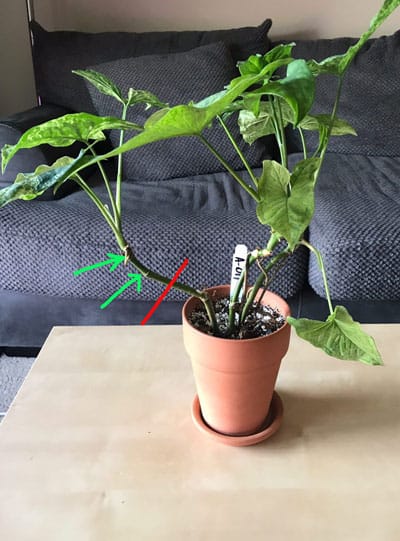
My reader didn't like the look of her plant anymore above and prefers her Arrowhead vine to be bushier, so I demonstrate where to cut the vine (red line) and the two points (green arrows) that will root in water.
For more details, check out my post on propagating Syngonium.
Syngonium Varieties
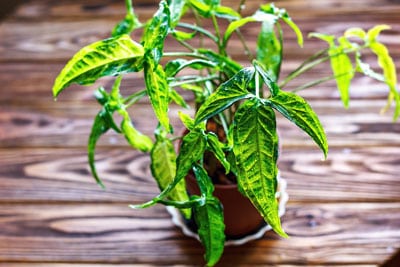
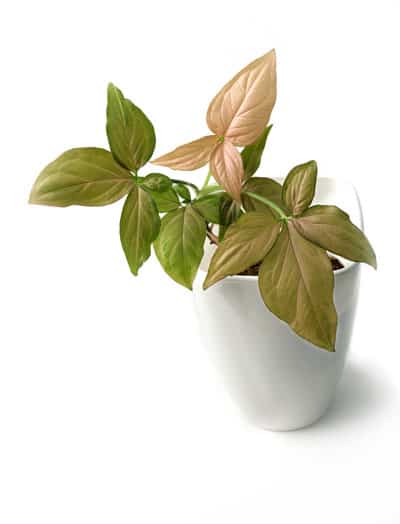
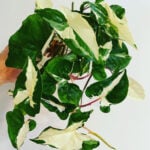
Other than the ones I've already shown, here are some other varieties that are available.

I repotted my plant water it correctly but the leaves are getting brown spots on them. What did I do wrong. I did not use to big of a pot. I'm used to growing outside but now in apt. I do mist regulary and have them in low bright light, no sun
I would stop misting, and if there are not a ton of leaves with spots, go ahead and cut them off.
Greetings from Singapore!
Great post! I just bought a syngonium variegated and it has a lot of aerial roots! My question is can I just snip between nodes and plant in soil or should I place in water and wait for roots before doing that?
Thanks much! 😊
You can definitely place them right in soil. I just did this recently in fact, but you'd have to keep the potting mix moist and keep the humidity high while it is rooting. Good luck!
I bought some soil specifically for anthuriums. I could have made it but I have limited space. Do you know if that soil will work for syngonium.
It is composed of:
Horticultural charcoal, sand, peat moss, perlite, fir bark, and lime
Thank you!!!
I don't see why not! it's just a matter of maintaining the proper moisture level. You should be fine!
@Raffaele, thank you!!! I have difficulties of when I should water. At least it’s still alive! I also have a Pixie Syngonium so hoping to keep that going too. Can they be under a grow light or is that to much? Thanks again!
what great information thank you so much
You're very welcome Patricia!
I have an Arrowhead plant that has become two long vines, they're about a foot long each. Most of the leaves are on the last 5 inches of the vines. If I cut them below the leaves to propagate, will the original stems sprout new leaves? Or do I need to leave some leaves on the stems in order for the original plant to continue growing?
Thanks in advance!
If the plant is pretty healthy, it should grow back! Make sure you leave at least one node though on the parent plant because the new growth will come from there.
I am new to caring for my syngonium Podophyllum Albo-variegadum, but I've been growing Aroids for awhile now. I just received a new Albo in the mail that has had obvious signs of root rot and came in a pot of sopping wet soil. I immediately (and very gently) rinsed all the wet soil from the roots, carefully cut away the roots with obvious signs of rot,separated into 5 plants instead of one to give each a better chance to recover, and repotted them in smaller individual pots with my homemade Aroid mix of coconut bark chunks, charcoal, pumice, pine bark fines, and some potting soil. It's been about 5 days, and they are all recovering very well, except the two half & half split solid green/white leaves. Each leaf is on a separate plant, but both have the same changes. The green half of the leaf is slowly turning yellow, and the white half the edges are turning brown and are so thin they Curl upward and look like wet newspaper when I mist them. The rest of plants and even other leaves on those plants are all thriving. Why would only those two leaves deteriorate so quickly while all the other are recovering quicker than I had expected them to.?? Also, you stated that these propogate easily in water. About how long on average does it take to start seeing root growth? Thank you SO much for sharing your knowledge with us. My mouth dropped to the floor when I saw your gorgeous Albo cascading all the way down your plant shelves! Beautiful.
Hi Nikki! Those leaves that you were referring to probably aren't as vigorous because of the heavy variegation. It sounds like your plants are starting to recover so just give it some time and attention, and they will be OK! They grow pretty vigorously once they get going! Good luck!
Hi, great article! My question is, once you cut below the node, what happens to be bottom part which is rooted? Do you keep it in water and wait for the new groth given the steam has healthy roots?
Once the cutting has roots that are about 1/2 inch long or so, you can go ahead and pot it up.
Thank you Rafaelle for your fantastic photographs and detailed advice on caring for and propagating the syngonium plant.
You're so welcome Virginia! I'm glad you enjoyed my post 🙂
I bought an ALBO that had two beautiful leaves. It has now lost all leaves. I didnt change the pot because I was trying to let it acclimate to my hoe. I have now put it in a slightly bigger pot and put it in a West facing window that get filtered light. I am worried I am losing it and I paid a lot for it. I did let it get really dry not realizing it, gave it a good drink of rain water yesterday. Here's hoping I can save it. Help...
Hi Gail, you're right that these should not go completely dry. Try and avoid that in the future. Maybe only let the top inch or so dry out, and then water. Everything else you described sounds great, so just keep a close eye on the soil moisture and you should be fine! 🙂
Thank you ... It helps a lot,,
Hi, great post! I'm a new syngonium "mother" from Malaysia and I have an albo that that has lost its variegated pattern and all the leaves are deep green now. It's in partial morning sun and gets adequate daily watering. Should I remove all the green leaves and put it out in full morning sun? What should I do? Thanks in advance!
Glad you enjoyed the post! Are there any variegated leaves left on the plant? If there are, you should cut the vine right above the last leaf that has good variegation. The new growth from this point should be more variegated. Where do you have your plant currently? Is it near a window?
I am so very grateful to you for sharing this beautifully written article. You have given me the confidence to look after and propagate my syngonium. Thank you.
Glad you enjoyed the post Melissa! Good luck!
Hi, i propagated a variegated syngonium and after a week one of the leaves started to turn yellow on the sides. What could be the cause to this?
Hi Caroline. I wouldn't worry too much if it's just one leaf. Your plant probably just shed a leaf during the propagation process. Give it some time to root and plant it. It is normal for a little stress to occur.
Will trellising my sygonium encourage larger leaves to grow?
Yes absolutely! It will take time and patience though! Once it reaches the top, you can take cuttings off the top and start another plant and give it a support. Over time when you do that, the resulting plants will get bigger and bigger as long as you give it a secure support and the plant is attached to it.
This is the best syngonium care post I've read, thank you for sharing your expertise
Thank you, and I'm so glad you found it helpful!
Thanks so much for this blog. Especially now that we are more or less house bound it is good to pay attention to my indoor garden.
You're very welcome Beth! Absolutely...more attention to your indoor garden will benefit both you and your plants 🙂