Are you ready to repot your Hoya plant (commonly known as Wax Plant) and want to make sure that you're following all the proper steps? Or maybe you're not sure when or even IF you should repot your Hoya? I will go through all of this and more, so have no fear!
Regardless what type of Hoya plant you have (and there are a LOT), you can use this process and I will show you step-by-step, with photos, how I repotted one of my own Hoya plants so that you can have the most success possible.
Would you like to save this post?
Enter your email, and I will send this link straight to you!
Whether you need to repot your Hoya carnosa, Hoya obovata, Hoya curtisii, hindu rope hoya, or any Hoya, you can follow this same process.
After I go through my easy 3 step process, I also will go over many tips and tricks as well as frequently asked questions about repotting Hoyas. Let's get to it!
Table of Contents
WHEN TO REPOT HOYA PLANTS
Before I get into my process for repotting and transplanting Hoyas, I wanted to touch briefly on when and even IF you should repot your Hoya.
Hoyas can stay in the same pot for quite a long time, and in fact they prefer this. Did you know that having your Hoya root-bound will also help to encourage blooming?
How do you know if your Hoya needs a bigger pot? If you notice one or more of the following, it may be time to transplant your Hoya to a bigger home:
You see a hard mat of roots on the surface of the pot. If you see this, your plant is likely very root-bound.
Your find yourself watering a lot more frequently than you used to because the soil or potting mix is drying out much more rapidly than before.
You see a lot of roots coming out of the drainage holes.
Your plant seems unusually large for its pot and growth has slowed down dramatically or may have even come to a halt.
All of the above are indeed strong indications that your plant needs a larger pot. The only way you can truly tell for sure is if you take your plant out of its pot and look at the root ball.
HOW TO REPOT A HOYA OR WAX PLANT: 3 EASY STEPS
1. TAKE YOUR HOYA OUT OF THE POT AND LOOSEN THE ROOT BALL
If your potting mix is really dry, I normally like to give my plant a good soak and then actually do the repotting a few hours later or even the next day. This will make it much easier to loosen the root ball.
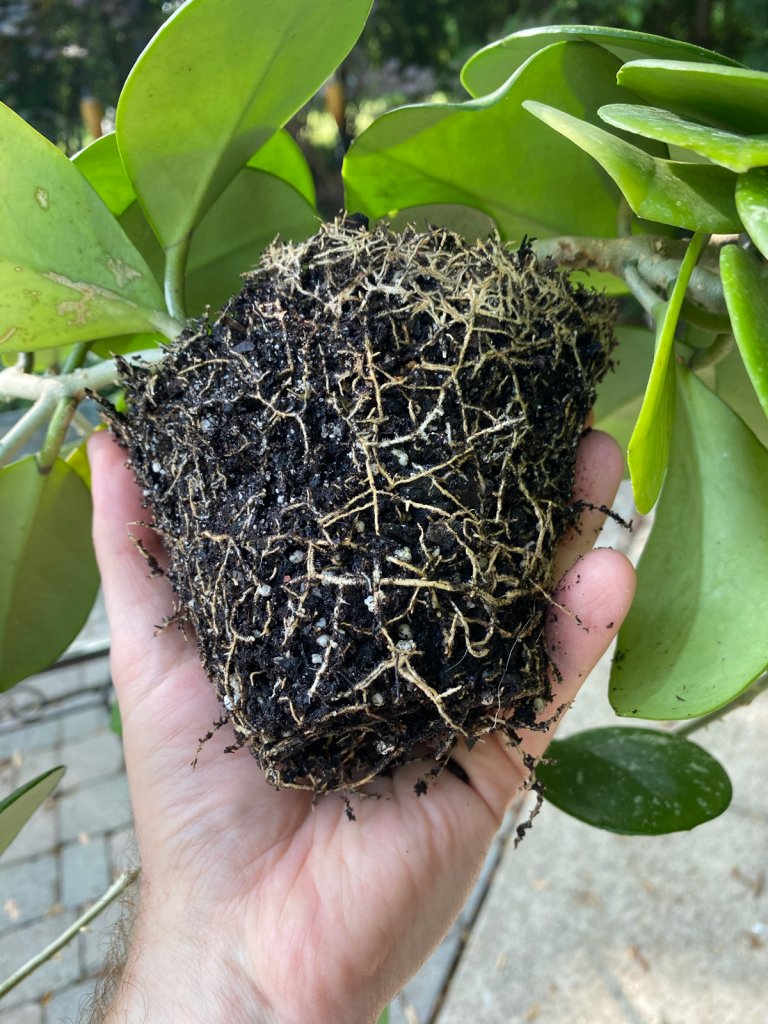
Here is the root ball of my Hoya obovata. I propagated the plant from cuttings and it grew in a 5-inch terra cotta pot for 3 years before I gave it a bigger pot.
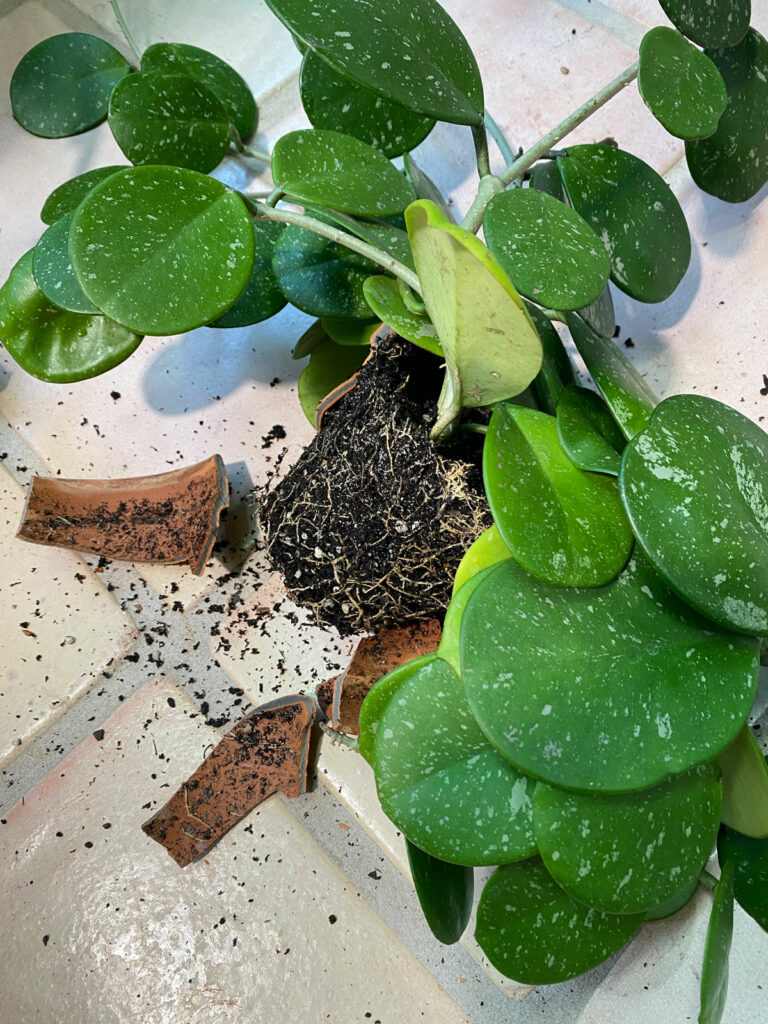
You can see that the plant is pretty root-bound and there were quite a few roots matted on top of the soil mix. I had been planning on giving it a new pot. One day I was moving my 17+ year old Hoya carnosa, and it got entangled with my obovata and it fell to the ground!
Fortunately nothing broke on my plant and I was planning on repotting anyway. The universe gave me the push (literally) to proceed.
On this note, if you have a Hoya that seems too difficult to take out of it's pot and are worried you're going to damage the plant, there is nothing wrong with breaking the terra cotta pot or ceramic pot that it is growing in! I've done this in many cases where I care more about the plant than the pot.
Of course if you have your plant growing in a plastic nursery pot, it will be much easier to take out since you can gently squeeze around the perimeter and and can then tease the plant out.
Once you take your Hoya out of its pot, it's time to loosen the root ball. Why is this necessary? Simply because it will make it easier for the roots to grow into the potting mix once you transplant it to a bigger pot.
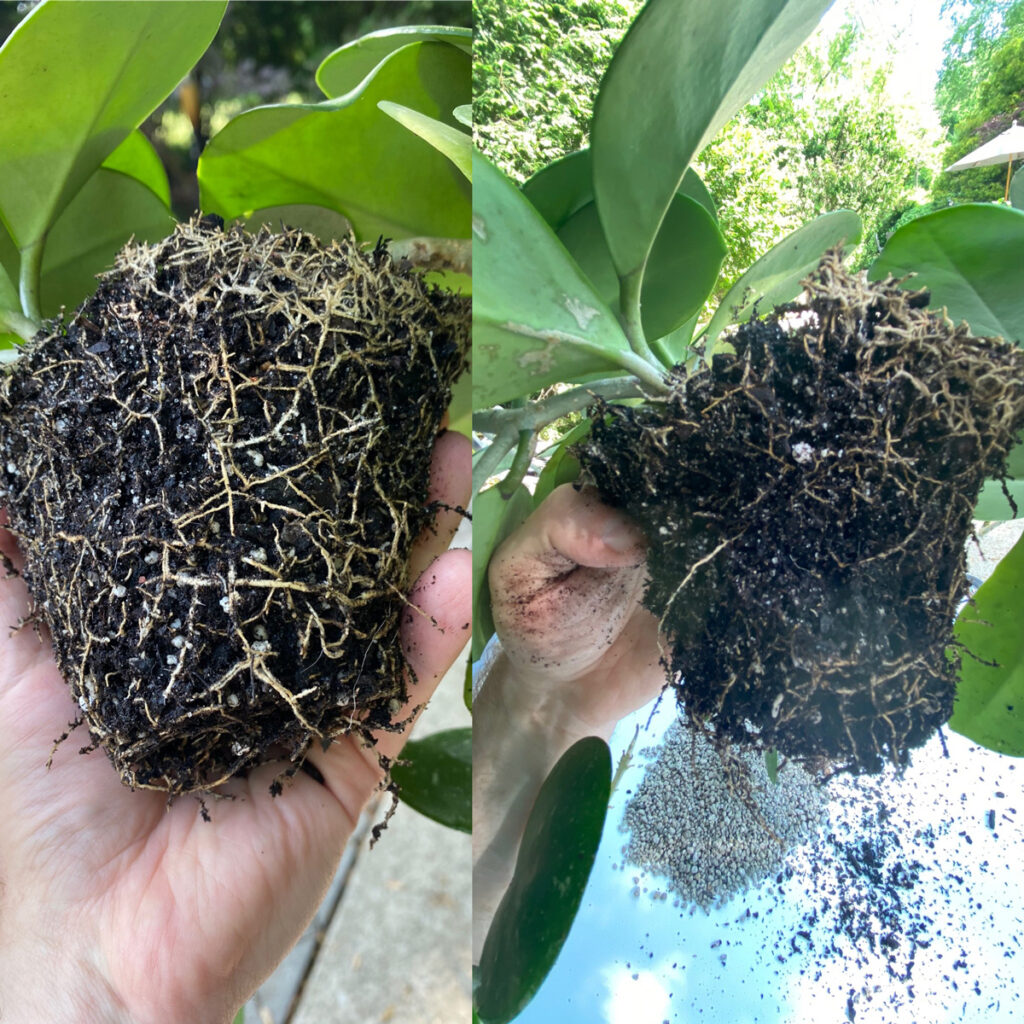
This is especially critical if your plant is extremely root-bound. In my case, it was easy to loosen the root ball a bit. You can see the before and after in the photo below.
Before loosening the root ball (left) and after loosening the root ball (right).
You can see from the photo above that I didn't go too crazy, but I did gently tease the roots at the bottom of the root ball as well as around the perimeter.
If your plant is so badly root bound where the root ball seems like one solid mass of roots with little if any potting mix or soil left at all, and you can't seem to loosen it at all, there is still something you can do.
In this case, you can take a sterilized knife or pruning shears and slice a few vertical slits around the perimeter of the root ball. I would do at least 4. This will at least allow for some areas for new roots to grow from. You will not damage the plant by doing this!
I will update this post with some photos showing how I do this with my 17+ year Hoya carnosa that has been in the same pot for all those years! I suspect that it will be one solid mass of roots.
2. CHOOSE AN APPROPRIATELY SIZED POT
Next, you'll want to choose an appropriately sized pot. My general recommendation, and this applies especially to Hoyas, is to choose a pot that is about 1-2 inches in diameter bigger than the old pot. Whatever pot you do choose, make sure it has a drainage hole. This is a must.
For example, if your plant was previously growing in a 4 inch diameter pot, go ahead and transplant it into a 6 inch diameter pot.
There are a couple reasons for this. If you choose a pot that is much too big (for example, going from a 4 inch pot to an 8 inch diameter pot or bigger), your potting mix will take a lot longer to dry out. Hoyas need to dry out pretty quickly in between watering otherwise you'll increase your risk of root rot and your plant will not be happy.
The other reason is that when Hoyas are root-bound, it will help to encourage blooming.
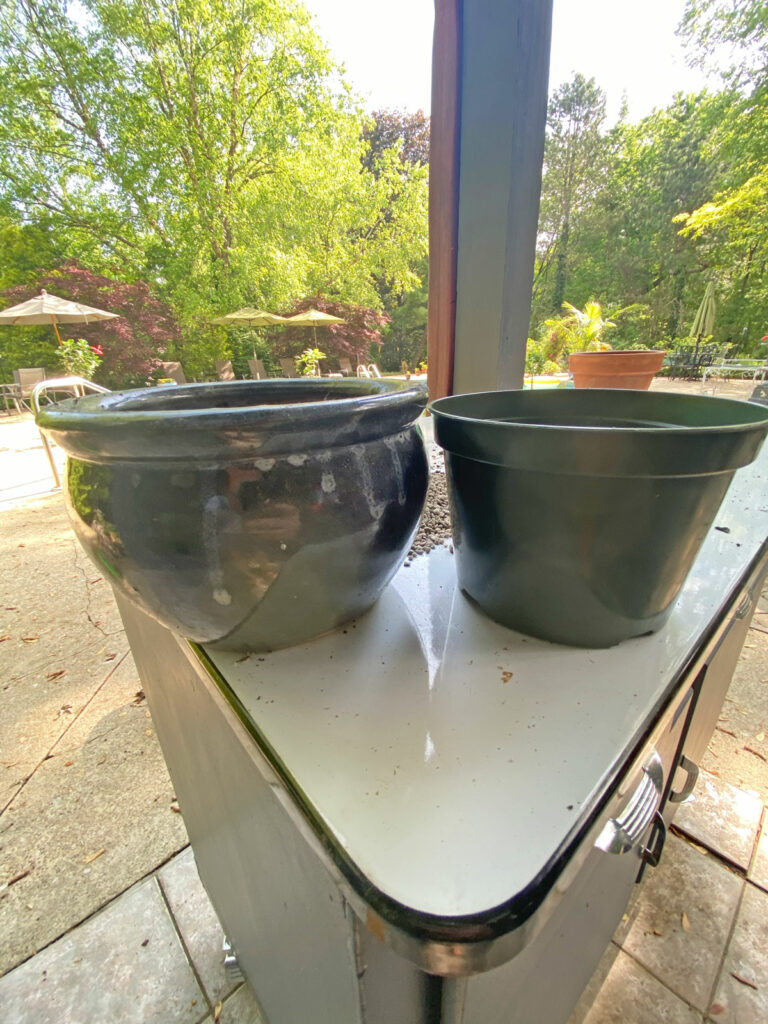
When I repotted my Hoya obovata, I decided to place it in a plastic nursery pot, and then slipped it into a decorative glazed ceramic pot.
The reason I like doing this is simply because plants are much easier to repot when growing in flexible nursery pots, and I can always slip it into a decorative cache pot to make it pretty, so I can have the best of both worlds!
I ended up repotting my Hoya into the plastic nursery pot on the right and then slipped it inside the ceramic cachepot on the left.
3. POT IT UP USING A VERY-WELL DRAINED POTTING MIX
Lastly, you want to make sure to have an extremely well draining potting mix for your Hoyas. Hoyas need to dry out pretty rapidly in between watering.
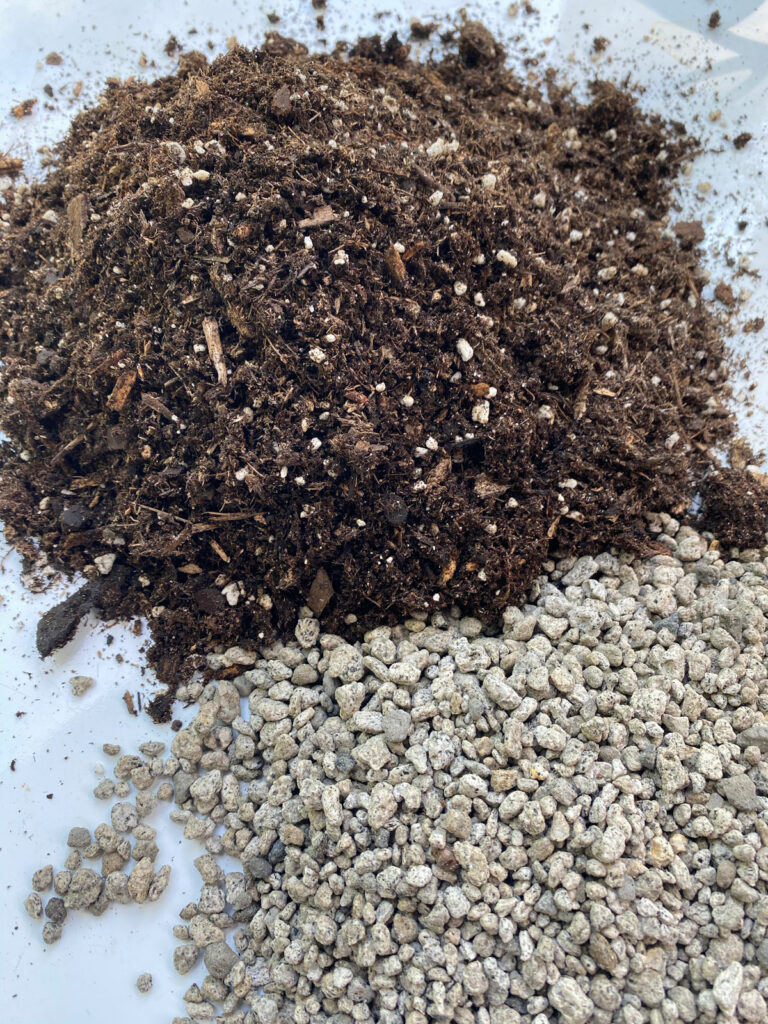
The mix that I love using for Hoyas (and I also like to use this mix for aloes, echeverias, jade plants and other succulents) is simply 2 parts of a cactus/succulent mix plus 1 part ¼" pumice.
Top: A cactus/succulent mix right out of the bag. Bottom: ¼" pumice
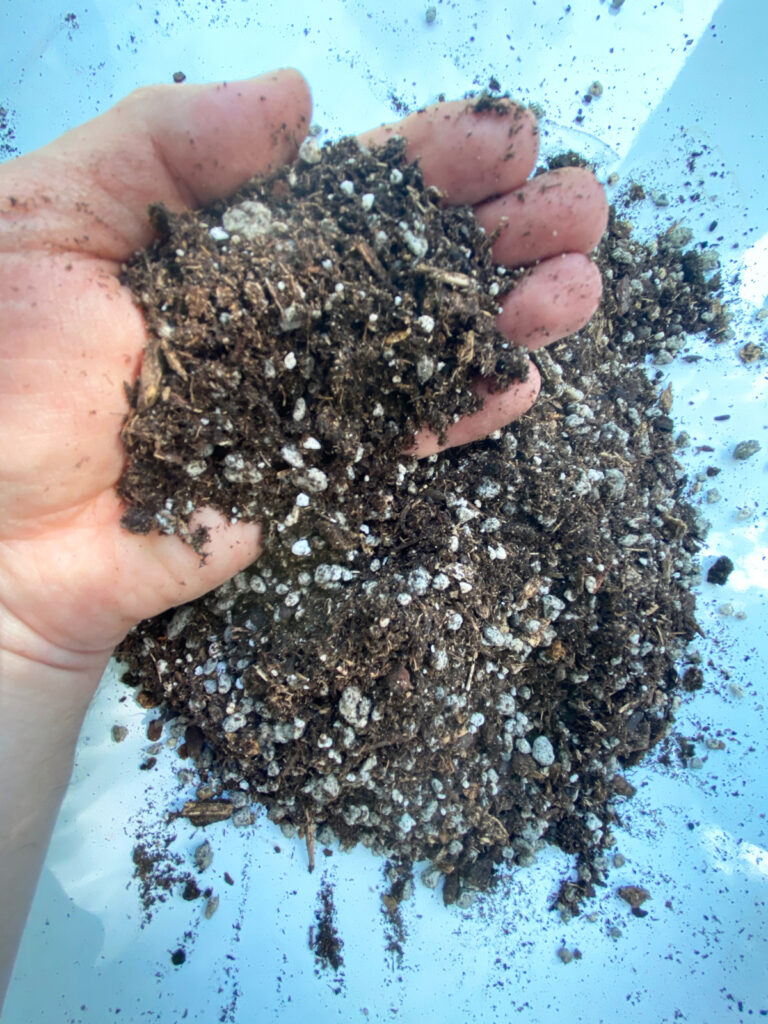
This blend results in an extremely well-drained mix that Hoyas just love. Here is what the mix looked like when I blended it all together.
Here are the actual products that I used.
Espoma makes a wonderful cactus mix. I used two parts of this cactus mix plus 1 part of ¼" pumice.
This mix works really well for me (2 parts cactus mix to 1 part pumice). You can also modify the proportions depending on your conditions.
If you want an amazing mix to use right out of the bag, check out the amazing Hoya soil blendfrom Oh Happy Plants. This is an amazing mix and you will get 10% off at checkout automatically if you use my link.
Your environmental conditions, as well as pot types, can greatly affect how quickly your mixes dry out so don't be afraid to experiment.
I have a more specialized guide to helping you choose the best pot for Hoyas.
You can use perlite too instead of pumice, but pumice will not float to the top like perlite often does when watering. And pumice is much heavier and it will help add some weight and make it less likely to have your pot knocked over.
Next add a little of your custom mix to the bottom of the new pot. Set your plant in and adjust as needed. Add your potting mix blend, and gently press down as you go to make sure that you don't have any big air pockets. Leave about a ½" of space from the soil line to the top of the pot.
This will allow for a reservoir for when you water so that you don't make a mess.
Lastly, give your plant a good watering, and you're all done!
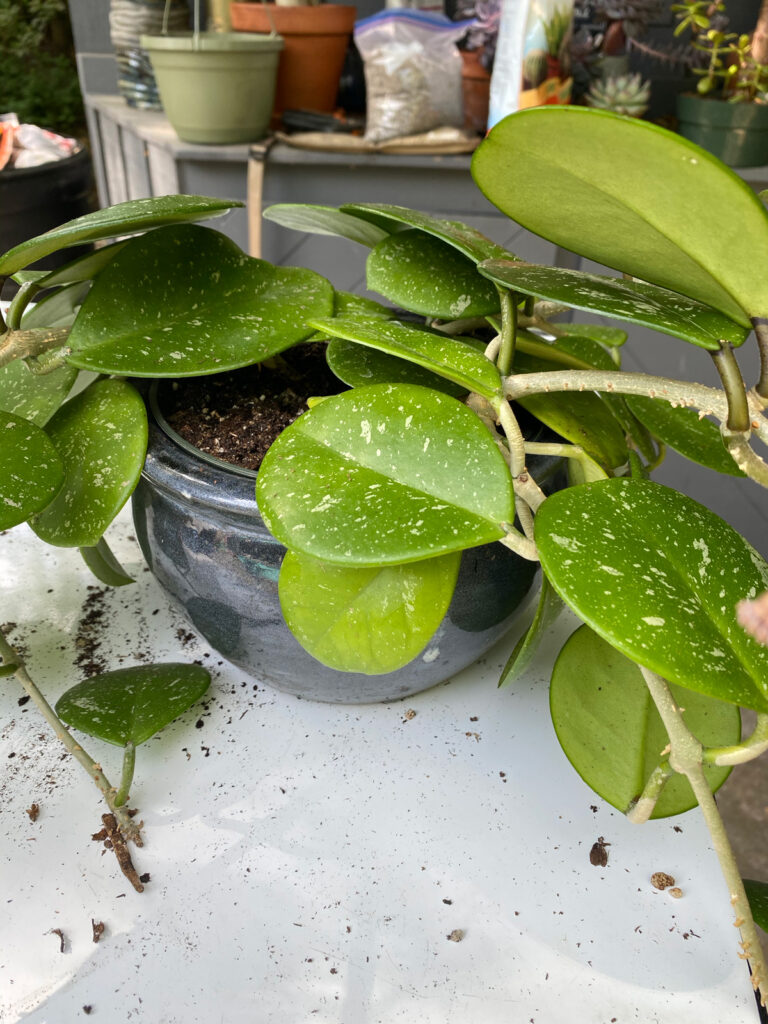
My newly repotted Hoya obovata
FREQUENTLY ASKED QUESTIONS ABOUT REPOTTING HOYAS
What kind of soil does a hoya plant need?
Hoyas need to dry out rapidly in between watering. One wonderful blend to use is 2 parts of a good cactus potting mix with 1 part of pumice. This results in a very well-drained mix that Hoyas love. You can adjust the ratio as needed to suit your environmental conditions.
Should I repot my Hoya?
Hoyas can stay in the same pot for quite a few years. Eventually, they will need a bigger home in order for the plant to continue growing. When your plant is pretty root-bound, you can go up one pot size (1-2 inches bigger in diameter compared to the old pot).
Do Hoya plants like to be root bound?
Yes! In fact, you will help encourage your plant to bloom if it is pot-bound. Eventually, your Hoya will grow better if you repot it into a slightly larger pot.
How often should I repot my hoya plant?
It's difficult to generalize as this can depend greatly on your conditions and how well your plant is growing. You should repot your plant when it is root-bound, but Hoyas can stay in the same pot for quite a few years.
Do Hoyas like small pots?
In general, they do like to have tight quarters. They should be repotted once they are root-bound.
When can I transplant a hoya plant?
Like any plant, it is best to repot during periods of active growth (typically spring or summer). Try and avoid repotting when the plant is not growing at all.
Can you split a hoya plant?
Yes you can and this is best done when you are repotting. If you have multiple plants in the same pot, all you have to do is simply divide your plant at the roots into as many segments as you wish and pot each of them up separately. Tease the plants gently apart at the root system, or if your plant is particularly root-bound, you can even take a sharp, sterilized knife or pruning shears and cut through the root ball to divide your plants.
What kind of pots do Hoyas like?
There are a lot of different types of pots that can work. Terracotta pots work well for hoyas since they are porous and dry out quickly. You can also plant directly in a flexible, plastic nursery pot and then slip your plant into a decorative cachepot. There are many combinations.
Should I water Hoya after repotting?
Yes. Give your Hoya a good watering after you repot. This will allow your potting mix to settle. Wait until your potting mix is just about completely dry, or close to it, before watering again.
Hi! I didn’t have access to the listed ingredients so I made a soil mix of regular soil, orchid bark, and perlite so it can be well draining. Is this a good mix? I just repotted it as I just purchased it and the roots were coming out the bottom. Maybe I could have held off but I was so excited.
That mix sounds great to me! Just be careful though because super chunky mixes like that will dry out more quickly. As long as you are attentive to watering, it will be great.
I would try treating first for spider mites. You can easily manage them by spraying it down with water once a week, and then in between spray with either an insecticidal soap or horticultural oil once a week. Do it for a few weeks, even after you stop seeing the spider mites.
Raffaele, I have a Hoya plant that is at least 68 years old. It started out in my mothers bathroom window in a glass of water. It is huge and gets 50 to 60 flowers when it blooms. I have had it for about 50 years myself and I am ashamed to say that I have never repotted it! I have given hundreds of stems away to friends. Many have never taken them out vase full of water that I gave it to them in to root and they continue to bloom in water alone. I am so afraid to repot it because of its size. I would need to break it down into smaller pots and it may take blooming away for a while. I would miss the blooms. I feel like a poor mother for not addressing repotting earlier.
Hi Barb! Wow, that sounds like quite a specimen! I'm in a similar situation. I've had one in the same pot since I purchased it close to 20 years ago probably. It desperately needs to be repotted and will do it this summer! That's amazing that the cuttings are doing their thing and blooming in just water. They're incredible plants!
Will repotting Hoya keep it from blooming for a while?
Just purchased mine there is a climbing pole in the middle.
No blooms yet but roots are coming out of plastic pot on bottom top is hard packed.
It may, but if it needs to be repotted, you should go ahead and do it, and it sounds like it's really root bound. It will be better off in the long run!
Hi! I am getting ready to repot my Hoya but it’s blooming. Should I wait? Also I bought a self-watering hanging pot for it because I always make a mess when I water it (the current saucer is too small) and I just put in a new floor! Will that type of pot be OK? I still plan to water from the top even though it’s a self waterer.
Hi Anne, what kind of Hoya to you have? As far as repotting, if it really needs it, go ahead and do it. You still have time, so you can always wait another month or so until after the flowers drop and that may be better. Self watering pots may not be the best option for Hoyas because they need to dry out somewhat before watering again. If you do use a self-watering pot, it's best to use a lot of perlite in the mix because this will provide more air to your roots. Light/fluffy mixes are needed for self-watering pots because they will stay more moist, and having lots of perlite will help avoid root rot. Just some things to consider.
Hi there, my Hoya grew straight up and not in clusters like yours. It is identical to your plant though. Did I do something a wrong? Should just let the vine curl over? I would prefer it to be like yours as it’s more manageable than a very tall vine. Any tips you can give me would be greatly appreciated!
Hi Celeste! As the plant grows, it will weigh itself down. When the vines start to grow, they don't have much weight to them until the leaves start to grow and weigh the plant down, if that makes sense! Just give it some time, and you will get what you want 🙂
@Raffaele, thank you so much for your response! I have a stake in my
pot right now holding up the vine, because it is quite large. I just repotted it. So should I take the stake out and let it lay down or just let it bend as it grows beyond the stake? Does that make sense?
Thank you, thank you for answers to all my questions about Hoja plants, was going to re-pot and searched some places on the net, no real answer until I found you here. Decide not to re-plant since I did it just last year. 🙂
Hi Raffaele! Thank you for this informative article. Several weeks ago, a friend gave me 3 long hoya cuttings, with flower spurs. I wasn't organized, so I just threw them all together in a pot with some drainage gravel and damp potting mix. I popped a clear bag over top, for humidity, with a few small holes, put them in a bright spot and forgot about them for a while...
I didn't want to remove the flower spurs, so I left the cuttings quite long. Now it appears that they have all rooted nicely; I wasn't sure they would. I took the bag off but now I'm wondering when I can or should split them up...? I don't want to disturb their newly formed roots. Should I leave them alone? Wait a while before separating? Or just keep them all together? Do you think they enjoy each other's company...? 🙂
For future reference, should I have trimmed them short and discarded the long tips with the flower spurs?
Thank you!
Hi Elise! Personally, I would not disturb them again. And you will get a fuller plant much more quickly this way since you planted them all in the same pot. As far as the flowering spurs, I would recommend always leaving them. They will bloom again in the future! I never cut mine off. Hope this helps and good luck!
Hi Raffaele! Do you have an article describing various substrates and what each one does for plants to make the optimum mix? I am currently killing my Hoya Lacunosa, after repotting, I think from adding too many ingredients into its reporting mix (succulent/cactus soil, chunky pumice, perlite including the smaller dust particles in the bag and chunky orchid mix). Thank you!
Hi Athena! I don't currently have an article on this, but I've been wanting to write one. Just a couple comments though to help you out. When you make your potting mix "overly chunky", you may be going too far in the other direction. The drainage becomes amazing, but on the other hand, it will dry lot more quickly that you'd like. Is this perhaps what happened in your case? I will put that type of post on my list of things to write about. Thanks for the idea 🙂
@Raffaele, just received a Hoya Compacta from a friend. She has one and it’s just beautiful hangs over pot and trails her window sill. My is grooming but it’s growing straight up. How do you get it to trail?
Hi Gloria! It may be growing towards a light source. Is your plant on the lower part of a window maybe and it's perhaps growing upwards because of that? But eventually, regardless of where you have your plant positioned, it will trail and hang down as it grows and becomes heavier. You just have to wait it out a bit.
Can I bring my Hoya outside for some bright light. I live in Arizona
Yes absolutely, but I would put it in the shade where you live. It can get a little sun outdoors, but make sure you acclimate it in shade first so that it doesn't burn. Or just keep it in complete shade outdoors. It will still likely be brighter than inside your home.
Any advice for moving a Hoya carnosa into a smaller pot with better soil? The plant is still in container from nursery (had about 2 years). The soil takes a long time to dry out and recently I have a soft, yellow stem. Assuming the plant is staying too wet?
Hi Ashlee! What kind of light are you giving your plant (window exposure, distance from window, etc), and what size pot is it in? How are you watering, and how do you determine when you need to water again? It would help if I can see a photo. If you can send me details on your care, I can help you more. Please use the contact form on my website and include all the details. When I respond, you can attach photos and I will be able to help you out more.
Hi Candice! They can stay in the same size pot for quite a long time, but one sign I watch out for is if I can't keep up with watering anymore. The roots will fill the pot and even become a hard mat of roots on the surface.
Would you recommend reporting if there is green mold ?
I recently purchased a Hoya queen. And kerri and noticed there’s green mold algae in the plastic container. Should I repot in the same size ? I’m not sure what to do
Hi Jessie! Are you sure it's not just moss? I can't recommend repotting or not since I don't know how root-bound your plant is. If your plant is root-bound and the entire root ball comes out in one piece, you can probably give it a larger pot, but only go up one size. Hoyas like to stay pretty root-bound and it actually help to encourage blooming.
I just got into plants and found your site! I got 2 cuttings that I'm currently rooting. But just looking ahead, can 2 Hoyas live in the same pot? Like Hoya Jade and Hoya Krimson Queen?
Hi Maggie! Yes why not? This is so funny because someone just asked me the exact same question as you, but she was asking about Calatheas. 🙂 You should be just fine because you are just mixing two Hoyas and they have the same growing conditions. If you were to mix two plants that had completely different growing conditions, like succulents and ferns, I would have said no. 😉
I very recently got into raising plants (Hoyas in particular, as I have a curious dog who will give anything a lil nibble) and I feel so lucky to have found your website! Thank you so much for your quality content -- I will be following your advice closely ❤




Hi! I didn’t have access to the listed ingredients so I made a soil mix of regular soil, orchid bark, and perlite so it can be well draining. Is this a good mix? I just repotted it as I just purchased it and the roots were coming out the bottom. Maybe I could have held off but I was so excited.
That mix sounds great to me! Just be careful though because super chunky mixes like that will dry out more quickly. As long as you are attentive to watering, it will be great.
my hoya has spider mites, can I cut the vines off and let it start over?
I would try treating first for spider mites. You can easily manage them by spraying it down with water once a week, and then in between spray with either an insecticidal soap or horticultural oil once a week. Do it for a few weeks, even after you stop seeing the spider mites.
Raffaele, I have a Hoya plant that is at least 68 years old. It started out in my mothers bathroom window in a glass of water. It is huge and gets 50 to 60 flowers when it blooms. I have had it for about 50 years myself and I am ashamed to say that I have never repotted it! I have given hundreds of stems away to friends. Many have never taken them out vase full of water that I gave it to them in to root and they continue to bloom in water alone. I am so afraid to repot it because of its size. I would need to break it down into smaller pots and it may take blooming away for a while. I would miss the blooms. I feel like a poor mother for not addressing repotting earlier.
Hi Barb! Wow, that sounds like quite a specimen! I'm in a similar situation. I've had one in the same pot since I purchased it close to 20 years ago probably. It desperately needs to be repotted and will do it this summer! That's amazing that the cuttings are doing their thing and blooming in just water. They're incredible plants!
Will repotting Hoya keep it from blooming for a while?
Just purchased mine there is a climbing pole in the middle.
No blooms yet but roots are coming out of plastic pot on bottom top is hard packed.
It may, but if it needs to be repotted, you should go ahead and do it, and it sounds like it's really root bound. It will be better off in the long run!
Hi! I am getting ready to repot my Hoya but it’s blooming. Should I wait? Also I bought a self-watering hanging pot for it because I always make a mess when I water it (the current saucer is too small) and I just put in a new floor! Will that type of pot be OK? I still plan to water from the top even though it’s a self waterer.
Thanks for your posts!
Hi Anne, what kind of Hoya to you have? As far as repotting, if it really needs it, go ahead and do it. You still have time, so you can always wait another month or so until after the flowers drop and that may be better. Self watering pots may not be the best option for Hoyas because they need to dry out somewhat before watering again. If you do use a self-watering pot, it's best to use a lot of perlite in the mix because this will provide more air to your roots. Light/fluffy mixes are needed for self-watering pots because they will stay more moist, and having lots of perlite will help avoid root rot. Just some things to consider.
Hi there, my Hoya grew straight up and not in clusters like yours. It is identical to your plant though. Did I do something a wrong? Should just let the vine curl over? I would prefer it to be like yours as it’s more manageable than a very tall vine. Any tips you can give me would be greatly appreciated!
Hi Celeste! As the plant grows, it will weigh itself down. When the vines start to grow, they don't have much weight to them until the leaves start to grow and weigh the plant down, if that makes sense! Just give it some time, and you will get what you want 🙂
@Raffaele, thank you so much for your response! I have a stake in my
pot right now holding up the vine, because it is quite large. I just repotted it. So should I take the stake out and let it lay down or just let it bend as it grows beyond the stake? Does that make sense?
Thank you, thank you for answers to all my questions about Hoja plants, was going to re-pot and searched some places on the net, no real answer until I found you here. Decide not to re-plant since I did it just last year. 🙂
You're very welcome Jenny!
I love your information and your site and am looking forward to improving my plants with your help! Thank you💕
Glad you enjoy my site Linda! If you haven't seen it, my new book Houseplant Warrior launched yesterday 🙂 If you want to check it out: https://www.ohiotropics.com/houseplant-warrior/
Hi Raffaele! Thank you for this informative article. Several weeks ago, a friend gave me 3 long hoya cuttings, with flower spurs. I wasn't organized, so I just threw them all together in a pot with some drainage gravel and damp potting mix. I popped a clear bag over top, for humidity, with a few small holes, put them in a bright spot and forgot about them for a while...
I didn't want to remove the flower spurs, so I left the cuttings quite long. Now it appears that they have all rooted nicely; I wasn't sure they would. I took the bag off but now I'm wondering when I can or should split them up...? I don't want to disturb their newly formed roots. Should I leave them alone? Wait a while before separating? Or just keep them all together? Do you think they enjoy each other's company...? 🙂
For future reference, should I have trimmed them short and discarded the long tips with the flower spurs?
Thank you!
Hi Elise! Personally, I would not disturb them again. And you will get a fuller plant much more quickly this way since you planted them all in the same pot. As far as the flowering spurs, I would recommend always leaving them. They will bloom again in the future! I never cut mine off. Hope this helps and good luck!
Hi Raffaele! Do you have an article describing various substrates and what each one does for plants to make the optimum mix? I am currently killing my Hoya Lacunosa, after repotting, I think from adding too many ingredients into its reporting mix (succulent/cactus soil, chunky pumice, perlite including the smaller dust particles in the bag and chunky orchid mix). Thank you!
Hi Athena! I don't currently have an article on this, but I've been wanting to write one. Just a couple comments though to help you out. When you make your potting mix "overly chunky", you may be going too far in the other direction. The drainage becomes amazing, but on the other hand, it will dry lot more quickly that you'd like. Is this perhaps what happened in your case? I will put that type of post on my list of things to write about. Thanks for the idea 🙂
@Raffaele, just received a Hoya Compacta from a friend. She has one and it’s just beautiful hangs over pot and trails her window sill. My is grooming but it’s growing straight up. How do you get it to trail?
Hi Gloria! It may be growing towards a light source. Is your plant on the lower part of a window maybe and it's perhaps growing upwards because of that? But eventually, regardless of where you have your plant positioned, it will trail and hang down as it grows and becomes heavier. You just have to wait it out a bit.
Can I bring my Hoya outside for some bright light. I live in Arizona
Yes absolutely, but I would put it in the shade where you live. It can get a little sun outdoors, but make sure you acclimate it in shade first so that it doesn't burn. Or just keep it in complete shade outdoors. It will still likely be brighter than inside your home.
Any advice for moving a Hoya carnosa into a smaller pot with better soil? The plant is still in container from nursery (had about 2 years). The soil takes a long time to dry out and recently I have a soft, yellow stem. Assuming the plant is staying too wet?
Hi Ashlee! What kind of light are you giving your plant (window exposure, distance from window, etc), and what size pot is it in? How are you watering, and how do you determine when you need to water again? It would help if I can see a photo. If you can send me details on your care, I can help you more. Please use the contact form on my website and include all the details. When I respond, you can attach photos and I will be able to help you out more.
I adore hoyas! Question, as I am very new to them: how root bound is too root bound? Do they stop growing? What signs do I watch for?
Hi Candice! They can stay in the same size pot for quite a long time, but one sign I watch out for is if I can't keep up with watering anymore. The roots will fill the pot and even become a hard mat of roots on the surface.
Would you recommend reporting if there is green mold ?
I recently purchased a Hoya queen. And kerri and noticed there’s green mold algae in the plastic container. Should I repot in the same size ? I’m not sure what to do
Hi Jessie! Are you sure it's not just moss? I can't recommend repotting or not since I don't know how root-bound your plant is. If your plant is root-bound and the entire root ball comes out in one piece, you can probably give it a larger pot, but only go up one size. Hoyas like to stay pretty root-bound and it actually help to encourage blooming.
I just got into plants and found your site! I got 2 cuttings that I'm currently rooting. But just looking ahead, can 2 Hoyas live in the same pot? Like Hoya Jade and Hoya Krimson Queen?
Hi Maggie! Yes why not? This is so funny because someone just asked me the exact same question as you, but she was asking about Calatheas. 🙂 You should be just fine because you are just mixing two Hoyas and they have the same growing conditions. If you were to mix two plants that had completely different growing conditions, like succulents and ferns, I would have said no. 😉
I very recently got into raising plants (Hoyas in particular, as I have a curious dog who will give anything a lil nibble) and I feel so lucky to have found your website! Thank you so much for your quality content -- I will be following your advice closely ❤
I'm so happy that you enjoy my website Alisha! Good luck with your collection, and try and keep your doggie away 🙂