Overwintering banana plants is one of the easiest things ever. If you're anything like me, you would hate to just watch that huge banana plant freeze and die after a long summer of luxurious growth. In this post, I will show you exactly how to overwinter your Red Abyssinian Banana plant.
If you've never done it before, you will be shocked at how simple it is. Keep reading to learn exactly how.
Would you like to save this post?
Enter your email, and I will send this link straight to you!
By overwintering, I mean preparing your plant to sit dormant when cold weather arrives in Fall and Winter. As much as I would love to keep the plant growing, I don't have the room in the house, nor in my greenhouse, so I prepare it for dormancy.
Fortunately, it is simpler than you think! All you need is a saw and a cool, dark area to store your pot during cold weather.
Table of Contents
OVERWINTERING BANANA PLANTS
In this post, I demonstrate with the Red Abyssinian Banana (Ensete vetricosum 'Maurelii'), but the process will also work for any plant in the banana family, Musaceae.
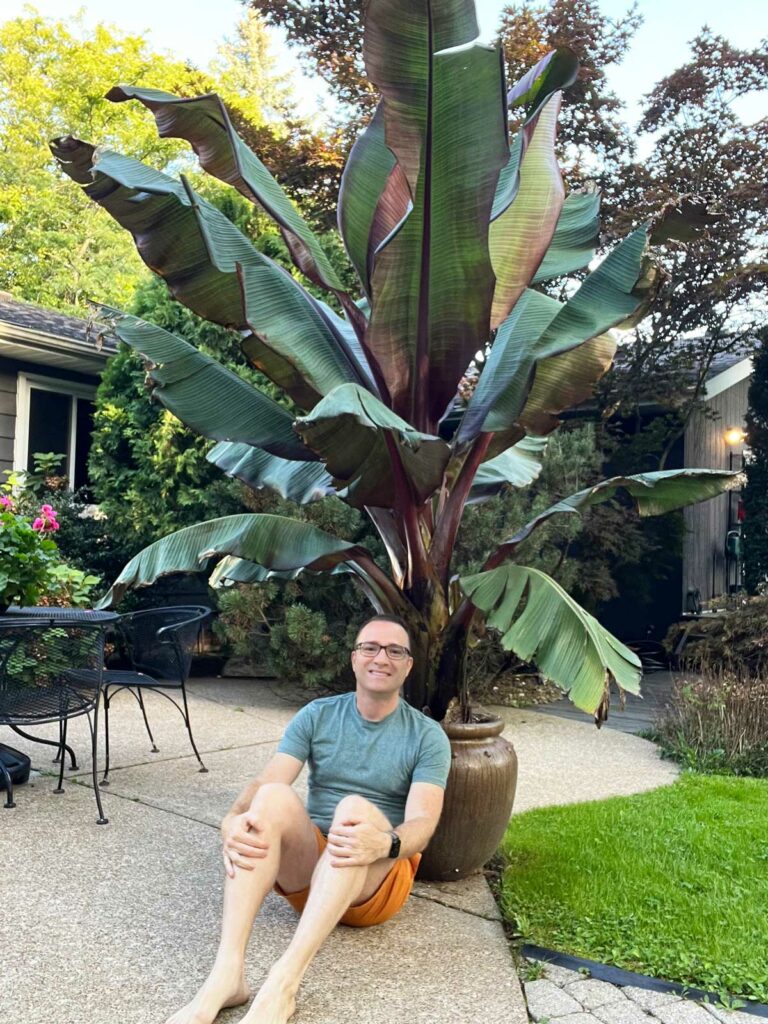
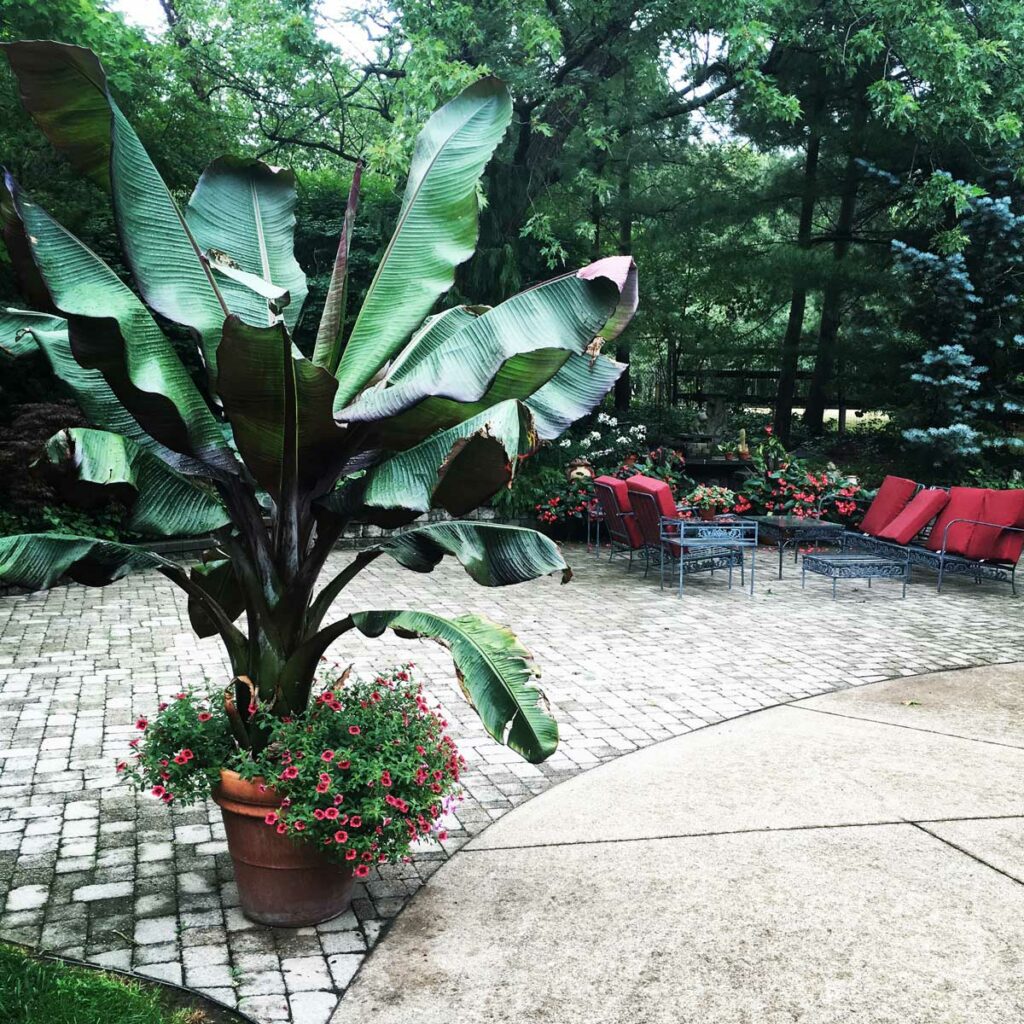
I've been overwintering these plants for many years. Here is my plant in the summer of 2023, with me sitting underneath the plant for scale.
I try and wait as long as I can before placing the plant in storage. I don't go strictly by the calendar, but rather, I wait until temperatures dip down consistently to about 40°F or so.
The plants can take it a bit colder, but I try and do it before freezing temperatures happen since our weather can be very volatile and change on a whim.
Here are the steps I take to overwinter the plant.
1. TAKE A SAW TO IT
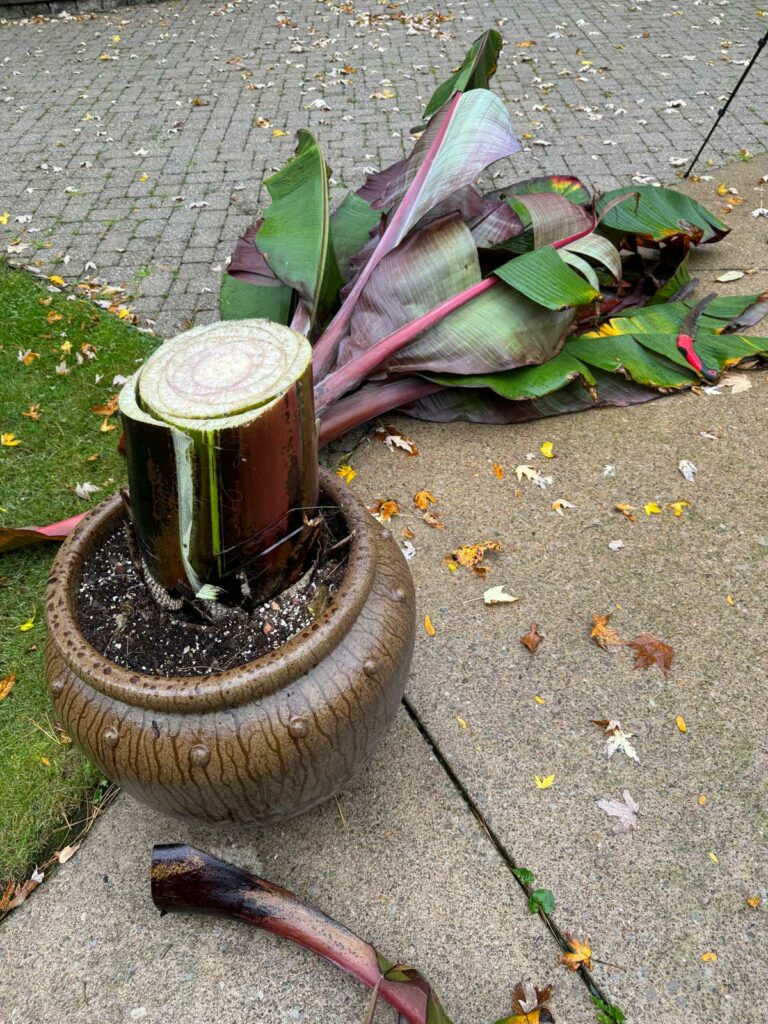
Once temperatures get to the 40s Fahrenheit (for me it usually means around October or November), I will take a saw and cut the trunk down and leave about a foot or so at the base of the plant.
After you take a saw to your plant, I recommend tipping the pot to its side. You will see that there will be a lot of water dripping out, so this helps to dry things out a bit before storage.
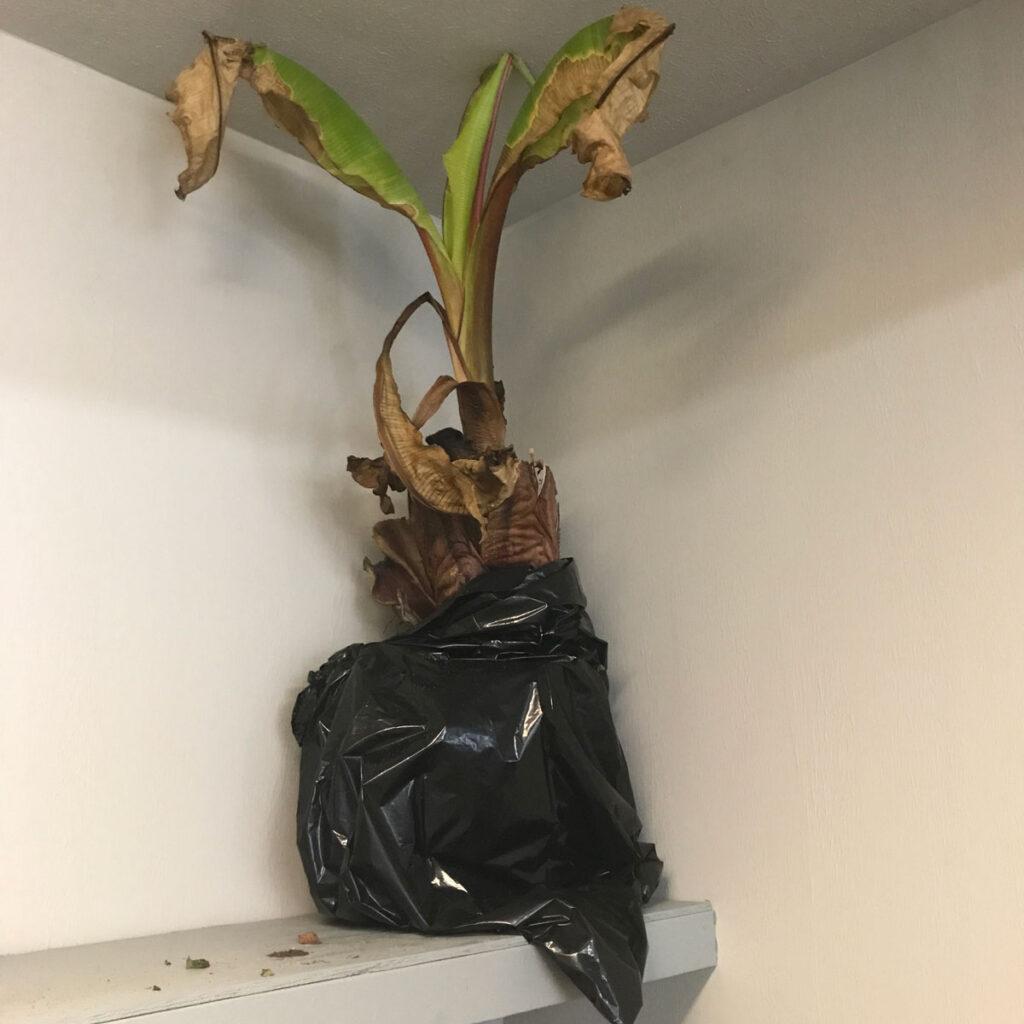
If you have your plant in the ground and not in a pot, simply take a saw like I showed above, and then dig out your plant. You can then tip it over to drain excess water, or even place it upsideside down to drain. In the next step below, you can see how I store it if I dig it out of the ground. You can store the plant in a plastic bag (don't cover the stem of the plant, just the base) or you can even insert it into a pot for security.
2. PLACE IN STORAGE FOR THE WINTER
Next, you'll want to place your banana in a cool, dark area until the springtime when the weather warms up. If you can, choose a location that is about 40-55°F (4-13°C). A cool, dark basement is great, or a garage that stays above freezing works well too.
As long as you plan on keeping it dormant, which is what I'm describing in this post, a location that is completely dark is perfect. You want to provide as little light as possible.
I've stored my banana plants as warm as 60°F, but cooler is MUCH better because it will slow down the growth. Surprisingly, after you saw off the plant, your plant will want to push out growth very quickly after warmer temperatures.
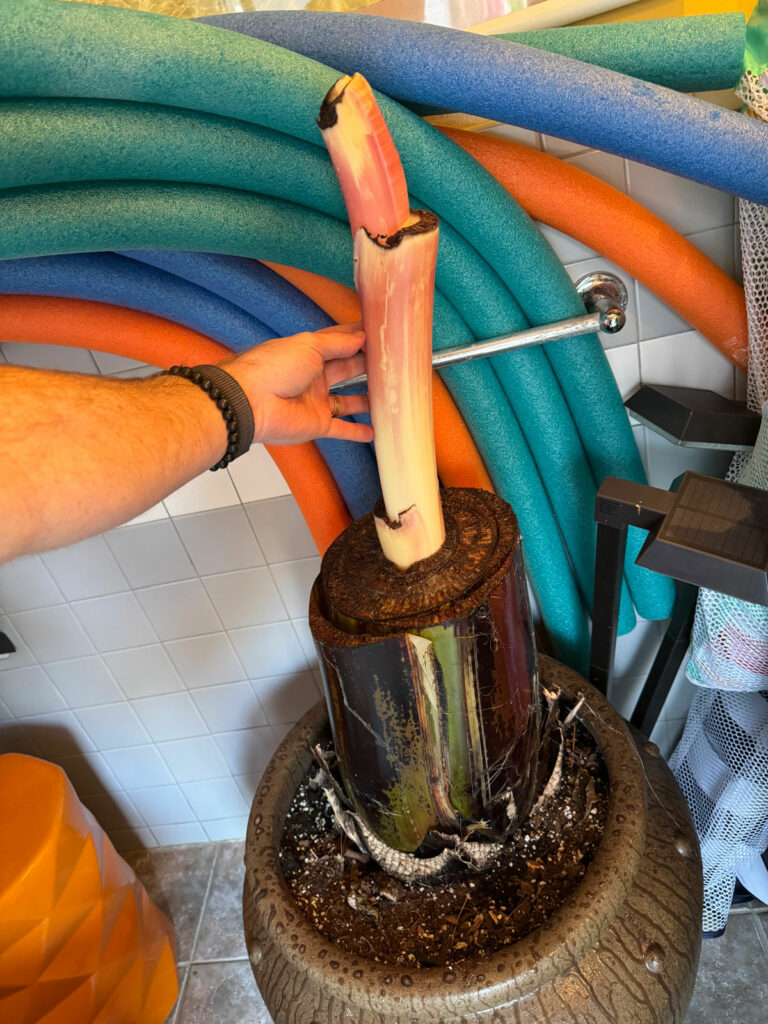
Take a look at the same plant below, just days after starting to store it. We had a warm snap and so it started to grow even in the dark.
If this happens, just leave it until the Spring. I will soon show you what to do soon.
And while the banana plant is in storage, I leave it that way during the entire storage period with no water at all until Spring. This may seem extreme, but it will survive just fine, especially if it was a larger plant to begin with.
In the photo below, this is a plant that I had growing in the ground and you can see how I stored it over the winter.
3. TAKE IT OUT OF DORMANCY IN THE SPRING
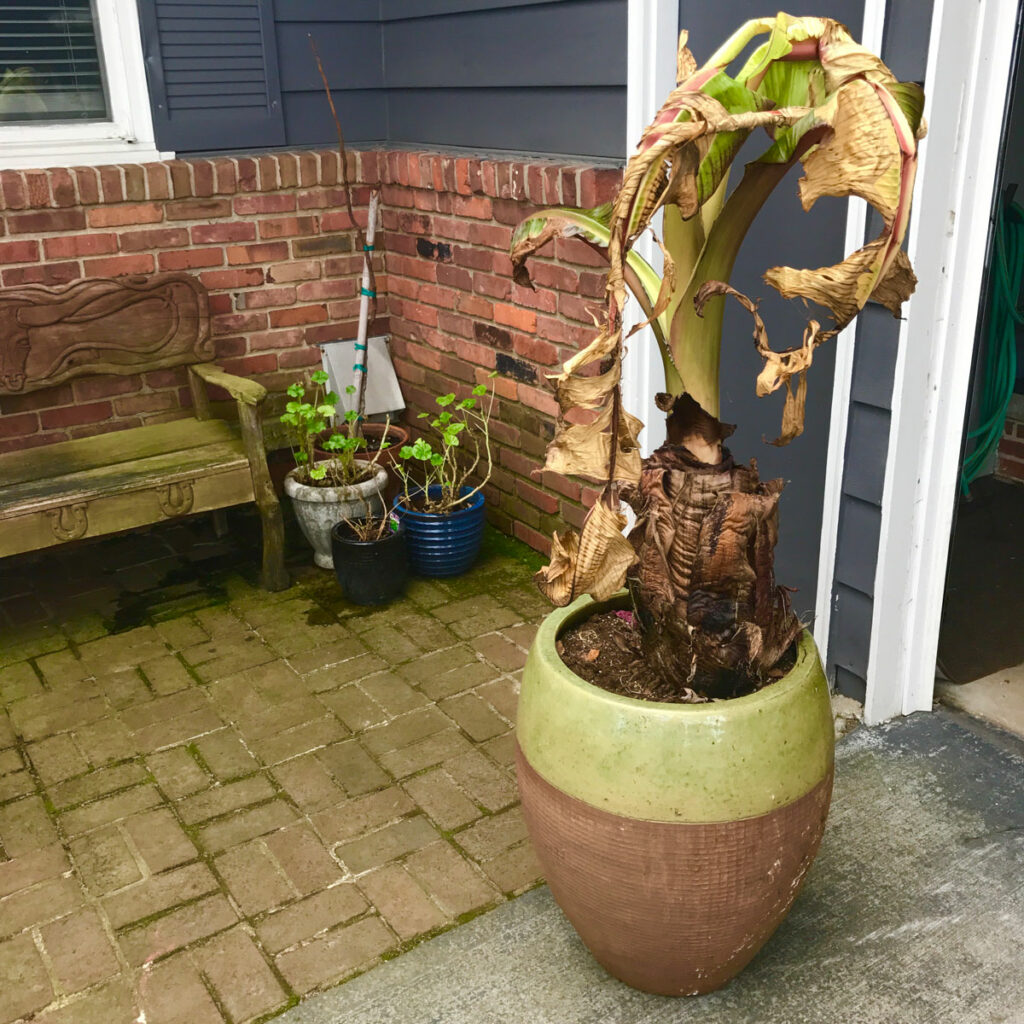
Now let me show you a different plant from previous years so I can continue to show the process. Here is a plant that stayed in a heated garage the entire winter and in the photo below, I just set it outside in the Spring when the weather warmed up. You can see all the new growth that it pushed out, and it's not pretty!
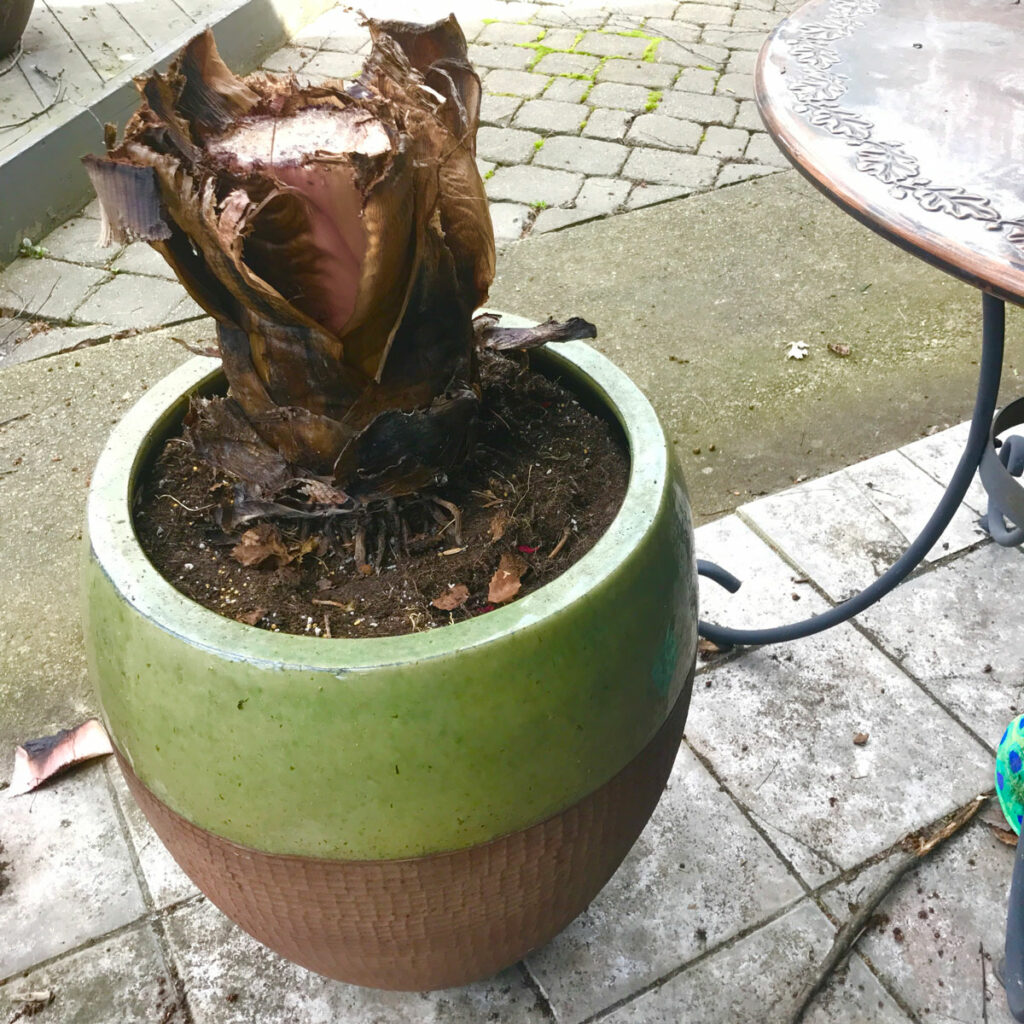
Since the foliage is damaged and unsightly, at this point, I simply cut the plant off again, resulting in the following. Don't worry. It will grow back!
At this point, you can repot into a larger pot, or top dress your plant with fresh soil. I transplanted this into another pot, added some Osmocote time-release fertilizer and started watering again.
I then placed it in a shady area outdoors for a few days. After that, I moved it to a spot with a little sun, and gradually increased the sun exposure until it was acclimated to a full sun spot.
Two months later, by June, this is what the same plant looked like.
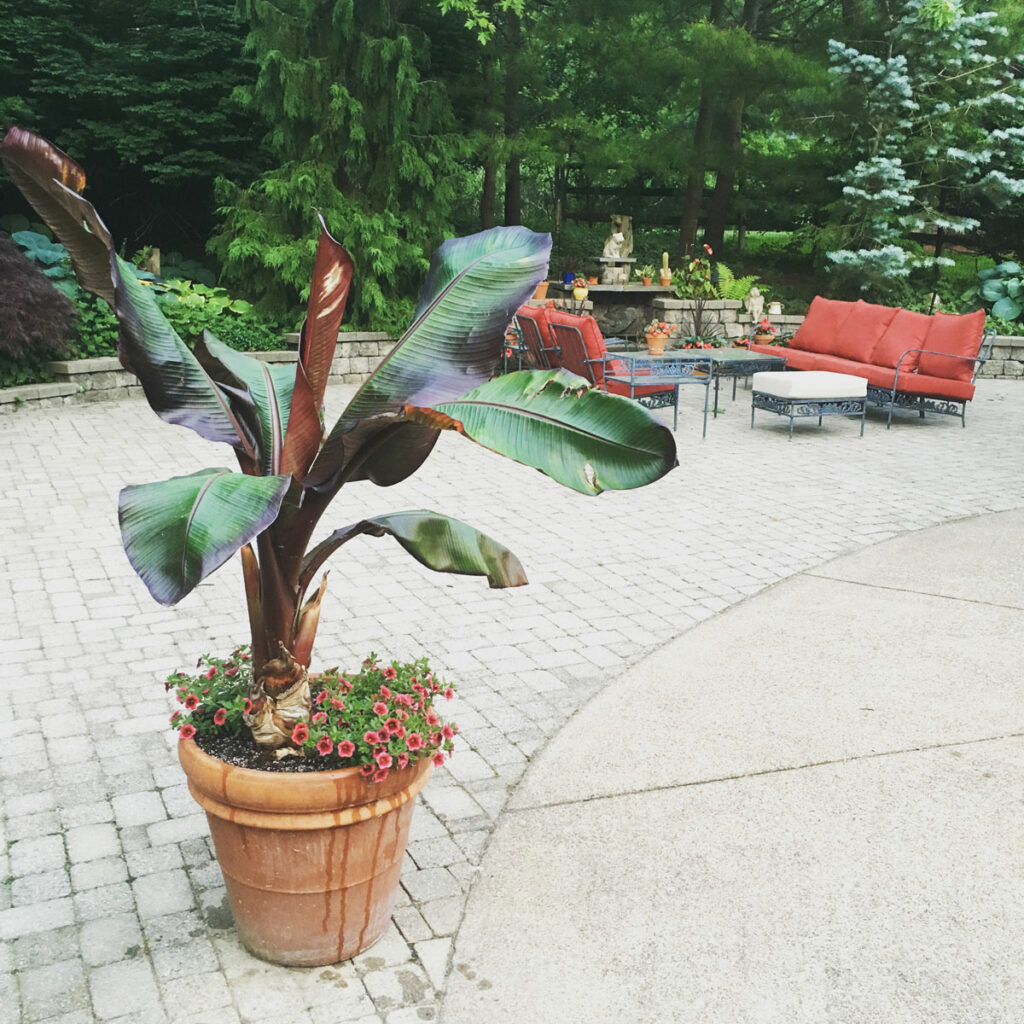
Another two months later, by August, it grew into the beauty that you see below.
RED ABYSSINIAN BANANA CARE TIPS
LIGHT
These plants like full sun, so the more sun the better. I would recommend at least a half day sun at a minimum. Keep in mind though that when you take your plants out of dormancy and place them outdoors initially, I would recommend placing them in the shade for a few day and gradually acclimate your plant to more sun slowly over the period of at least a couple weeks.
This will help prevent burning.
WATER
Keep your plants very well watered. I normally water my plants daily during warm weather. It is very difficult to "overwater" these plants. They like plenty of water! Water as soon as the surface of the soil starts to feel dry.
FERTILIZER
These plants are very rapid growers and like a lot of fertilizer. Like I mentioned previously, when I take the plants out of dormancy and back outside, I will mix in Oscomote slow-release fertilizer. Then every week, I apply Miracle-Gro.
I hope you've enjoyed this post on overwintering banana plants. Have you tried this? Comment below. I'd love to hear!
I live in southern Nevada. We don't often get a freeze in the winter, and daytime temperature usually doesn't get down below 40. It can happen, but not often. My newest plants, red Abyssinian, are just a few months old, and less than 2 ft. I have them in pots, on the deck. My concern is the large Cavendish(?) in my living room. It definitely doesn't like the heat we had this past summer. I'm thinking of moving it outside, now that it's cooler. Any thoughts?
Hi Leo! It should be fine as long as the Cavendish doesn't go below 40 (even then it's probably fine, but you don't want to push it too far...freezing temps will damage the leaves). Another big thing to think about is if you move the Cavendish outside (after being indoors all this time), you have to very gradually acclimate it to any direct sun outdoors. If you move it immediately to any direct sun outside, the leaves will burn. So I'd recommend moving it to a completely shaded area outside for at least a week, and then gradually introduce a little sun at a time over the period of at least 2-3 weeks. Hope this helps!
Thank you for this excellent article. I just bought one that I'm super excited about. Where I live it can be super hot throughout the summer months and then very cold in the winter
Most of the plants in my garden have died due to the full sun. I'm really hoping this lovely will thrive. I was worried about how I'd winter it but this article has completely alleviated those fears. Now I know what to do.
@Raffaele Di Lallo, This worked really well. I couldn't put it anywhere inside, so I packed/wrapped it in a dense coconut fibre cloth and then black polythene and left it on the porch step. We had some hard frosts but it was fine under there and sprang back to life when all the wrappings were removed. Thanks again for the advice.








Thank you very much for the detailed information. You are very helpful with all the tips you mentioned.
You're very welcome!
I live in southern Nevada. We don't often get a freeze in the winter, and daytime temperature usually doesn't get down below 40. It can happen, but not often. My newest plants, red Abyssinian, are just a few months old, and less than 2 ft. I have them in pots, on the deck. My concern is the large Cavendish(?) in my living room. It definitely doesn't like the heat we had this past summer. I'm thinking of moving it outside, now that it's cooler. Any thoughts?
Hi Leo! It should be fine as long as the Cavendish doesn't go below 40 (even then it's probably fine, but you don't want to push it too far...freezing temps will damage the leaves). Another big thing to think about is if you move the Cavendish outside (after being indoors all this time), you have to very gradually acclimate it to any direct sun outdoors. If you move it immediately to any direct sun outside, the leaves will burn. So I'd recommend moving it to a completely shaded area outside for at least a week, and then gradually introduce a little sun at a time over the period of at least 2-3 weeks. Hope this helps!
Grew my firts one this year. The wife and I are in love with it!!!
Thanks for the tips for preserving it over winter. We are in zone 6B.
I cant to see how big it gets next year!!!
You're very welcome! Good luck!
Thank you for this excellent article. I just bought one that I'm super excited about. Where I live it can be super hot throughout the summer months and then very cold in the winter
Most of the plants in my garden have died due to the full sun. I'm really hoping this lovely will thrive. I was worried about how I'd winter it but this article has completely alleviated those fears. Now I know what to do.
I hope mine gets as beautiful and lush as yours.
Glad you enjoyed the post and good luck!
@Raffaele Di Lallo, This worked really well. I couldn't put it anywhere inside, so I packed/wrapped it in a dense coconut fibre cloth and then black polythene and left it on the porch step. We had some hard frosts but it was fine under there and sprang back to life when all the wrappings were removed. Thanks again for the advice.