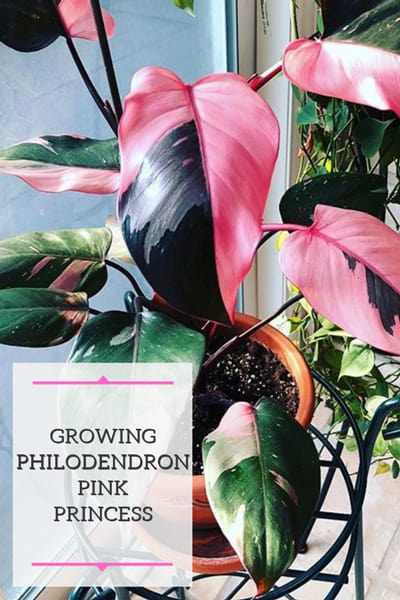
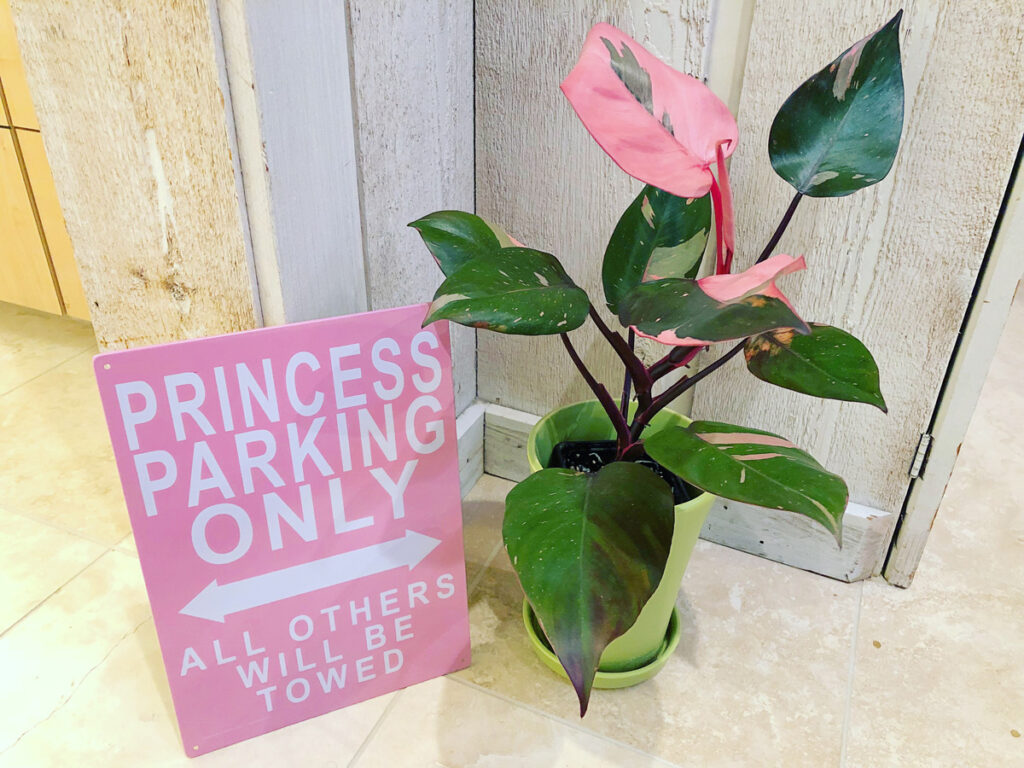
The Philodendron Pink Princess is one of the hottest houseplants around. Literally and figuratively! The hot pink variegation is stunning, and nurseries can't seem to keep this plant in stock. Philodendron Pink Princess is easy to grow, but there are several very important things that you need to know in order to grow this plant to its maximum beauty.
Would you like to save this post?
Enter your email, and I will send this link straight to you!
I got lucky and purchased my Philodendron Pink Princess before nurseries started price gouging for them, making them outrageously expensive. These days, they can't seem to keep them in stock, despite skyrocketing prices.
I will go over some general care tips first on growing this amazing houseplant, and later will reveal a super important tidbit of information that you need to know in order to keep your Philodendron Pink Princess in tip top shape!
Most people don't know this tip either, but it is absolutely critical and I learned about it after speaking with an expert commercial grower. More on that later though.
Table of Contents
UNDERSTANDING PINK VARIEGATION
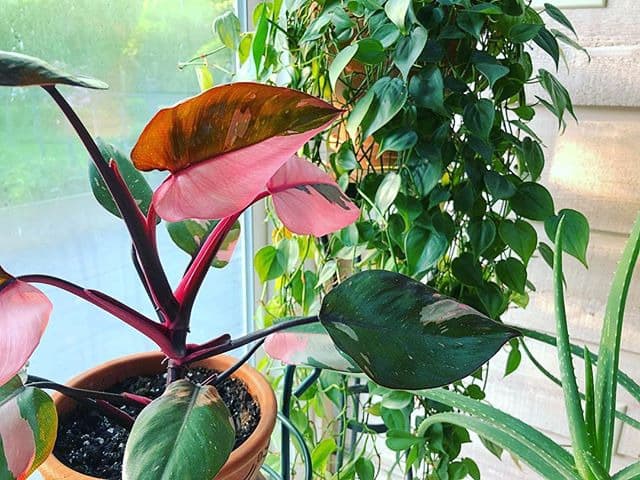
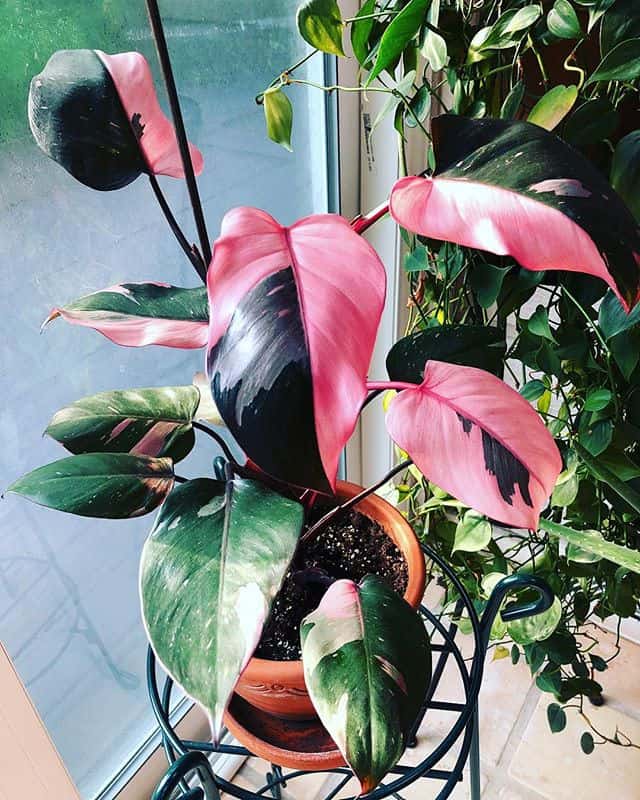
One of the fun parts about growing the Philodendron Pink Princess is seeing how variegated each new leaf is!
First of all, what is variegation? It is important to understand this so you can manage its growth and so that you know what you can expect from this plant.
According to the Royal Horticultural Society, variegation means when a plant has areas of different color. In the case of the Philodendron Pink Princess, that color is pink.
In many other plants, it may be a creamy white, yellow, and other variations. Normally, the variegation is caused by a mutation in the plant.
The bottom line is that whatever the variegated color is, those sections of the leaves lack chlorophyll that is needed for the plant to photosynthesize and make food from the sun's energy.
As a result of less chlorophyll being present in variegated plants, they will grow more slowly than their non-variegated counterparts.
Philodendron Pink Princess Care Tips
1. LIGHT
Logee's Greenhouses recommends good light in order to maximize the coloration in Pink Princess.
What does this mean? As with all philodendrons, they like bright indirect light. Some direct sun is fine, but don't place this plant in full sun otherwise you will damage the plant. Especially the variegated regions.
I have mine growing very nicely in an East facing window, so it receives some morning sun.
A handful of hours of direct sunlight in the morning or afternoon, provided by East or West windows respectively, would benefit this plant.
Just be sure to avoid direct sun in the middle part of the day when the sun is strongest. Remember, these are jungle plants (this plant happens to be native to Colombia) so they do not want to be in direct sun all day.
That being said, some direct sun early in the morning or late in the afternoon is beneficial indoors. Indoors we have a lot less light than we think.
Since it is slower growing than many Philodendrons, be sure not to keep this plant too far from a window or you will be further disappointed with growth! This is definitely a plant that should reside immediately in front of an appropriate window.
If you don't have an appropriate window, you can consider using a grow light to provide enough light for your plant's growth, and also to help maximize the pink coloring.
2. WATERING
Philodendrons in general like to be on the moist end, but of course should always be well drained.
I find that my plant responds best when I give it a thorough watering and let all the excess water drain away.
Then I let the surface of the soil dry out before I water thoroughly again. Ideally, I let at least the top ½ inch to 1 inch or so dry out.
You can let even more dry out, but try and avoid letting the potting mix dry out completely.
On the opposite end, never allow your plant to sit in water. If you water your plants in place and move them, be sure to at least discard any excess water that has collected in the saucer underneath, or in the cache pot that it may be sitting in.
Leaving your plant sitting in water will increase your risk of root rot.
3. SOIL & REPOTTING
As with any Philodendron, they do best in a soil mixture high in organic matter. You can also use your favorite soilless potting mix, but be sure to add a good amount of perlite to it to make it nice and airy.
I rarely use potting mix straight out of the bag anymore. A good default houseplant potting mix that I use frequently is 3 parts of Miracle Gro Potting Mix with 1 part of Perlite.
Mix it up and you have a nice, fluffy potting mix for your leafy tropical plants! This blend works beautifully for Pink Princess.
Or if you want an AMAZING mix that you can use right out of the bag, try the Tropical Climber Soil Blend or the Rainforest Soil Blend from Oh Happy Plants. If you use my link, you will automatically get a 10% discount upon checkout for any products.
As far as repotting goes, if your plant is growing well, you'll likely need to repot every year or two. If you take your plant out of the pot and it's root bound (lots of roots around the perimeter, and even circling around the bottom), it is time for a bigger pot.
My general rule of thumb is to only go up one pot size. For example, if your plant was in a 4 inch diameter pot, go up to a 6 inch diameter pot.
The reasoning for this is that if you go up TOO big in pot size, the potting mix will take much longer to dry out and potentially cause issues.
Repotting can be done at any time of year, but if you are a beginner, it is probably safest to stick with Spring or Summer.
Drainage holes are a must so make sure your pots have one or more.
4. FERTILIZING
Fertilize regularly during the active growing season for best results. During winter, when growth has slowed down due to much shorter days, I normally stop fertilizing.
My favorite fertilizer and the one I recommend for all leafy tropical plants (available on Amazon) is Dyna-Gro Grow. My plants absolutely love this fertilizer.
It is a premium fertilizer that contains all the micro and macro nutrients that plants need, and is urea-free.
I simply use ¼-1/2 teaspoon per gallon of water every time I water during the growing season. Which for my houseplants, I'll start fertilizing around February or March and then stop around October.
I've seen wonderful results using Dyna-Gro Grow. Try it for yourself. You don't be disappointed! A good fertilizer makes a big difference in your plant's vigor.
But it is no substitute for sound watering practices, appropriate light conditions, etc. Don't use fertilizer to fix a plant. But rather, use it to enhance a plant that is already growing in good conditions!
5. HUMIDITY & TEMPERATURE
Like any Philodendron, Pink Princess will appreciate higher humidity levels. If you can provide at least 50% humidity, your plant will love it.
Paying attention to the humidity level is especially important if you have forced heat. My indoor air in the winter get painfully dry and it's bad for my skin and my plants!
If you see smaller new leaves, and even crinkled leaves, low humidity could potentially be a contributing cause.
If you need help choosing a great humidifier, check out my blog post where I reviewed 3 different brands of humidifiers. I'm sure one of them will suit your needs and budget.
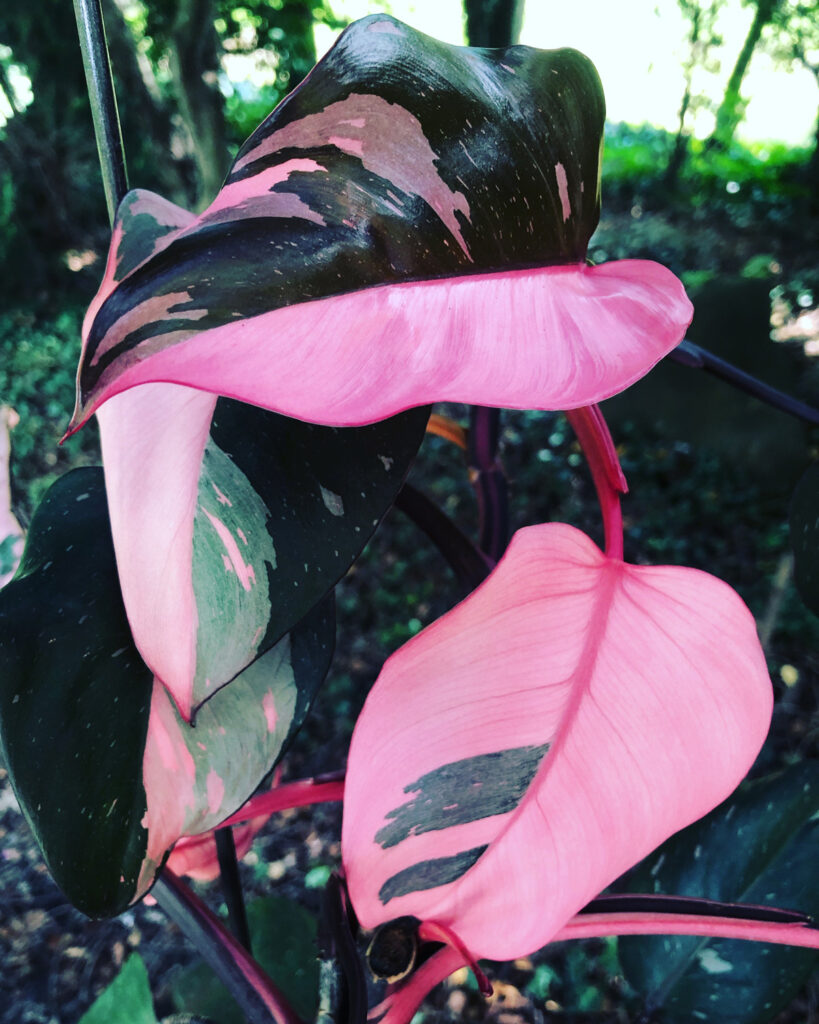
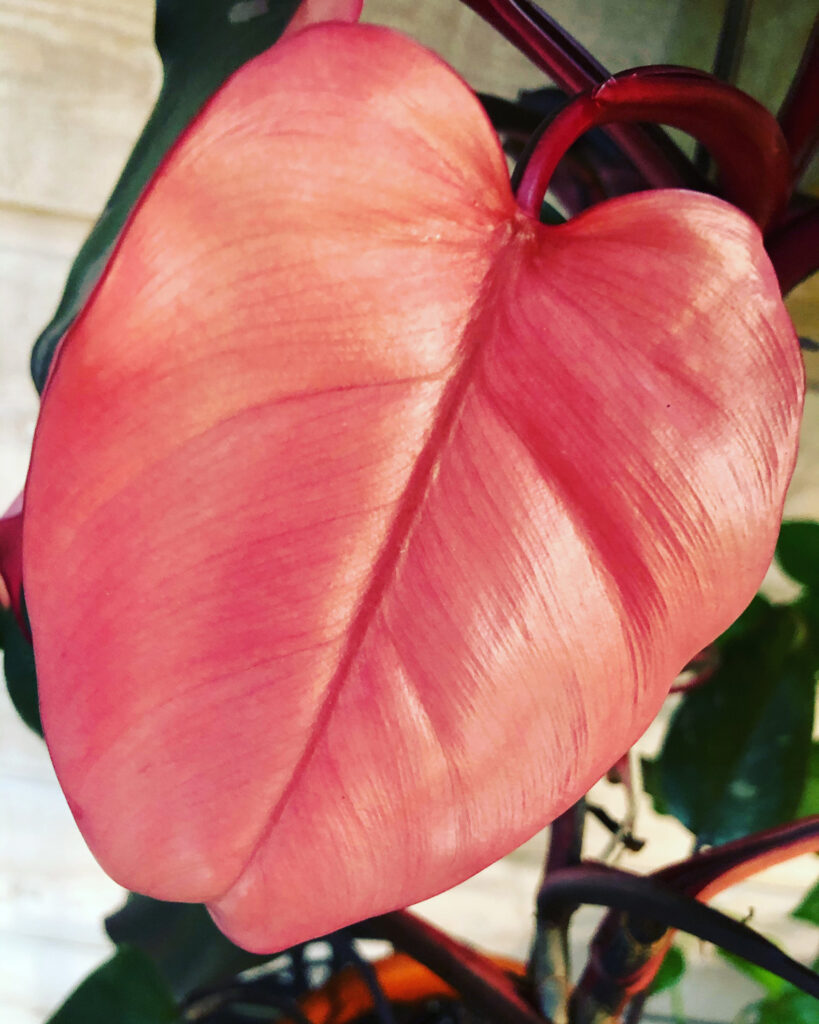
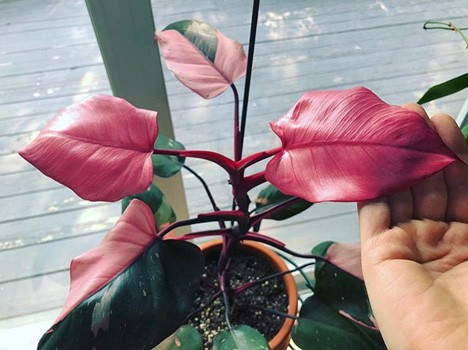
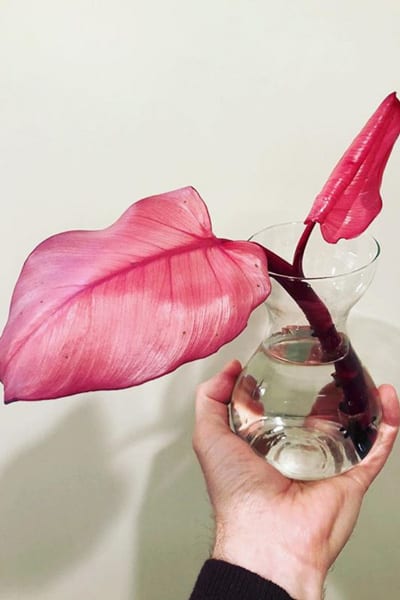
An all pink leaf on my Philodendron Pink Princess. They won't last terribly long since no chlorophyll is present.
As far as temperature goes, these plants are best grown in minimum temperatures of 60F or above. 60-85F (16-29C) is a great range for growth. If temperatures dip below 60F at night, it is fine as long as it's just temporary. In general, keep your plant always above 55°F (13°C).
This is important to consider if you want to place your plants outside during the summer months.
CLIMBING SUPPORT
Even though she's a princess...even princesses need support.
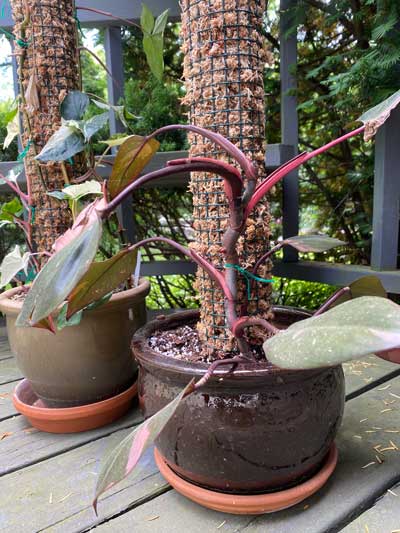
Philodendron erubescens is a vining plant by nature, so be sure to give it a trellis or post to climb on. As it grows, loosely tie the vine to the support structure.
You will achieve the best results from this plant if you provide a nice support for it. The aerial roots will attach and grow up your support.
Whether you use a moss post, a cedar board, or any other support, your plant will appreciate the support.
Be sure not to miss my DIY guide to making your own moss pole. It is better and cheaper than any moss post you will find on the market!
If you don't want to bother with providing a support, you can continually cut your plant plant and propagate it. The original plant will force out new growth and become bushier. If that's the look you're going for, hack away!
PRUNING TO MANAGE VARIEGATION
Now on to the very important part that I was promising!
So many people want to have all pink leaves. But be careful what you wish for. The all pink leaves have zero chlorophyll in them, and if you don't manage your plant, it will decline.
So what are some tips to keep your Philodendron Pink Princess in top shape?
I'll refer to an interview that I did with the owner and greenhouse manager of Steve's Leaves. We discussed the topic of variegated plants and the importance of pruning when needed.
You basically want a balance in non-variegated and variegated leaves on your plant.
If your plant starts to be overrun with all green leaves, your plant may revert to all green in time and bye bye Pink Princess. You may have a Green Princess, and who wants that?
On the other end, if you get ALL pink leaves, or leaves that are more than half pink, your plant will slowly decline in time because the variegated portions of the leaves have no chlorophyll at all for the plant to sustain itself.
The plant is basically starving itself if you don't do something about it. Plants use chlorophyll to photosynthesize and make food for themselves utilizing the sun's energy. Too much variegation means your plant is not producing enough food.
I needed to prune my Philodendron Pink Princess because it was producing completely pink leaves. I actually rooted the part that I cut off and sent it to someone. I'm not sure if it survived or not, but she was willing to take the risk!
If your plant has started to grow all green leaves, or all pink leaves, you'll need to prune your plant back a bit. Simply prune your plant back to the next leaf that has a balance variegation.
When I pruned off the all-pink leaves, my plant started to grow back leaves that had a more balanced variegation.
The growth from the node where you cut the plant back at should produce a more variegated growth. The "node" is simply the area where the leaf meets the stem. New growth is produced at the nodes.
Of course, if you do get all pink leaves, it is fine to enjoy the beauty for a while. Just don't leave them on for too long otherwise your plant will start to decline.
PINK CONGO PHILODENDRON
Please note that Philodendron pink congo is NOT the same as Pink Princess Philodendron. Pink Congo has been chemically altered and eventually revert to all green.
PINK PRINCESS PROPAGATION
I've written a separate post detailing 3 great propagation methods, including one unusual method (a special technique using stem cuttings) to help you increase your collection in the fastest way possible!
One method that I do NOT talk about in that propagation post is growing Pink Princess from seed. I've seen many places online selling Pink Princess seeds.
If you attempt to grow these from seed, they will not produce any pink leaves and you will likely get the all-green species of Philodendron erubescens. Seeds will simply not give you an exact genetic copy of the plant.
So spare yourself any frustration and hard earned money and don't get scammed into buying any Pink Princess seeds.
Did you just receive a Pink Princess in the mail and it doesn't look so hot? Or maybe it's struggling to grow, or growing slowly? Brown spots on the leaves?
Like any variegated plant, it will grow slower than it's non-variegated counterpart because it has less chlorophyll.
How big do Pink Princess plants get?
Over time, with good conditions and care, they can get several feet tall, but it is very important to provide support with a moss pole, a wooden stake or plank, or similar support.
Is Pink Princess toxic to pets?
Like all aroid plants, Pink Princess is toxic to dogs and cats because of insoluble calcium oxalates according to the ASPCA.
Why are Pink Princess plants so expensive?
Quite simply, supply and demand. There is an extraordinary demand for this plant, and this drives some pretty outrageous prices. This, coupled with the fact that variegated plants grow slower, will compound the issue. In addition, variegation is very unstable so when nurseries propagate, every single plant will be different and not all of them may be suitable for sale if they are not pink enough. It can take months until plants are ready for sale.
Can I put multiple vines of Pink Princess in the same pot?
Yes absolutely! This is one way to achieve a fuller look. There is nothing wrong with only having one vine per pot. It is all personal preference.
Is Pink Congo the same as Pink Princess?
Absolutely not. In fact, the Pink Congo plant is a scam. It looks very similar, except Pink Congo leaves are a little pointier and leaves are entirely pink. Rumors have emerged that Pink Congo has been chemically altered in order to produce a certain hormone that temporarily changes the color of the leaves. Eventually the plant reverts to all green. Don't be fooled by the Pink Congo scam.
Is Pink Princess affected by any pests?
Generally, these plants aren't plagued by too many pests, though occasionally you may find scale, mealybugs, scale, or even thrips.
Why is my Pink Princess getting yellow leaves?
There are numerous reasons for plants developing yellow leaves. If you let your potting mix dry out completely for too long, you'll notice the base of your plant developing yellow leaves. Perpetually moist soil, especially compounded with low light, will also cause yellowing.
Why do my Pink Princess Philodendron plants have dark green leaves?
Even if you have the right conditions to encourage pink variegation (good light, etc), sometimes these plants can revert and grow nothing but dark green leaves. If this is the case, trim your plant's stem back to the first leaf that exhibits good variegation. After pruning it back, this may encourage the new growth to grow in with pink variegation. Keep in mind that these plants are not stable so the results can vary.
Do you have a Philodendron Pink Princess? I'm looking forward to placing mine outdoors in the summer so it can really take off. If you do place any of your plants outside, be sure to harden them off properly.
How is your PPP doing? Comment below! I'd love to hear!
Hi,
I just purchased a ppp. It has around 8 decent sized leaves and it's has a new leaf about to unfurl. Unfortunately, none of the leaves have any variegation (can't see on the new leaf yet)..there were other plants at the nursery which had some small flecks of variegation already but they weren't in the best of shape so I selected the one without variegation. Have I made a mistake in picking this one? The overall appearance of the plant is very bright burgundy.. will these leaves turn just green or will any pink flecks appear when they mature? Or will the pink variegation only be on the new leaves? I'm questioning whether I should exchange this plant for one that had the variegation already?
Kind regards
Sam
If the leaves have no variegation on them at all, they won't develop any. Not all pink princess plants are the same. You might just have a plant that doesn't exhibit much variegation. Hopefully you didn't overpay for it. But keep an eye on it, as each new leaf might be different as the plant grows.
Hi i have a baby pink princess i got her in january and she only grew two leaves. The first one grew with a sort of wave in it. The second leaf grew fine came out 2 days ago had a little funky wave like the other one but not as bad and not its all curved up. Whats going on?
Hi I have a baby philodendron pink princess.. the bottom leaves are dying out. so i took it out of the pot to see if there’s a problem. But I noticed an early stage of root rot. So i cleaned the rotting bit and repot it in a new soil. I also drenched the soil with a very mild diluted hydrogen peroxide. It looks ok but i noticed that the newer leave has brow spot on the pinkier side? I did give it a good sunbath not too direct but brighter light then usual to help it restore. Will it survive and thrive or am killing it softly? I have moved it to its original location.
Hi Alia, I would first make sure that you are keeping your plant in good enough light and that your pot is an appropriate size. Follow the instructions in this blog post as much as you can. Did you just receive the plant? Your plant may need a bit of time to adjust, so just try your best and give it a little time. You can email me a photo if you have further questions. It would help to see your plant. I'd recommend reading this blog post that I wrote that talks about issues with this plant. Look at #5 that talks about browning leaves. https://www.ohiotropics.com/2020/02/21/pink-princess-philodendron-dying/
Hi! I just have a couple questions. So I bought a Pink Princess in December 2019. It's give me 3 new leaves, but they're much smaller than the other leaves. They're also a muddy burgundy color with some pink flecks. What does this mean? Does it need fertilizer?
Also, I want to repot, but I want to give it the best mix. What would you suggest besides the default houseplant mix? Thank you!!!
Hi Kayla! Are you following all my care recommendations from my post? I would definitely start fertilizing now, but make sure that your plant is sitting in good light as described in the post. You should always fertilize during the growing season and it's Spring now so definitely start. I'm not sure what you mean about the potting mix. There is no 1 magic potting mix. What I described in my post works very well. Remember that houseplant care is about getting a combination of things right, not just one thing. If you follow everything I have in my post collectively concerning light, fertilizing, watering, soil, etc., you will have success!
I want a PPP so bad. They’re so beautiful. Once I have my hands on a cutting, I’m definitely going to be coming back here to read and make sure I’m taking the best care of my ppp.
I bought a pink princess. Has one leaf with a pink marking on it. Otherwise, the leaves are growing in green. Any suggestions as to what I can do to encourage pink leaves to grow? It is still pretty small, but I want to set it up for success.
Hi Viktoria. On a small plant, all you can do is to follow the advice I have in my blog post. Most importantly, be sure that you have your plant right in front of a window like I talk about in the blog post. You can't prune your plant now since it's too small. Have patience, allow it to grow, follow all the cultural advice, and then you can re-evaluate what to do later. Once it's bigger, you can selectively prune it. I describe this in the following blog post that I wrote. Go to the "Managing Variegated Plant Growth" section and I talk about it there. You can't do this quite yet though since your plant is too small, but keep it in mind for the future: https://www.ohiotropics.com/2018/10/15/interview-with-steves-leaves/
Hi Raffaele, I hope this message finds you well.
I have a beautiful PPP, she is growing new leaves on a regular basis, but over the weekend I noticed her one new leaf, as it started opening was slightly bent forward, when I softly touched it just broke clean off, then today I noticed the same with the other new leaf. Please help!
Many Thanks,
Thank you, it is on a South West window sill, getting a lot of light and late afternoon sun, but I tend to move her a bit out of the sun on a hot day.. I am in Cape Town, South Africa, so it is summer here at the moment.
I have a humidifier, but use it for my plants downstairs, I mist her in the mornings though. I only water her when the top layer (2cm) of soil gets dry, basically works out to be once a week. The soil is very airy, lots of bark.
She has a few 1/2 pink variegated leaves (x3), most of them are very dark green and burgundy.
Have the new leaves been physically damaged perhaps? It's hard to say what happened...Your culture sounds very good.
Thank you.
Not at all, I thought so at first, with the 1st new leaf that bent/broke, that maybe someone touched or bent it, but when the second leaf bent/broke, I was confused... could the stem maybe not be strong enough to hold the leaf, has it maybe been growing too quickly that the stem didn't had time to strengthen? Both broken stems have new leaves starting, I will just make sure not to move the pot at all.
Hello how are you? I bought two seedlings from PPP, one is beautiful and has new leaves, the other is very sad, opaque, two leaves are dying, I do not know how to care. Should I cut the leaves? Both are inside my apartment, with indirect sunlight, but in the afternoon it's hot. Both do not have leaves with large pink variegations, I would love to be able to increase the amount of pink, can you help me?
PS: I live in Brazil.
Hi Camila! Especially on small plants, I wouldn't remove any leaves until they're completely dead. How far are your plants from a window? What exposure is your window? You'll have to give the seedlings a chance to grow before knowing how variegated they will be. Having appropriate light is very important.
Hi Raffaele, thanks for replying. Currently, they remain at a distance of 1.5 meters from the window, where the afternoon sun shines, however, they do not receive direct sunlight, only light. However, it is quite hot in the place.
I have another question: how often should I water PPP?
It's a bit far from the window. Try and place it as close as you can to the window. As far as watering, don't go by frequency. Just feel the soil and water whenever the top inch or so has dried out.
Hello! How are you?
My PPP is growing new leaves, however, I noticed that the variegated leaves are small, do not grow much, one of the smaller leaves is turning yellow. What should I do?
I have another question, how should I fertilize, I think that may be the problem. thanks.
Hi Camila. How long have you had your plant? Do you have it immediately in front of a window? As far as fertilization goes, I like to use Dyna-Gro Grow for my houseplants and I fertilize about February through October or so (or whenever the plants are in active growth). I like to fertilize dilutely with each watering and add about 1/4 teaspoon per gallon. I will expand on the blog post to include more information soon. Hope this helps!
Hello Raffaele! I would like to ask if it is normal for PP to shed off lower leaves when new leaf is about to come out? Thanks!
I have a question I am sure you can answer! I purchased a node cutting from an individual and now im wondering, do the nodes produce more than one leaf? I can tell its already produced one, will it have another? Thanks!!
Hi Brandi! I want to make sure I understand what you're asking. Are you actually asking, can it grow two separate stems from each node? If so, it really all depends on the cutting and is hard to predict, but it may! I would just be happy that yours is growing and that one leaf that you have will continue to grow and eventually you will see a stem and it will produce more leaves and a nice plant for you. I hope this answers your question.
Hi, I am from Brisbane Australia and I have had my PP for approximately 6 months. It is very leggy and I was wondering if I chopped the top off at one of the nodes about half way down, will it grow from there and thicken up? And would it be best to put the cut off top straight into water to root? Thank you
Hi Lee! You can place the cutting in water to root, absolutely. After you chop the plant off, the original plant should force out new growth. Many times, new growth occurs in multiple areas. Just give it some time. My one concern is that you need to resolve why the plant is leggy. Was it due to poor light? Or maybe neglect? Be sure to follow the tips in my blog post and it should result in a fuller plant. Hope this helps Lee!
Hi my ppp reverted is lovely and big I bought this as is but leaves are turning yellow all of a sudden .
I purchased it as is 4 weeks ago same pot and I’m watering about every 2weeks with filtered water , I’m in Melbourne, Australia. We’ve just had winter and this plant is indoors near a closed sliding door window and we have the central heating on at night only at 18 degrees Celsius.
I’m thinking I could of been the heating or too much light ? Not sure really
Hi Rochelle. Which leaves are turning yellow? The bottom leaves? Or everywhere? 18C is fine. As long as there are no cold drafts coming in from outside, but it sounds like your sliding door stays closed? How much direct sun does it get, if any? And when you get around to watering, is the soil completely dry? Yellowing of leaves can be caused by many different issues, so if you answer these questions, I will be better able to say what went wrong. Also, I assume you have a drainage hole in your pot?
Hi Katherine. I'm afraid I'm not 100% certain! For some plants, the variegation will come true, and for other it won't. I'm not certain specifically for Pink Princess. I have wondered the same thing myself!
J'ai une princesse (que j'ai acheté bébé et qui a une seule feuille sur 7 qui a produit un panaché la feuille était moitié rose et moitié verte. Aucune autre feuille plus récente qui ont poussées n'ont de rose ou panachées. Est ce que je peux faire quelque chose pour quelle sortent a nouveau des feuilles panachées?
De plus j'ai un petit plant qui a été acheté en même temps que les autres mais il est plus petit et produit des feuilles complètement rose aux 5 feuille et le plant reste petit je l'ai laissé dans son pot de 3 po. Que devrait faire selon vous pour qu'elle grandissent bien?? Et conserve du rose évidemment! Merci!!!?
Bonjour! Je m'excuse si cette traduction ne sort pas correctement. J'ai utilisé Google Translate pour traduire en français. S'il vous plaît lire ce blog que j'ai écrit. Une section décrit comment gérer les plantes panachées! Espérons que cela aide! https://www.ohiotropics.com/2018/10/15/interview-with-steves-leaves/
Great advices, Thanks!
I'm in Japan, and just got a beautiful PPP in last week.
Now I'm so happy to know how to take care of mine.
Hi! I'm thinking about buying a reverted PPP. The leaves are still a beautiful dark greenish/reddish color. $40 shipped, do you think it's worth it? Is there any chance of pink returning to a reverted PPP?
Hi Emily! It's hard to say if you'll get pink leaves again on that particular plant. If the $40 is worth it to you, buy it because you like how the plant looks right now. If you really want a pink one, I would buy one that is pink otherwise nothing is guaranteed. Hope this helps.

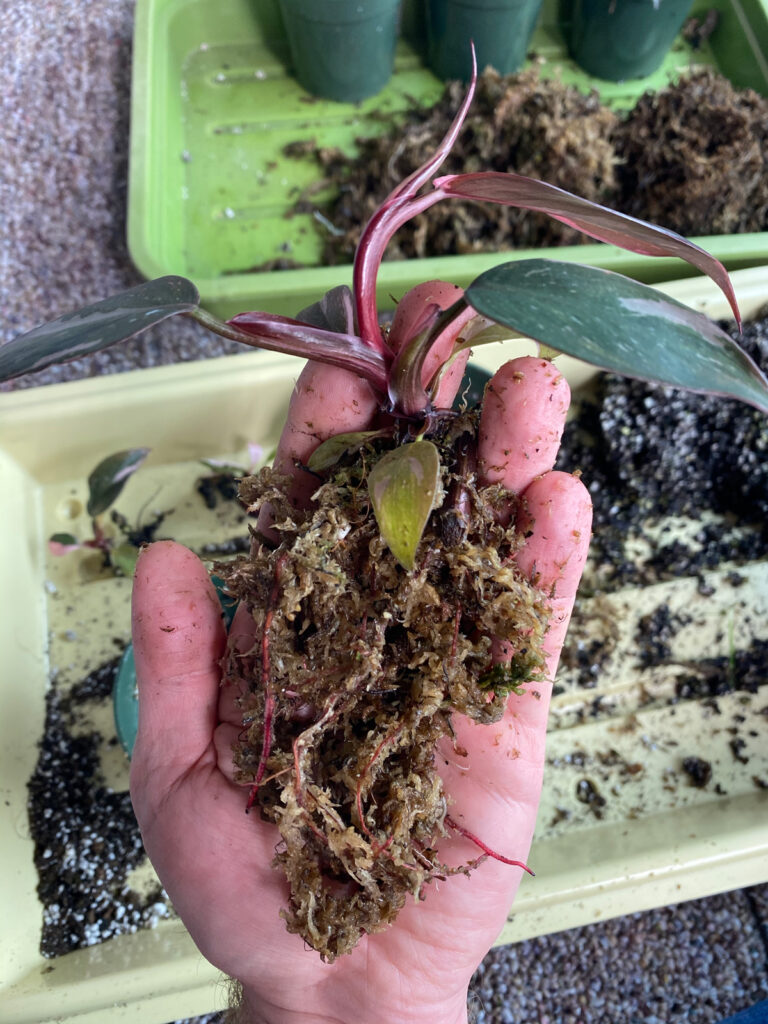

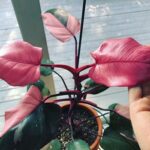
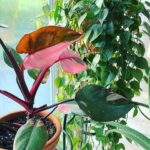


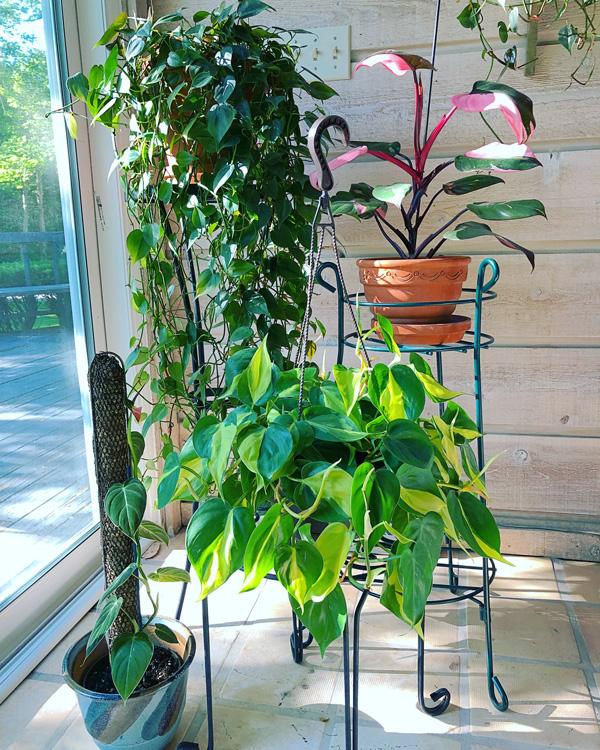
Hi iv got a pink princess iv got it in non drain hole but I put rocks under is that okey
No it's not. I would repot it into a pot that has a drainage hole.
Hi,
I just purchased a ppp. It has around 8 decent sized leaves and it's has a new leaf about to unfurl. Unfortunately, none of the leaves have any variegation (can't see on the new leaf yet)..there were other plants at the nursery which had some small flecks of variegation already but they weren't in the best of shape so I selected the one without variegation. Have I made a mistake in picking this one? The overall appearance of the plant is very bright burgundy.. will these leaves turn just green or will any pink flecks appear when they mature? Or will the pink variegation only be on the new leaves? I'm questioning whether I should exchange this plant for one that had the variegation already?
Kind regards
Sam
If the leaves have no variegation on them at all, they won't develop any. Not all pink princess plants are the same. You might just have a plant that doesn't exhibit much variegation. Hopefully you didn't overpay for it. But keep an eye on it, as each new leaf might be different as the plant grows.
Hi i have a baby pink princess i got her in january and she only grew two leaves. The first one grew with a sort of wave in it. The second leaf grew fine came out 2 days ago had a little funky wave like the other one but not as bad and not its all curved up. Whats going on?
Are you following everything I'm describing in the blog post for care? Especially light and watering? Are you doing anything different?
Hi I have a baby philodendron pink princess.. the bottom leaves are dying out. so i took it out of the pot to see if there’s a problem. But I noticed an early stage of root rot. So i cleaned the rotting bit and repot it in a new soil. I also drenched the soil with a very mild diluted hydrogen peroxide. It looks ok but i noticed that the newer leave has brow spot on the pinkier side? I did give it a good sunbath not too direct but brighter light then usual to help it restore. Will it survive and thrive or am killing it softly? I have moved it to its original location.
Hi Alia, I would first make sure that you are keeping your plant in good enough light and that your pot is an appropriate size. Follow the instructions in this blog post as much as you can. Did you just receive the plant? Your plant may need a bit of time to adjust, so just try your best and give it a little time. You can email me a photo if you have further questions. It would help to see your plant. I'd recommend reading this blog post that I wrote that talks about issues with this plant. Look at #5 that talks about browning leaves. https://www.ohiotropics.com/2020/02/21/pink-princess-philodendron-dying/
Hi! I just have a couple questions. So I bought a Pink Princess in December 2019. It's give me 3 new leaves, but they're much smaller than the other leaves. They're also a muddy burgundy color with some pink flecks. What does this mean? Does it need fertilizer?
Also, I want to repot, but I want to give it the best mix. What would you suggest besides the default houseplant mix? Thank you!!!
Hi Kayla! Are you following all my care recommendations from my post? I would definitely start fertilizing now, but make sure that your plant is sitting in good light as described in the post. You should always fertilize during the growing season and it's Spring now so definitely start. I'm not sure what you mean about the potting mix. There is no 1 magic potting mix. What I described in my post works very well. Remember that houseplant care is about getting a combination of things right, not just one thing. If you follow everything I have in my post collectively concerning light, fertilizing, watering, soil, etc., you will have success!
I want a PPP so bad. They’re so beautiful. Once I have my hands on a cutting, I’m definitely going to be coming back here to read and make sure I’m taking the best care of my ppp.
Hi Madeline! You will end up getting one someday! Just be persistent :-).
@Raffaele, I’VE GOT ONE ON THE WAY AND IT’LL BE HERE FRIDAY!!!!!!!!
@Raffaele, also I was wondering, do you have any other fertilizer suggestions?
Hello!
I bought a pink princess. Has one leaf with a pink marking on it. Otherwise, the leaves are growing in green. Any suggestions as to what I can do to encourage pink leaves to grow? It is still pretty small, but I want to set it up for success.
Thanks!
Hi Viktoria. On a small plant, all you can do is to follow the advice I have in my blog post. Most importantly, be sure that you have your plant right in front of a window like I talk about in the blog post. You can't prune your plant now since it's too small. Have patience, allow it to grow, follow all the cultural advice, and then you can re-evaluate what to do later. Once it's bigger, you can selectively prune it. I describe this in the following blog post that I wrote. Go to the "Managing Variegated Plant Growth" section and I talk about it there. You can't do this quite yet though since your plant is too small, but keep it in mind for the future: https://www.ohiotropics.com/2018/10/15/interview-with-steves-leaves/
Hi Raffaele, I hope this message finds you well.
I have a beautiful PPP, she is growing new leaves on a regular basis, but over the weekend I noticed her one new leaf, as it started opening was slightly bent forward, when I softly touched it just broke clean off, then today I noticed the same with the other new leaf. Please help!
Many Thanks,
Hi Jeane. I need to know more about your conditions. Location of the plant, light, humidity, watering, etc.
Thank you, it is on a South West window sill, getting a lot of light and late afternoon sun, but I tend to move her a bit out of the sun on a hot day.. I am in Cape Town, South Africa, so it is summer here at the moment.
I have a humidifier, but use it for my plants downstairs, I mist her in the mornings though. I only water her when the top layer (2cm) of soil gets dry, basically works out to be once a week. The soil is very airy, lots of bark.
She has a few 1/2 pink variegated leaves (x3), most of them are very dark green and burgundy.
Have the new leaves been physically damaged perhaps? It's hard to say what happened...Your culture sounds very good.
Thank you.
Not at all, I thought so at first, with the 1st new leaf that bent/broke, that maybe someone touched or bent it, but when the second leaf bent/broke, I was confused... could the stem maybe not be strong enough to hold the leaf, has it maybe been growing too quickly that the stem didn't had time to strengthen? Both broken stems have new leaves starting, I will just make sure not to move the pot at all.
Hello how are you? I bought two seedlings from PPP, one is beautiful and has new leaves, the other is very sad, opaque, two leaves are dying, I do not know how to care. Should I cut the leaves? Both are inside my apartment, with indirect sunlight, but in the afternoon it's hot. Both do not have leaves with large pink variegations, I would love to be able to increase the amount of pink, can you help me?
PS: I live in Brazil.
Hi Camila! Especially on small plants, I wouldn't remove any leaves until they're completely dead. How far are your plants from a window? What exposure is your window? You'll have to give the seedlings a chance to grow before knowing how variegated they will be. Having appropriate light is very important.
Hi Raffaele, thanks for replying. Currently, they remain at a distance of 1.5 meters from the window, where the afternoon sun shines, however, they do not receive direct sunlight, only light. However, it is quite hot in the place.
I have another question: how often should I water PPP?
It's a bit far from the window. Try and place it as close as you can to the window. As far as watering, don't go by frequency. Just feel the soil and water whenever the top inch or so has dried out.
Hello! How are you?
My PPP is growing new leaves, however, I noticed that the variegated leaves are small, do not grow much, one of the smaller leaves is turning yellow. What should I do?
I have another question, how should I fertilize, I think that may be the problem. thanks.
Hi Camila. How long have you had your plant? Do you have it immediately in front of a window? As far as fertilization goes, I like to use Dyna-Gro Grow for my houseplants and I fertilize about February through October or so (or whenever the plants are in active growth). I like to fertilize dilutely with each watering and add about 1/4 teaspoon per gallon. I will expand on the blog post to include more information soon. Hope this helps!
Hello Raffaele! I would like to ask if it is normal for PP to shed off lower leaves when new leaf is about to come out? Thanks!
Hi Vanessa! It depends. Does it happen every time? There are various reasons why this can happen.
I have a question I am sure you can answer! I purchased a node cutting from an individual and now im wondering, do the nodes produce more than one leaf? I can tell its already produced one, will it have another? Thanks!!
Hi Brandi! I want to make sure I understand what you're asking. Are you actually asking, can it grow two separate stems from each node? If so, it really all depends on the cutting and is hard to predict, but it may! I would just be happy that yours is growing and that one leaf that you have will continue to grow and eventually you will see a stem and it will produce more leaves and a nice plant for you. I hope this answers your question.
Hi, I am from Brisbane Australia and I have had my PP for approximately 6 months. It is very leggy and I was wondering if I chopped the top off at one of the nodes about half way down, will it grow from there and thicken up? And would it be best to put the cut off top straight into water to root? Thank you
Hi Lee! You can place the cutting in water to root, absolutely. After you chop the plant off, the original plant should force out new growth. Many times, new growth occurs in multiple areas. Just give it some time. My one concern is that you need to resolve why the plant is leggy. Was it due to poor light? Or maybe neglect? Be sure to follow the tips in my blog post and it should result in a fuller plant. Hope this helps Lee!
Hi my ppp reverted is lovely and big I bought this as is but leaves are turning yellow all of a sudden .
I purchased it as is 4 weeks ago same pot and I’m watering about every 2weeks with filtered water , I’m in Melbourne, Australia. We’ve just had winter and this plant is indoors near a closed sliding door window and we have the central heating on at night only at 18 degrees Celsius.
I’m thinking I could of been the heating or too much light ? Not sure really
Hi Rochelle. Which leaves are turning yellow? The bottom leaves? Or everywhere? 18C is fine. As long as there are no cold drafts coming in from outside, but it sounds like your sliding door stays closed? How much direct sun does it get, if any? And when you get around to watering, is the soil completely dry? Yellowing of leaves can be caused by many different issues, so if you answer these questions, I will be better able to say what went wrong. Also, I assume you have a drainage hole in your pot?
Can a Philodendron Pink Princess be grown from seed? Alot of online sellers, but I'm nervous that they're fakes.
Hi Katherine. I'm afraid I'm not 100% certain! For some plants, the variegation will come true, and for other it won't. I'm not certain specifically for Pink Princess. I have wondered the same thing myself!
J'ai une princesse (que j'ai acheté bébé et qui a une seule feuille sur 7 qui a produit un panaché la feuille était moitié rose et moitié verte. Aucune autre feuille plus récente qui ont poussées n'ont de rose ou panachées. Est ce que je peux faire quelque chose pour quelle sortent a nouveau des feuilles panachées?
De plus j'ai un petit plant qui a été acheté en même temps que les autres mais il est plus petit et produit des feuilles complètement rose aux 5 feuille et le plant reste petit je l'ai laissé dans son pot de 3 po. Que devrait faire selon vous pour qu'elle grandissent bien?? Et conserve du rose évidemment! Merci!!!?
Bonjour! Je m'excuse si cette traduction ne sort pas correctement. J'ai utilisé Google Translate pour traduire en français. S'il vous plaît lire ce blog que j'ai écrit. Une section décrit comment gérer les plantes panachées! Espérons que cela aide! https://www.ohiotropics.com/2018/10/15/interview-with-steves-leaves/
Great advices, Thanks!
I'm in Japan, and just got a beautiful PPP in last week.
Now I'm so happy to know how to take care of mine.
You're welcome Ton! Good luck with your plant!
Hi! I'm thinking about buying a reverted PPP. The leaves are still a beautiful dark greenish/reddish color. $40 shipped, do you think it's worth it? Is there any chance of pink returning to a reverted PPP?
Hi Emily! It's hard to say if you'll get pink leaves again on that particular plant. If the $40 is worth it to you, buy it because you like how the plant looks right now. If you really want a pink one, I would buy one that is pink otherwise nothing is guaranteed. Hope this helps.